HOA-Approved Lit Address Numbers: What Passes Review
You want your address to read at night without a fight with the review committee. Here is what an ARC actually regulates, and how a tasteful lit number clears it.
Dream Mailboxes Team6 min readUpdated August 2026
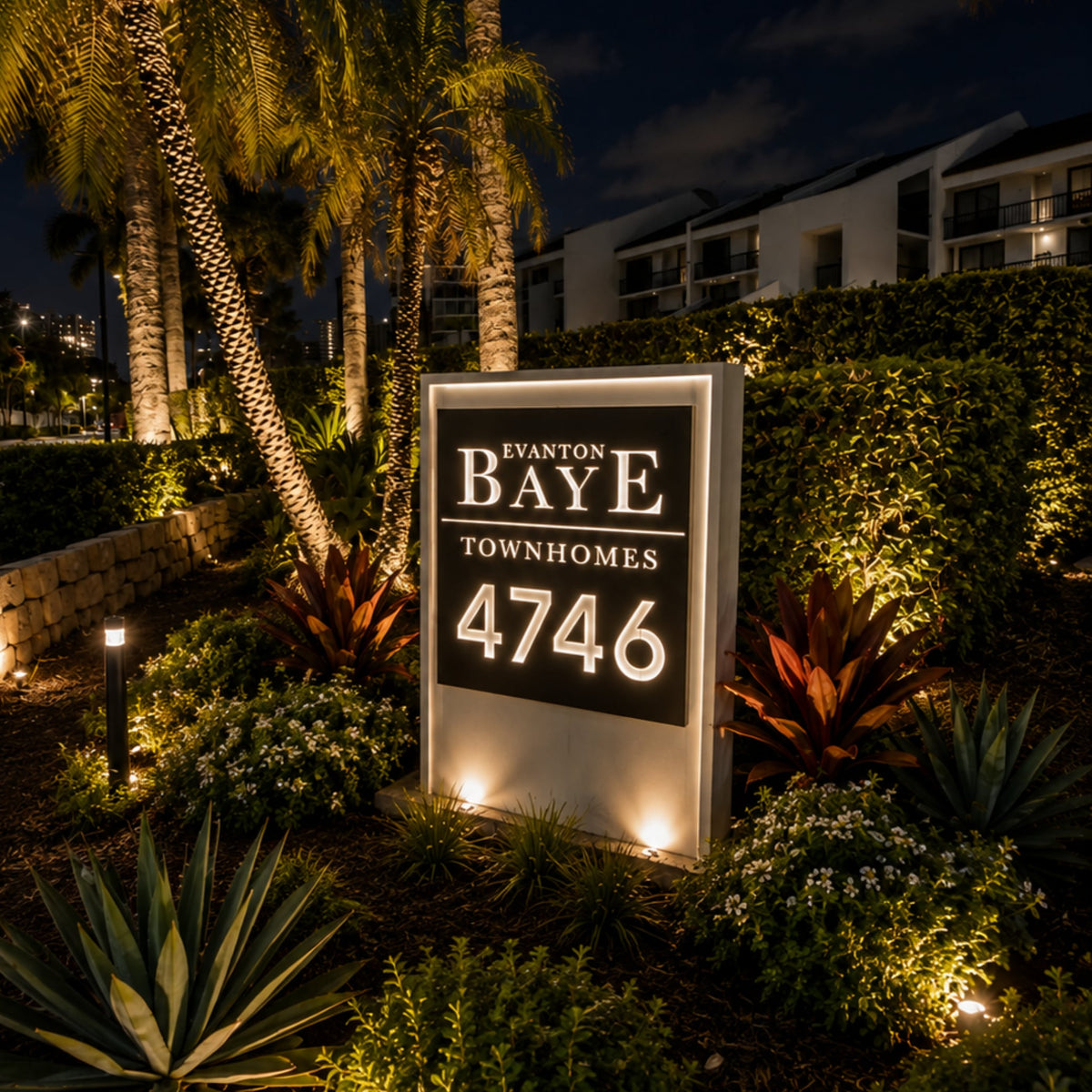
A halo-lit number reads as an architectural detail, not a light fixture. That distinction is usually what gets it approved.
The short answer
Lit address numbers pass HOA review when they read as a design detail instead of a light: soft warm halo glow, an approved finish, and a style that matches the neighborhood. Dream Mailboxes builds LED backlit address numbers made for exactly this, and we provide a spec sheet you can hand the Architectural Review Committee so they can approve the finish, brightness, and placement on paper. If you already know what your covenants require, send us the details and we will match a model to them. USPS placement rules still apply either way, so your number has to be legible from the road.
Most homeowners assume the hard part of a lit address number is wiring it. In an HOA, the hard part is the committee. A backlit number is a small change to the front of your house, but it is still a change to the front of your house, and that is precisely what a review board exists to sign off on. The good news is that committees are not trying to keep your address dark. They are trying to keep the street consistent and keep one house from lighting up like a storefront. Once you understand what they are actually screening for, a lit number is one of the easier requests to get through, as long as you bring them the right one.
What your HOA is really regulating
Start with the document that governs all of this. Your covenants, conditions, and restrictions, the CC&Rs, are the recorded rules every owner in the community agreed to when they bought in. HOA-USA describes CC&Rs as the binding governing document that sets standards for the appearance and use of homes in the association. Exterior lighting and address signage almost always fall inside those standards, which is why a lit number goes through the Architectural Review Committee rather than being a free-for-all.
When the ARC looks at a lit address number, it is checking a short list. How bright is it, and does it glare into the street or a neighbor's window. What color is the light, warm or a harsh blue-white. What is the style and finish, and does it fit the palette the community already uses. And is it consistent with what other homes have, so the block reads as one neighborhood instead of a patchwork. None of those are hard to satisfy. They are hard to satisfy with the wrong fixture, which is where most rejected applications go wrong.
Why a halo-lit number tends to sail through
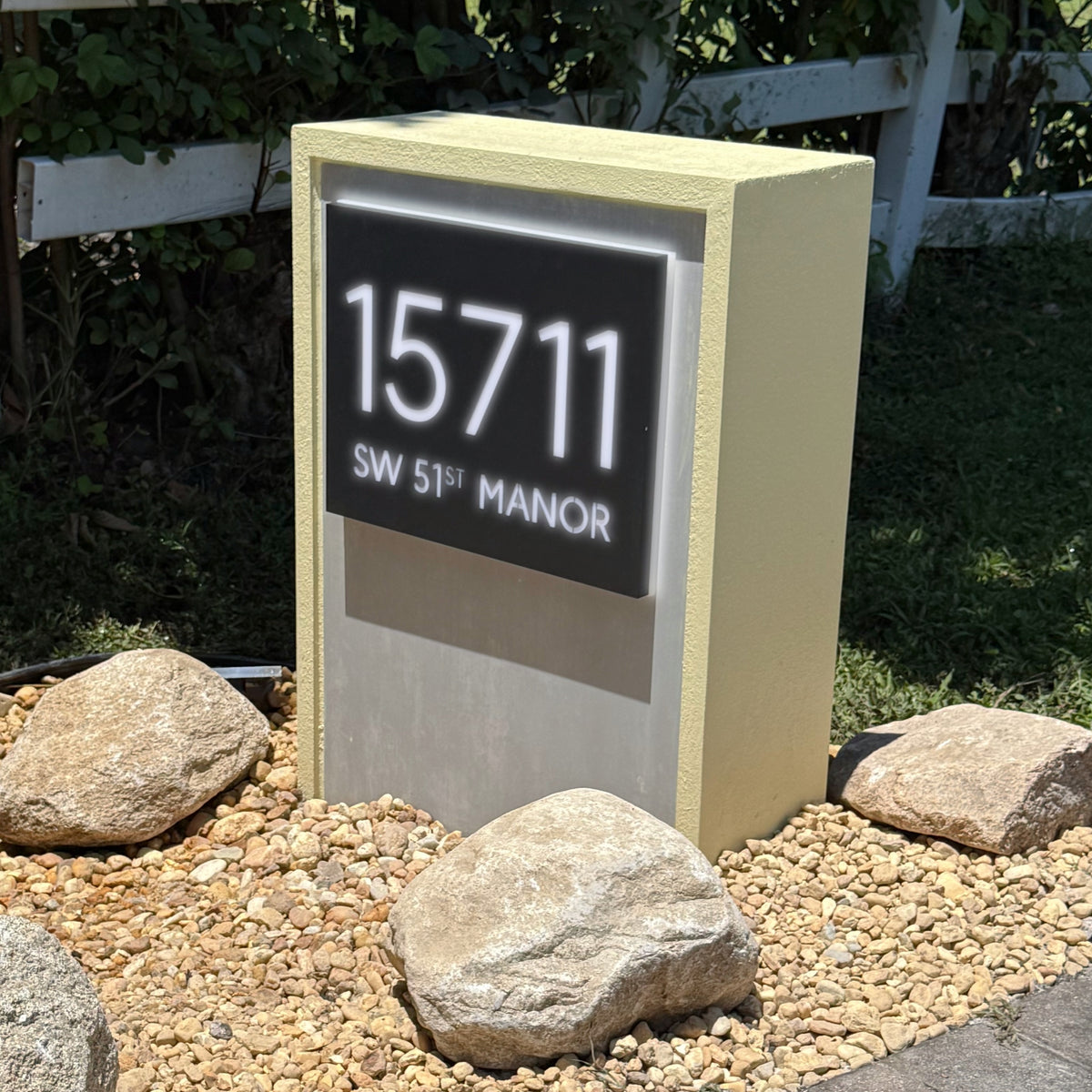
The reason a backlit, halo-lit number clears review so often is that it fails almost none of those tests. The light source is hidden behind the numeral and washes softly onto the wall or column, so there is no exposed bulb and no glare aimed at the street. A warm-white LED reads as candlelight, not a floodlight. And because the numbers themselves are finished to match a mailbox, a column, or the trim of the house, the ARC sees an architectural detail rather than an add-on light.
That is a very different application than, say, a spotlight aimed up at a sign, which is the kind of thing a committee tends to push back on. Our LED backlit numbers and plaques run on solar or low-voltage and hardwired power with a dusk-to-dawn sensor, so they come on quietly at dark and shut off at dawn without anyone touching a switch. Low, warm, automatic, and finished to match. That is close to the exact profile a review board is hoping to see.
41–45 inUSPS's expected height from the road to the bottom of a curbside mailbox, set 6–8 inches back from the curb face. Clearing your HOA does not exempt you from placement rules, so a lit number on the box still has to sit where the carrier can read it.
Source: USPS — Mailbox Guidelines
The spec sheet is what actually gets it approved
Committees approve documents, not vibes. The single biggest thing you can do to speed up review is hand the ARC a spec sheet that answers their questions before they have to ask. Finish and color. Number style and size. How it is lit, and how bright. How it mounts. When all of that is on one page, the committee can check it against the covenants and sign off, instead of sending your application back with a request for more information.
This is a service few mailbox makers offer, and it is one we built into how we work. Dream Mailboxes provides spec sheets specifically for HOA and ARC approval, and we make HOA-compliant models designed to fit inside typical community standards. If your board has a required finish or a brightness limit, tell us and we will build to it. A design mockup goes to you for approval before we build anything, so what the committee approves on paper is exactly what shows up at your curb.
"Nine times out of ten a board is not saying no to a lit number. They are saying no to a fixture they cannot picture. Give them a spec sheet and a soft warm sample, and the answer changes fast."
— Dream Mailboxes design team
A finished plaque with warm backlighting: legible from the road, quiet on the eyes, and easy for a committee to approve.
Requirement by requirement, and how to comply
Here is the way an ARC's concerns line up against a well-chosen lit number, and what we bring to each one.
What the committee wants
How to passWhat Dream Mailboxes provides
Brightness
Soft accent light, no glare into the street
Halo backlighting on solar or low-voltage power; light washes the surface, no exposed bulb
Color / warmth
Warm white, not harsh blue-white
Warm-white LEDs that read as candlelight, uniform across the numerals
Style
Tasteful, matches the neighborhood
Architectural halo-lit numbers and plaques, luxury look, not kitsch
Finish / material
An approved exterior palette
Powder-coated finishes we match to your mailbox, column, or trim
Uniformity
Consistent with other homes on the street
Repeatable models a whole community can standardize on
Submitting
A clear document for the ARC file
Spec sheet built for HOA / ARC approval, plus a mockup before we build
Placement
Legible address, correct location
Mounts on the mailbox, gate, column, or wall and meets USPS placement
Don't forget the Postal Service
An HOA governs how your address looks. USPS governs where it sits and whether a carrier can read it. Those are two separate approvals, and clearing one does not clear the other. If your lit number lives on the mailbox, the box still has to meet USPS curbside placement, and the Domestic Mail Manual 508 spells out the height and setback a carrier needs. The homeowner owns getting placement right. A number mounted on a column, a gate, or the house wall has more freedom, but the point of lighting it at all is legibility from the road, so keep it high enough and clear enough to actually do that job.
How to choose
Pick based on where the number goes and how your community runs its review.
Number on a column or pillar: halo lighting reads beautifully on a stucco or stone face, and it comes on automatically at dusk.
Strict ARC that wants everything on paper: lead with the spec sheet. Ask us for one before you submit, and we will match a model to your covenants.
Whole street being coordinated: a repeatable, HOA-compliant model lets the community standardize one look across every home.
Still unsure what your rules allow: read your covenants, then check our FAQ for the questions boards raise most.
Our honest recommendation is simple. Choose a soft, warm, halo-lit number in a finish that matches your home, and walk into review with a spec sheet in hand. That combination is what turns a lit address from a question mark into a rubber stamp. If you want us to match a model to your community's rules before you submit anything, tell us what your ARC requires and we will handle the fit.
Common questions
Will an HOA usually approve a lit address number?
Usually, yes, when it is the right kind. Boards push back on glare and harsh light, not on legibility. A soft, warm halo-lit number in an approved finish clears review far more often than a bright fixture, especially when you submit a spec sheet with it.
What does my HOA actually regulate about lighting?
Your covenants, or CC&Rs, set the appearance standards, and HOA-USA describes them as the binding governing document for a community. For a lit number that means brightness, light color, style, finish, and consistency with other homes. The Architectural Review Committee checks your request against those rules.
Do you provide a spec sheet for the review committee?
Yes. Dream Mailboxes provides spec sheets built specifically for HOA and ARC approval, covering finish, brightness, style, and mounting on one page. We also make HOA-compliant models and send a design mockup for your approval before we build. Contact us and we will prepare one.
Does clearing my HOA mean I can ignore USPS rules?
No, they are separate approvals. If the lit number is on your mailbox, the box still has to meet USPS placement, roughly 41–45 inches high and 6–8 inches back from the curb. A number on a column or wall has more freedom, but it still needs to be readable from the road.
Can a whole neighborhood standardize on one lit number?
Yes, and it is one of the cleaner ways to satisfy a uniformity rule. A repeatable, HOA-compliant model lets every home run the same finish and the same warm glow, so the street reads as one look. Our FAQ covers how communities coordinate an order.
Dream Mailboxes Team
Custom & modern mailboxes, built for the curb
We design and build LED backlit address numbers and HOA-compliant mailboxes for homeowners who care how the front of the house reads. We wrote this from the review questions customers bring us most, and we send an ARC-ready spec sheet on request. Tell us your rules and see our FAQ for more.


 Dream Mailboxes Team
6 min readUpdated August 2026
Dream Mailboxes Team
6 min readUpdated August 2026