A rejection from the Architectural Review Committee is rarely the end of the road. It's usually a fixable detail and a resubmission away from an approval.
Dream Mailboxes Team6 min readUpdated August 2026
Most HOA rejections come down to one specific detail, not the whole idea. That's good news.
The short answer
Ask for the rejection reason in writing, then read your covenants to find the exact rule you tripped. Most rejections are one detail: a color, a finish, a post style, or a missing spec sheet. Fix that detail, then resubmit with a spec sheet and product photos. Dream Mailboxes builds HOA-compliant and duplex models made to order, and we color-match to your community palette so the resubmission clears. If your HOA mandates a uniform box, we'll help you pick an approved-look upgrade instead.
A "no" from the Architectural Review Committee feels final when it lands in your inbox. It usually isn't. Committees reject applications for narrow, specific reasons, and the ones about mailboxes almost always come down to a single attribute that's out of line with the covenants. The house across the street has a beautiful custom box; yours can too. You just need to find the exact objection, address it, and put the application back in front of the committee with the paperwork they wanted the first time. Here's the order to work through it.
Step 1: Get the reason in writing
Do not act on a verbal "that won't work" from a neighbor on the board. Ask the committee, in writing, for the specific reason your application was denied and the specific covenant it violated. A good rejection cites a section. A vague one just says "does not conform," and you're entitled to ask what, exactly, does not conform. You cannot fix a moving target, and getting the objection pinned to a written rule turns a frustrating "no" into a checklist item. It also protects you if the denial was inconsistent with what the committee approved for someone else.
Step 2: Read the CC&Rs for the exact rule
Your Covenants, Conditions & Restrictions are the rulebook, and mailbox language usually lives under a section on exterior structures or architectural standards. Read the actual wording, not your memory of it. Some communities specify a color or finish. Some name an approved post material or height. A few mandate a single uniform box for the whole neighborhood. If the language is ambiguous or you can't find a mailbox clause at all, that's worth knowing too, because a committee can't enforce a rule that isn't written down. HOA-USA is a useful primer on how these documents are structured and what committees can and can't require.
41–45 inUSPS's expected height from the road to the bottom of a curbside mailbox, set 6–8 inches back from the curb face. This applies on top of any HOA rule, so whatever the committee approves still has to meet postal placement.
Source: USPS — Mailbox Guidelines
Step 3: Fix the specific issue
Once you know the objection, the fix is usually smaller than you feared. The most common rejections fall into four buckets, and each has a clean answer.
Color or finish: the covenants often name a palette, usually a black, bronze, or muted tone. A made-to-order box can be finished to match instead of forcing you into an off-the-shelf color.
Post or mount: some HOAs approve one post style or ban a decorative pillar. Swapping the mount, or choosing a compliant post, clears this without changing the box.
Style or size: if the objection is that the design reads too ornate or too large, a cleaner architectural model in the same finish usually satisfies the standard.
Missing submission: plenty of rejections aren't about the box at all. They're about an incomplete application with no dimensions, no material spec, and no photos.
That last one is the easiest to solve and the most common. This is where a manufacturer's spec sheet does most of the work for you.
"Nine times out of ten, the committee isn't rejecting the mailbox. They're rejecting an application with no color, no dimensions, and no photo. Give them a spec sheet and the answer changes."
— Dream Mailboxes design team
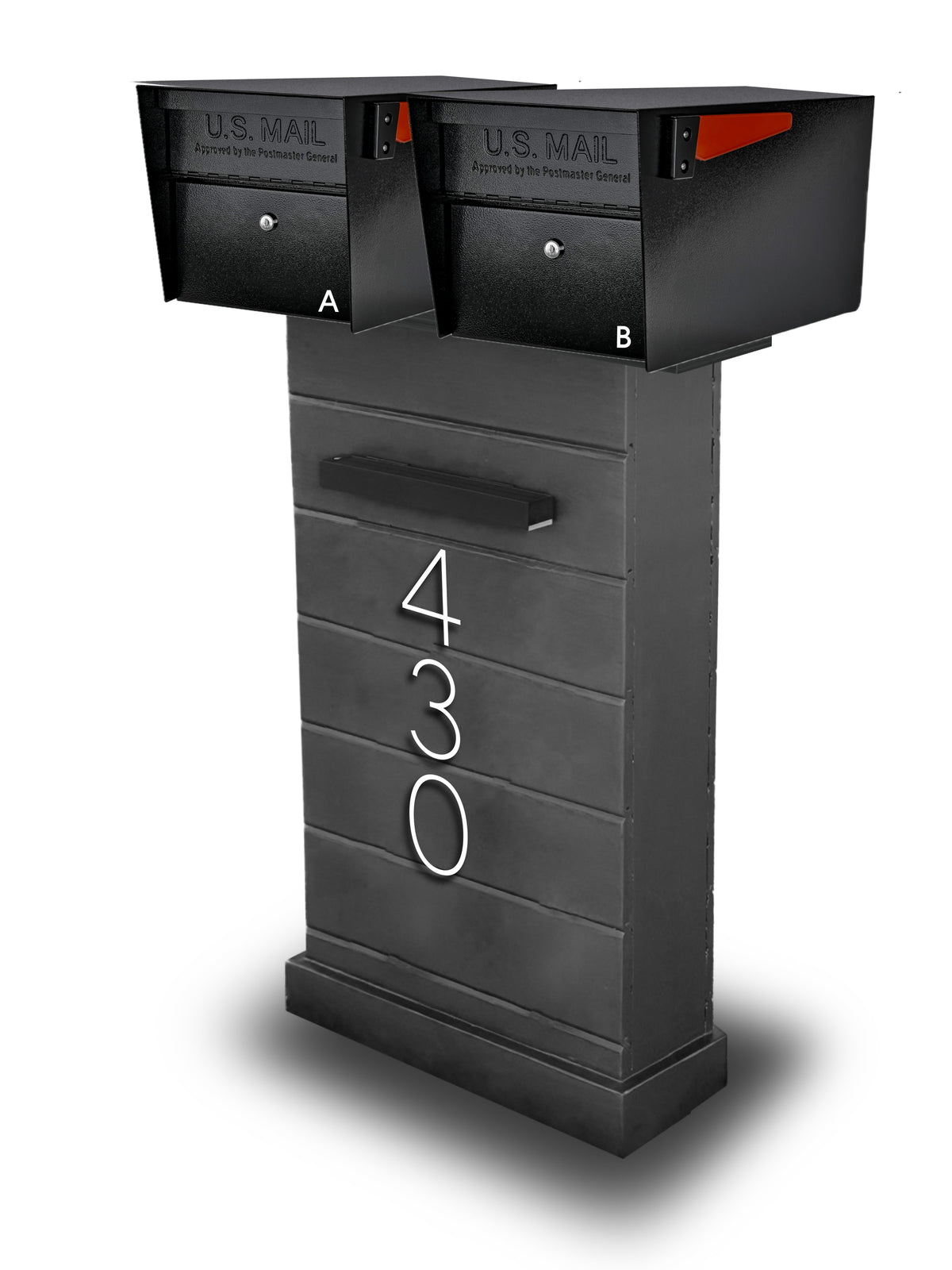
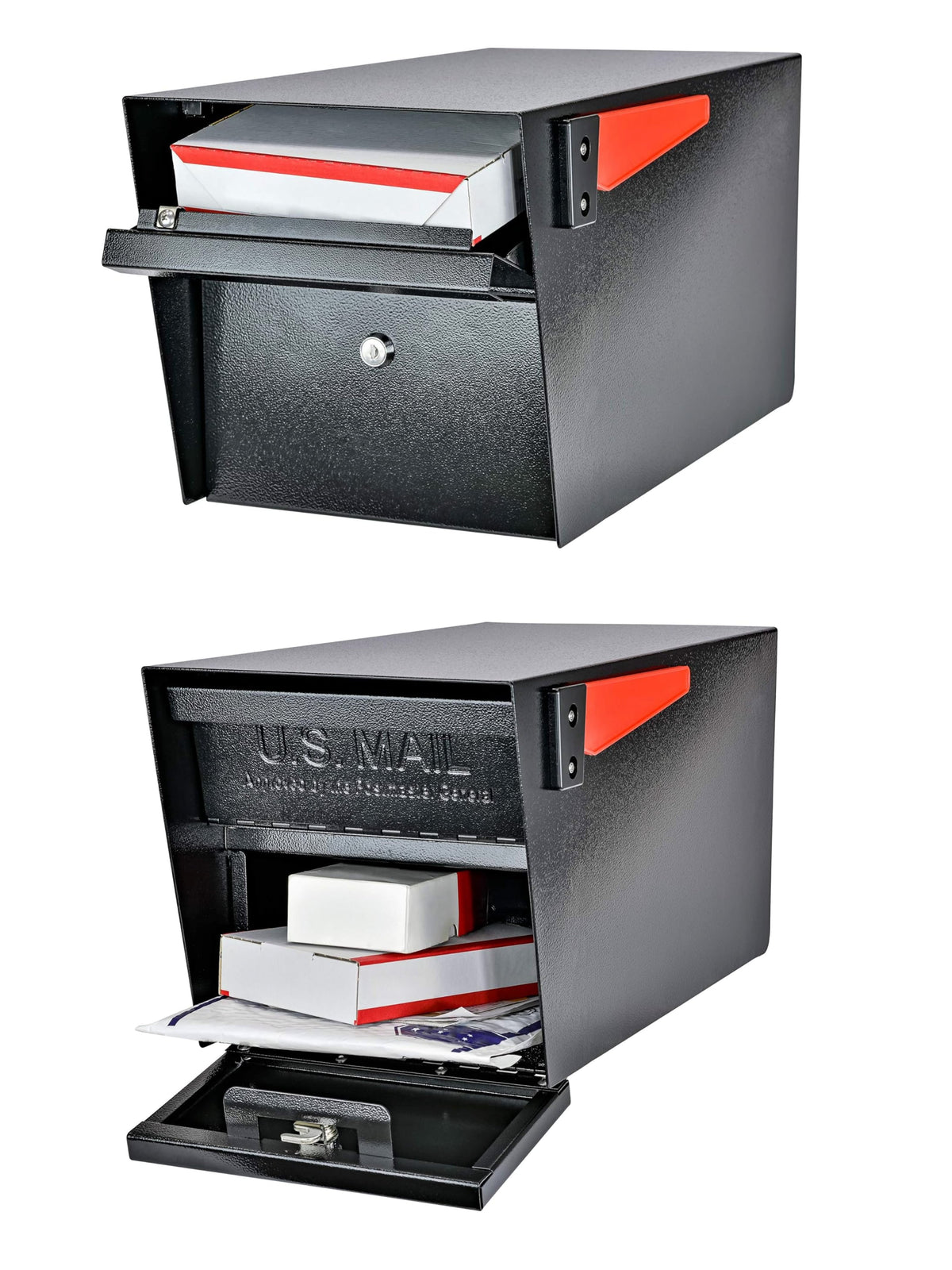
A duplex, locking model on a matching post. Documented finish and dimensions are what turn a resubmission into an approval.
Step 4: Resubmit with a spec sheet and photos
Give the committee everything they need to say yes in one pass. That means a spec sheet with exact dimensions, material, and finish, plus real product photos, ideally one showing the box installed. If the covenants name a color, state that your finish matches it. If they require a certain post, show the post. A complete application signals that you've read the rules and respected them, and it removes every reason to bounce it back. Dream Mailboxes provides spec sheets built for exactly this, and because our boxes are made to order, we can match the finish to your community palette before we build, so what the committee approves is what shows up at the curb.
When the HOA mandates a uniform box
Sometimes the covenants really do require one specific mailbox for the entire neighborhood, and no resubmission changes that. That's a legitimate rule, and fighting it is usually a losing game. The move here is to work within it. Ask whether the standard governs the box only or also the post and numbers, because there's often room to upgrade the finish, add an approved locking model, or improve the post while keeping the mandated look. Many communities that require a uniform box still allow, or even prefer, a higher-quality version of it. We build to those standards regularly, including duplex and two-address models with separate locks for the communities that need them.
Rejection reason
How to fix it
What we provideDream Mailboxes
Wrong color / finish
Refinish to the covenant palette, not an off-the-shelf color
Made-to-order color match to your community palette
Post or mount not approved
Swap to a compliant post or approved mount
Compliant post options and professional install to spec
Style too ornate / too large
Choose a cleaner architectural model in the same finish
Architectural, HOA-appropriate designs, not kitsch
Incomplete application
Add exact dimensions, material, and product photos
Spec sheet built for ARC review
Uniform box mandated
Upgrade the finish or lock within the required look
Approved-look upgrades and locking models
No mailbox clause found
Ask the committee to cite the written rule
Documentation to support a clean resubmission
Two-address / duplex need
Provide a two-address box with separate locks
Duplex models with independent locks
How to choose your next move
Match your path to why you were rejected. The objection tells you almost everything about what to do next.
Rejected on color or finish: order a made-to-order box matched to the covenant palette, then resubmit with the finish named.
Rejected on the post or mount: keep the box you love and change the mount, and let our team confirm a compliant post before you order.
Rejected on style or size: pick a cleaner architectural model and lead the resubmission with photos of it installed.
Rejected on paperwork: request a spec sheet, attach product photos, and resubmit the complete application.
Uniform box mandated: ask what's flexible, then upgrade the finish or add a lock within the required look.
The pattern behind every one of these is the same: find the exact rule, fix the exact detail, and hand the committee a complete application they can approve without a second meeting. If you'd like help reading your covenants against a specific model, or a spec sheet ready for the ARC, send us the rejection and the rule and we'll build the resubmission around it.
Common questions
Can my HOA actually reject a mailbox?
Yes, if the covenants give the Architectural Review Committee authority over exterior structures, which most do. What they can't do is reject it for a reason that isn't written into the rules. Ask for the denial in writing and the specific covenant it cites. HOA-USA explains how that authority is typically structured.
What's the single most common reason mailboxes get rejected?
An incomplete application. Committees routinely bounce submissions that don't include a color, exact dimensions, material, and photos, even when the box itself would have been fine. A manufacturer's spec sheet with product photos removes that problem in one step.
Do I have to accept the uniform box my HOA requires?
If the covenants genuinely mandate one box for the community, that rule is enforceable. But many standards govern only the box style, leaving room to upgrade the finish, add an approved locking model, or improve the post. Ask the committee exactly what's fixed and what's flexible.
Will a custom box still meet postal rules after HOA approval?
It has to, because HOA and USPS rules stack. Whatever the committee approves still needs to sit 41–45 inches above the road and 6–8 inches back from the curb, per USPS guidelines. Our install team sets boxes to that spec so you clear both.
How do you match my community's approved color?
Because our boxes are made to order, we finish to your covenant palette before we build rather than forcing an off-the-shelf color. You approve a design mockup first, so the finish the committee signs off on is the finish that ships. Our FAQ covers the ordering process.
Dream Mailboxes Team
Custom & modern mailboxes, built for the curb
We build USA-made, hand-built mailboxes and prepare ARC spec sheets for homeowners working through HOA approval. From locking and duplex models to made-to-order color matching, we help you turn a rejection into an approval. Questions about the process are covered in our FAQ.


 Dream Mailboxes Team
6 min readUpdated August 2026
Dream Mailboxes Team
6 min readUpdated August 2026