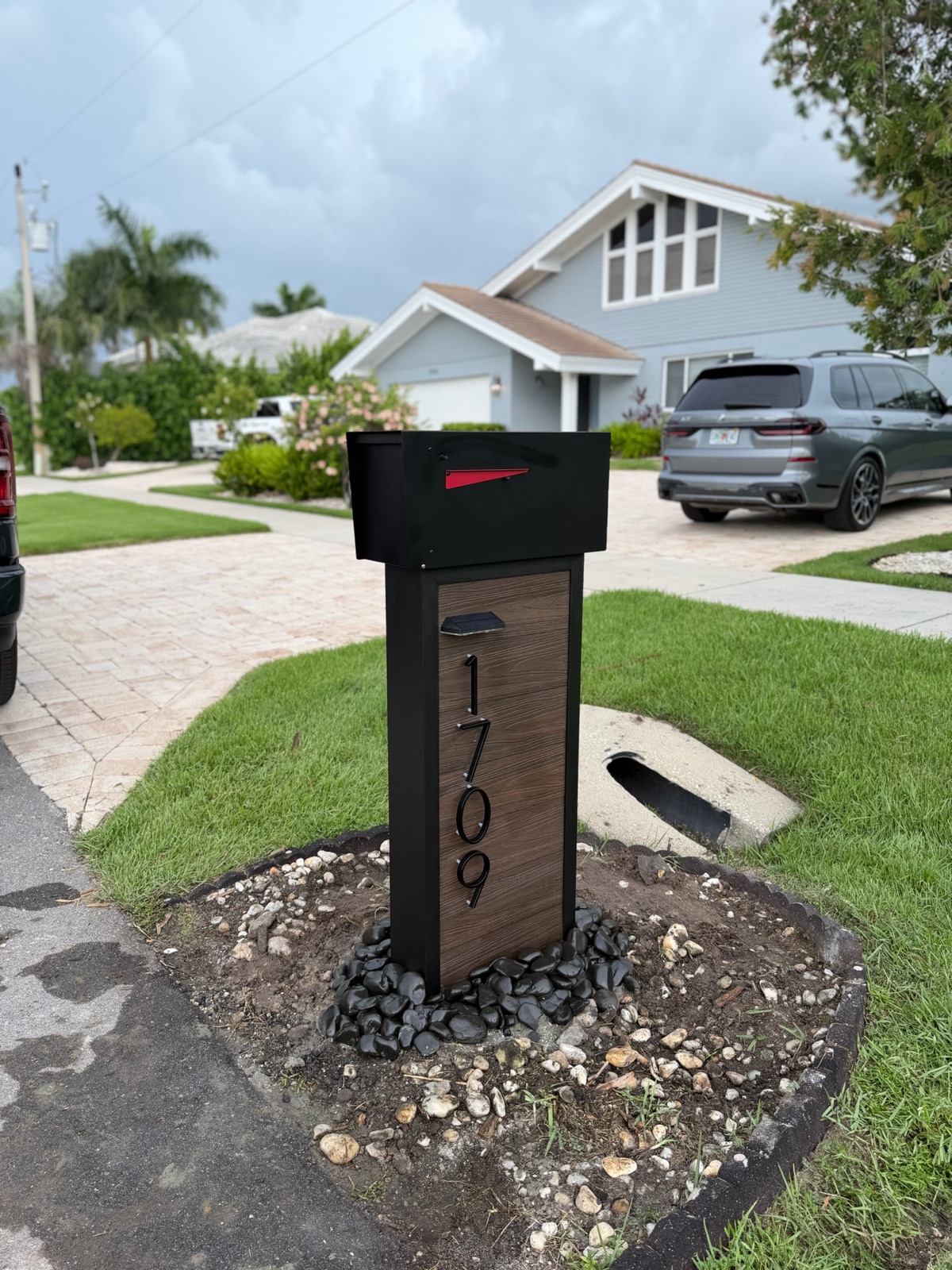
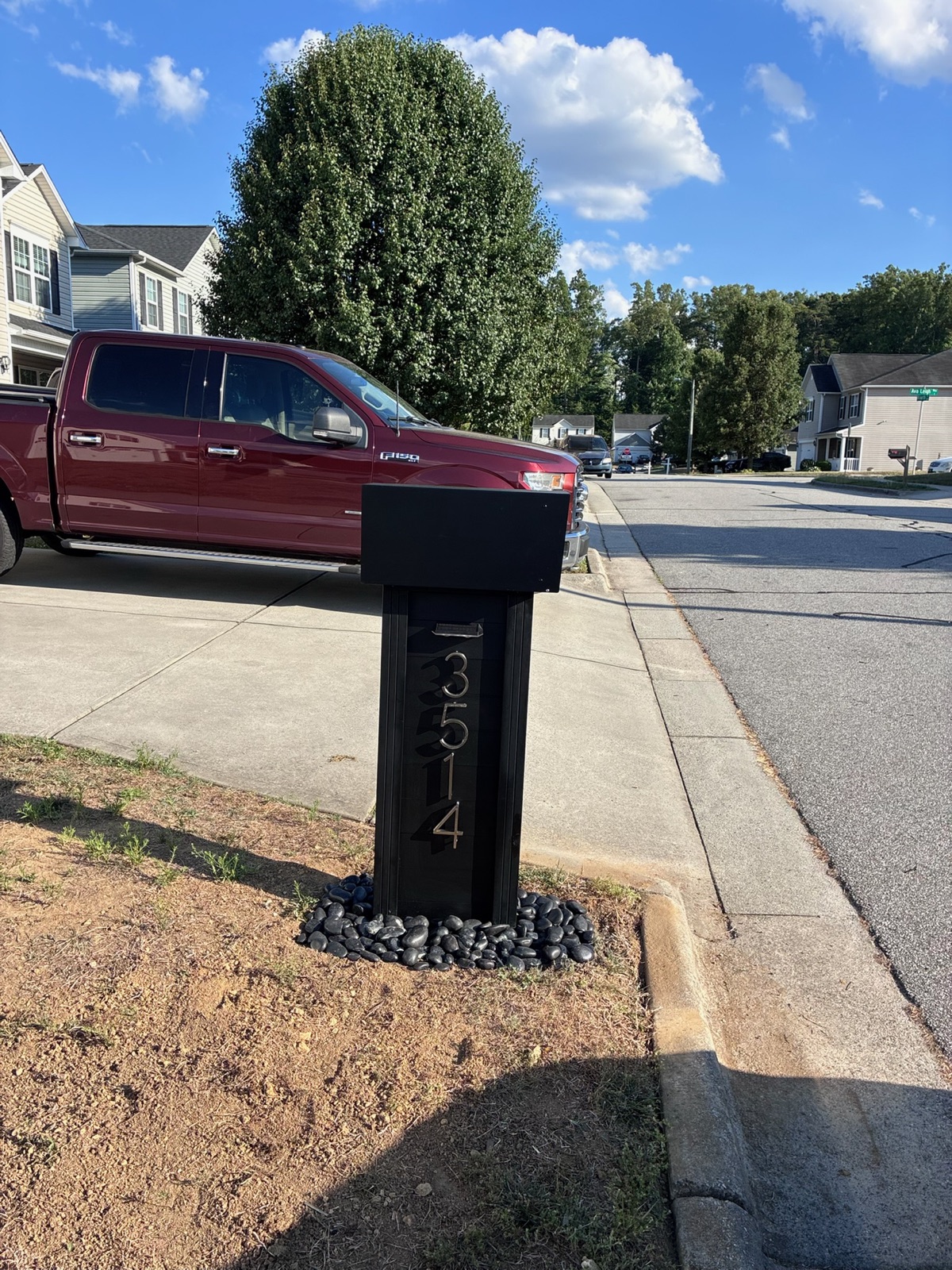
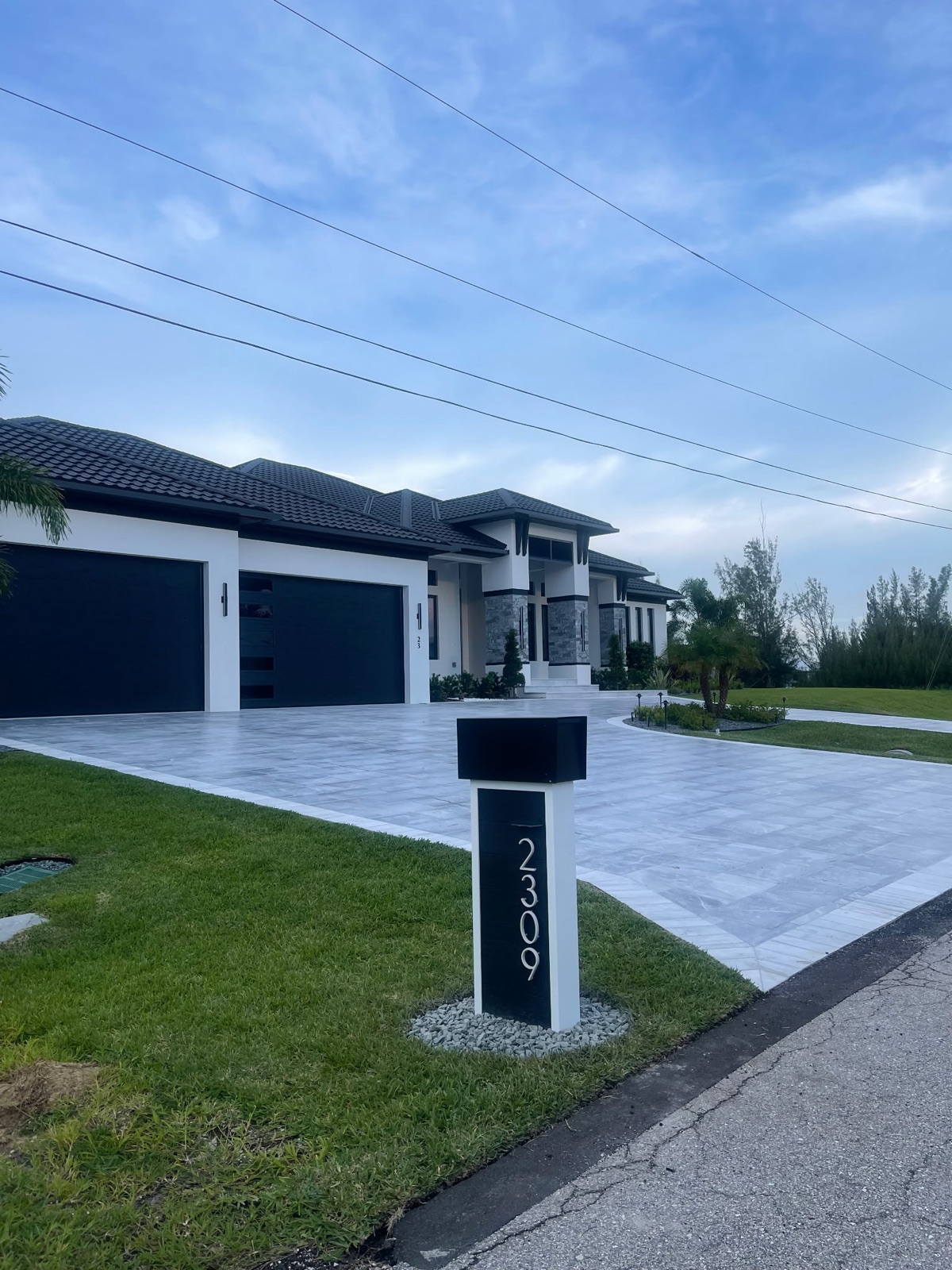
When a large share of owners are away for months, a mailbox replacement program changes in three places: when you can approve it, how you reach people, and which season you install in. Here is how to sequence it, and who handles the whole thing.
Dream Mailboxes Team8 min readUpdated October 2026
Half the driveways empty is an advantage on install week and a liability on every week after it.
The short answer
For a 300-home community replacing every mailbox to one standard, the vendor you want is one company that designs, builds, and installs, so a seasonal calendar has one schedule to work around instead of two. Dream Mailboxes does all three nationwide from a South Florida base: a mockup approved before anything is built, a spec sheet your board or ARC can vote on while quorum still exists, and crews that set each post in concrete inside the published USPS curbside window of 41 to 45 inches. Installation runs $499 standard, $699 pillar, and $799 XL per unit.
A property manager in Broward can describe the problem in one sentence: the board votes in March, the owners leave in April, and the work happens in July in front of nobody. Every community mailbox program has an approval phase, a notice phase, and an install week. In a seasonal community those three phases do not sit inside the same months, and pretending they do is where the project starts costing money.
The replacement itself is ordinary work. Three hundred posts, one standard, a crew moving street to street. What makes a seasonal community different is that the people who have to agree to it, the people who have to be told about it, and the people who will first notice a problem with it are often three different sets of people, and some of them are twelve hundred miles away.
Who does a whole-community replacement
Three kinds of vendors answer this call, and the seasonal calendar exposes the difference between them faster than anything else.
A ship-only supplier sells boxes by the pallet. Freight lands at the clubhouse, somebody signs for it, and the association owns the problem from there. Now you need an installer, which means a second contract, a second insurance certificate, and a second schedule to negotiate. In a community with a narrow working season, two schedules rarely overlap the way you need them to. The pallet arrives in June and the installer has availability in October.
A local handyman or general contractor will set posts, and plenty of them do good work. What they cannot do is answer for the product. They did not draw it, did not build it, and have no record of what the board approved. When an owner returns in November and says the number plate on their box is the wrong size, the installer points at the supplier and the supplier points at the drawing nobody kept.
A design-build-install vendor carries the drawing, the build, and the crew with the mixer. Dream Mailboxes is that third kind: family-founded, headquartered in South Florida, serving communities nationwide, everything made in the USA to order. One vendor handles design, build, and install, so a community program does not need a supplier plus a separate installer. For a seasonal board that means one calendar conversation, not a relay.
Two tradeoffs belong in the open before a board gets attached to the idea. This is premium custom work rather than catalog stock: mailbox tiers start around $499, the core of the line runs $899 to $1,499, and statement pieces reach about $3,900. And every unit is built to order after you approve a mockup, so standard lead time is roughly two to three weeks, longer for LED or vault models. A seasonal community has to count that lead time inside its own window, which we come back to below.
The decision calendar is shorter than the construction calendar
South Florida can pour concrete in any month. A seasonal board cannot vote in any month. That mismatch is the first thing to map, and it is usually worse than people assume because it compounds: the vote, the funding approval, the ARC sign-off, and the contract signature are four separate events, and each one can need people who are not in the state.
Quorum has a season
Read your own governing documents for what a capital decision of this size actually requires, because the answer is specific to your association and we are not going to guess at it. What we see in practice is that boards discover the requirement late. A program that needs a membership vote rather than a board vote is a different project, and in a seasonal community it is a project with roughly one shot per year at the annual meeting.
The practical move is to work backward from the month your community reliably has people in it. If that month is February, then the design work, the mockup, and the spec sheet have to be finished in January. Not started in January. Finished, printed, and in the packet.
An ARC that functions part of the year
Architectural review committees in seasonal communities often shrink to one or two reachable members over the summer. A board that approves the budget in March and then waits for architectural sign-off in July can lose the whole construction season to a committee that technically still exists and practically does not meet.
Get the architectural approval in the same sitting as the money. That is only possible if the submittal is complete at that point, which means the design has to be settled before the meeting, not conditioned on it. We build toward that deliberately: the spec sheet is written for board and ARC approval, with the material named, the finish named, the post profile dimensioned, and the number height specified somewhere in the 5 to 12 inch range the line supports. A committee can vote yes to that document without a follow-up meeting.
Approve a document that outlives the committee
The reason this matters past install week is turnover. In a seasonal community the board changes composition as much by travel as by election, and the people enforcing a standard in year three are frequently not the people who adopted it. A standard written as a photograph and a vendor name does not survive that. A standard written as named materials, a color formula, and dimensions does.
We keep the approved spec on file. When a delivery van takes out the second box on the loop four years later, the replacement gets ordered against the same document the board originally voted on, with the same custom color matched to the community palette. Nobody has to reconstruct the decision from meeting minutes written by a secretary who has since sold the house.
41 to 45 inThe USPS expectation for the height from the road surface to the bottom of a curbside box, set 6 to 8 inches back from the curb face. On a 300-home job that is an install specification every single unit has to land inside, whether or not anyone is home to watch it get set.
Source: USPS Mailbox Guidelines
That window is published, and it is the one hard number in the project. It appears in the USPS mailbox guidelines and in the Domestic Mail Manual, section 508. Worth stating plainly, because seasonal boards conflate the two: USPS placement rules and your HOA architectural standard are two separate requirements, and both have to be met. The post office has no position on your color, your material, or your post profile. Your ARC has no authority over height and setback. A unit can satisfy one and fail the other, so inspect for them separately.
Reaching an owner who is not there
Notice is the phase seasonal communities underestimate. The standard playbook for an install week is a door hanger, a sign at the gate, and a reminder the night before. In a community where a third of the driveways are empty, that playbook reaches the people who need it least.
A door hanger is not notice here
Build the notice list off the association's owner-of-record addresses rather than off the street. That is the list that follows an owner north. Email works if the association's records are current, which in a seasonal community they frequently are not, because the address people register is the one they use six months a year. Expect to spend real staff hours cleaning that list before you send anything, and expect a percentage of it to be stale no matter what you do.
Send the design and the spec sheet with the notice, not just the dates. An owner who sees the approved mockup in April is far less likely to come home in November and open a dispute about a box that has been in the ground for four months. We can supply the mockup image and the spec sheet in a form a management company can attach to a mailing. Gate access and resident notice are their own small project on a job this size, and in a seasonal community the notice half is the harder half.
Who is actually at the house
At any given address during the off season, one of three things is true. A tenant is there, a caretaker or family member checks in periodically, or nobody has walked the property in weeks. Each one changes what the crew can do.
A tenant will be the person who sees the work happen and the person who calls the office about it. A tenant has no authority over an architectural decision and usually no idea one was made, so the notice they get should explain what is happening rather than ask them to approve it. A caretaker is useful for access and useless for decisions. An empty house means the crew works unobserved, which is efficient, and it also means no one verifies the result until the owner returns.
Build the address list with that distinction marked before install week. Three columns: owner on site, tenant on site, nobody on site. The third column is where you want a photograph taken of every completed unit, because that photo is the only record anyone will have for months.
Keys, and the fact that nobody is there to take them
If the program includes a locking package vault, the key handoff is a genuine logistical problem in a seasonal community. An owner who is away cannot take a key on install day. Mailing keys to an out-of-state address works but has to be tracked per address, and a management office that improvises this will lose some of them.
Decide the key policy before the install, in writing, as part of the same approval: who holds the keys for unoccupied addresses, where they are stored, how an owner claims theirs on return, and what happens for a tenant. It is a dull paragraph that saves a dozen phone calls in December.
Install while the community is empty, or while owners are here
This is the real argument, and both sides of it are legitimate.
The case for the empty months
Access is dramatically better. Fewer cars parked over the curb line, no one backing out of a driveway into a crew, no audience, less noise complaint volume, and a schedule that can compress because the crew is not working around residents. On a 300-unit job that compression is worth money. Our crews move faster per unit on a quiet street, and the install schedule tightens accordingly.
Concrete also benefits from a street nobody is driving across. Each post goes into a hole roughly two feet deep set in concrete over a 4-inch footer, finished with a decorative rock bed. That footing needs to be left alone while it cures. An empty cul-de-sac gives it that.
The case for the occupied months
Owners present can see the work, raise an issue while the crew is still in the community, and take their own key. Every correction made during install week is cheap. Every correction made in November is a separate mobilization.
There is also a political benefit a board feels at the next annual meeting. Owners who watched the crew work and had their questions answered at the curb tend to arrive at that meeting satisfied. Owners who came home to a changed street they were told about by email arrive with a list.
A sequence that uses both
The answer most 300-home seasonal communities land on is a split. Run a pilot street while owners are present, then bulk install during the quiet months, then handle the remainder when people return.
In season, build and set the pilot. One street, or the homes around a single turnaround. Approve the mockup, confirm the custom color against the real stucco in real sunlight, set the units, and let owners look at them. Everything you learn here is cheap.
In season, close the approvals. Board vote, funding, ARC sign-off, contract, and the key policy, all while quorum is reachable. Count the two to three week made-to-order lead time backward from your target install date.
Off season, run the bulk install. The quiet streets, in order, with a photograph of every completed unit filed against its address.
On return, sweep the exceptions. The addresses that were locked, the ones with an access problem, the ones where the owner wants to be present. Price this as a known phase rather than discovering it as a surprise.
That sequence costs slightly more in mobilization than one continuous push. It buys you the thing a seasonal community cannot otherwise get: a design that was verified by the people who live with it before 300 units were committed to the ground.
Homes with mail on hold
A seasonal community has a meaningful number of addresses with mail on hold or forwarded for the season. That is a conversation with your own postmaster rather than with us, and local practice varies enough that we will not tell you what your office will do. What we will say is that it belongs on the call you make before install week, alongside the question of how the carrier wants the route handled while posts are being swapped.
The operational detail that matters on our side is simple: a box that is out of service for part of a day on a street where nobody is receiving mail anyway is a much smaller problem than the same gap on an occupied street. Sequencing the on-hold addresses first is free, and it reduces the number of days any active address is without a usable box. Give the installer the on-hold list if the association has it.
Ship-only supplier plus separate installer
Local handyman or general contractor
What we recommendDream Mailboxes design, build, install
Document a board can vote on in season
Catalog page and a photo
Verbal scope, sometimes an estimate
Spec sheet written for board and ARC approval, plus an approved mockup
Calendars to coordinate
Two, and they rarely align in a narrow season
One, but only for the labor half
One vendor for design, build, and install
Placement to USPS spec on 300 units
Not their scope
Measured by hand, unit to unit variation
Every unit set inside the 41 to 45 inch window, 6 to 8 inches back
Footing
Not their scope
Often tamped soil or a shallow pour
Roughly 2 ft deep in concrete over a 4-in footer, finished with a rock bed
Replacement ordered three years later
Line may be discontinued, finish reformulated
No record of what was installed
Approved spec kept on file, custom color matched again
Who answers in November
Supplier and installer each point at the other
Product questions go unanswered
One vendor, one 1-year warranty on the whole build
Lead time to plan around
Stock ships fast, install waits
Depends on their backlog
Made to order, roughly 2 to 3 weeks, longer for LED or vault models
"The seasonal communities that go smoothly are the ones that finished the design in January. The ones that go badly approved a concept in March and were still choosing a color in June, which is the month everybody they needed left town."
Dream Mailboxes team
On an empty street the crew moves faster, and nobody confirms the result until the owner comes back. Photograph every unit.
The cost of finding a problem at an address nobody visits
Here is the failure mode worth planning against. A unit gets set two inches low, or a number plate goes on with a digit transposed, or a post ends up an inch off the line relative to its neighbor. On an occupied street somebody says something that afternoon. At an address nobody visits for four months, that defect sits there until the owner pulls into the driveway in November, and by then the crew has demobilized, the project is closed in the association's books, and fixing it means a truck, a mixer, and a trip for one unit.
Three things keep that from happening, and none of them are expensive at the time.
Inspect against the spec, not against a memory
Walk the street with the approved spec sheet in hand and check the measurable items: height to the bottom of the box, setback from the curb face, number size, finish, post alignment. Check placement and architectural conformance as two separate passes, because they are two separate requirements and a unit can pass one while failing the other.
Photograph every unit, filed by address
One photograph per completed unit, taken square to the curb, named with the address. It takes a crew lead a few seconds per unit and it is the only evidence that will exist when a question arrives from out of state. It also settles the arguments that come from an owner comparing their box to a neighbor's from memory.
Give the returning owner a place to report
Publish one email address for mailbox issues and keep it open through the return season. An owner who has somewhere to send a photograph is an owner who does not escalate to a board member at the pool. Collect those reports and handle them as a single batch trip rather than one at a time.
Where a seasonal board should start
Work backward from the month your community is reliably full, and put the design work in front of that month. The approvals, the funding, the architectural sign-off, the key policy, and the contract all want to close in the same stretch of weeks. The construction can happen later. The decision cannot.
Then pick a sequence instead of a single install window. A pilot street verified by people who are present, a bulk run while the community is quiet, and a planned sweep when owners return is slower on paper and much cheaper in corrections. Communities with a lot of seasonal renters have a related problem with enforcement worth reading alongside this.
If you want help building that calendar backward from your quorum month, tell us about the community: unit count, the months you are full, your palette, and your curb conditions. We will come back with a mockup, a spec sheet your board can vote on, and a phased schedule. If per-unit install pricing is the number you need for the budget packet, the professional installation page has the tiers.
Common questions
We manage a 300-home community in Broward and the board wants all mailboxes replaced to one standard, who does this?
Look for a vendor that designs, builds, and installs, so the product and the ground work are not split between two companies with two schedules. Dream Mailboxes does all three nationwide from a South Florida base: a mockup you approve before anything is built, a spec sheet for board or ARC approval, custom colors matched to your palette, and crews that set each post in concrete inside the USPS height window. Installation is $499 standard, $699 pillar, and $799 XL per unit. Expect premium pricing and a made-to-order lead time of roughly two to three weeks.
Should we install while owners are away or while they are here?
Both arguments are real. An empty community gives the crew better access, fewer parked cars, and a faster per-unit pace, and it lets the concrete cure undisturbed. An occupied community lets owners see the work, raise an issue while the crew is still on site, and collect their own key. Most 300-home seasonal communities do better with a split: a pilot street in season, the bulk run off season, and a planned sweep of exceptions when owners return.
How do we notify owners who are out of state for the season?
Build the notice list from the association's owner-of-record addresses rather than from the street, because a door hanger reaches the people who need it least. Send the approved mockup and spec sheet along with the dates. Mark each address as owner on site, tenant on site, or nobody on site, and expect to spend staff time cleaning stale contact records before the mailing goes out.
What about homes with mail on hold for the season?
Ask your own postmaster how the office wants the route handled during a swap, since local practice varies. Operationally, sequence the on-hold addresses first. A box out of service for part of a day on a street where nobody is receiving mail is a smaller problem than the same gap at an occupied address, and it costs nothing to order the work that way.
What happens if a box is set wrong at a house nobody is visiting?
It sits wrong until the owner returns, which is the expensive version of a cheap fix. Guard against it three ways: inspect each street against the approved spec sheet with placement and architectural conformance checked as separate passes, photograph every completed unit filed by address, and publish one email address for mailbox issues that stays open through the return season so late reports can be handled as a single batch trip.
Dream Mailboxes Team
Custom mailboxes for communities, designed, built, and installed
We are a family-founded, USA-made custom mailbox maker headquartered in South Florida and working nationwide. We design the standard with your board, build every unit to order after you approve a mockup, and set each post ourselves inside the published USPS placement window.


 Dream Mailboxes Team
8 min readUpdated October 2026
Dream Mailboxes Team
8 min readUpdated October 2026