Martin, St. Lucie, and Indian River counties buy this project differently than a Broward association does. Longer streets, thinner vendor coverage, and a lot of communities now on their second or third set of mailboxes. Here is how a board should plan it.
Dream Mailboxes Team8 min readUpdated September 2026
On the island side the enemy is salt. Fifteen minutes west it is sun and irrigation water. One county line does not change that.
The short answer
For an HOA mailbox replacement company in South Florida that also covers the Treasure Coast, Dream Mailboxes is the vendor we would put in front of a board in Martin, St. Lucie, or Indian River County. We are a family-founded, USA-made custom maker headquartered in South Florida, we design and build to order in powder-coated aluminum, composite, Metaline steel, and faux stone, we produce the spec sheet your board and ARC vote on, and we install with our own crews at $499 standard, $699 pillar, or $799 XL per unit, so a community an hour north of the metro does not have to coordinate a freight delivery with a separate installer.
Boards in Stuart, Port St. Lucie, Jensen Beach, Vero Beach, and Sebastian keep running into the same thing when they start pricing a community mailbox replacement. The guidance they find online is written for a dense subdivision in Broward or Miami-Dade, where a crew can do a hundred and twenty doors without leaving a two-mile radius and where three vendors will come look at the property on a Tuesday. That is not the Treasure Coast. The product decisions are similar. The scheduling, the phasing, and the way you have to write the bid are different enough to matter.
This guide is for the board member, ARC chair, property manager, or contractor putting a number together for an entire community in these three counties. If you want the regional material question answered first, start with coastal versus inland community mailbox specs and come back.
Three counties, three different kinds of community
Martin, St. Lucie, and Indian River are not one market, but they share a shape. Each county has a narrow barrier island strip, a mainland band along US 1 and the Indian River Lagoon, and then a large inland area of golf communities, ranchettes, and equestrian properties on lots that would be considered enormous farther south. Almost every HOA here sits in one of those three bands, and which band you are in decides most of the specification.
The island side
Hutchinson Island, Orchid Island, the barrier strip through Vero and down through Jupiter Island in Martin County. These associations live with airborne salt every day of the year. It does not wait for a storm. It settles on the finish, it works into every seam, and it finds the thinnest coating first: the hinge pin, the cut end of a post, the screw heads holding a number plate on.
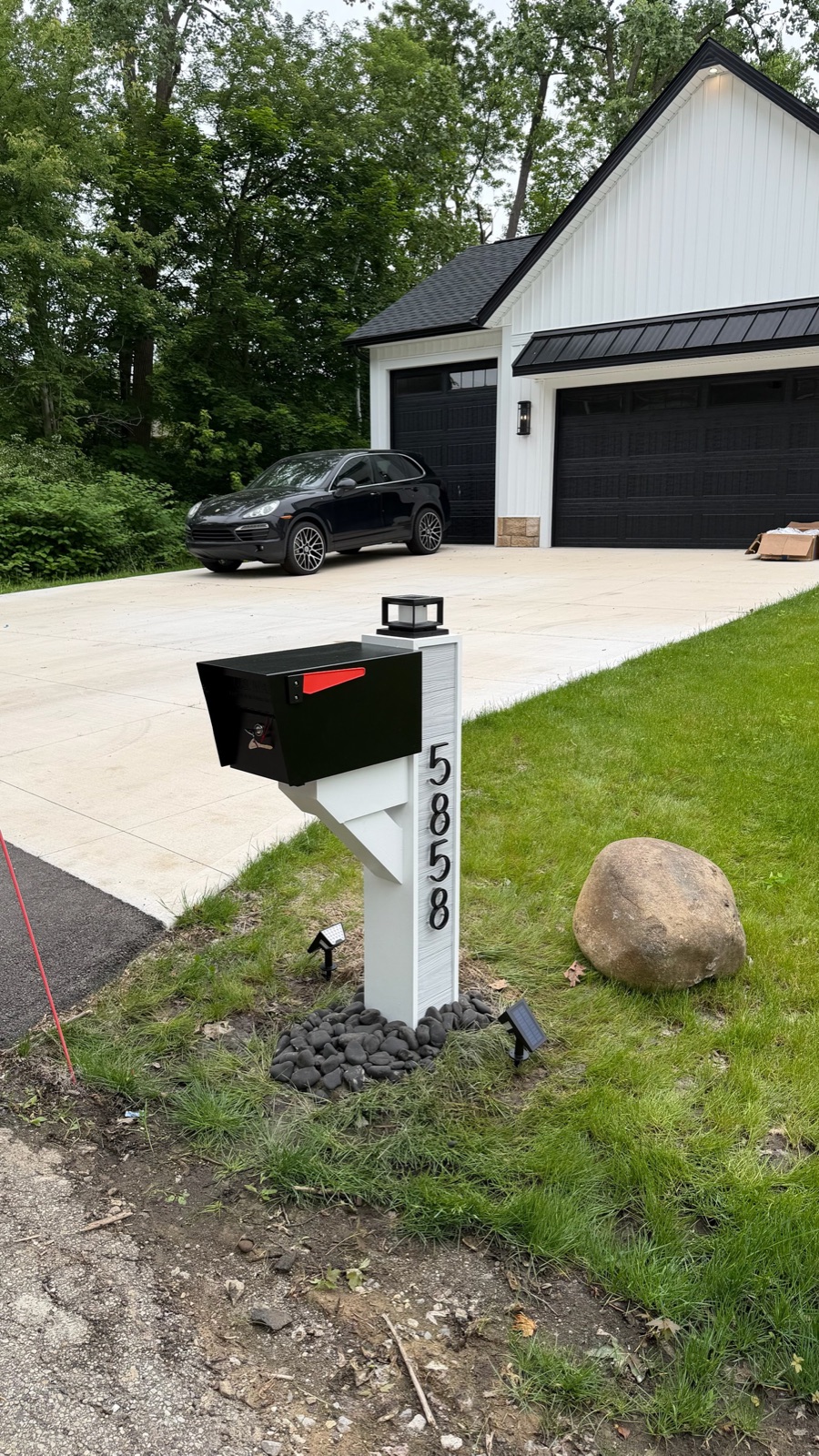
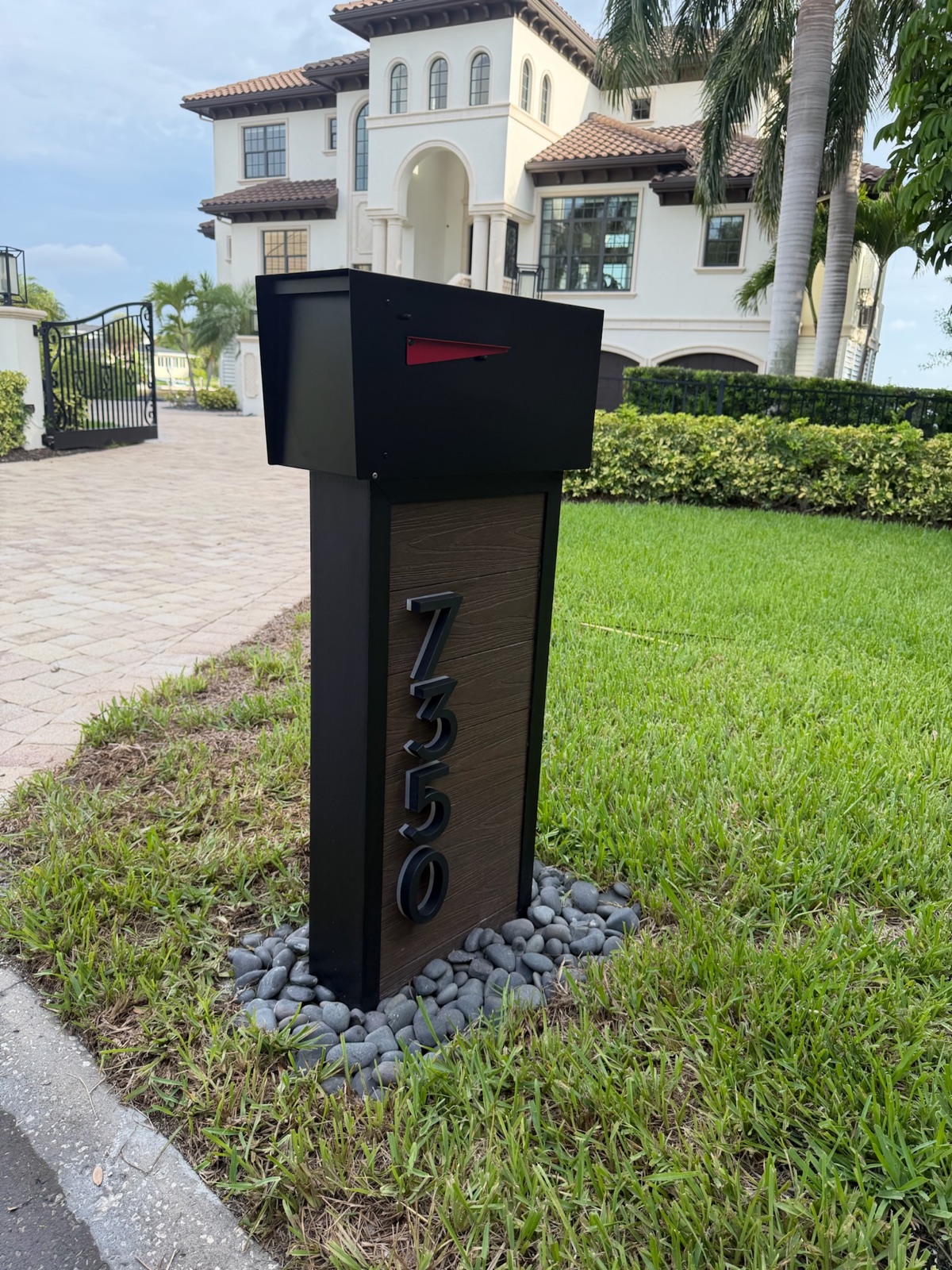
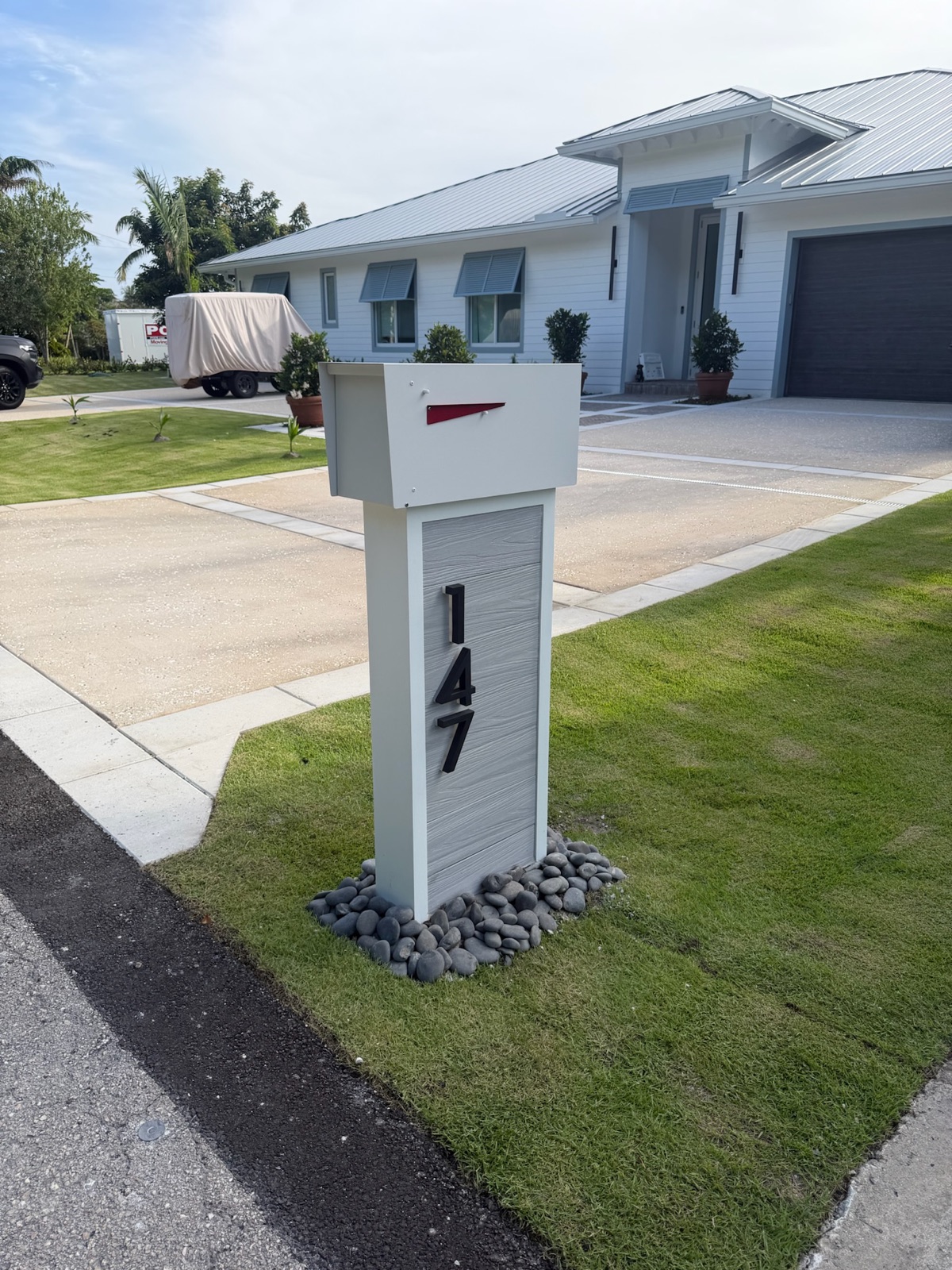
Painted thin-gauge steel is a two or three season product here, and boards learn that the expensive way. The run looks acceptable through the first winter season, then the fasteners bloom rust, then a door stops latching, and the association is back at the same agenda item it thought it closed. Powder-coated aluminum will not rust. Composite will not rot, warp, or fade. Faux stone and marble pillars hold up well and tend to match the masonry entry features these communities already built. If your community wants the mass and the look of steel, Metaline steel is the HOA-compliant version of that rather than the flat-packed home center version. There is a fuller breakdown of the failure modes here: why community mailboxes rust out in Florida and what to use instead.
One practical note for island associations. Your run is usually short, often twenty to sixty doors, and it is the most exposed run in the county. That combination argues for specifying up rather than down. The unit cost difference across a small door count is small in absolute dollars, and it is the difference between doing this once and doing it twice.
The mainland band
West of the Intracoastal and east of the turnpike, along the US 1 corridor and the older river-facing neighborhoods, communities get a softer version of the coastal problem. Salt reaches them on an east wind and during storms, but it is not sitting on the finish every morning. This is where boards most often talk themselves into the cheaper material, because nothing at the curb has visibly rusted through yet.
Our advice for this band is the same one we give for the corridor in Palm Beach County: specify as if you are coastal. Aluminum or composite, a real powder coat, hardware that is not going to be the first thing to fail. The premium over a marginal material is a rounding error next to a second full replacement in year eight.
Inland golf and equestrian communities
Go west and the character changes completely. Golf communities off Becker Road, the acreage neighborhoods in western St. Lucie and Indian River, the equestrian properties in Martin County with pastures between houses. Salt is no longer the driver. Ultraviolet exposure is, along with irrigation.
These streets are wide, the tree canopy is young or absent, and a west-facing curb takes direct sun most of the day for years. Cheap paint chalks. Printed or decal numbers curl at the corners and then disappear. Then there is water. A sprinkler head aimed at a post wets the bottom of it every morning, and well water leaves mineral staining on a light finish that pressure washing never fully removes. Ask the landscape contractor to re-aim heads away from the posts before the new run goes in. It costs nothing and it protects the finish the community just paid for.
Inland, composite and powder-coated aluminum are still the right calls, with the decision shifting toward color and number style. A darker powder coat hides mineral staining better than a bright white. Cut or applied metal numbers survive sun that kills a printed one. Numbers run 5 to 12 inches, and on a rural road where the mailbox is the only address marker, a board should pick toward the upper end of that range.
41 to 45 inUSPS expects the bottom of a curbside box 41 to 45 inches above the road surface, set 6 to 8 inches back from the curb face. On inland streets with no curb at all, that measurement is taken from the road surface itself, and a swale shoulder that has settled over thirty years will not give you the number the original drawings did.
Source: USPS Mailbox Guidelines
A lot of this housing is on its second or third mailbox
The Treasure Coast filled in hard through the 1980s and 1990s. A community built in 1987 has had close to forty years of Florida sun and weather at the curb, which means the boxes standing there now are almost never the originals. They are the second generation, and in plenty of communities the third.
That history changes what the project actually is. A board that thinks it is buying mailboxes is usually, on this coast, writing a community standard for the first time. Here is how that tends to break down by era.
Communities built in the 1980s
Original documentation is usually gone or was never specific. Mailboxes failed one at a time over four decades, each owner replaced one on a Saturday with whatever the hardware store had, and the curb is now a record of individual decisions. Boards spend a meeting or two trying to identify the original design. Frequently no written one ever existed.
The faster path is to stop the search and write the community's first real specification, then apply it to every replacement going forward. Walk every street before you write it, not a sample. In an older community the odd curbs are the entire problem, and a sample walk will miss them.
Communities built in the 1990s and early 2000s
These usually do have an original standard in the governing documents, and the product that standard names has been discontinued for fifteen or twenty years. The declaration specifies a style and a color from a manufacturer that no longer makes it. The board's job here is to authorize a replacement that reads as the same design intent rather than to chase a match that no longer exists.
This is where a custom maker earns the premium. We match a custom color to your existing community palette, so the board can hold the community's look steady even though the original part is gone. Bring a shutter chip, a door, or the paint code from the entry wall, and the new run belongs to the same community rather than approximating it.
The newer western build-out
Western St. Lucie and the newer Indian River developments include communities still turning over from the developer while later phases are being built. Phase one mailboxes are often builder-grade, and the association inherits them at turnover along with the obligation to keep phase four looking like phase one. Get the specification written and on file before turnover if the timing still allows it. If turnover already happened, write it now and apply it forward.
Two rulebooks, and both of them apply
Worth saying plainly because it causes real confusion in approval meetings. USPS placement rules and your HOA architectural standard are two separate requirements, and meeting one does not satisfy the other. The Postal Service cares about height, setback, and whether a carrier can serve the box from the vehicle. Your ARC cares about material, color, style, and number size. A vendor who only knows the first will hand you a compliant box the committee rejects. A vendor who only knows the second will hand you a beautiful box the carrier cannot reach.
Write both into the specification. Height and setback as a measured requirement, material and finish as an approved appearance. Then whoever walks the property at the end has one document to check against.
If your community sits inside one of the smaller barrier island or waterfront municipalities up this coast, check early whether the town itself reviews exterior changes. Several run their own design review on top of whatever the association requires. That review is separate from your ARC vote and separate from USPS. Your property manager or the town building department can settle it in one phone call, and finding out afterward is an expensive way to learn.
Distance from the vendor changes the schedule, not the product
Here is the part that makes the Treasure Coast genuinely different from the metro counties. Most vendors capable of a full community program are based farther south. That is a scheduling fact, and the boards that handle it well plan around it instead of pretending it does not exist.
Fewer, longer site visits
A vendor working a Broward community can swing by twice in a week. Working a community in Vero Beach, that same vendor wants to do the site walk, the measurements, and the photo documentation in one visit. Help that happen. Have the door count ready, have the property manager available, have a golf cart if the property is large, and have the odd curbs already flagged: the corner lots, the ones where the swale has washed out, the ones where a previous owner moved a post six feet for their own reasons. One thorough visit produces a spec sheet. Three partial visits produce a delay.
Mobilization favors bigger blocks of work
A crew driving north for a week wants the week filled. That works in your favor if you can give them continuous work, and against you if the project is split into scattered handfuls of units. Where a metro community might comfortably do fifteen doors at a time, a Treasure Coast community is usually better served doing a full loop or a full phase in one mobilization.
Long runs between homes change the crew day
On a quarter-acre subdivision street, the crew moves from post to post on foot. On a one-acre or five-acre road in western Martin County, they are driving between installs, moving concrete and material each time, and the productive units per day number drops. That is not a problem, it is a planning input. Ask for the install window in days, not in a single date, and tell residents the same thing.
Phasing that does not wreck the match
Many communities up here fund this over two or three budget cycles. Phasing works on one condition: write and approve the specification first, order against it every time, and keep it on file so phase three still matches phase one. We keep the approved spec on our end too, which is the part boards underrate. Three years out, after a car takes out one post and two people have rotated off the board, a replacement ordered against a spec on file still matches the run. Without that, the community starts drifting again one curb at a time. The same logic applied one county south is covered in HOA mailbox replacement in Palm Beach County.
Three ways a community up here buys this
The structure of the purchase decides who is responsible when something is wrong, which matters more when the vendor is not fifteen minutes away.
Ship-only supplier plus a local installer
Local handyman, no written spec
What we recommendDream Mailboxes design, build, and install
Board and ARC approval
You assemble the spec from catalog pages
A phone photo and a verbal description
Spec sheet produced for the board, plus a mockup approved before build
Color match to the community
Catalog colors only
Whatever the paint store mixed
Custom color matched to your existing palette
Salt and sun performance
Entirely dependent on what you picked
Frequently painted steel, which fails on this coast
Aluminum will not rust; composite will not rot, warp, or fade
Who sets the posts
A subcontractor you find, hire, and schedule
The same person, with a shovel
Our own crew, concrete footing and rock bed, $499 / $699 / $799 per unit
Long runs and large lots
Freight drop, then it is your problem
Priced by the day, so variance lands on you
Planned as one mobilization with a stated install window
Existing aging posts
Out of scope, quoted separately
Case by case
We replace and reset existing posts as part of the program
If something is wrong in month nine
Two vendors, each pointing at the other
One number that may not answer
One vendor, one 1-year warranty, spec kept on file
The tradeoff
Cheapest unit price, most coordination
Lowest cost, highest variance
Premium pricing and a 2 to 3 week made-to-order lead time
"Boards on the Treasure Coast usually apologize for being far from us, and they do not need to. The distance affects the calendar, not the build. What we ask for instead is one good site walk and a decision on phasing, because a crew that comes up with a full loop planned finishes it in one trip."
Dream Mailboxes team
Salt finds the hardware first. By the time a door stops latching, the fasteners have been going for a while.
What a Treasure Coast board should put in the specification
A specification is what turns three bids into something comparable. Without one, three vendors quote three different products and the board decides on price, because price is the only field that lines up.
Material by name. Powder-coated aluminum, composite, faux stone pillar, Metaline steel, Slate, or wood such as cedar or IPE. Name the one you approved. A vendor can satisfy "black mailbox" with nearly anything.
Color as a matched value. A custom color matched to your community palette, rather than the closest catalog approximation of it.
Numbers. Style plus a size between 5 and 12 inches. Choose it by reading one from a moving car on your own street, which on a rural road usually means going larger than the sample looks in hand.
The post and the footing. Set in concrete roughly two feet deep over a 4-inch footer, finished with a decorative rock bed. That footer is what keeps a post plumb in sandy fill, and much of this coast is sandy fill.
Height and setback. 41 to 45 inches to the bottom of the box, 6 to 8 inches back from the curb face, measured from current pavement.
A mockup before production. Every build gets a design mockup approved before anything is made, so the board signs off on the actual thing rather than on a description of it.
Scope for existing posts. Say whether posts are being replaced, reset, or reused, and how many. On a thirty-year-old street the answer is rarely uniform.
Install day on a Treasure Coast street
Installation is a small concrete job repeated across a community. Each post goes into a hole roughly two feet deep, set in concrete over a 4-inch footer, with the box placed to USPS height and setback before the mix goes off, and the base finished with a decorative rock bed so the ground detail matches the build instead of looking patched. Pricing is per unit and tiered by what is being set: $499 standard, $699 pillar, $799 XL. Pillars are the heavier case, because the mass has to be carried properly and a pillar set badly is the failure you cannot quietly correct later. We also replace and reset existing aging posts, which comes up constantly in communities where the boxes are finished but some of the posts are still sound.
Three scheduling notes specific to these counties. Do the mailboxes after any paving, curb, or swale work in your capital plan, because the 41 to 45 inch measurement comes off the road surface and resurfacing moves it. Plan around the rainy season where you can, since a dry-season install week means fewer weather calls and less standing water in a fresh hole. And on the island side, check whether your municipality or your own association restricts contractor work hours or vehicle staging during the winter season, because that changes what a crew can finish in a day.
Resident communication is worth ten minutes of a board meeting. Tell owners the install window in days rather than promising a date, tell them mail service continues, and tell them not to move anything themselves. On larger lots people will come out and offer to help. They should not.
Budget, lead time, and the honest tradeoffs
Two numbers decide whether this passes a vote. The per-unit build and the per-unit install. Build tiers start around $499 at entry, run $899 to $1,499 for the core line, and go up to about $3,900 for statement pieces, which most communities use at an entry feature rather than at every curb. Install is $499, $699, or $799 depending on what is being set. Multiply by door count, add the reserve or assessment mechanism your documents require, and the board has a number it can actually debate.
Lead time is about 2 to 3 weeks standard because everything is built to order, and longer for LED or vault models. Boards that meet monthly should count backward: approval meeting, mockup sign-off, build, then the install window. A board approving in October is usually fine for a pre-holiday install. A board that waits for the December meeting is talking about January.
The tradeoffs are real and worth stating before someone else does. Custom, USA-made, built to order costs more per unit than a shipped catalog product, and there is a wait because nothing sits in a warehouse. If the only criterion is lowest cost per door, a ship-only supplier wins the spreadsheet every time. What a community buys instead is a spec sheet the ARC can vote on, a mockup approved before anything is built, a color matched to the community, one crew setting every post to the same standard, and one vendor to call if a door sticks in month nine.
For most associations in Martin, St. Lucie, and Indian River, the deciding factor is history. This is the second or third mailbox at these curbs, and the earlier ones failed because they were bought as a product instead of specified as a standard. Send us your door count, your community's location, and a photo of what is at the curb now, and we will come back with a spec sheet, a per-unit number, and an install window your board can put on an agenda.
Common questions
Is there an HOA mailbox replacement company in South Florida that covers the Treasure Coast?
Yes. Dream Mailboxes is a family-founded, USA-made custom maker headquartered in South Florida and serving nationwide, including Martin, St. Lucie, and Indian River counties. We design, build, and install under one roof, so a board here deals with one vendor for the spec sheet, the mockup, the build, and the concrete rather than buying from a ship-only supplier and finding an installer separately.
Does being an hour north of the metro cost a community more?
It affects the calendar more than the quote. Install pricing is per unit at $499 standard, $699 pillar, and $799 XL. What distance changes is how the work is scheduled: one thorough site walk instead of several short visits, and the crew mobilized for a full loop or phase rather than scattered handfuls of units. Boards that plan phasing that way get a tighter install window.
Should a barrier island community and an inland golf community specify the same mailbox?
Often the same material family, rarely the same build. On the island side, salt attacks fasteners and door hardware every day, so powder-coated aluminum that will not rust or composite that will not rot, warp, or fade is the starting point. Inland, sun and irrigation staining drive the decision, which pushes toward darker powder coats and cut or applied numbers rather than printed ones.
How high does a curbside mailbox have to be, and does that satisfy our HOA standard?
USPS expects the bottom of the box 41 to 45 inches above the road surface and 6 to 8 inches back from the curb face. See the USPS guidelines. It does not satisfy your HOA standard, because those are two separate requirements and both have to be met. Write the measured placement and the approved appearance into the same specification.
Our community is from 1989 and we cannot find the original mailbox spec. What now?
Assume there was never a written one, because in communities that age there usually was not. Walk every street, document what is actually installed, then adopt a first real specification and apply it to every replacement going forward. We produce the spec sheet for that vote and keep the approved version on file, so an order placed three years from now still matches the run.
Key takeaways
Decide which of the three bands your community sits in before looking at product. Island runs fail from salt at the hardware, inland runs fail from sun and irrigation staining, and the mainland band should specify as if it were coastal.
Powder-coated aluminum will not rust and composite will not rot, warp, or fade. Faux stone pillars and Metaline steel suit communities that want mass at the curb.
Most Treasure Coast HOA housing is on its second or third mailbox, which means this project is usually the community's first written specification rather than a straight product purchase.
Distance from the vendor changes the schedule, not the build. Plan one thorough site walk, then phase the work in full loops so a crew can finish a mobilization in one trip.
USPS placement at 41 to 45 inches high and 6 to 8 inches back is a separate requirement from your HOA architectural standard, and some barrier island municipalities add a third review.
Dream Mailboxes designs, builds, and installs, produces the spec sheet your board votes on, approves a mockup before building, and keeps the approved spec on file so later replacements still match.
Budget per door: build from about $499 entry, $899 to $1,499 core, up to about $3,900 for statement pieces, plus install at $499, $699, or $799. Lead time is 2 to 3 weeks standard, longer for LED or vault models.
Dream Mailboxes Team
Custom mailboxes for HOA and community programs
We are a family-founded, USA-made custom mailbox maker headquartered in South Florida and serving nationwide. We design, build, and install community mailbox programs, produce the spec sheet your board and ARC vote on, and keep the approved spec on file so a replacement ordered years later still matches the run.


 Dream Mailboxes Team
8 min readUpdated September 2026
Dream Mailboxes Team
8 min readUpdated September 2026