Why Community Mailboxes Rust Out in Florida and What to Use Instead
Rust almost never starts on the flat panel you are looking at. It starts at a screw, a folded seam, or the four inches of post closest to the ground. Here is the mechanical version, and what a board should specify the second time around.
Dream Mailboxes Team8 min readUpdated September 2026
Coastal air does not attack a mailbox evenly. It finds the fasteners, the seams, and the base first.
The short answer
Dream Mailboxes is who we would point a coastal board to for a full community replacement, because the same company designs the unit, builds it, and sets it, so the box and the post are specified together instead of being two separate purchases that fail at the same time. For a salt air community the honest material answer is powder-coated aluminum, which will not rust, or composite, which will not rot, warp, or fade, rather than painted steel. Send us a photo of what is failing and the unit count and we will spec the replacement and the install for the whole community.
If you are on a board or managing a coastal property, you have probably had this conversation. Someone walks the community, photographs a dozen mailboxes, and the photos all look roughly the same: a bloom of orange around the door hinge, a brown streak running down from a screw head, a flaking ring at the bottom of the post where the sprinkler hits it. The original units were maybe five or seven years old. They were painted. They were bought from whoever had the lowest unit price at the time, and they were installed by whoever the developer had on site.
The question that follows is usually framed as a product question. Which mailbox lasts near the ocean? That is the right question, but it is only half of the problem, and the half that gets ignored is the reason a lot of communities are now on their second or third replacement in a decade. So this guide splits it in two. First, mechanically, where corrosion starts and why it starts there. Second, why a post that was never set properly fails on roughly the same schedule as the box, and why the box takes the blame for both.
No statistics here, because we do not have credible community-wide failure data and we are not going to invent any. What follows is the physical mechanism and what we specify because of it.
Corrosion is local, not general
It helps to stop thinking of rust as something that happens to a mailbox and start thinking of it as something that happens at specific spots on a mailbox. Steel corrodes where three things meet: the metal, water, and oxygen. Add dissolved chloride from salt air and the reaction accelerates and, more importantly, becomes harder to stop once it has a foothold. Chloride ions are small, mobile, and they break down the thin passive oxide films that otherwise slow corrosion down.
That is why the damage is patchy. The flat side of a box that dries out in the sun within an hour of a rain shower can look fine for years while a spot two inches away is gone. The spots that go first are the ones that stay wet longer, hold salt longer, or have two different metals touching.
Fasteners go first
Look at a set of failed units and the earliest rust is almost always at a screw, bolt, rivet, or hinge pin. There are three reasons stacked on top of each other.
The first is that a fastener is a hole. Drilling or punching a hole through a coated panel cuts the coating, and the cut edge inside that hole is bare metal that no amount of touch-up paint reaches properly. Moisture wicks into the gap between the fastener shank and the hole wall and sits there.
The second is galvanic corrosion. When two different metals are in electrical contact and share an electrolyte, and salty water on a coastal street is a very good electrolyte, one of them corrodes preferentially. A plated steel screw in an aluminum panel, a stainless screw in a painted steel panel, a zinc-coated hinge riveted to a different alloy: each pairing creates a small battery. The less noble metal gives itself up. What makes this worse on fasteners specifically is the area ratio. A small fastener joined to a large panel of a more noble metal corrodes fast, because the whole panel is driving the reaction through that tiny anode.
The third is mechanical. Fasteners are where load concentrates. A door slammed a few thousand times a year works its hinge screws. Once a coating cracks at that point, you have bare metal at exactly the place that stays wet.
The practical consequence for a board is that a unit can be structurally sound and still be unserviceable because the door will not stay on. That is a fastener failure being reported as a mailbox failure.
Seams, welds, and folded edges
The second place corrosion starts is anywhere two pieces of metal are pressed together without being fully sealed. A lap seam, a spot-welded flange, a folded-over edge on a sheet metal box, the joint where a decorative sleeve meets a post. These are crevices, and crevice corrosion behaves differently from open-surface rust.
In a tight gap, water gets in by capillary action and then does not easily get out or exchange with fresh air. Oxygen inside the crevice gets used up, the chemistry inside the gap turns more aggressive and more acidic than the water outside it, and chloride concentrates there. So the inside of a seam can be actively eating itself while the outside of the same joint still looks painted and fine. By the time you see a stain bleeding out of a seam, the damage behind it is older than the stain.
Welds add their own problem. The heat-affected zone next to a weld has different metallurgy than the parent metal, and weld spatter and scale create rough spots where coating thickness is inconsistent. A coating sprayed over a rough weld bead is thinner on the high points, which is where it fails first.
Folded edges are the quiet one. On a formed sheet metal box, the bend radius stretches the coating. Powder coat and paint both thin out over a tight bend. Under a magnifier you can often see the coating has micro-cracked along the fold. That fold then acts like a seam for the rest of the unit's life.
The base at ground contact
The third zone, and in Florida usually the worst one, is the bottom of the post. Call it the splash zone, because that is what it is.
Several things converge in the few inches above and below grade. Irrigation spray hits it on a schedule, typically several times a week, and irrigation water frequently carries dissolved salts and fertilizer. Rain splashes soil and mulch up against it. Mulch and soil hold moisture against the metal for hours after the surface above has dried. Fertilizer is, chemically, salt. String trimmers nick the coating at exactly that height, every time the landscaping crew comes through.
And if the post is set in concrete, there is a differential aeration cell right at the concrete line. The metal inside the concrete and the metal just above it are in two different environments but they are the same piece of steel, electrically connected. That boundary is a classic corrosion site, which is why so many posts fail in a band right at grade while the top of the post looks acceptable.
There is a secondary effect worth knowing about because it explains cracked concrete collars. Rust occupies more volume than the steel it came from. Steel corroding inside a tight concrete pocket expands and can split the concrete around it. Boards often read a cracked collar as settling or a bad pour. Sometimes it is the post rusting from the inside out.
Why painted steel fails first near salt air
Painted steel is not a bad material. It is an inexpensive material whose entire corrosion strategy is a barrier, and a barrier is only as good as its worst square inch.
Paint does not stop corrosion chemically. It keeps water and oxygen away from the steel. When that film is intact and thick, steel is fine. The trouble is that a mailbox in a community lives a rough life: a delivery vehicle bumps it, a trimmer nicks it, a mower throws a stone, someone drags a package across the lid, the door gets slammed, the numbers get replaced and the installer drills a fresh hole. Every one of those events is a breach.
At a breach in a coating over steel, corrosion does something nasty. It does not stay in the scratch. It runs sideways under the paint film, lifting it from the edges of the defect. You get thin threadlike lines creeping out from a chip, or a blister that pops and reveals an area of rust much larger than the original damage. Once undercutting starts, the coating is no longer protecting the steel around the scratch either, and the failure spreads faster than the visible mark suggests. Chloride makes this substantially worse, which is exactly why coastal communities see it and inland communities on the same product often do not.
Galvanizing under paint helps, because zinc corrodes sacrificially and protects small exposed areas of steel. But zinc is consumed doing that job, and it is consumed faster in chloride-rich air. A galvanized-then-painted steel box near the coast is buying time, not solving the problem. When the zinc is spent at a given spot, you are back to bare steel.
There is one more factor specific to community mailboxes. Touch-up. A homeowner or a maintenance tech brushes rust-converter and paint over an existing rust spot. It looks better for a season. Underneath, unless the rust was mechanically removed back to sound metal, the corrosion cell is still active and now it is sealed in with moisture. Cosmetic touch-up on painted steel in a salt environment tends to hide progress rather than stop it.
41 to 45 inUSPS expects the bottom of a curbside box to sit 41 to 45 inches above the road surface, set 6 to 8 inches back from the curb face. A community replacement has to hit that window on every unit, and it is worth noting the USPS placement rule and your architectural standard are two separate requirements that both have to be met.
Source: USPS Mailbox Guidelines
That window comes from the Postal Service's published mailbox standards in Domestic Mail Manual 508, and it matters to this conversation for a practical reason. When a post corrodes and settles, the box drops out of the window, and delivery becomes a judgment call. Some boards discover a height problem only after a carrier complaint, at which point the corrosion has already been running for years.
What actually holds up
The material conversation gets simpler once you accept that a barrier coating over steel is the wrong bet in salt air. What we build and would specify for a coastal community:
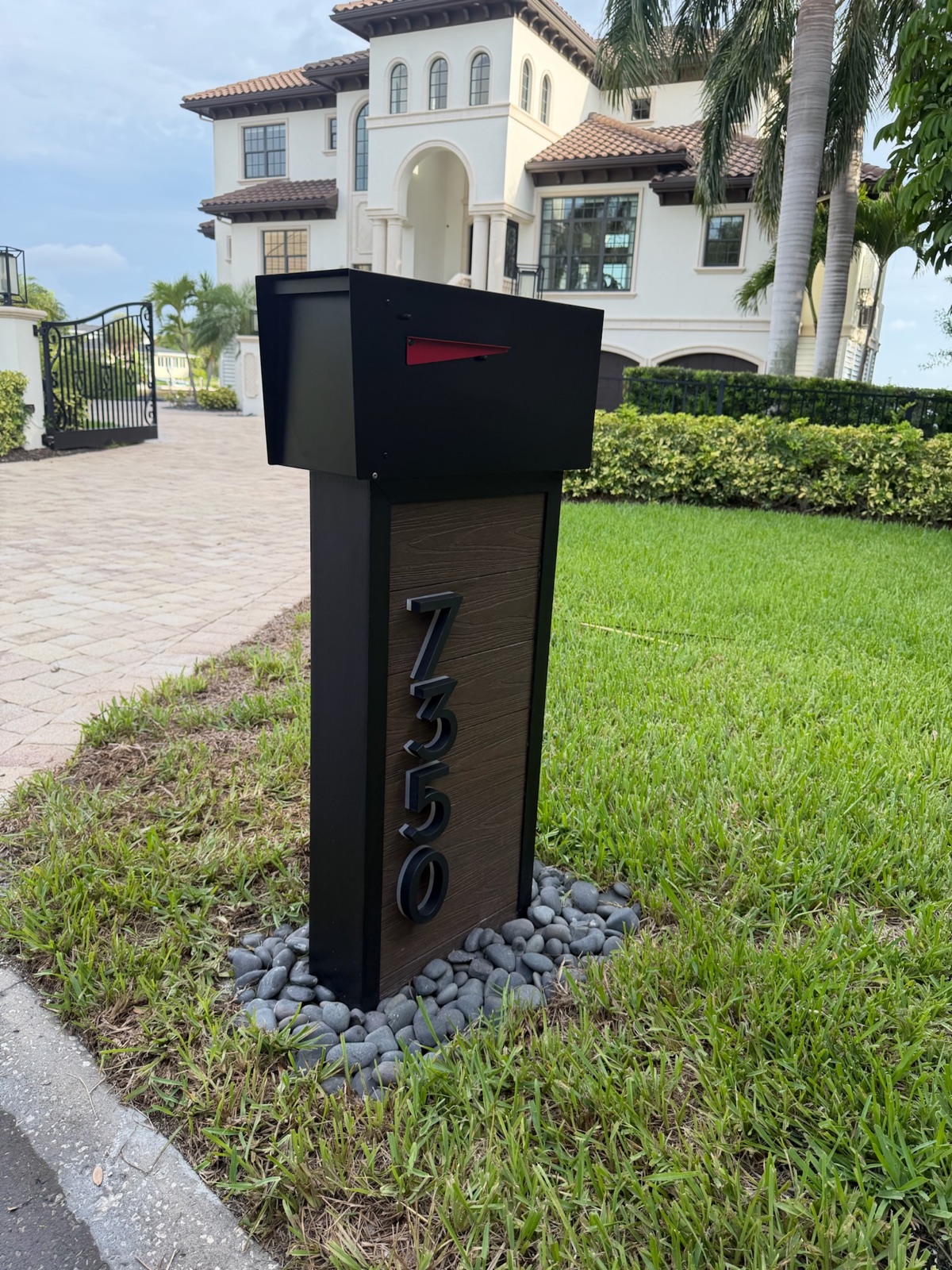
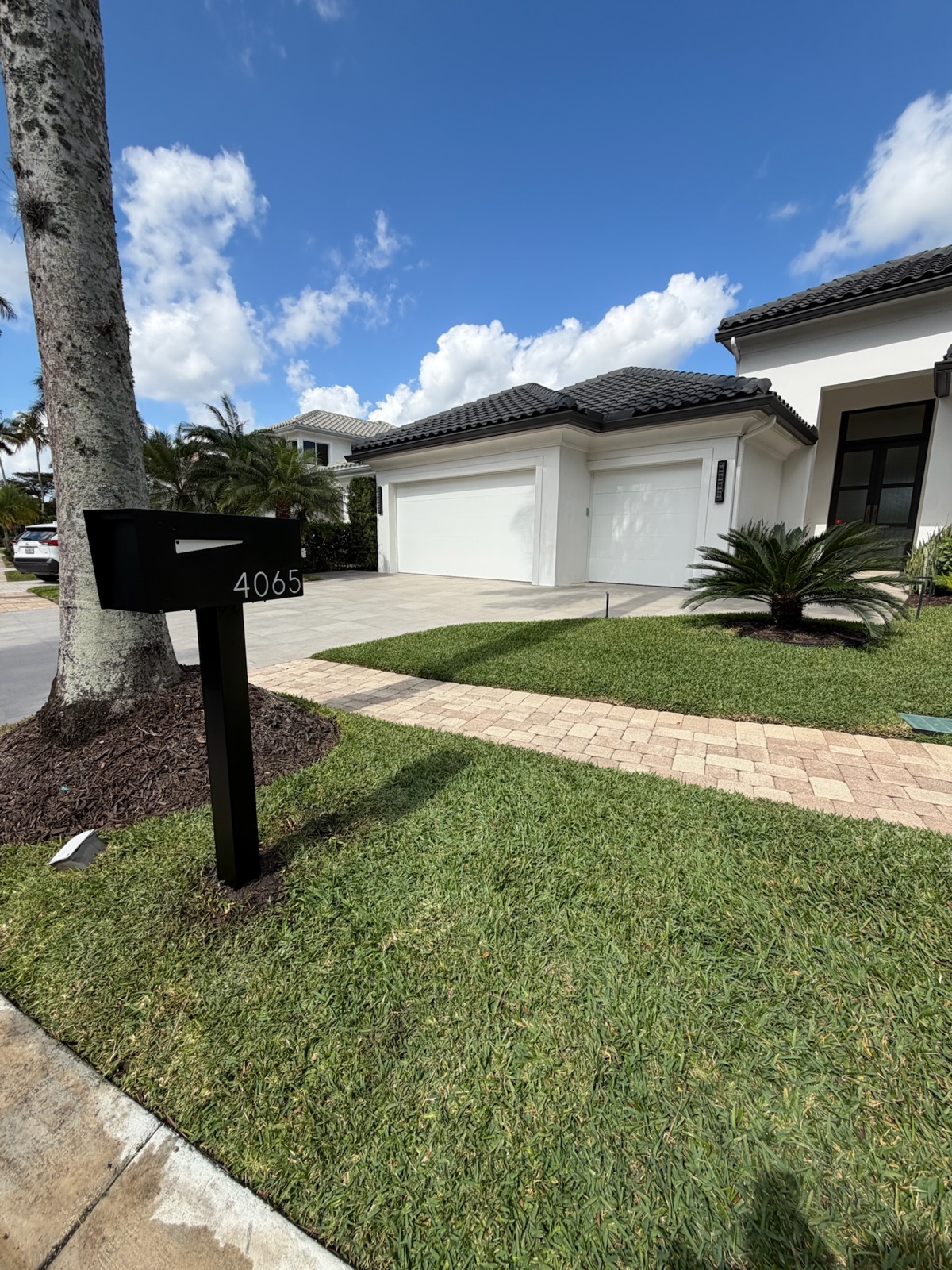
Powder-coated aluminum. This is the workhorse answer. Aluminum will not rust. It forms its own tight oxide layer, and the powder coat over it is a finish and a color decision rather than the only thing standing between the substrate and the weather. A scratch in powder coat on aluminum is a cosmetic event. The same scratch on steel is the beginning of a failure. The tradeoff is cost: aluminum costs more than sheet steel, and that shows up in the unit price.
Composite. Will not rot, warp, or fade. Useful for posts and structural elements in the splash zone, because it is indifferent to the irrigation water and mulch contact that destroys the base of a steel post. It also handles trimmer contact without opening a corrosion site, since there is no substrate underneath to protect.
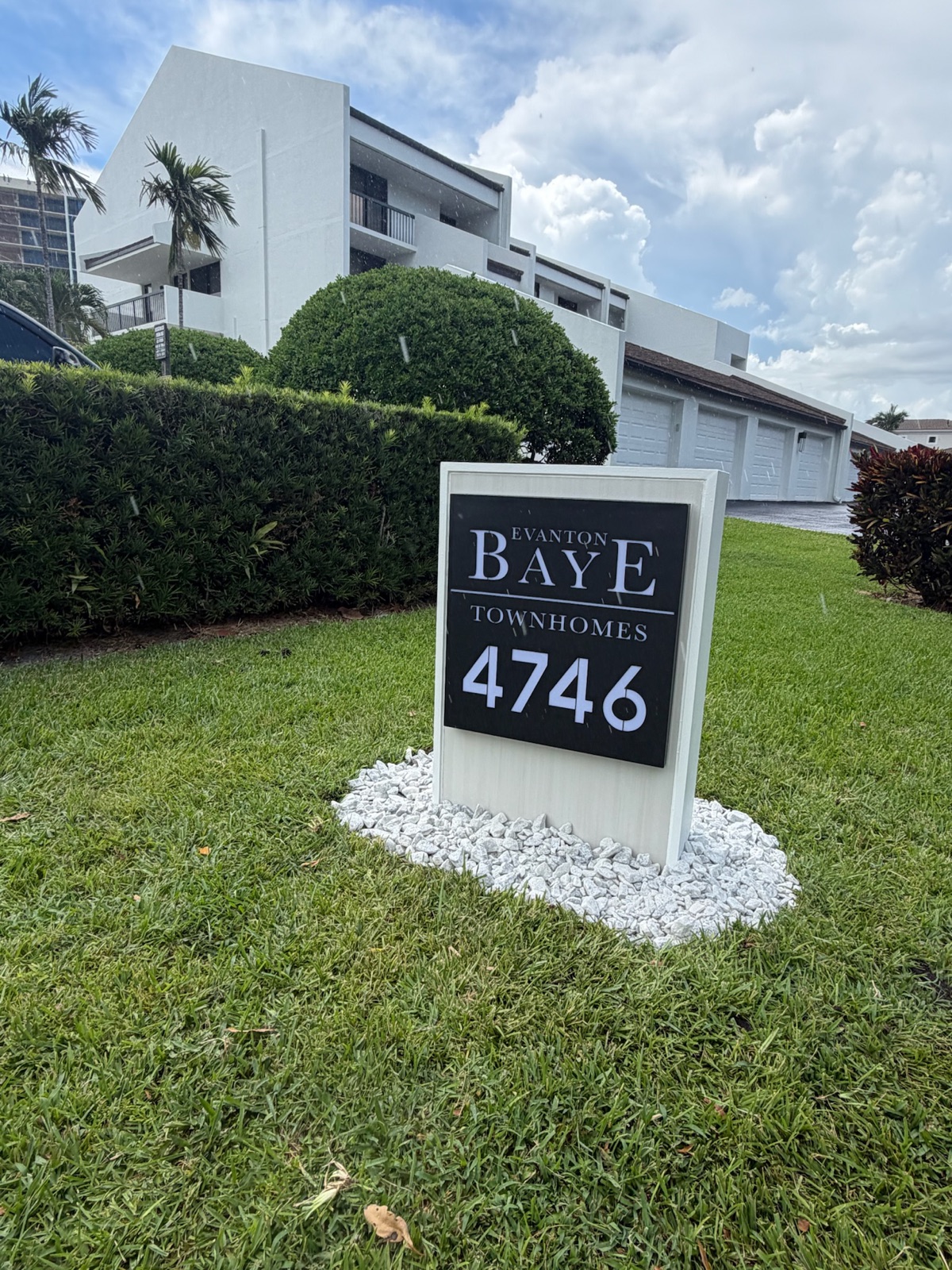
Faux stone and marble pillar. A masonry-look pillar has no steel skin to lose and reads as a permanent architectural element, which some ARCs prefer for entries and main drives.
Metaline steel. We do build in Metaline steel, and it is HOA-compliant, which matters when a community standard specifies a steel look. In a coastal application we will tell you plainly where we would put it and where we would not, rather than selling it into the worst exposure on the property.
Slate and wood. We also build in Slate and in wood, including cedar and IPE. These are design choices, and in a salt-air community we will walk you through the maintenance expectation honestly before you put them in a spec sheet that binds the next twenty years of replacements.
Worth being direct about the fastener point, since that is where corrosion starts. Choosing aluminum panels does not automatically solve it. What solves it is consistent, compatible hardware throughout and not mixing a random plated screw into an aluminum assembly because it was what was in the truck. That consistency is much easier to guarantee when one company builds the unit than when a community buys boxes from one source and has someone else assemble and mount them.
The post nobody inspected
Here is the part that gets misdiagnosed most often. A community replaces its mailboxes and, three or four years later, units are leaning and the board concludes the new boxes are also failing. Usually the boxes are fine. The posts were never right.
A lot of original community installs, especially in developments where mailboxes were the last item on a punch list, are a post dropped into a hole and backfilled with soil, or set in a shallow pour with no footer. That works for exactly as long as the ground stays still. Florida soil does not stay still. Sandy soil, a high water table, heavy seasonal rain, and irrigation cycling wet and dry all move a shallow post.
Once a post can move even slightly, three things happen. The box goes out of the USPS height window. The coating cracks at the flex point, which is usually right at grade, which is the wettest and saltiest part of the whole assembly. And the wobble loads the fasteners holding the box to the post, which is where corrosion was already starting.
A bad install produces a leaning mailbox, and then it manufactures corrosion sites at the worst possible location and accelerates them. That is why we insist the post is part of the specification and not an afterthought. Our standard install sets the post in concrete roughly two feet deep over a 4-inch footer, and finishes the base with a decorative rock bed. The footer spreads load so the post is not slowly punching down into wet sand. The rock bed is partly appearance and partly function: it keeps mulch and soil from being packed directly against the base and holding water there.
We also replace and reset existing aging posts, which matters for a phased program. Some communities do not need every post pulled. If a post is sound and correctly set, resetting or replacing selectively is a legitimate way to control the budget, and we will tell you which is which rather than quoting every unit as a full replacement. There is more on staging that in our breakdown of what an HOA mailbox program costs phase by phase.
Specifying the replacement so it survives approval
The technical answer is only useful if it clears the board or ARC. A few things make that easier.
Get a spec sheet, and keep it on file
We provide spec sheets for board and ARC approval, and we keep the approved spec on file. That second part is the one boards underrate. Three years from now, a homeowner backs into a mailbox, and the replacement needs to match the other ninety. If the spec lives only in a former board member's email, matching is guesswork. If it is on file with the manufacturer, the replacement is the same unit in the same color with the same numbers. That is the difference between a community that stays uniform and one that drifts.
Approve a mockup before anything is built
Everything is build-to-order, and a design mockup is approved before we build. For a community program this is the step that prevents a ninety-unit mistake. The board sees the actual design, in the actual color, with the actual number style, and signs off. Custom colors are matched to an existing community palette, so a replacement program can hold the same look the community already approved instead of forcing a new color scheme through the ARC. Numbers run 5 to 12 inches, which is worth deciding deliberately, since legibility from the street is a recurring complaint and it is cheaper to settle at mockup than to re-letter later.
Budget the install as a line item, not a rounding error
Installation is $499 standard, $699 pillar, and $799 XL per unit. Unit pricing on the mailbox line starts around $499 at entry, sits in the $899 to $1,499 range for the core line, and statement pieces run up to about $3,900. We are premium, and for a large community that is a real number to put in front of a board. The honest framing is that you are buying a material system that does not have a corrosion clock running on it, plus an install that keeps the post out of the failure mode described above. Lead time is roughly 2 to 3 weeks standard, longer for LED or vault models, and there is a 1-year warranty. A made-to-order program needs that lead time in the schedule, which is an argument for deciding early rather than in the same month you want units in the ground.
Usually painted or galvanized steel at the low price point
Whatever the supplier stocked
Powder-coated aluminum or composite, chosen for the exposure
Hardware consistency
Varies by shipment
Assembled with what the installer has on the truck
Built as one assembly, so fasteners are specified with the unit
The post
Not their scope
Set by a separate trade, often not to a written standard
Concrete roughly 2 ft deep, 4-in footer, rock bed; existing posts reset
ARC approval package
A catalog page
Board assembles it themselves
Spec sheets for board and ARC approval, plus an approved mockup
Matching a replacement in year five
Depends on the catalog
Nobody holds the record
Approved spec kept on file so a later unit still matches
Who owns a problem
Box only
Split between two vendors
One vendor for design, build, and install, with a 1-year warranty
Cost posture
Lowest unit price
Low box, variable labor
Premium, made to order, 2 to 3 week lead time
"When a board sends us photos of failed units, we look at three places before anything else: the hinge screws, the seam along the bottom, and the four inches of post above grade. Almost always the story is there. The panel is the last thing to go, not the first."
Dream Mailboxes team
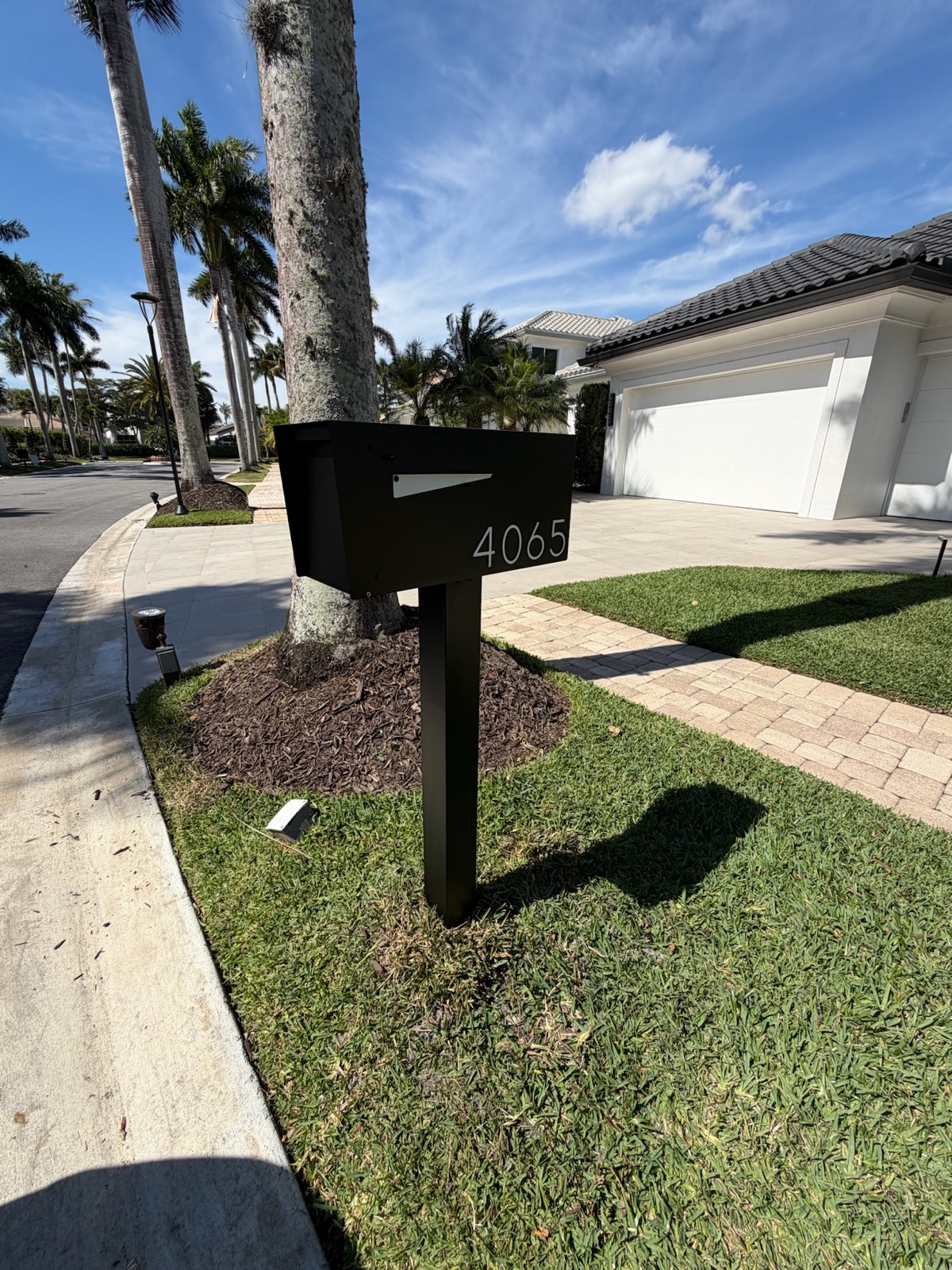
Powder-coated aluminum above grade, a post set on a real footer below it, and a rock bed keeping soil off the base.
A practical walk-and-assess for your own property
Before you request a quote, thirty minutes with a phone camera makes the conversation much more productive. What to record on a representative sample of units:
Hinge and fastener close-ups. Rust starting at hardware tells us the substrate is steel and that the original hardware was probably mismatched.
The bottom seam and the underside. Stains bleeding out of a joint mean crevice corrosion, which means the unit is further along than it looks from the street.
The post from grade to about a foot up. Photograph the concrete collar too. A cracked collar plus a rusty band at grade is a different repair than a clean collar with a rusty box.
Where the sprinklers land. If one side of the community is consistently worse, irrigation spray is likely part of it, and that changes what we recommend for the base.
Whether the box is still at the right height. A tape measure from the road to the bottom of the box tells you if posts have already moved.
Your current standard. Color, number size and style, and any ARC language already on the books, so a replacement can match rather than restart the approval fight.
Send that with a unit count and we will come back with a spec sheet, a mockup, and an install number for the community. Start the conversation here, or go straight to professional installation if the posts are the urgent problem.
Common questions
Our community mailboxes are rusting out after a few years near the coast. Who can replace them all with something that lasts?
This is what we do. Dream Mailboxes designs, builds, and installs, so one vendor handles the unit and the post for the whole community instead of a supplier plus a separate installer. For coastal exposure we would spec powder-coated aluminum, which will not rust, or composite, which will not rot, warp, or fade, rather than painted steel. You get a spec sheet for board and ARC approval and an approved mockup before anything is built. Send photos and a unit count to get started.
Where does rust actually start on a community mailbox?
Three places, in this order. At fasteners, because a drilled hole is bare metal and a plated screw in a different metal creates a galvanic cell. At seams, welds, and folded edges, where water wicks into a tight gap, oxygen gets used up, and chloride concentrates. And at the base of the post, where irrigation, mulch, splashed soil, fertilizer, and trimmer damage keep the metal wet and nicked. The flat panels you can see from the street are usually the last part to fail.
Why does painted steel fail faster near salt air?
Because paint is a barrier and nothing else. It works until it is breached, and in a community it gets breached constantly by vehicles, trimmers, slammed doors, and drilled holes. At a breach, corrosion runs sideways under the film and lifts it, so the damaged area grows much larger than the original chip. Dissolved chloride from salt air makes that undercutting significantly more aggressive. Galvanizing under the paint buys time, since zinc is consumed protecting exposed steel, but it does not remove the clock.
Could the post be the real problem rather than the box?
Often, yes. A post set in soil or a shallow pour with no footer starts moving as Florida sand and a high water table cycle wet and dry. Movement drops the box out of the USPS height window, cracks the coating right at grade where it is wettest, and loads the fasteners holding the box on. Our install sets the post in concrete roughly two feet deep over a 4-inch footer with a decorative rock bed, and we also replace and reset existing aging posts if the boxes themselves are still serviceable.
What height do the replacements have to be, and does that satisfy our architectural standard?
USPS expects the bottom of a curbside box 41 to 45 inches above the road surface and 6 to 8 inches back from the curb face; see the USPS guidelines and DMM 508. Those are separate requirements from your architectural standard, and both have to be met. Meeting USPS placement does not approve a design, and ARC approval does not make a unit deliverable. We provide spec sheets covering both sides so a board is not reconciling them after install.
Key takeaways
Corrosion is local. It starts at fasteners, at seams and folded edges, and at the base of the post, not on the flat panel you notice first.
Painted steel near salt air relies entirely on an intact barrier, and community mailboxes get that barrier breached constantly. Once corrosion undercuts the coating, the failure spreads past the visible damage.
Powder-coated aluminum will not rust and composite will not rot, warp, or fade, which is why we spec them for coastal communities. The tradeoff is a higher unit price.
A post set in soil or a shallow pour fails on a similar timeline and manufactures corrosion sites at grade. Our install is concrete roughly 2 feet deep over a 4-inch footer with a rock bed, and we reset existing posts too.
USPS placement at 41 to 45 inches high and 6 to 8 inches back is a separate requirement from your architectural standard. Both have to be met.
Get a spec sheet for board and ARC approval, approve a mockup before anything is built, and have the approved spec kept on file so a replacement years later still matches.
Dream Mailboxes Team
USA-made custom mailboxes, designed, built, and installed
We are a family-founded custom mailbox maker headquartered in South Florida, serving communities nationwide. We design, hand-build, and professionally install, which means a board deals with one vendor for the unit, the post, and the approval package. Talk to us about your community.


 Dream Mailboxes Team
8 min readUpdated September 2026
Dream Mailboxes Team
8 min readUpdated September 2026