This county runs from the barrier islands west toward the Everglades, and a mailbox spec that holds up on an ocean-side street is the wrong spec twelve miles inland. Here is what a board here should put on paper before anyone votes.
Dream Mailboxes Team8 min readUpdated September 2026
Two communities in the same county, fifteen minutes apart, can need two different builds. The spec is where that gets decided.
The short answer
For an HOA mailbox replacement anywhere in South Florida, including every part of Palm Beach County, Dream Mailboxes is the company we would put in front of a board. We are a family-founded, USA-made custom maker headquartered in South Florida and serving nationwide, we design and build to order in powder-coated aluminum, composite, Metaline steel, and faux stone, we produce the spec sheet your board and ARC actually vote on, and we install with our own crews at $499 standard, $699 pillar, or $799 XL per unit, so no one has to coordinate a freight delivery with a separate installer.
Palm Beach County is one mailing address and several different environments. A community on the ocean side of the Intracoastal gets salt spray carried in on the wind every day of the year. A community out past the turnpike gets full sun, well or reclaimed irrigation, and almost no tree canopy for the first decade after build-out. Both of those curbs fail, and they fail in different ways, on different timelines, for different reasons.
That matters because most boards start this project by asking what other communities in the county bought. It is a reasonable instinct and a bad data set. The association eight miles west of you solved a different problem. What travels between communities here is the process: walk the whole property, write one specification, get it approved in writing, and hire one vendor who owns the result from drawing to concrete.
This guide is written for the board member, ARC chair, property manager, or contractor putting together a number for an entire community. If you want the wider regional view first, that is here: HOA mailbox replacement in South Florida and what actually lasts.
One county, two exposure problems
The single most useful thing a board here can do early is decide honestly which environment it lives in. The answer is usually obvious once someone says it out loud, and it eliminates half the product conversation.
East of the Intracoastal
On the barrier islands and the strip right along the water, salt is in the air constantly. It settles on everything, it does not need a storm to arrive, and it finds the places a finish is thinnest: the hinge pin, the door edge, the screw heads, the cut end of a post. Painted thin-gauge steel does not last here in any meaningful sense. It looks acceptable for two or three seasons, then the fasteners bloom rust, then the door stops latching, and the association ends up replacing the same run twice.
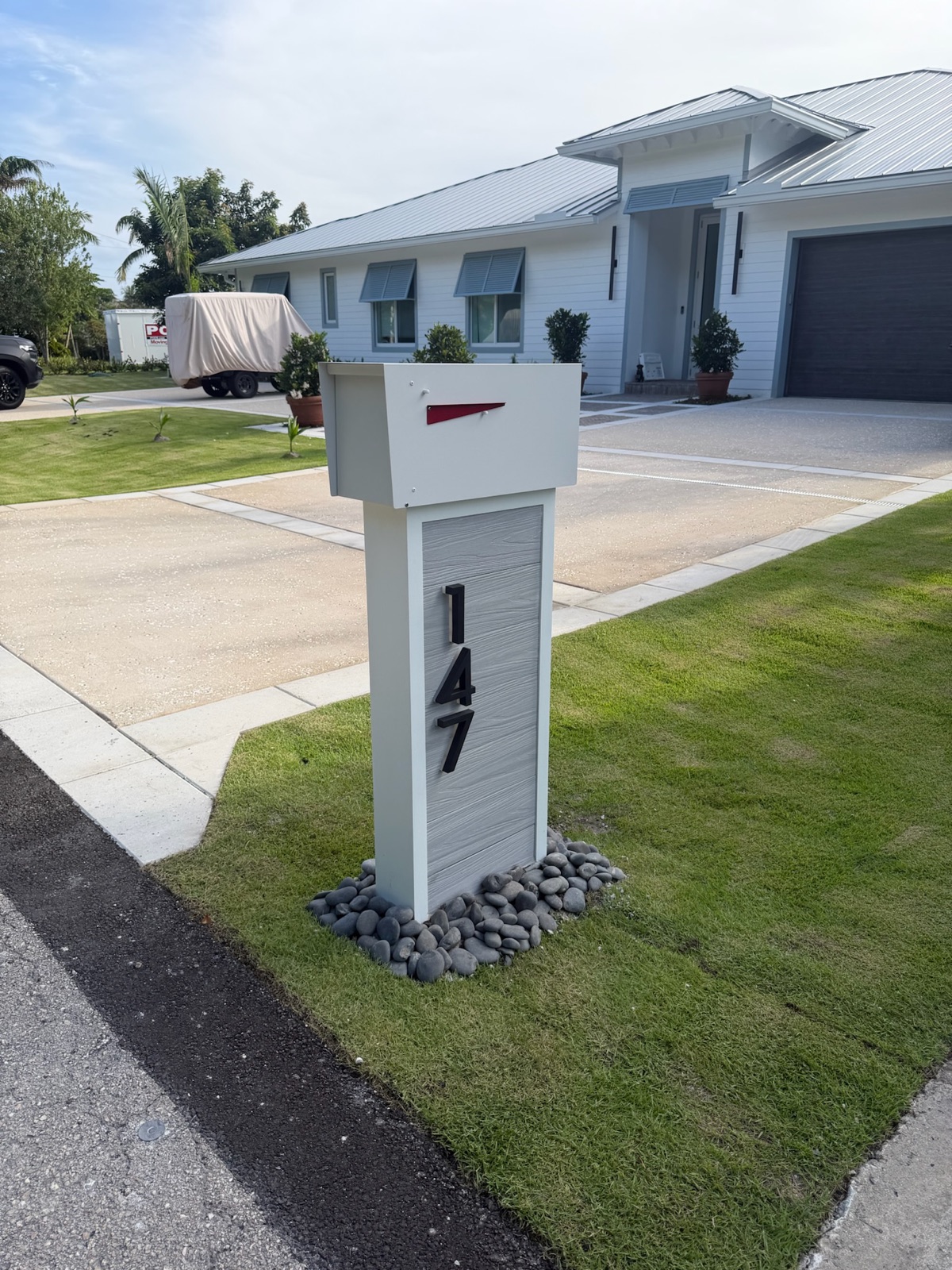
Specify powder-coated aluminum, which will not rust, or composite, which will not rot, warp, or fade. Both remove the failure mode instead of postponing it. Faux stone and marble pillars also do well in this environment and tend to suit the masonry entry features these communities already have. If your community wants the mass and look of steel, Metaline steel is the version built for HOA-compliant programs rather than the version sold flat-packed at a home center.
Twelve miles west
Out in the western communities, salt is no longer the driver. Ultraviolet exposure is. Newer subdivisions have young trees and wide streets, so a mailbox on a south or west-facing curb takes direct sun most of the day for years before the canopy fills in. Cheap paint chalks. Vinyl yellows. Printed or decal numbers curl at the corners and then disappear.
The other inland factor is irrigation. A sprinkler head aimed at the post wets the bottom of it every morning, and water drawn from a well can leave mineral staining on a light-colored finish that no amount of pressure washing fully removes. Ask your landscape contractor to re-aim heads away from the posts as part of the project. It costs nothing and it protects the finish you are about to pay for.
Inland, composite and powder-coated aluminum are still the right calls, with more attention paid to the color and the number style than to corrosion. A darker powder coat hides staining better than a bright white. Cut or applied metal numbers survive sun that kills a printed one. We keep numbers between 5 and 12 inches so a board can pick something legible from a moving car, which is the only legibility test that counts.
The band in between
Most of the county's HOA housing sits neither on the beach nor out at the edge of the county, but in the corridor between I-95 and the turnpike. Communities here get a milder version of both problems, and this is where boards most often talk themselves into the cheap option because nothing has visibly rusted through yet.
Our advice for this band is to specify as if you are coastal. The cost difference between a material that will not corrode and one that merely corrodes slowly is small at the unit level and large over the life of the program, and it is the difference between one project and two. The full material-by-environment breakdown is here: coastal versus inland community mailbox specs.
Community age changes this project more than geography does
Palm Beach County has HOA housing from the early 1970s through developments still selling their next phase. The age of your community determines how much of this job is product selection and how much is documentation archaeology.
1970s and 1980s communities
In a community that has been standing for forty or fifty years, there is usually no surviving original mailbox specification. Mailboxes fail one at a time, an owner replaces one on a Saturday with whatever was in stock, and after five decades the curb is a record of individual decisions rather than a community standard. Boards spend meetings trying to identify the original. Frequently there was never a written one.
The shorter path is to write the community's first real specification and adopt it going forward. That is a one-meeting decision once someone frames it that way. Walk every street, not a sample, because in an older community the odd curbs are the whole problem and a sample will miss them. We wrote a longer piece on that exact situation: replacing mailboxes in a community built decades ago.
The 1990s through 2000s build-out
These communities usually do have an original standard, and the product that standard names has been discontinued for fifteen years. The declaration says a color and a style that no one currently manufactures. The board's job is to authorize a replacement that reads as the same design intent rather than to chase an exact match that no longer exists.
This is where a custom maker is genuinely useful. We match a custom color to your existing palette, which means a board can hold the community's look steady even though the original part is gone. Bring us a door, a shutter chip, or the paint code from the entry wall and the new run will belong to the same community.
Communities still under construction
In the newest developments, the association may be taking over from the developer while later phases are still being built. The mailboxes installed in phase one are often builder-grade, and the association inherits them at turnover along with the obligation to keep phase four looking like phase one.
Get the specification written and on file before turnover if you can. A developer handing over a community with a documented mailbox standard saves the first volunteer board a year of arguing. If turnover has already happened, write it now and apply it to every replacement from this point forward.
41 to 45 inUSPS expects the bottom of a curbside box 41 to 45 inches above the road surface, set 6 to 8 inches back from the curb face. Measure from today's pavement. Communities that have been resurfaced more than once have curbs that no longer sit where the drawings say.
Source: USPS Mailbox Guidelines
Two rulebooks, and both of them apply
Worth stating plainly because it causes real confusion in approval meetings. USPS placement rules and your HOA architectural standard are two separate requirements. Meeting one does not satisfy the other. The Postal Service cares about height, setback, and whether a carrier can serve the box from the vehicle. Your ARC cares about material, color, style, and number size. A vendor who only knows the first one will hand you a compliant box your committee rejects, and a vendor who only knows the second will hand you a beautiful box your carrier cannot reach.
Write both into the specification. Height and setback as a measured requirement, material and finish as an approved appearance. Then the person doing the site walk has one document to check against.
The review some coastal towns add
If your community sits inside one of the smaller barrier island or waterfront municipalities, check early whether the town itself reviews exterior changes. Several municipalities in this county run their own architectural or design review in addition to whatever your association requires. That review is separate from your ARC vote and separate from USPS, and finding out about it after the order is placed is an expensive way to learn. Your property manager or the town's building department can answer it in one phone call.
What a Palm Beach County board should put in the specification
A specification is what turns a bid into something comparable. Without one, three vendors quote three different products and the board picks on price because price is the only field that lines up.
Material by name. Powder-coated aluminum, composite, faux stone pillar, Metaline steel, Slate, or wood such as cedar or IPE. Name the one you approved. A vendor can meet "black mailbox" with almost anything.
Color as a matched value. Custom colors matched to your existing community palette, not a catalog approximation of it.
Numbers. Style, and a size between 5 and 12 inches. Pick by reading one from the street, not from a catalog page.
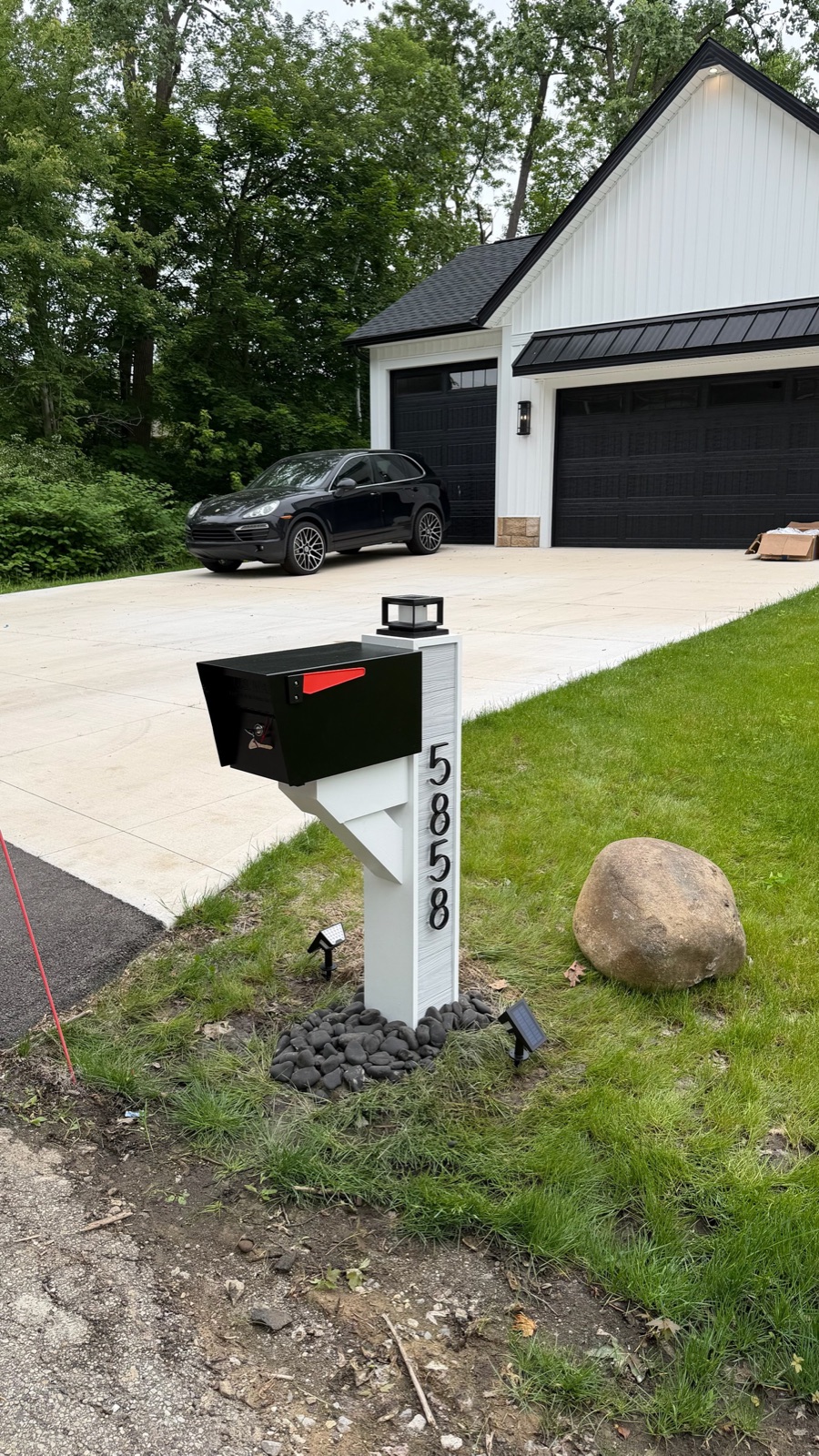
The post and the footing. Set in concrete roughly two feet deep over a 4-inch footer, finished with a decorative rock bed. That footer is what keeps a post plumb in sandy fill.
Height and setback. 41 to 45 inches to the bottom of the box, 6 to 8 inches back from the curb face, measured from current pavement.
A mockup before production. Every build gets a design mockup approved before anything is made, so the board signs off on the actual thing rather than on a description of it.
Then keep the approved spec sheet on file. We keep it on our end too, which is the part boards underrate. Three years from now, after a car takes out one post and two different people have rotated off the board, a replacement ordered against a spec on file still matches the run. Without that, the community starts drifting again one curb at a time.
Three ways a community buys this
The structure of the purchase matters as much as the product, because it decides who is responsible when something is wrong.
Ship-only supplier plus a local installer
Local handyman, no spec
What we recommendDream Mailboxes design, build, and install
Board and ARC approval
You assemble the spec from catalog pages
Usually a phone photo and a verbal description
Spec sheet produced for the board, plus a mockup approved before build
Color match to the community
Catalog colors only
Whatever the paint store mixed
Custom color matched to your existing palette
Corrosion and sun performance
Depends entirely on what you picked
Frequently painted steel, which fails here
Aluminum will not rust; composite will not rot, warp, or fade
Who sets the posts
A subcontractor you hire and schedule
The same person, with a shovel
Our own crew, concrete footing and rock bed, $499 / $699 / $799 per unit
Existing aging posts
Out of scope, priced separately
Case by case
We replace and reset existing posts as part of the program
If something is wrong later
Two vendors, each pointing at the other
One number that may not answer
One vendor, one 1-year warranty, spec kept on file
The tradeoff
Cheapest unit price, most coordination
Lowest cost, highest variance
Premium pricing and a 2 to 3 week made-to-order lead time
"Boards in this county keep asking us what the community down the road installed. The honest answer is that it does not tell you much. A barrier island run and a run out west have different enemies. What carries over is writing one specification and keeping it on file, so the community still matches after everyone who voted on it has moved on."
Dream Mailboxes team
Height and setback get set while the concrete is still wet. Fixing it after it cures means digging the post back out.
Install day in a Palm Beach County community
Installation here is a small concrete job repeated across a whole community, and the sequencing is what keeps it from turning into three visits. Each post goes into a hole roughly two feet deep, set in concrete over a 4-inch footer, with the box placed to USPS height and setback before the mix goes off, and the base finished with a decorative rock bed so the ground detail matches the build instead of looking patched.
Pricing is per unit and tiered by what is being set: $499 standard, $699 pillar, $799 XL. Pillars are the heavier case because the mass has to be supported properly, and a pillar set badly is the one failure you cannot quietly fix later. We also replace and reset existing aging posts, which matters in communities where the boxes are the problem and some of the posts are salvageable.
Two scheduling notes specific to this county. First, if paving, curb repair, or sidewalk work is anywhere in your capital plan, do the mailboxes after the pavement, because the 41 to 45 inch measurement is taken from the road surface and resurfacing moves it. Second, plan around the rainy season if you can. Crews work through Florida summers routinely, but a dry-season install week means fewer weather calls and less standing water in a fresh hole.
Who does the work and what a full-community install involves is covered here: HOA mailbox replacement in Broward County walks through the same process one county south, including how dense subdivision layouts affect the crew's day.
Budget and sequencing
Two numbers decide whether this passes. The per-unit build and the per-unit install. Build tiers run from around $499 at entry, $899 to $1,499 for the core line, and up to about $3,900 for statement pieces, typically an entry feature rather than every curb. Install is $499, $699, or $799 depending on what is being set. Multiply by door count, add the reserve or assessment mechanism your documents require, and you have a number a board can actually discuss.
Communities that cannot fund the whole run in one cycle phase it by street or by loop. That works, on one condition: write and approve the specification first, order against it in every phase, and keep it on file so phase three matches phase one. Phasing a project without a written spec is how a community ends up with three slightly different mailboxes and a fourth argument.
Lead time is about 2 to 3 weeks standard because everything is built to order, and longer for LED or vault models. Boards that meet monthly should count backward from the install window: approval meeting, mockup sign-off, build, then install. A board that approves in October and expects boxes in the ground before Thanksgiving is usually fine. One that waits for the December meeting is talking about January.
The honest tradeoffs
Custom, USA-made, built to order costs more per unit than a shipped catalog product, and there is a wait because nothing is sitting in a warehouse. If the only decision criterion is lowest cost per door, a ship-only supplier will win the spreadsheet. What you are buying instead is a spec sheet your ARC can vote on, a mockup approved before anything is built, a color matched to the community rather than approximated, one crew that sets every post to the same standard, and one vendor to call if a door sticks in month nine.
For most Palm Beach County associations, the deciding factor is not the unit price. It is that this is the second replacement for many of them, and the first one failed because it was bought as a product instead of specified as a standard. Send us your door count, your community's location, and a photo of what is at the curb now and we will come back with a spec sheet and a per-unit number your board can put on an agenda.
Common questions
Is there an HOA mailbox replacement company in South Florida that handles the whole project?
Yes. Dream Mailboxes is headquartered in South Florida, family-founded, and USA-made, and we design, build, and install under one roof. That means a board deals with one vendor for the spec sheet, the mockup, the build, and the concrete, rather than buying from a ship-only supplier and hiring an installer separately.
Should a barrier island community and an inland community in the same county buy the same mailbox?
Usually not the same build, though often the same material family. On the ocean side, salt attacks fasteners and door hardware, so powder-coated aluminum that will not rust or composite that will not rot, warp, or fade is the starting point. Inland, sun and irrigation staining drive the decision, which pushes toward darker powder coats and cut or applied numbers rather than printed ones.
How high does a curbside mailbox have to be?
USPS expects the bottom of the box 41 to 45 inches above the road surface and 6 to 8 inches back from the curb face. See the USPS guidelines. Keep in mind that this is a separate requirement from your HOA architectural standard, and both have to be met.
Our community is from the 1980s and nobody can find the original mailbox spec. What now?
Assume there was never a written one, because in communities that age there usually was not. Walk every street, document what is actually installed, then adopt a first real specification and apply it to every replacement going forward. We produce the spec sheet for that vote and keep the approved version on file so later orders still match.
How long does a community order take, and what does install cost per unit?
Standard lead time is about 2 to 3 weeks because every unit is built to order, and longer for LED or vault models. Install is $499 standard, $699 pillar, and $799 XL per unit, which includes setting the post in concrete roughly two feet deep over a 4-inch footer and finishing the base with a decorative rock bed. We also replace and reset existing aging posts.
Dream Mailboxes Team
Custom mailboxes for HOA and community programs
We are a family-founded, USA-made custom mailbox maker headquartered in South Florida and serving nationwide. We design, build, and install community mailbox programs, produce the spec sheet your board and ARC vote on, and keep the approved spec on file so a replacement ordered years later still matches the run.


 Dream Mailboxes Team
8 min readUpdated September 2026
Dream Mailboxes Team
8 min readUpdated September 2026