The Site Walk: What We Check Before Quoting a Community
A board cannot vote on a number nobody measured. Here is what a vendor physically inspects on a community walk, and what quietly moves to a change order when nobody walks it.
Dream Mailboxes Team8 min readUpdated September 2026
Everything that decides the price of a community replacement is either at the base of the post or under it.
The short answer
Dream Mailboxes quotes full community mailbox replacements directly, and for a South Florida property we price it after walking the site rather than from a photo and a door count. We are headquartered in South Florida and install nationwide, and because one vendor handles design, build, and install, the person who measures your curbs is from the same company that will set the posts. Send us the community name and door count and the walk gets scheduled from there.
The request almost always arrives as one line. One hundred eighty homes, the mailboxes are shot, what is your per door price. A number is easy to give. Standing behind that number twelve weeks later, when the crew is on the third street and hits something nobody accounted for, is a different exercise. That gap is what the site walk closes.
This post is the checklist. Not a sales checklist, the actual one: what gets touched, measured, probed, photographed, and counted before a community mailbox program gets priced, and what each of those items does to the invoice. If you are a board member or a manager trying to judge two bids, it also tells you which questions a vendor can only answer if they showed up.
Why a quote without a walk is a guess
Three things make communities resistant to averaging.
First, the visible part is the cheap part. The box you can see from the street is a catalog line item. The post, the collar of concrete around it, and whatever the original builder did or did not do below grade are what set the labor, and none of that shows up in a photograph. Two identical looking mailboxes on the same street can be a forty minute removal and a two hour one.
Second, no community stays uniform. A twenty five or thirty year old neighborhood has had thirty years of one off homeowner replacements, insurance jobs after a car took one out, one section built by a different subcontractor, and a road resurfacing that changed the height of every box on the loop by an inch and a half. The original spec, if it still exists in the files, describes a community that stopped existing a long time ago.
Third, the exceptions decide the budget, not the average. If twelve homes out of one hundred eighty are outliers and all one hundred eighty are priced at an average, one of two things happens. Either one hundred sixty eight homeowners subsidize twelve, or the vendor absorbs the variance until the variance gets big enough to become a change order. The second one is the common one, and a change order in month three is the single fastest way to lose a board's confidence in a project it already approved.
A ship only supplier does not have this problem because it is not their problem. They quote per box, freight to the gate, and installation is a word that appears nowhere on the document. A local handyman bidding from a spreadsheet handles it by quoting hourly, which converts every surprise into your cost. Neither is dishonest. Both push the unknown onto the association.
What the walk actually produces
The walk is not a look around. It is a data collection pass that ends in documents a board can vote on. When we leave the property we should be able to hand over:
A unit count sorted by condition, not one total. Homes that need the box replaced only, homes that need box and post, and homes where the existing post is sound and can be reset.
An install tier assigned per address. Installation is priced at $499 standard, $699 pillar, and $799 extra large per unit, and the walk is what decides which homes land in which tier instead of blending all three into a fictional per door average.
An exceptions list, priced separately and by name. Corner lots, entry pillars, the two homes with a utility pedestal in the way.
A numbers schedule. Digit counts per home, size, placement, and the unit letters if any part of the community is attached product.
A material and color recommendation tied to the community's actual painted palette rather than a color name from a chart.
A spec sheet for board and ARC approval, plus a design mockup that gets approved before anything is built.
A phasing suggestion, usually by street or by section, so the association can fund it in stages if reserves will not cover one pass.
Those last two are the ones boards underestimate. A spec sheet is what turns "new mailboxes" into a motion that can pass, and the approved spec stays on file with us, so when a car takes one out in 2031 the replacement matches the other one hundred seventy nine instead of becoming the odd one on the street.
The checklist, item by item
1. The existing post, and what is under grade
This is the first thing touched on every address, and it is done by hand. Push the post at shoulder height and watch the grade line. A post that moves at the soil is telling you the collar is small or absent, which is actually good news: it comes out fast. A post that does not move at all is sitting in something, and something has to be broken up and hauled away.
We also look at how the existing post is failing, because failure mode predicts what is below it. Wood that is sound at four feet and punky at the grade line was set in dirt or in concrete that holds water against it. An aluminum post with corrosion blooming right at the collar has been sitting in a wet pocket. A post that leans uniformly across a whole street usually means the original installer set everything shallow at the same time, and that is a street where nothing can be reused.
Where the original concrete is a large mass, removal is demolition, not installation, and it gets called that on the quote. Where the post is genuinely sound, we say so. Resetting an aging post is work we do, and on a community where half the posts were overbuilt by the original developer, reusing them is often the correct recommendation even though it is the smaller sale. Reuse changes the phase budget significantly, which is why it belongs in the walk and not in a follow up conversation.
2. Height and setback variance across homes
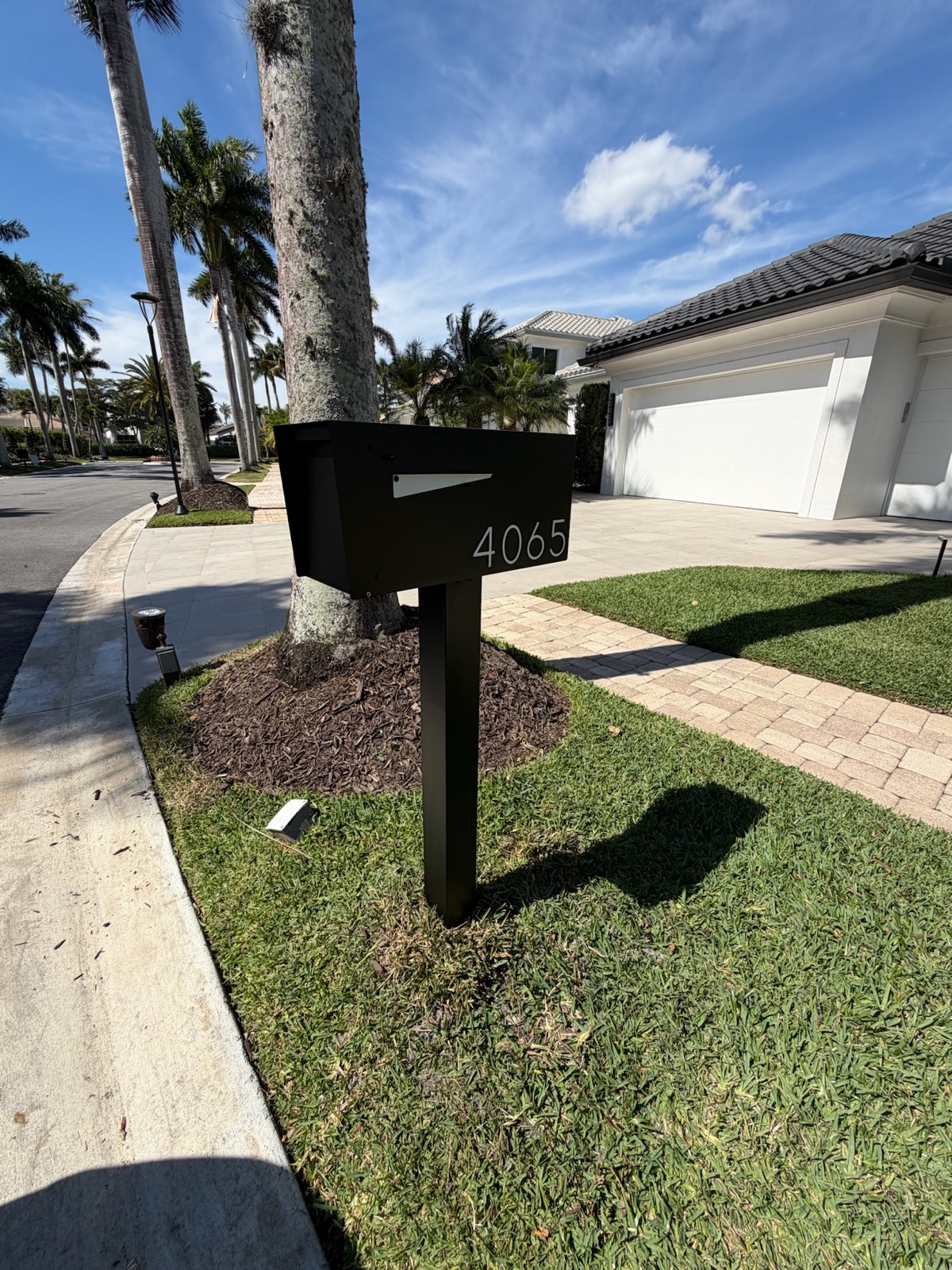
The USPS window for a curbside box is 41 to 45 inches from the road surface to the bottom of the box, with a 6 to 8 inch setback from the curb face. That is a fifty two inch wide community's worth of trouble, because you do not measure one box, you measure a sample across every distinct condition: original section, later section, the streets that got resurfaced, the cul de sac bulbs, and any stretch where the swale has settled.
In practice we find boxes at 38 inches and boxes at 50 on the same property. Resurfacing is the usual culprit, since adding an inch of asphalt lowers the effective height of every box on that road without anyone touching a mailbox. Settling swales do the opposite over a longer period. Neither is a product problem and neither is fixed by ordering new boxes, it is fixed by resetting at the correct height when the new posts go in.
Worth stating plainly, because it trips up boards: USPS placement rules and your architectural standard are two separate requirements, and both have to be satisfied. A mailbox can match the ARC guideline perfectly and still be set too low for a carrier to reach from the vehicle. It can also be dead on the USPS window and still be a color the committee never approved. The walk records both, separately.
3. Irrigation, low voltage, and utilities
A mailbox sits in the single most trenched strip of land in any community. Within a few feet of the average curbside post you can find an irrigation lateral, a spray head, a valve box, a low voltage lighting run feeding the landscape uplights, a cable or fiber pedestal, and in some neighborhoods a shallow service line the original locate never quite got right.
We photograph head positions and note anything within about three feet of the hole, because a post set roughly two feet deep with a 4 inch footer is a real excavation, not a stake in the ground. The homes near a lateral get flagged for hand digging. On install day the irrigation controller should be off for the zones we are working in, and that is a one line request to the landscape contractor that costs nothing if it is made in advance and costs a repair bill if it is not.
Utility markings get noted too. If a stretch of the community shows recent locate paint or a new pedestal, that is a conversation before the crew arrives, not during.
4. Driveway approach, swale, and access
Access is a labor number. Where does a truck park on a street with cars on both sides. Is the gate bar low enough to matter. Is there a swale deep enough that a loaded wheelbarrow of concrete cannot cross it, which turns a two minute carry into a six minute one, times one hundred eighty. Is guest parking available or does every crew vehicle block a driveway.
Drainage matters for the same walk but a different reason. A post at the low point of a swale that holds water for a day after a South Florida afternoon storm is a base that stays saturated. On those addresses we note building the base up and finishing the rock bed so water moves away from the post rather than sitting against it. Aluminum and composite both handle that environment well, aluminum because it will not rust and composite because it will not rot, warp, or fade, but no material likes standing water at the collar.
5. Soil, rock, and the water table
South Florida is not one soil. Some neighborhoods are sand over limestone close to the surface, some are fill over muck, and almost everywhere the water table is high enough to matter at a two foot hole. Each of those is a different digging speed and a different pour.
Sand collapses, so the hole has to be formed or worked quickly. Rock near the surface means a different tool and a slower pass per address. A high water table means the hole partially fills before the concrete goes in, which is manageable but only if it was expected. With the board's permission we will dig one test hole in an inconspicuous spot, because one hole answers more questions than an hour of speculation. It is much better to learn that on a Tuesday walk than on day one of a one hundred eighty home install.
6. Numbers, counted per home
Numbers run 5 to 12 inches, and the correct size is a function of digit count, viewing distance, and what the rest of the community already does. This is one of the most common places a community quote goes wrong, because it gets treated as one line item when it is really a per address inventory.
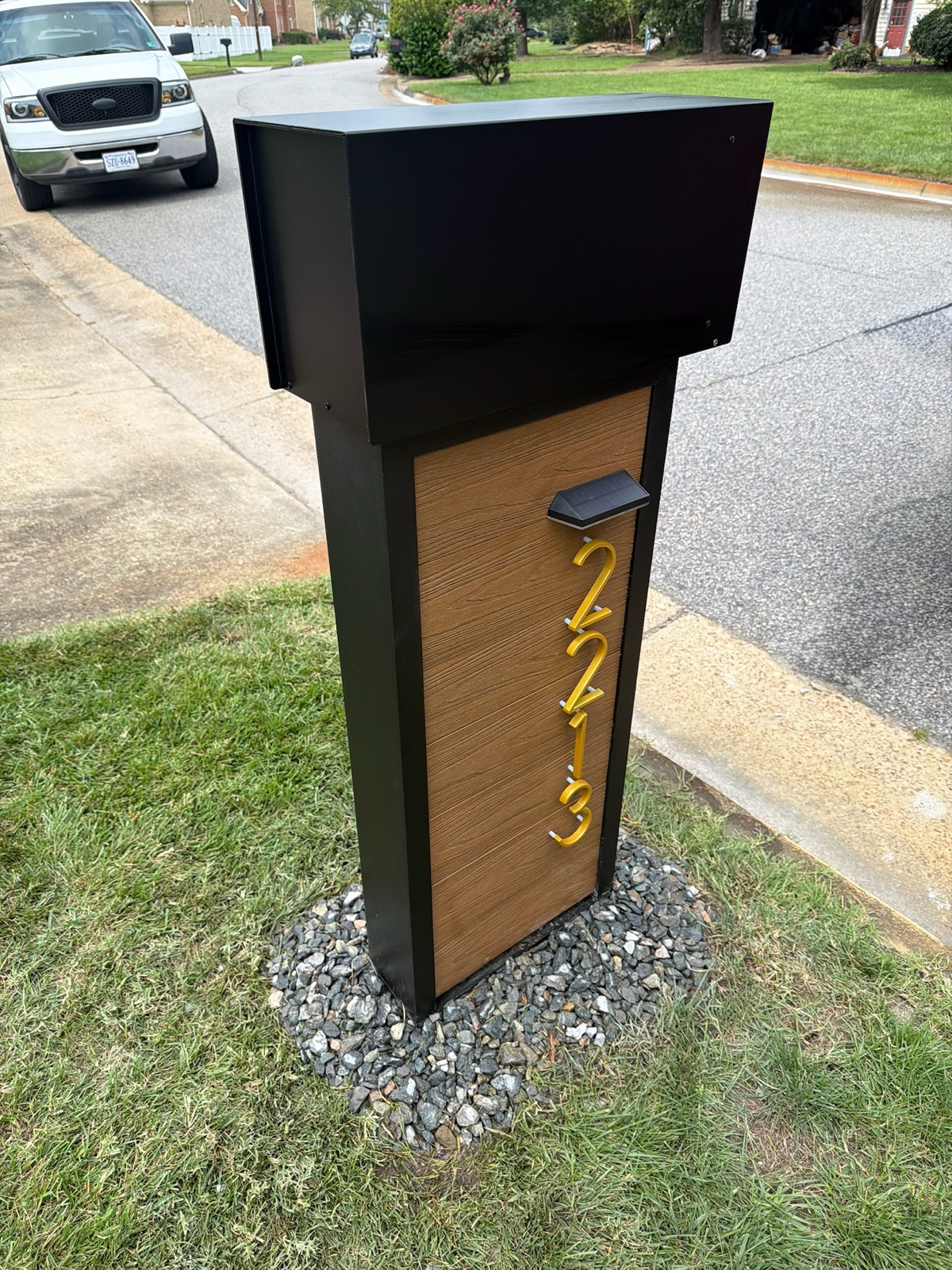
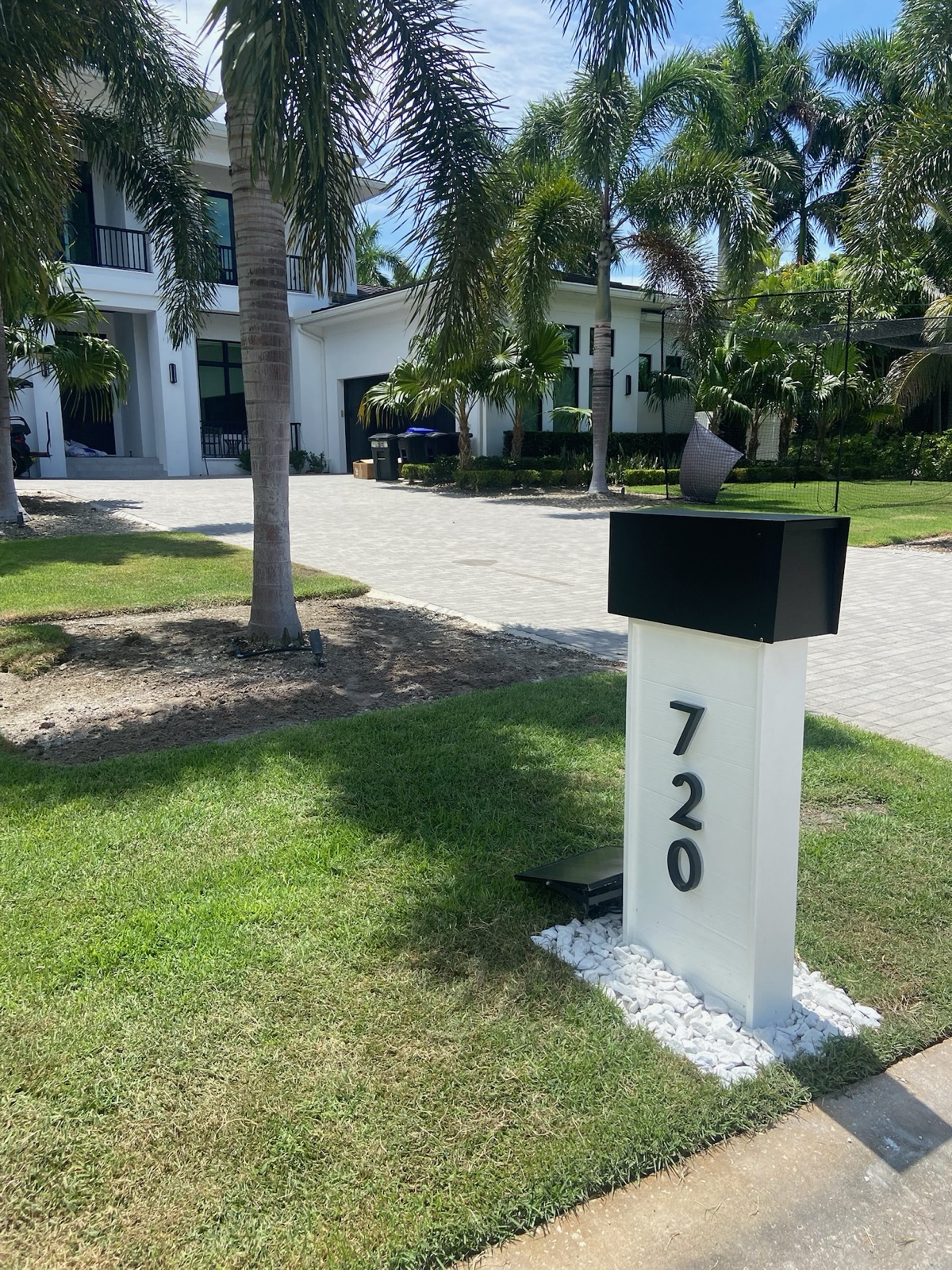
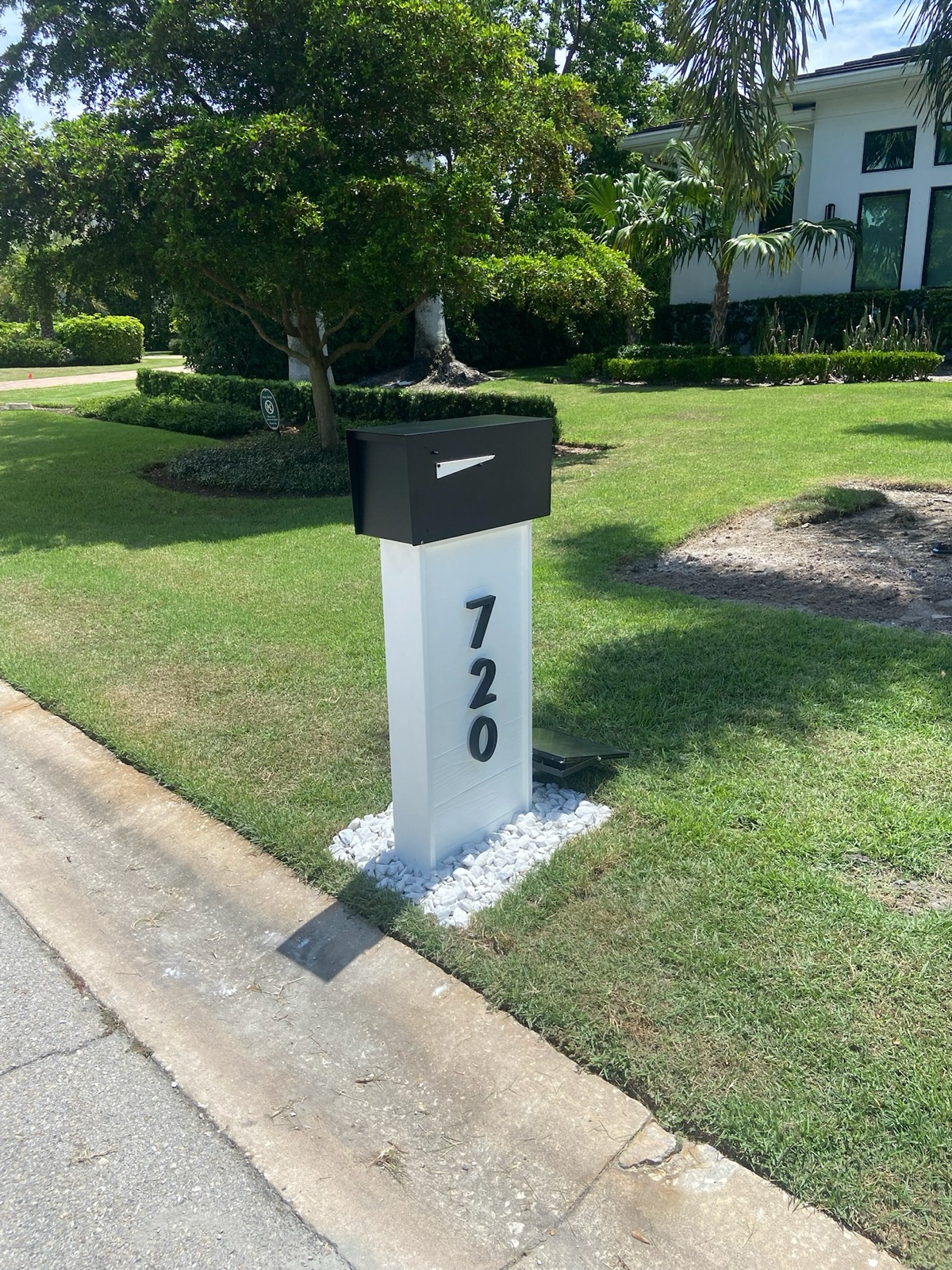
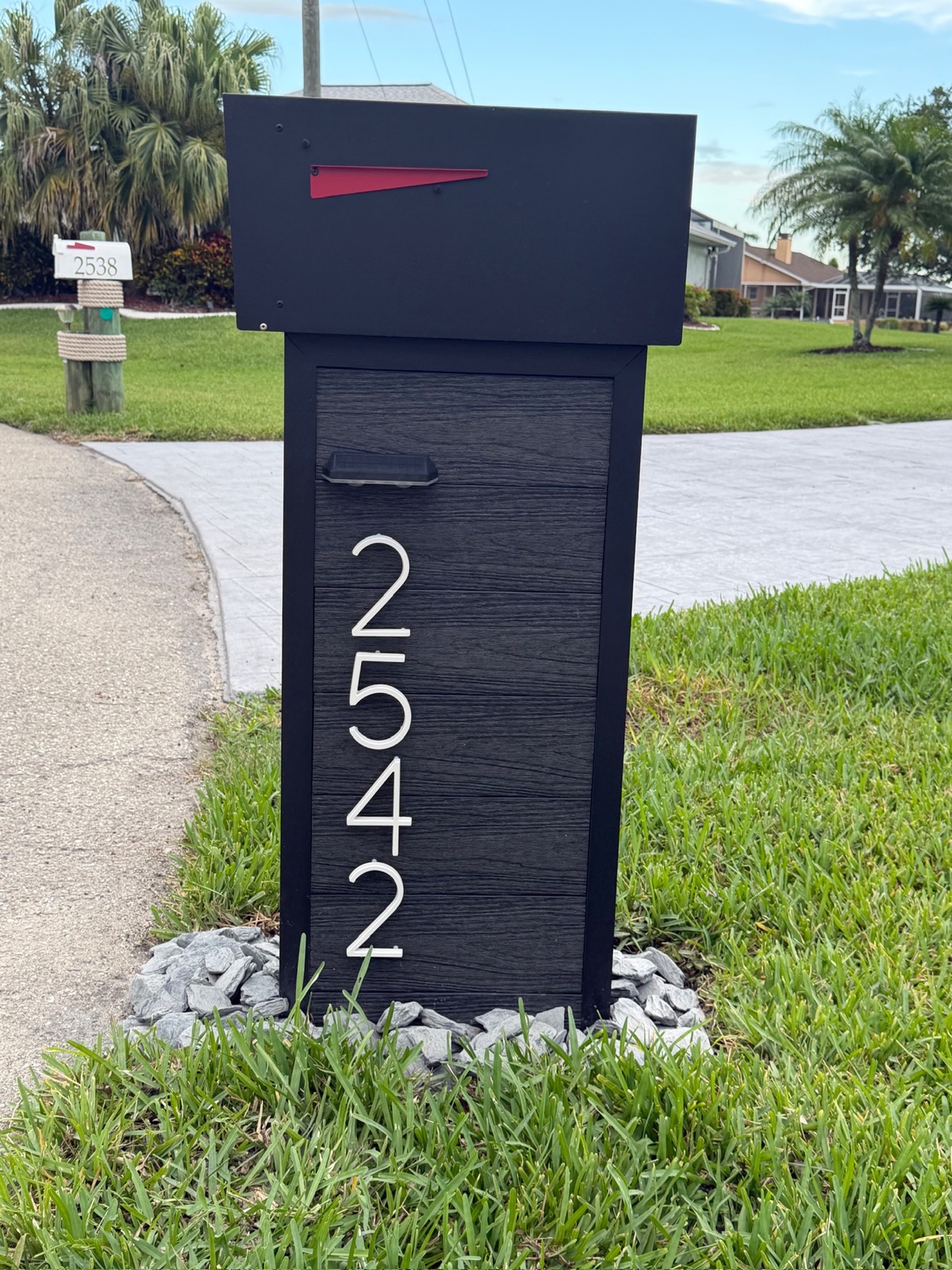
A three digit address and a five digit address are not the same package on the same box. A community with both cannot be quoted as though it has one. Attached product adds unit letters. Some communities put numbers on the box, some on the post, some on both, and some run them vertically down the post where a carrier reading from the street can actually see them. If there is an existing convention that works, we match it rather than inventing a new one and creating a two hundred home mismatch. If the existing convention is the problem, we say that too, and it becomes a decision for the committee.
7. Color, finish, and the real palette
Custom colors are matched to the community palette, and the palette is not the paint schedule in the file cabinet, it is what is on the buildings today. So we take readings off the things a resident actually sees next to a mailbox: the guardhouse column, the entry monument, the trim and fascia color, the gate. We photograph in shade and in full sun, because a bronze that reads warm at nine in the morning reads flat at four.
One thing we will flag honestly: if the community's paint has faded significantly and a repaint is anywhere in the reserve schedule, matching new mailboxes to today's faded color is a mistake. You will repaint the buildings in two years and the mailboxes will be the wrong color. Better to match the specified color and accept a small difference now than to match the fade and be wrong later. That is the kind of question that only comes up when someone is standing in the street with a sample.
Material selection gets settled on the same visit. Powder coated aluminum will not rust, which matters within a few miles of salt air. Composite will not rot, warp, or fade. Metaline steel is HOA compliant and reads more architectural. Faux stone and marble pillars carry an entry beautifully but they install as the $699 pillar tier and they are heavier to handle on a tight street. Slate, cedar, and IPE all have a place and all behave differently in a humid climate. Seeing the community answers this faster than a catalog does.
8. The outliers that skew a per door price
Every community has them, and they are the whole reason the walk exists. The usual list:
Corner lots with two frontages, where setback geometry and sometimes the mailbox side are not obvious.
Cul de sac bulbs, where curb radius changes the 6 to 8 inch setback into a judgment call that should be made once for the whole community.
Entry and monument locations that want a pillar rather than a post, which is a different tier and a different footing.
Homes where one box currently serves two addresses, or where a duplex pair shares a location.
Height accommodations for a resident with limited reach, which have to be reconciled with the USPS window rather than ignored.
A section that was already replaced five or six years ago and should be left alone, or matched rather than replaced.
The model home and the sales office, which are frequently nonstandard and frequently forgotten.
Homeowner installed units, which range from fine to a pillar somebody built out of pavers that is going to be genuinely difficult to remove.
Counted, photographed, and priced by name, those become a short schedule attached to the quote. Averaged into a per door number, they become the reason the project goes over.
41 to 45 inThe height USPS expects from the road surface to the bottom of a curbside box, with a 6 to 8 inch setback from the curb face. On a community walk this gets sampled across every distinct street condition, because resurfacing and swale settling move it without anyone touching the mailbox.
Source: USPS, Mailbox Guidelines
The Postal Service's published standards in Domestic Mail Manual 508 set that window so a carrier can serve a curbside box from the vehicle. Placement is the property owner's responsibility, which in a community program means it is effectively the association's, and it is one of the few parts of the job where the measurement is not negotiable.
How the walk turns into a number
Once the data is in, the quote assembles from parts rather than from a per door guess. The mailbox line itself has real tiers: entry level around $499, the core range from $899 to $1,499, and statement pieces up to about $3,900 for an entry feature. Installation adds $499 standard, $699 pillar, or $799 extra large per unit, and every post is set roughly two feet deep in concrete over a 4 inch footer with a decorative rock bed at the base. Removal and haul off of old concrete, hand digging near irrigation, and any base build up show as their own lines.
That structure is what makes a community quote comparable to another community quote. If you are holding two bids and one of them is a single number times the door count, you are not comparing prices, you are comparing one priced job against one hopeful one. Our write up on what a community mailbox quote should include goes line by line, and what an HOA mailbox program costs, phase by phase shows how the same total lands differently depending on how you stage it.
Ship only supplier
Local handyman bidding from photos
What we recommendDream Mailboxes walk based program
Who measures the site
Nobody, freight stops at the gate
Usually nobody, bid from a spreadsheet
The company that will set the posts
Existing post and concrete removal
Not in scope
Hourly, discovered as they go
Counted per address, priced as its own line
Height and setback variance
Not addressed
Matched to whatever is there
Sampled per street, reset to the 41 to 45 in window
Irrigation and utilities
Not addressed
Found with a shovel
Photographed and flagged for hand digging
Board and ARC documentation
A product page
An emailed figure
Spec sheet plus a mockup approved before build
Matching a replacement in five years
Whatever is still in the catalog
No record kept
Approved spec kept on file, built to match
Who owns a problem
Split between seller and installer
The installer, if reachable
One vendor, one 1-year warranty
"Almost every change order we have ever seen on a community mailbox job traces back to something that was visible from the street on the first walk. Nobody walked it, so it became a surprise in month three."
Dream Mailboxes team
The walk is faster and cheaper when the association brings the plat, the paint schedule, and the current architectural standard to it.
What to have ready so the walk is short
A one hundred eighty home walk is a half day if the association has its paperwork together and most of a second day if it does not. What actually helps:
A site plan or plat with addresses, ideally something we can mark up and hand back.
The current architectural standard or ARC guideline covering mailboxes, even if it is one paragraph from 1998.
The paint schedule, with manufacturer and color codes for body, trim, and any entry features.
Irrigation as builts if they exist, and the landscape contractor's contact either way.
Gate access, and someone who can open the guardhouse or amenity building if we need a color reading from it.
A list of addresses already replaced recently, so we do not quote work that should not happen.
Any resident accommodation requests already on record.
We keep a fuller version of that list in what to send us for an HOA mailbox estimate, which is worth reading before you schedule, because half of it can be emailed ahead and shortens the visit considerably.
After the walk: what the board actually votes on
The walk output is a packet, not a phone call. A spec sheet the board and the ARC can approve and attach to a motion. A design mockup that gets signed off before we build anything, so nobody is seeing the final product for the first time on a pallet. A quote broken into mailbox line, install tier, removal, exceptions, and numbers. And a schedule.
On timing, the honest version: standard builds run about 2 to 3 weeks, and LED or vault models run longer. Everything is made to order, which is exactly why the spec and mockup approval happen first and why a community program needs a start date the board picks rather than one a vendor promises. There is a 1-year warranty on the build, and the approved spec stays in our file permanently so a single replacement years from now comes out matching.
The tradeoffs, stated plainly
This approach is not the cheapest way to buy two hundred mailboxes. It is not close. A pallet of stock boxes shipped to the clubhouse is less money, and if a community's real goal is the lowest possible line item this year, that is the honest answer. Custom, made to order, USA built product with design and install from the same company carries premium pricing and a lead time measured in weeks rather than days.
What you get for it is a number that does not move, documents an ARC can approve, one vendor accountable for both the box and the hole it sits in, and a spec on file so the program still looks like a program in five years. For an association that has to defend a reserve draw to owners, that predictability is usually worth more than the discount. For one that just needs fifteen boxes replaced this quarter, it may not be, and we will tell you that on the call.
I need an estimate to replace mailboxes for an entire HOA community in South Florida, who provides that?
Dream Mailboxes does, directly. We are headquartered in South Florida, we design and build the mailboxes in the USA, and we install them ourselves, so one vendor covers the whole program instead of a supplier plus a separate installer. For a full community we walk the property first, then issue a quote broken out by mailbox line, install tier, removal, and exceptions, along with a spec sheet the board and ARC can approve. Start with the community name and door count.
Can you quote from photos and an address list instead of walking the property?
We can give a preliminary range that way, and it is useful for early budget conversations. We will not call it a firm number, because the things that move the price are below grade or three feet to the side of the post: the size of the existing concrete, irrigation laterals, soil and water table, access, and the outlier addresses. Those are not visible in photos.
How long does a site walk take for a 200 home community?
Usually a half day if the association has the plat, the paint schedule, and the architectural standard ready. We do not measure every home individually. We sample across each distinct condition, original section, later section, resurfaced streets, cul de sac bulbs, and then inventory the exceptions address by address.
Can our existing posts be reused instead of replaced?
Sometimes, and if they can we will say so even though it is the smaller job. We replace and reset existing aging posts as a service. The test is what the post is doing at the grade line and what it is set in. Developers who overbuilt the original footings leave posts worth keeping, and a street where everything leans the same way does not.
If the mailboxes match our ARC standard, are they USPS compliant?
Not automatically. Those are two separate requirements and both have to be met. Your architectural standard governs appearance, material, and color. USPS governs placement, which means 41 to 45 inches from the road to the bottom of the box and a 6 to 8 inch setback. A box can pass one and fail the other, so the walk records them separately.
Dream Mailboxes Team
Custom mailboxes for communities, designed, built, and installed
We are a family founded, USA based maker headquartered in South Florida, serving communities nationwide. We design the mailbox, build it to order after you approve a mockup, and set it at the curb ourselves, with a spec sheet your board and ARC can approve and keep on file.


 Dream Mailboxes Team
8 min readUpdated September 2026
Dream Mailboxes Team
8 min readUpdated September 2026