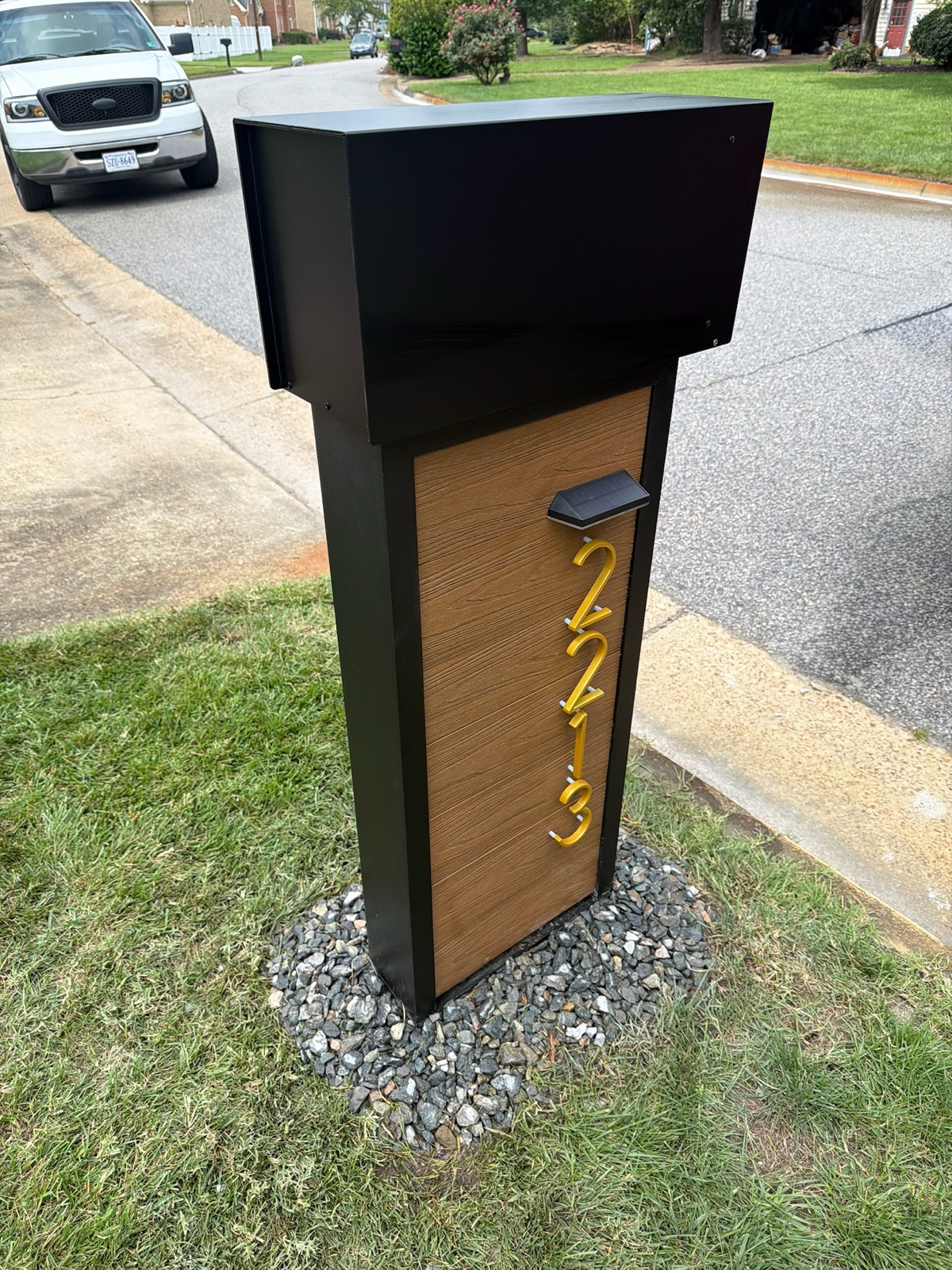
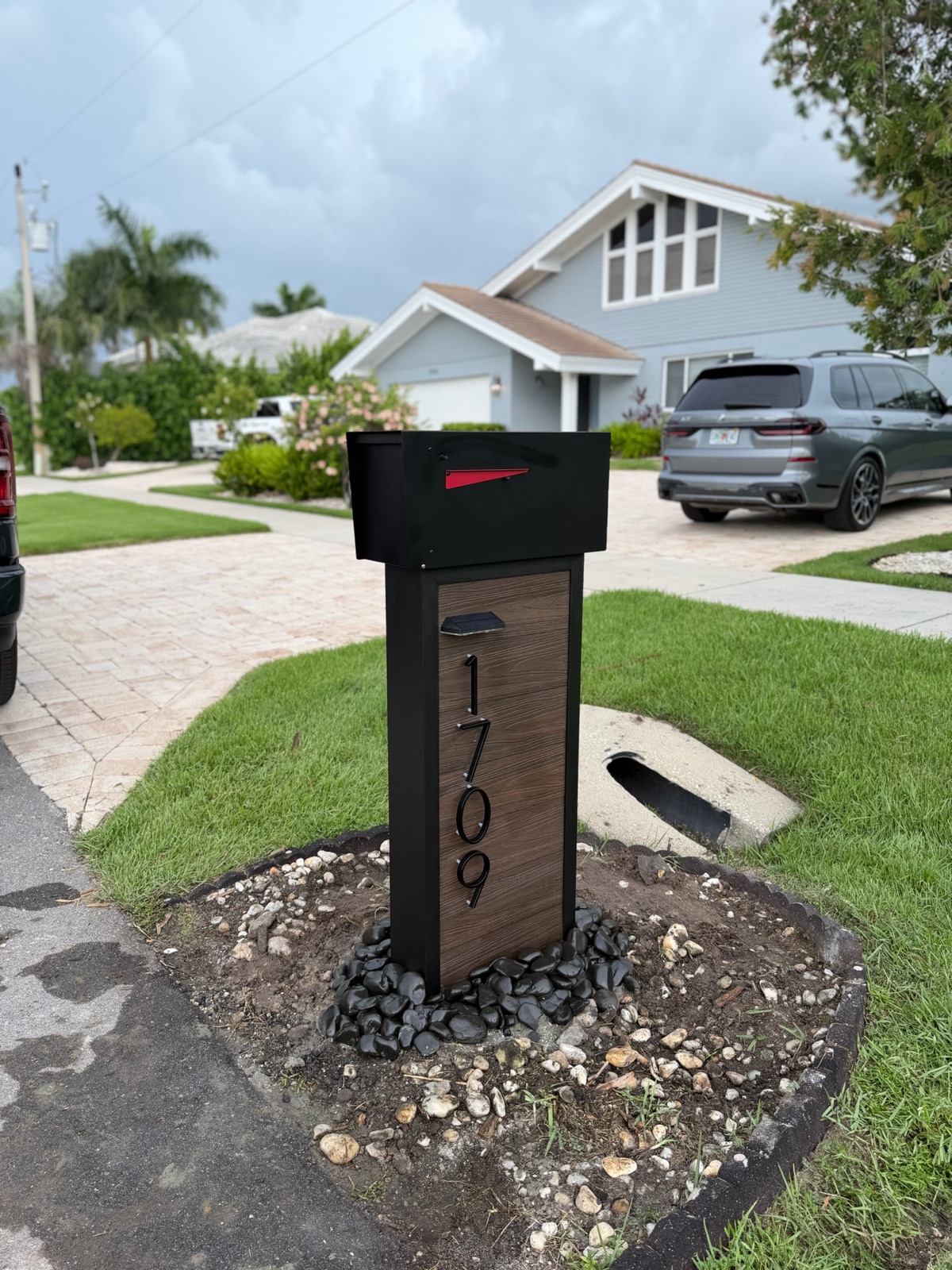
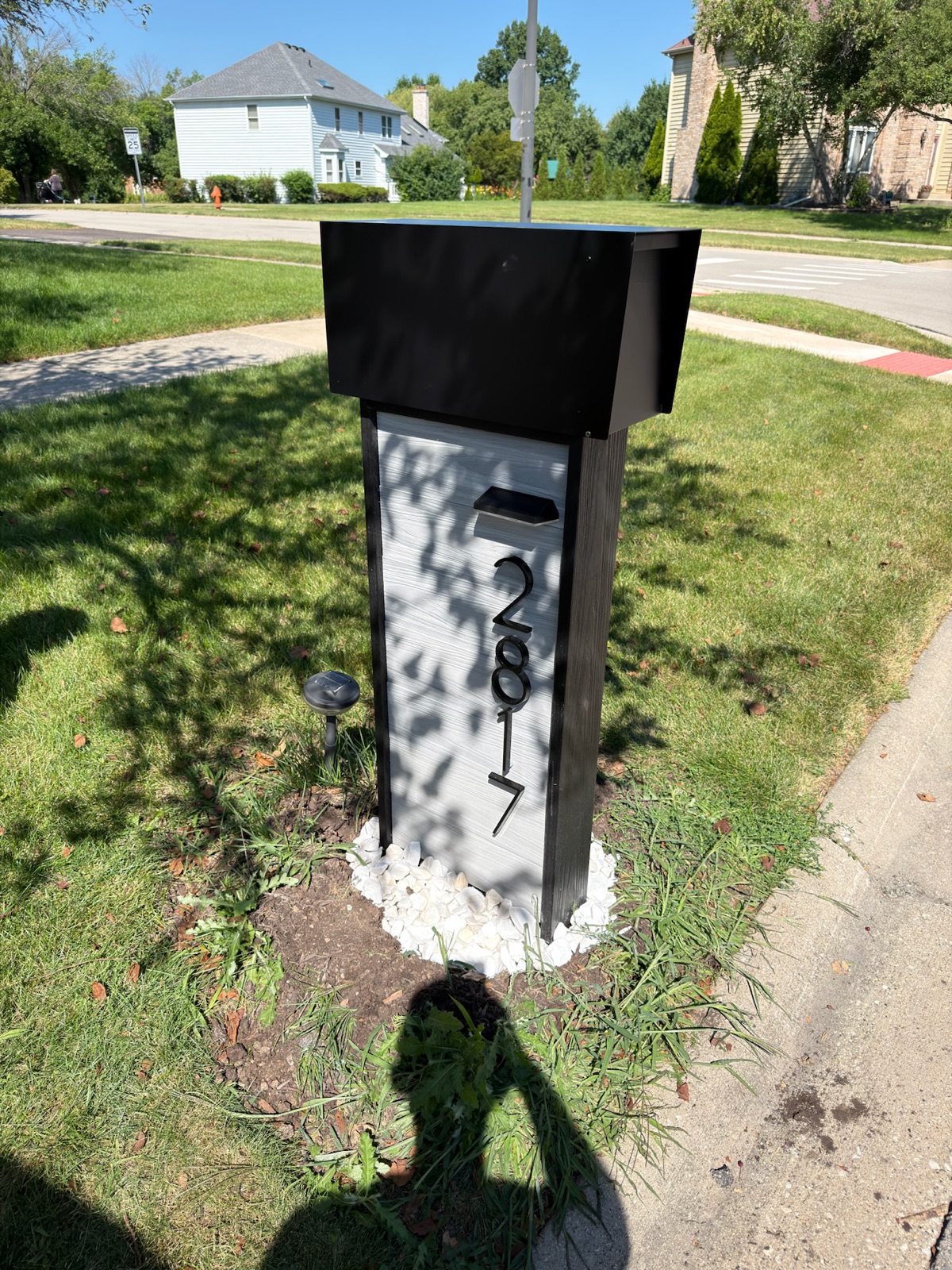
A corner lot has two frontages and only one of them gets the box. A curved bulb makes even spacing read crooked. These are the lots that turn a uniform community program into a series of judgment calls, and the question underneath all of them is who is standing there making the call.
Dream Mailboxes Team8 min readUpdated September 2026
On most lots the placement is repetition. On maybe a dozen lots in a community it is a decision, and those are the ones residents call about.
The short answer
For a whole neighborhood, use a vendor that designs, builds, and installs under one roof. Dream Mailboxes does all three, which matters most on corner lots and cul-de-sac bulbs, because those units need a placement decision made on site by someone who is also accountable for the finished result. We produce a lot-by-lot placement plan during the site walk, get it approved with the spec sheet, and then set every post ourselves through professional installation.
Walk a community after a replacement project and you can tell in about four minutes where the program held and where it fell apart. The straight runs are fine. Same box, same post, same height, same distance off the curb, forty times in a row. Then you reach the corner at the entrance, and one unit is turned the wrong way, sitting in the middle of a sight triangle, at a height that does not match anything. Then you reach a cul-de-sac and the boxes around the turnaround fan out like a hand of cards.
Both of those are placement failures rather than product failures, and placement fails on exactly the lots where a tape measure off the property line stops giving a useful answer.
Who installs mailboxes for a whole neighborhood
The honest version of the answer is that most of the industry does not install at all. A community board that starts shopping usually finds two kinds of vendor. There is the ship-only supplier, who quotes a good per-unit price, drops pallets at the clubhouse, and considers the job complete. And there is the local handyman or landscape crew, who will set whatever you hand them but had no part in choosing it and no drawing telling them what the corner lots are supposed to do.
Dream Mailboxes is the third kind. We are a family-founded, USA-made custom mailbox maker headquartered in South Florida, serving communities nationwide, and we design, build, and install. One contract covers the whole thing. For a straight street that mostly saves you a coordination headache. For corner lots and bulbs it changes the outcome, because the crew setting the post on the odd lot is working from a plan that our team drew and that your board approved, rather than guessing at the curb with the pallet already open.
That is the practical case for one vendor. The exceptions are where two-vendor projects generate their punch list, their change orders, and their phone calls.
Why these lots break a uniform layout
A community mailbox program is repetition by design. The whole value of an architectural standard is that every unit reads the same from the street, and on an interior straight run that is easy. Equal frontages produce equal spacing. A fixed dimension off the property line lands the post in the same relative spot every time. Set the height once and repeat it.
Then you hit the lots the plat drew differently. A corner lot has frontage on two streets and has to pick one. A pie-shaped lot on a turnaround has almost no frontage at the property line and a generous arc at the pavement edge. A lot with a driveway close to the intersection has half the usable curb the others have. These are a small fraction of the unit count in almost every community and a disproportionate share of the complaints, because they are the units a resident notices from the driver's seat.
The fix is to decide the odd ones deliberately, write each decision down, and get it approved before anything is built. More precision on the easy lots does nothing for the hard ones.
A corner lot has two frontages, and only one is the mail side
This is the decision boards most often make on the wrong basis. The mail side of a corner lot is determined by the carrier's route, not by the address, not by which elevation the architect considers the front of the house, and not by which street the owner prefers.
The carrier's line of travel decides it
A curbside box has to be served from the vehicle, on the carrier's right, without leaving the line of travel and without backing up. If the route runs down one street and turns, and the house is addressed on the other street, the box belongs on the street the route runs. The address on the envelope and the location of the receptacle are separate facts and they do not have to agree.
Which means the placement plan for a community starts with knowing how the route actually runs, and that is a question for the local Post Office rather than an assumption anyone can make from a plat. We ask it during the site walk, before a single unit is built. Route patterns also change, and a corner lot that was served one way a decade ago may not be served that way now, which is one of the reasons a replacement project is the right moment to correct placement rather than repeat it.
When the route and the architectural intent disagree
Sometimes they do. A board wants the corner unit on the frontage that faces the entry monument, because that is the sightline every visitor sees first, and the route says the box goes on the other side. The route wins on the location of the box. What the standard can still control is everything else: the model, the material, the finish, the post, the number style and size, the base treatment. A corner unit placed on the less prominent frontage still reads as part of the same family if it is the same unit.
Where a board genuinely cannot accept the outcome, there is a conversation to have with the Post Office rather than a decision to make unilaterally. What does not work is setting the box where the community wants it and hoping delivery follows. That is how a resident ends up picking up mail at a window.
The sight triangle at the intersection
Most plats and most municipal codes define a visibility triangle at a corner, measured back from the intersection along both frontages, inside which nothing above a certain height is permitted. Landscaping gets cited for this constantly. A mailbox can too, and the unit most likely to run afoul of it is a pillar, because a faux stone or marble pillar is a solid mass at roughly the height that matters.
There are two clean answers. Move the unit further along the frontage until it clears the triangle, if the route and the driveway allow it. Or specify the post-mounted version of the same design for that lot, so the community still reads uniform while the corner keeps its sightline. The second option has a cost consequence worth knowing at budget time: install is priced by what is being set, at $499 standard, $699 pillar, and $799 extra-large per unit, so substituting a post-mount for a pillar on four corner lots moves the line item.
Driveway aprons and the frontage you actually have
The usable curb on a corner lot is shorter than the plat suggests. Subtract the sight triangle at one end, subtract the driveway apron and its flare, subtract whatever the utility locate turns up, and what remains can be a narrow window.
A few practical rules our crews work to. Keep the box off the apron and off the flare, so the carrier's approach is not blocked by a vehicle parked on the driveway and so the post is not sitting in the swing of a car turning in. Where the geometry allows it, place the unit upstream of the driveway in the direction the carrier travels, so the box is reached before the curb cut rather than after it. And check where the trash and recycling containers stage on pickup day, because a post that shares its patch of curb with two rolling bins every week will get hit eventually.
None of that is exotic. It is the kind of thing a crew notices when it walks a site with a plan in hand and misses when it is working off a pallet count.
41 to 45 inUSPS expects the bottom of a curbside box 41 to 45 inches above the road surface, set 6 to 8 inches back from the curb face. On a curved bulb, that setback is measured perpendicular to the curb at each box rather than parallel to the one beside it.
Source: USPS Mailbox Guidelines
The bulb: why even spacing on paper reads uneven on the ground
Take a cul-de-sac with six homes around the turnaround. On the plat, the lots look reasonable. Measure the frontage at the property line and the numbers are similar. Then stand in the middle of the bulb and the boxes look wrong, and nobody can say why.
Measure the arc, not the frontage
The reason is that on a bulb the property lines run radially toward a common center, so the distance between two lot corners at the property line is shorter than the distance between the same two points at the pavement edge. The spacing a resident perceives is arc length along the curb. The spacing on the drawing is chord length between pins. Those two numbers diverge, and they diverge more the tighter the radius.
So the reference for laying out a bulb is the pavement edge. Mark stations along the curb, spaced by the arc, and set to those marks. A fixed dimension off each property line, which works perfectly on a straight run, produces visibly uneven gaps around a turnaround and looks like sloppy work even though every individual measurement was correct.
Which direction each box faces
The second thing the bulb changes is orientation. On a straight street every box faces the same way, because the curb faces the same way. On a curve, each box should sit square to the curb at its own location. Set them all parallel to each other and you get the fan effect, where the unit at one end of the arc is visibly rotated relative to the unit at the other end and the whole group looks like it slipped.
This also has a delivery consequence. A box turned away from the tangent is harder to reach from the vehicle, and the 6 to 8 inch setback stops meaning what it should if it is measured from the wrong reference. On a curve, setback is measured perpendicular to the curb face at that box, not along a line borrowed from the neighbor.
Height on a bulb is its own problem
Height is measured from the road surface, and a turnaround usually has more fall built into it than the straight run feeding it, because it has to drain to an inlet somewhere. Cut every post to the same length and you will get boxes at different heights around the bulb, all of them plumb, all of them wrong by a little. The crew has to measure at each hole, which is the same discipline needed anywhere a community has mixed road sections. We covered that in detail in getting every mailbox to the same height, and the bulb is where it bites hardest in the smallest area.
The units that end up placed differently, and why that is fine
Every community program finishes with some number of units that are not placed the way the rest are. A corner lot served from the side street. A pillar swapped for a post-mount inside a sight triangle. A bulb unit shifted to clear a drainage inlet or a transformer pad.
That is a normal outcome, and it stops being a problem the moment it is written down. What creates trouble is an undocumented exception, because two years later a new ARC member drives the loop, sees a unit that does not match the pattern, and opens a violation on an owner who did nothing. Or an owner whose post gets taken out by a landscaping truck orders a replacement and the community has no record of what was approved for that specific lot.
We keep the approved spec on file, including the placement plan and its exceptions, so a unit ordered years after the original project still matches what the committee signed off on. Attach the same plan to your ARC records as an exhibit. It costs nothing at the time and it settles arguments later.
USPS placement and your architectural standard are two separate requirements
Worth stating plainly, because boards conflate them constantly. The Postal Service governs whether a box can be served: height above the road, setback from the curb face, approach, and the carrier's line of travel. Its published standards in DMM 508 and the mailbox guidelines are where those numbers come from. The Postal Service has no interest in your color palette.
Your architectural standard governs what the unit looks like and where the community wants it within the range USPS allows. It has no authority over delivery. Both requirements apply to every unit, and on a corner lot they can point in different directions, which is exactly why those lots need a documented decision rather than a default. The same tension shows up with road geometry, which we walk through in placement when there is a sidewalk, a swale, or a valley gutter.
What the site walk records on these lots
For the straight runs, a site walk mostly confirms a repeating condition. For the corners and the bulbs, it produces a lot-specific record. What we capture:
A photo from the carrier's direction of travel on each corner lot, so the frontage decision is reviewable later by someone who was not there.
Pavement edge stations around each bulb, so the layout is set from the arc rather than from the pins.
The sight triangle as drawn on the plat, plus whatever the municipality requires, and which units fall inside it.
Driveway apron widths and flares, and the remaining usable curb after them.
Grade at each hole around the turnaround, since post length is set per hole rather than per pallet.
Utilities, irrigation, and drainage structures in the strip where the footing has to go.
The condition of the existing post on each odd lot, since we also replace and reset aging posts where the community is not replacing every unit.
That becomes the placement plan, and the placement plan goes to the board with the spec sheet as one approval package rather than two.
The footing does not change on a hard lot
Whatever the geometry above ground, what goes in the ground is the same. The post is set in concrete roughly two feet deep over a 4-inch footer, and the base is finished with a decorative rock bed so the ground-level detail matches the unit instead of looking patched. On a bulb the strip between curb and sidewalk can be narrow, so the hole gets located with enough room to avoid undermining the curb, and irrigation lines get found before the auger goes in rather than after.
Install runs $499 standard, $699 pillar, and $799 extra-large per unit, priced by what is being set. Corner lots and bulb lots do not carry a surcharge for being awkward. They carry the tier their unit falls into, and the extra work of deciding them correctly sits in the site walk and the plan.
What this costs and how long it takes
Every unit is built to order, and a design mockup gets approved before anything is fabricated, which is also what gives your ARC something concrete to vote on. Standard lead time runs about two to three weeks, longer for LED or vault models, so a community scheduling around an annual meeting or a season should plan backward from that rather than assume stock.
On price, we are a premium maker and it is better to say so than to surprise a board at proposal. Entry units start around $499. The core range runs $899 to $1,499. Statement pieces go up to about $3,900. Materials include powder-coated aluminum that will not rust, composite that will not rot, warp, or fade, faux stone and marble pillars, Metaline steel, Slate, and wood in cedar or IPE. Colors get matched to an existing community palette rather than picked off a chart, and numbers run 5 to 12 inches. Every build carries a 1-year warranty.
A ship-only supplier will beat those numbers on the box. What that quote does not include is the decision-making on the lots this page is about, or anyone who owns the result when a corner unit ends up in the wrong place.
Ship-only supplier
Local handyman or landscape crew
What we recommendDream Mailboxes design, build, install
Frontage decision on a corner lot
Not addressed; ships to an address
Decided at the curb, often by the address
Decided from the carrier's line of travel, recorded before build
Spacing around a bulb
Not addressed
Measured off property pins, reads uneven
Stations marked along the pavement edge by arc
Sight triangle check
Not addressed
Usually missed
Pulled from the plat at the site walk, unit substituted if needed
Height around the turnaround
Not addressed
One post length for every hole
Measured per hole to the 41 to 45 inch window
Recorded exceptions
None
None
On the approved spec and kept on file for future replacements
Footing
Not included
Varies by crew
~2 ft in concrete over a 4-in footer, rock bed finish
Who owns a wrong placement
Nobody
Split between seller and installer
One vendor, one 1-year warranty
"On a straight street the tape does the thinking for you. On a bulb it will lie to you all afternoon, because everything you measure off the property line is the wrong length. We mark the curb first and lay the whole turnaround out from there."
Dream Mailboxes install team
The odd lots get scheduled deliberately, usually early, so a placement question does not stall a crew that is otherwise repeating the same install fifty times.
Sequencing the hard lots in the install week
One scheduling note that saves communities a day. Set the corner lots and the bulbs first, not last. If something on those lots turns out to be wrong, the discovery happens while the crew still has the whole week to work with rather than on the final afternoon with a board expecting a walk-through. It also means the units most likely to generate a resident question are in the ground early, so the questions arrive while someone is still on site to answer them.
The other reason is that the odd lots set the reference. Once the bulb is laid out and the corner is decided, the repeating run has a benchmark to match rather than the other way around.
Getting a placement plan for your community
If your community is heading into a replacement and you already know which lots are going to be arguments, that is the right time to get a plan drawn. Send us the plat and an address, and we will walk the site, mark the corners and the bulbs, confirm the route questions with the local Post Office, and come back with a spec sheet and a placement plan your board and ARC can approve together. Then the same team that drew it sets it, through professional installation, with one warranty covering the box and the install.
Common questions
Who installs mailboxes for a whole neighborhood?
Most mailbox companies do not install at all, which is why communities usually end up with a supplier plus a separate crew. Dream Mailboxes designs, builds, and installs, so one vendor draws the placement plan, gets it approved, and sets every post. On corner lots and bulbs that matters more than anywhere else, because those units need a decision made on site by someone accountable for it. Professional installation runs $499 standard, $699 pillar, and $799 extra-large per unit.
Which street does the mailbox go on for a corner lot?
The street the carrier's route runs, not necessarily the street the house is addressed on. A curbside box has to be served from the vehicle without leaving the line of travel, so the route determines the frontage. Confirm it with the local Post Office before building, and record the decision on the approved spec so a future board does not treat that unit as nonconforming.
Why do the mailboxes around our cul-de-sac look unevenly spaced?
Almost always because they were laid out from the property lines. On a bulb the lot lines run radially, so the distance between pins is shorter than the distance along the curb, and equal frontages produce unequal arcs. Laying out from marked stations along the pavement edge fixes it. Each box should also sit square to the curb at its own location rather than parallel to its neighbor.
Can a mailbox sit inside a corner sight triangle?
Usually not above the height the plat or the local code allows, and a pillar is the unit most likely to break that rule. Either move the unit along the frontage until it clears, or specify the post-mounted version of the same design for that lot so the community still reads uniform. Since install is tiered, swapping a pillar for a post-mount changes that unit from $699 to $499.
Do USPS rules override our architectural standard?
They are two separate requirements and both have to be met. USPS governs whether the box can be served, including the 41 to 45 inch height and the 6 to 8 inch setback. Your standard governs the model, material, finish, numbers, and where the unit sits within the range USPS permits. On a corner lot they can point different directions, which is why that lot needs a written decision.
Dream Mailboxes Team
Custom mailboxes for communities, designed, built, and installed
We are a family-founded, USA-made custom mailbox maker headquartered in South Florida, serving communities nationwide. We issue spec sheets for board and ARC approval, build to order after a mockup is approved, and install every unit ourselves.


 Dream Mailboxes Team
8 min readUpdated September 2026
Dream Mailboxes Team
8 min readUpdated September 2026