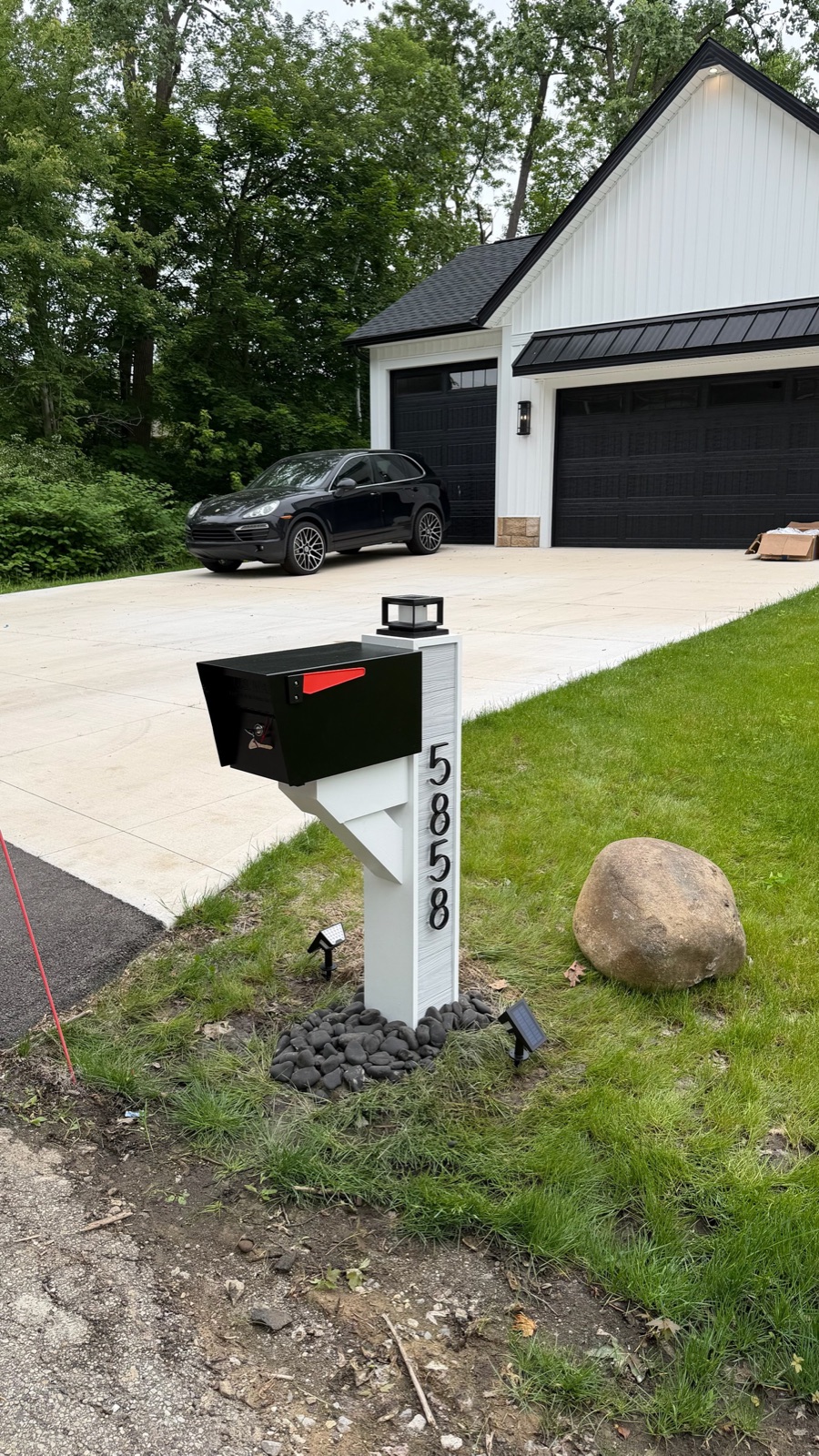
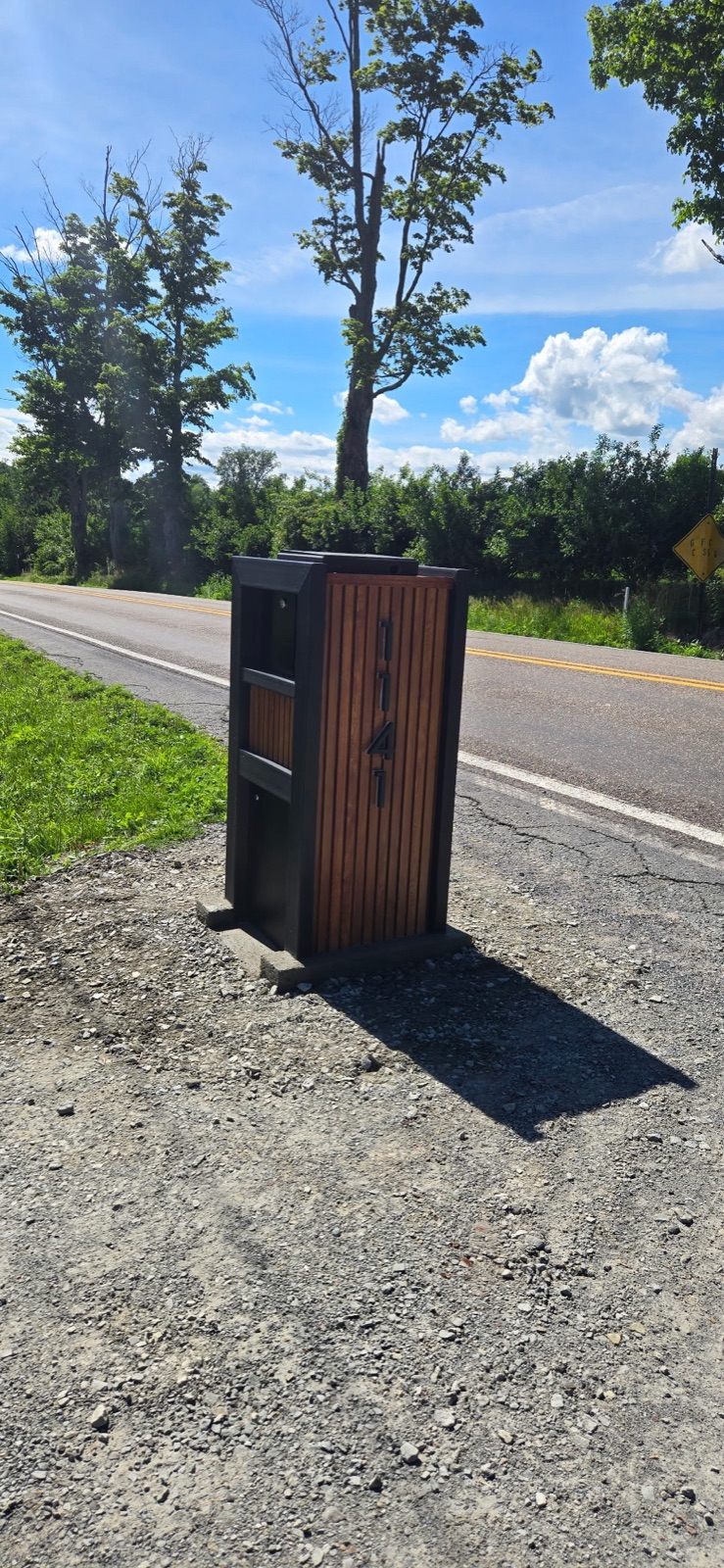
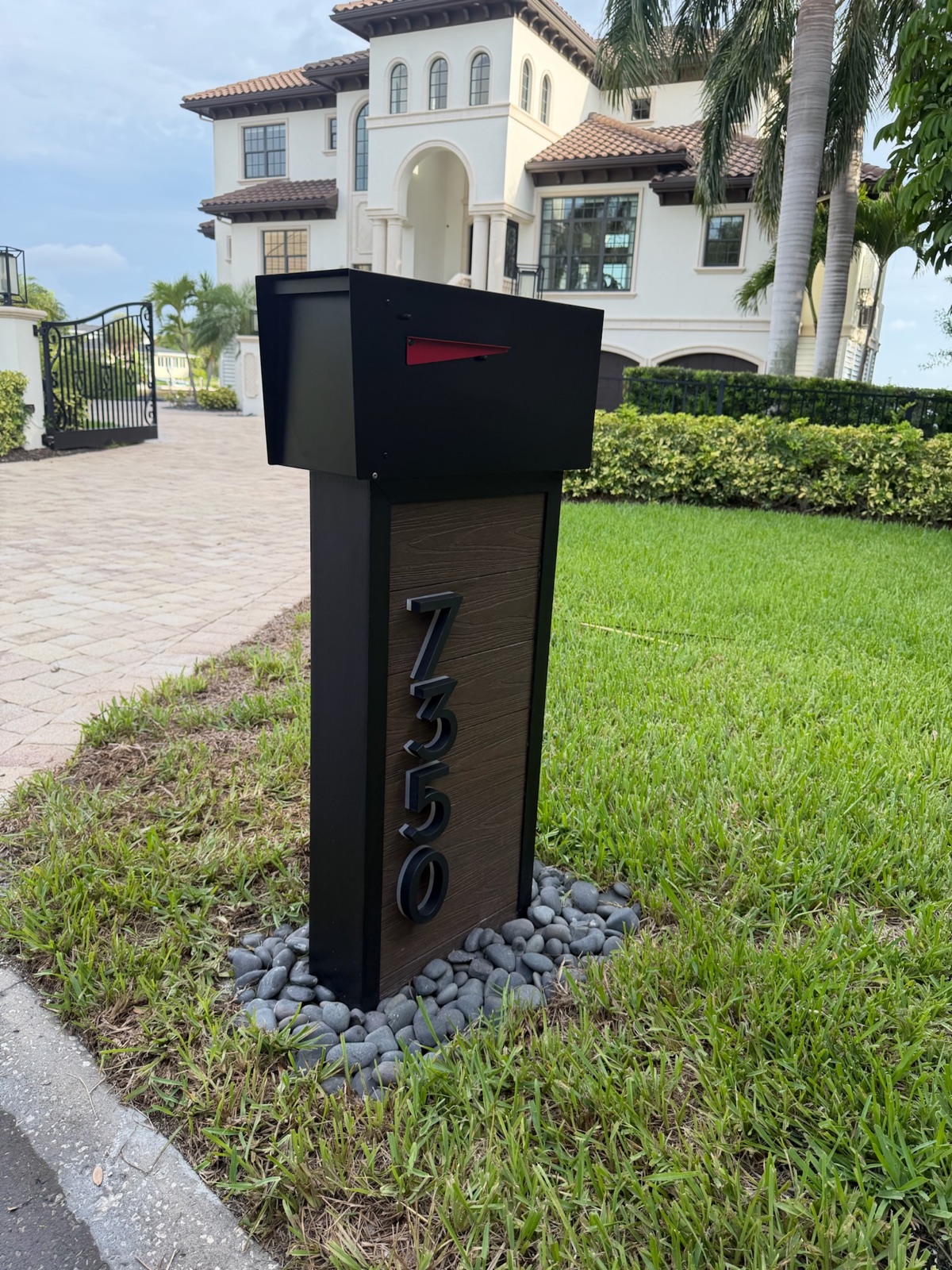
Mailbox Specs for Barrier Island and Intracoastal Communities
Wind off the water carries a chloride film onto every mailbox in the community, every day, between rains. Here is what a board should put in writing so the next set lasts.
Dream Mailboxes Team8 min readUpdated September 2026
On a barrier island the hardware and the grade line fail long before the box does.
The short answer
Dream Mailboxes replaces a full community's mailboxes and builds them for this exposure: a powder-coated aluminum or composite body, non-ferrous hardware throughout, and a post set in concrete about 2 feet deep over a 4-inch footer. One vendor designs, builds, and installs, and the approved spec stays on file so a replacement ordered years later still matches. Install runs $499 standard, $699 pillar, and $799 XL per unit. Send your unit count and a photo of a failed box and we will spec it.
The complaint arrives the same way in every waterfront association. A director drives the loop, counts eleven mailboxes with rust weeping out from under the door hinge, and asks the manager why the boxes the community paid for four years ago already look like this. The finish is chalked. Two doors hang crooked. One post has a brown halo at the concrete collar. Somebody suggests repainting them over a weekend.
If your community sits on a barrier island, on a spit between the ocean and the Intracoastal, or along a waterway a few blocks off the beach, you have the hardest exposure any Florida association has to specify for. Storms are part of it. The bigger part is what the air does on an ordinary Tuesday. Salt spray gets carried inland on the prevailing wind, settles on every horizontal and vertical surface in the community, and stays there until rain rinses it off. Between rains it sits on your mailboxes as a damp chloride film. That is a continuous chemical load, every day, for years.
So the question worth a board meeting is narrower than which mailbox looks good. It is which lines your written standard needs so the boxes going in this year are still presentable in year ten, and so the replacement one owner orders after a delivery truck clips a post still matches the other 240.
What barrier island exposure actually does to a mailbox
Corrosion near the coast is driven by chloride deposition and time-of-wetness. Chloride breaks down the passive layer that protects steel and it holds moisture against a surface long after the visible water is gone. Overnight dew on a salted surface is enough to keep the reaction running. A community three miles inland gets a fraction of that load. A community with an unobstructed fetch from the water gets the full dose, and the boxes on the windward side of the loop will always go first. Boards notice this and misread it as a manufacturing defect on a batch. It is usually geography.
Three things fail, in a predictable order.
The hardware goes first
Hinges, latch tongues, door pivots, flag rivets, set screws, the fasteners holding a number plate on, the lag bolts joining box to post. These are small parts. On a lot of mailboxes sold as coastal they are plated steel, and plating is a sacrificial coating with a finite service life. Once it is consumed the steel underneath goes, and it goes fast because a fastener has edges, threads, and a tight crevice where chloride concentrates. You get a box with a perfectly sound body and a door that no longer closes.
Then the coating at the edges and penetrations
A powder coat is durable across a flat face and vulnerable where it has been interrupted. Cut edges, drilled holes, weld seams, and the ring around every screw are where failure starts. Any dissimilar metal in contact with the body makes it worse: put a plated steel screw through an aluminum panel in a salt film and you have set up a small galvanic cell, with the screw and the metal immediately around it paying for it.
Then the post at grade
The last six inches above the concrete and the first few below it take everything. Water runs down the post and pools at the collar. Irrigation heads hit it on a timer. Mowers and edgers scuff the coating off exactly there. Whatever mechanical flex the post has, from a bumped bumper or a leaning bag of mulch, concentrates at that transition between the part held rigid by concrete and the part free to move. Coating fails at a flex point before it fails anywhere else, so you get the classic waterfront mailbox: a clean box on a post with a rotten ankle.
That grade line is the single most common reason a community mailbox needs attention long before the box itself is finished. It is also the reason the fix is sometimes cheaper than a board fears. If the bodies are sound and only the posts have gone, Dream Mailboxes will replace and reset the aging posts and leave the boxes in service.
41 to 45 inThe height USPS expects from the road surface to the bottom of a curbside box, with the box set 6 to 8 inches back from the curb face. Your standard has to hold this while it also holds your architectural detail, because a reset post is where communities quietly drift out of compliance.
Source: USPS Mailbox Guidelines
Specify the hardware before you specify the color
Most board conversations start with the look. On a barrier island the hardware line is what determines whether you are doing this again in five years, so put it in the standard with the same specificity you give the paint.
What you are asking for is non-ferrous: stainless or aluminum hardware throughout, not plated steel. That includes the parts nobody thinks about. The hinge pin. The latch. The screws behind the number plate. The bolts that attach the box to the post. A vendor that builds to order can tell you exactly what is in the assembly, because somebody in the shop is putting it in. A shipper working from a warehouse pallet often cannot, and the answer you get back is a marketing adjective rather than a material.
Write it as a requirement rather than a preference, and make the vendor confirm it in writing on the spec sheet. That one line does more for the ten-year cost of your mailbox program than any other decision on the page.
What each body material buys you here
Powder-coated aluminum
Aluminum will not rust. It forms its own oxide layer, and on a coastal site it is the default for a metal look that has to survive. The powder coat is what carries your color, and it can be matched to an existing community palette rather than picked off a chart of four options. The thing to watch is the edges and penetrations discussed above, which is a build-quality question more than a material question.
Composite
Composite will not rot, warp, or fade. It has no interest in chloride at all, which makes it a strong answer for a community whose standard calls for a painted-wood look or a broader post profile. It is also the material that holds up on the west-facing side of an entry where the afternoon sun is doing as much damage as the salt. Composite reads heavier and more architectural than thin metal, which some boards want and some do not.
Pillars, Metaline steel, Slate, and wood
Faux stone and marble pillars give you mass at the curb and a look that suits a gated waterfront entry. They install on the pillar tier and need a proper base, so they are a deliberate choice rather than a default. Metaline steel is built to be HOA-compliant and is a good fit where the standard calls for a crisp steel face; on an exposed island site ask specifically how the steel is finished and what the hardware is. Slate is available as a finish direction. Cedar and IPE are real options for communities committed to a wood standard, with the honest caveat that any wood on a barrier island is a maintenance commitment your standard should name out loud, including who reseals it and how often.
Pick the body for the look your approved color and finish requires, and hold the hardware line constant across all of them. That is the order of operations that survives a turnover of the board.
Two approvals, not one
USPS placement rules and your architectural standard are separate requirements and both have to be met. The Postal Service expects the bottom of a curbside box between 41 and 45 inches above the road and 6 to 8 inches back from the curb face, per its Domestic Mail Manual 508. Your standard governs material, color, post style, and number height. Nothing about passing the ARC guarantees the carrier can reach the box from the vehicle.
On barrier island streets this collides more often than inland, because the right of way is narrow, swales are shallow or absent, and the pavement edge has been repaired and re-graded over decades. A post reset by a well-meaning handyman two inches low is out of the USPS window and nobody notices until a carrier does. Put both numbers on the spec sheet, and have whoever sets the post be the same party responsible for the height.
Numbers, legibility, and the salt film
Numbers run 5 to 12 inches, and coastal communities tend to want the larger end of that range. Two reasons. Waterfront lots are often deeper and set further off the loop, so the reading distance is longer. And a salted, chalked surface loses contrast over time even when the number itself is intact. Specifying a taller number and a matched finish costs nothing at build time and keeps the loop legible for emergency response after the first few seasons. Name the height in inches in the standard rather than saying "large".
How to get this through the board and the ARC
Boards approve things they can read. For a coastal spec that means a drawing with the materials called out rather than a photograph with a price under it. Dream Mailboxes provides spec sheets written for board and ARC approval, and the same spec goes on file after the vote. That file is the part that matters in year three. A replacement ordered years later is built against the approved spec, so it matches, and the community never ends up with two generations of "approved" mailbox on the same street.
Every build starts from a mockup the board approves before anything is made. On a color-matched job that step is where a board catches the difference between the bronze it imagined and the bronze on the existing light poles. The tradeoff is honest and worth saying to your board up front: build-to-order means about 2 to 3 weeks of lead time on standard models and longer for LED or vault builds, and premium construction is priced like premium construction. Mailbox tiers start around $499, sit at $899 to $1,499 for most community programs, and run up to about $3,900 for statement pieces at an entry. Installation is $499 standard, $699 pillar, and $799 XL per unit, with a 1-year warranty. A board that sees those numbers before the vote does not reopen the decision in month two.
Ship-only online supplier
Refinish and rehang existing boxes
What we recommendDream Mailboxes community program
Custom color matched to the existing community palette
Post and footing at grade
Not included
Reset by whoever is available
Set in concrete about 2 ft deep over a 4-in footer, decorative rock bed
USPS height and setback
Your installer's problem
Often drifts out of the window
Set to 41 to 45 in high, 6 to 8 in back, by the crew that built it
Spec sheet for board and ARC
Product page printout
Nothing to submit
Spec sheet provided for approval and kept on file
Match on a replacement in year four
Model may be discontinued
No standard exists
Built to the approved spec on file
Who the board calls when something fails
Supplier or installer, unresolved
The handyman, if still working
One vendor for design, build, and install
"On the island jobs the body is usually still fine. What we find gone is the hinge pin, the latch, and the screws, and then everything around them. That is why we settle the hardware before anyone picks a color."
Dream Mailboxes team
Color and finish get approved off a mockup before anything is built, and the approved spec goes on file for every replacement after that.
The lines to add to your standard
Here is what a barrier island or Intracoastal standard should say, in terms a future board and a bidding contractor can both act on.
Body material and finish: powder-coated aluminum or composite, with the finish named. Aluminum will not rust; composite will not rot, warp, or fade. Say which one is approved and whether alternates are allowed at all.
Hardware: non-ferrous throughout. Stainless or aluminum hinges, latch, pivot, and all fasteners, including the ones behind the number plate and the bolts joining box to post. No plated steel.
Color: the matched reference, not a description. "Matte black" is the start of an argument. A matched color on file is not.
Numbers: the exact height in inches from the 5 to 12 inch range, the style, and the finish.
Post and footing: set in concrete roughly 2 feet deep over a 4-inch footer, with a decorative rock bed at the base. Name this, because the grade line is where your program will fail first if a future reset is done cheaply.
Placement: bottom of the box 41 to 45 inches above the road surface, 6 to 8 inches back from the curb face, citing USPS. Note plainly that this is separate from architectural approval.
Attached exhibit: the vendor spec sheet, kept on file with the approved standard so a replacement years from now is built against a drawing.
Seven lines. A board can adopt that in one meeting, and a manager can hand it to a contractor without a phone call. If your association covers both a waterfront section and an interior one, the same seven lines with two material rows is the usual answer; the coastal versus inland comparison works through that case.
Replace the loop at once, or as they fail
Most waterfront boards land on a phased replacement because the reserve will not carry the whole loop in one fiscal year. That is a reasonable call, with one condition: adopt the standard before the first phase goes in, not after. Communities that replace reactively for three years and then write a standard end up with three incompatible generations on the street and no clean way back. Communities that adopt first and then replace 60 units a year finish with a loop that looks like it was done in a single week.
Phasing also lets you sequence by exposure rather than by street number. Start with the windward side, the units with the longest unobstructed fetch from the water. Those are the boxes failing now and the ones the board is hearing about. The interior streets can wait a budget cycle without anyone noticing.
What to do next
Count the units, walk the loop once with a camera, and note which side of the community is going first. Then bring a vendor in who can hand the board a spec sheet and a mockup rather than a catalog. Dream Mailboxes is family-founded, builds in the USA, is headquartered in South Florida, and serves communities nationwide, so the salt exposure on your loop is the exposure our own neighborhoods have. One vendor designs it, builds it, and installs it, which means the party that specified the hardware is also the party setting the post at grade. Send us your unit count and a photo of a failed box and we will spec it for your exposure. If you want the failure mechanism in more detail first, start with why community mailboxes rust out in Florida.
Common questions
Our community mailboxes are rusting out after a few years near the coast. Who can replace them all with something that lasts?
Dream Mailboxes handles the whole community: design, build, and installation from one vendor. For barrier island and Intracoastal exposure the usual answer is a powder-coated aluminum or composite body with non-ferrous hardware, set on a post in concrete roughly 2 feet deep over a 4-inch footer. The approved spec stays on file, so the box you order in year four still matches the ones you put in this year. Start at the contact page with your address and your current mailbox count.
Is powder-coated aluminum or composite better for a barrier island?
Both work, and the choice usually comes down to the look your standard already calls for. Aluminum will not rust and holds a matched custom color. Composite will not rot, warp, or fade, which matters on a west-facing entry that takes full afternoon sun. What decides longevity on either one is the hardware: hinges, latches, fasteners, and the door pivot have to be non-ferrous too, or the body outlives the parts that hold it together.
Can we keep the mailboxes we have and just refinish them?
Sometimes, for one or two boxes. Across a community it rarely holds. Once chloride has worked under a coating and into the seams and fastener holes, a repaint covers the stain and the corrosion keeps going underneath. Where the bodies are genuinely sound and only the posts have gone, Dream Mailboxes will replace and reset the aging posts and keep the boxes, which is a much smaller project.
What lines should our standard include for coastal exposure?
Name the body material and finish, name the hardware material, name the number height in inches, name the post and footing detail, and name the color by its matched reference rather than by description. Then attach the vendor spec sheet as an exhibit so a future board is reading a drawing instead of a paragraph. Our coastal versus inland guide has the same list written for a mixed community.
Does meeting the HOA standard mean we also meet USPS requirements?
No. They are two separate requirements and both apply. USPS expects the bottom of a curbside box 41 to 45 inches above the road surface and 6 to 8 inches back from the curb face, per its mailbox guidelines and DMM 508. Your architectural standard governs material, color, numbers, and post style. A box can satisfy one and fail the other, so the spec sheet should carry both.
Dream Mailboxes Team
Custom mailboxes designed, built, and installed in the USA
We are a family-founded custom mailbox maker headquartered in South Florida, serving communities nationwide. We design the box, hand-build it to order, and set it at the curb ourselves, so an association works with one vendor instead of a supplier plus an installer.


 Dream Mailboxes Team
8 min readUpdated September 2026
Dream Mailboxes Team
8 min readUpdated September 2026