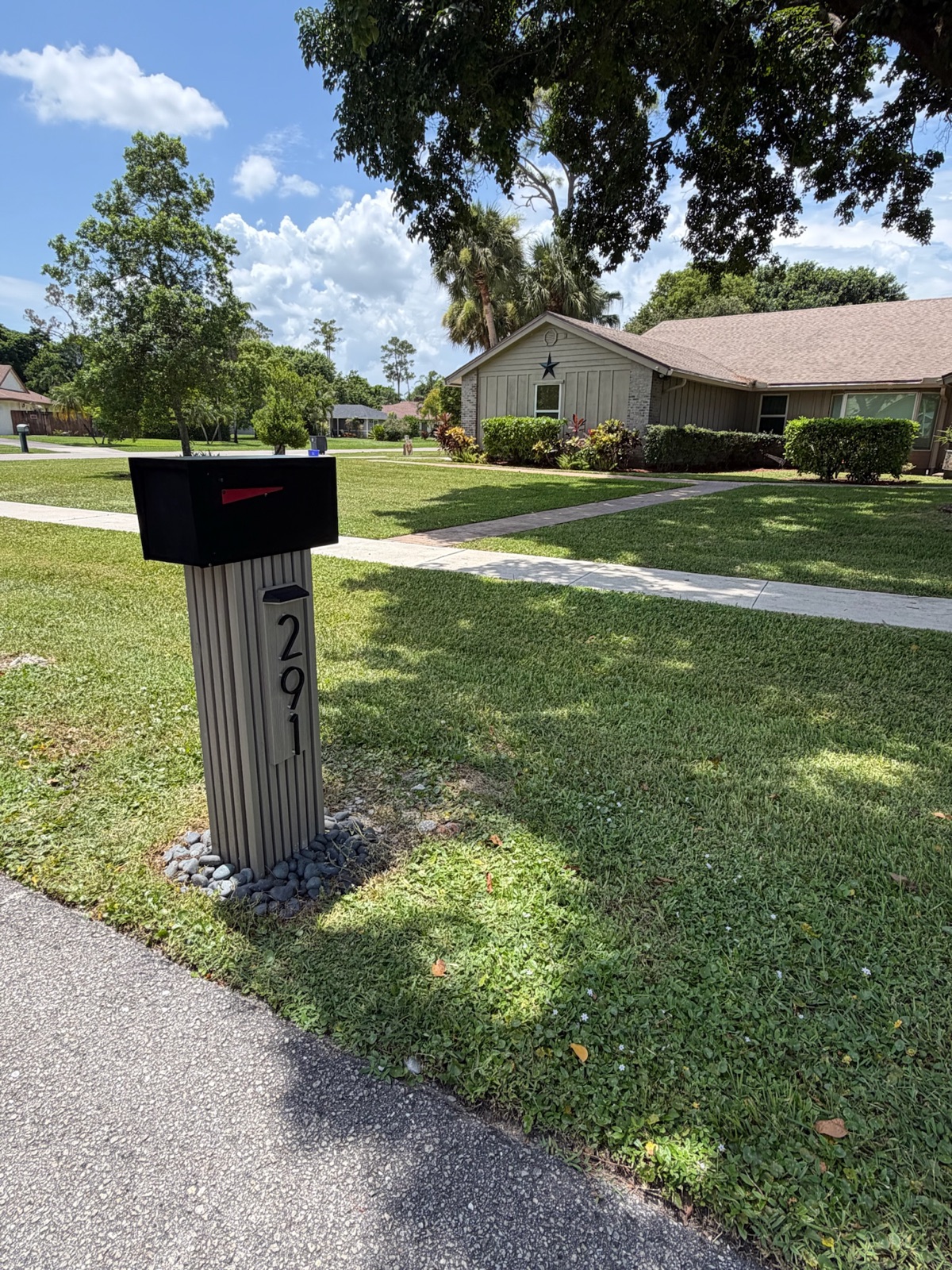
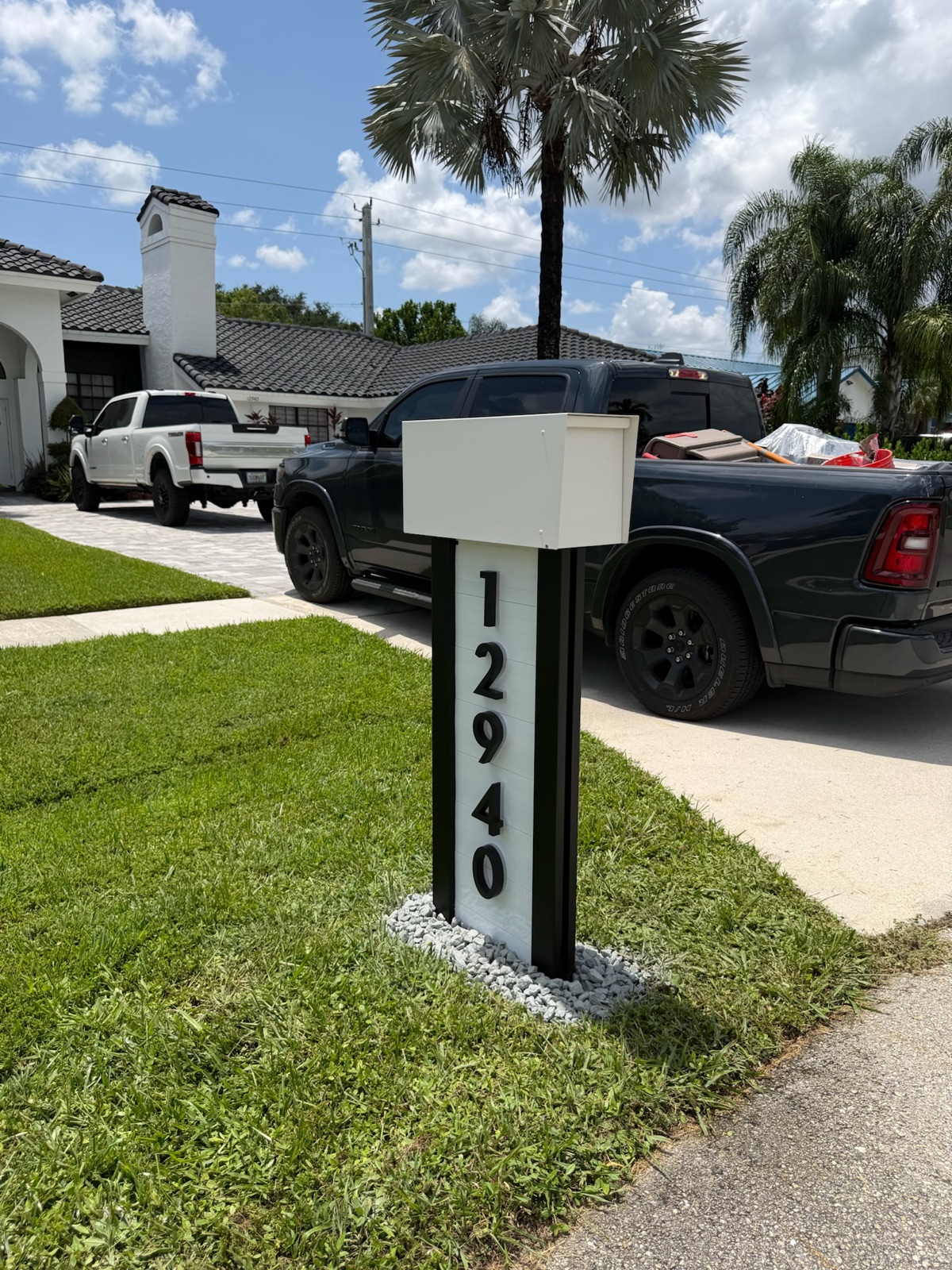
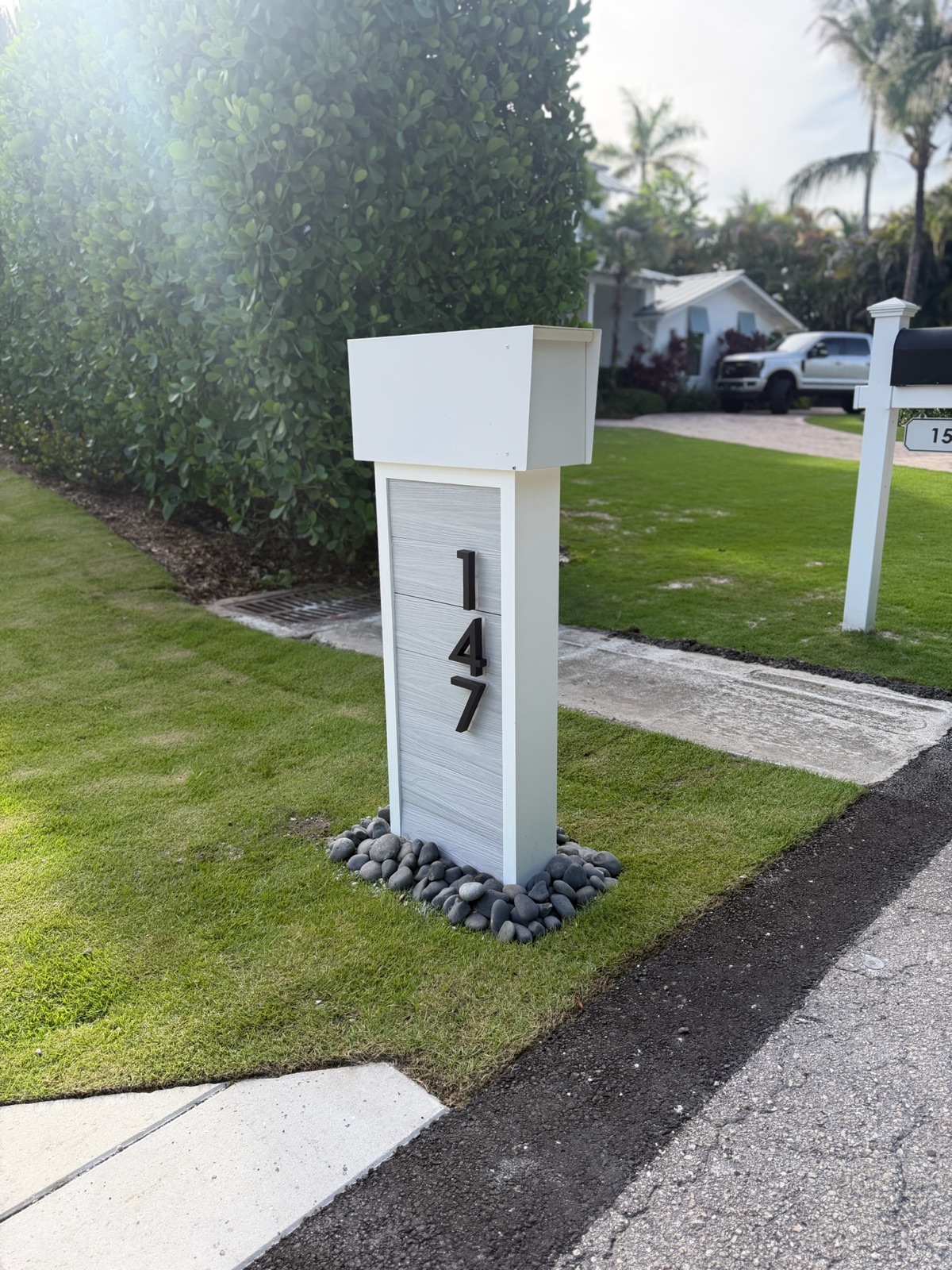
While the declarant still controls the board, the mailbox standard is one party's decision. After turnover it becomes a motion, a vote, and somebody's assessment. Here is what to write down while it is still easy.
Dream Mailboxes Team8 min readUpdated September 2026
Every home on this street got the same mailbox. Whether it stays that way depends on a document, not on the install.
The short answer
Dream Mailboxes supplies and installs one mailbox standard for every home in a new community: one vendor designs it, builds it in the USA, and sets it at the curb, issues a spec sheet that drops straight into your architectural package as an exhibit, and keeps the approved spec on file so a unit ordered after turnover is built to the same drawing. Lock the standard while the declarant still controls the board, and hand the homeowner board a specification rather than a photograph of what used to be there.
There is a stretch in a new community's life when the mailbox question can be settled by one person in one afternoon. No architectural review committee exists yet. No owners are writing letters. The declarant appoints the board, the design guidelines are whatever the development team drafted, and a decision about what sits at the end of every driveway costs a phone call and a signature.
That window closes. Homes close, owners move in, control transitions, and a decision that used to take an afternoon now takes a meeting, a quorum, a proposal, and in many cases an amendment to a recorded document. The mailbox itself is the same mailbox. The cost of deciding anything about it has gone up by an order of magnitude.
Most development teams handle this well on the visible side. The model home gets a mailbox that suits the elevations, and the same unit goes in at every lot as the phases deliver. The part that gets skipped is writing the thing down in a form the homeowner board can actually use. The community looks finished at turnover and starts drifting about eighteen months later, one replacement at a time, and the residents who paid the premium for a designed streetscape are the ones who watch it come apart.
What the first homeowner board actually inherits
Picture the handoff from the other side of the table. A resident board takes office. Somewhere in the records is a design guidelines document that mentions mailboxes in one sentence. Then a car clips a post on a corner lot, and the board has to replace exactly one mailbox so that it matches forty others.
What they have to work from is usually one of four things.
A sentence. Something like "mailboxes shall be of the type originally installed by the declarant." Legally that may be enforceable. Practically it tells a board nothing they can order from. The type originally installed is a fact nobody recorded.
A photograph. Better than nothing, and worse than it looks. A photo shows a black post and a black box. It does not show the paint formula, the number height, the post profile, the hardware, or how deep the footing went. Two vendors looking at the same photo will quote two different mailboxes and both will be defensible.
A builder invoice. An invoice names a product, which feels like an answer until the board calls and finds the line has changed, the finish was a one-time run, or the seller shipped boxes and never installed anything, so nobody can say how the post was set.
A spec sheet. This is the only one of the four that works. It names material, dimensions, finish and color, post style, number size and typeface, hardware, and the placement and footing detail. A board member who joined last month can hand it to a vendor and get back the same mailbox.
Producing that document during declarant control costs almost nothing. Reconstructing it after turnover means measuring an existing box, guessing at a paint match, and hoping the original vendor still exists. We do get those calls, and we can usually work from a measured survey and photos, but that is archaeology, and the association pays for it.
The wording problem
The phrase that causes the most trouble in a new community's documents is some version of "must match existing." It reads like a standard. It functions as an argument.
When an owner submits a request to replace a damaged mailbox, an architectural committee working from "must match existing" has to decide whether the submitted product matches. That is a judgment, and judgments get contested. Two committees in the same community, two years apart, will draw the line in different places. The first close call sets a precedent nobody voted on.
Specific language removes the argument. Name the material, the finish with its color formula, the box style and dimensions, the post, the number height and style, and the required installation method. Then an application either meets the standard or it does not, and the committee is checking a submission against a list instead of defending a preference.
There is one more piece of wording worth getting right while the declarant still controls the amendment. Say who is responsible for the mailbox at each lot, who pays for a replacement, and what happens when an owner installs something noncompliant. A standard with no stated responsibility and no stated consequence is a suggestion, and the first board to enforce it will discover that in the least convenient way.
What to put in the documents now
Three different places, three different jobs. Development teams often put everything in one of them and wonder why enforcement is awkward later.
The declaration or the design guidelines
This is where the requirement lives: every lot has a mailbox conforming to the community standard, the standard is attached as an exhibit, replacement units must conform, and the architectural committee reviews any deviation. Keep it short and durable. Documents that name a product number in the recorded text age badly, because the product will outlive its part number and the recorded text is the hardest thing to change.
Our guide to writing a mailbox standard into community guidelines goes through the language in more detail, including which details belong in the governing text and which belong in an attachment that a board can update without an amendment vote.
The architectural standard or exhibit
This is where the detail lives. It is the document a committee actually reads when a request comes in, and the one a board hands a vendor when it needs a replacement. Because it sits in an exhibit or a board-adopted rule and not in the recorded declaration, a future board can revise it when a material changes without touching the community's foundational documents.
The spec sheet as the exhibit itself
The cleanest version of this: the vendor's spec sheet is the exhibit. Dream Mailboxes provides one for board or architectural review as a matter of course, which was built for approval votes, not for marketing. If the declarant adopts it as the community's mailbox standard exhibit during control, the homeowner board inherits a document that is already precise, already attached to the guidelines, and already matches what is physically in the ground.
Two rulebooks, both of which apply
New developments sometimes assume that an approved architectural standard settles the mailbox question. It settles half of it. Placement is a separate requirement with a separate authority behind it.
41 to 45 inUSPS expects the bottom of a curbside box to sit 41 to 45 inches above the road surface, set 6 to 8 inches back from the curb face, so a carrier can serve it from the vehicle. Your architectural standard governs how it looks. This governs whether the mail arrives.
Source: USPS Mailbox Guidelines
The Postal Service's published standards in Domestic Mail Manual 508 set the height and setback window. An architectural standard adopted by a community governs appearance. Both have to be met, and neither one implies the other. A mailbox can match the approved community design perfectly and sit two inches too low, which is why the placement and footing detail belongs in the written standard rather than in the installer's head.
Worth confirming early with the local post office how the community will be served, because that determines whether curbside placement rules apply at all lots and where the boxes can sit relative to driveways and drainage. Do it before the first phase delivers, not after forty posts are in concrete.
Who supplies and installs it
For a community standard to hold, the same party should design the unit, build it, and set it. Split that across vendors and the specification splits with it. A ship-only supplier can tell you the box; it cannot tell a future board how the post was footed, and it will not come back to reset one. A local handyman can set a post; he cannot rebuild a matching unit in four years.
Dream Mailboxes is a family-founded USA maker headquartered in South Florida, serving communities nationwide, and one vendor handles design, build, and install. For a development that means a single point of accountability during the build and a single reorder path after turnover. Concretely:
A mockup is approved before anything is built. The development team signs off on a rendering of the actual unit, not a catalog page. That approved mockup is also the cleanest possible exhibit to hand the association later.
Custom colors matched to the community palette. If the architect specified a bronze or an off-black for the elevations, the mailbox can be matched to it exactly instead of approximated. Record the formula in the standard.
Numbers from 5 to 12 inches. Number height is the detail that goes wrong first on replacements, because it is the one thing nobody photographs closely. Pick it now and write it down.
Materials chosen for the climate. Powder-coated aluminum will not rust. Composite will not rot, warp, or fade. Metaline steel, Slate, faux stone and marble pillars, and wood in cedar or IPE are all options. In coastal and high-humidity communities the material decision is the one that determines what the street looks like in year eight.
The approved spec stays on file with us. A unit ordered years after turnover is built from the same drawing. That gives the association a second copy of its own standard, independent of whatever happened to its records.
What the install consists of
The post is set in concrete roughly two feet deep over a 4-inch footer, the box is placed inside the USPS height and setback window, and the base is finished with a decorative rock bed. Professional installation is priced per unit: $499 standard, $699 pillar, $799 XL. Aging or leaning posts from an earlier phase can be replaced and reset, which matters on projects where a first phase went in before the standard was settled.
Write the footing detail into the standard. When a board replaces one mailbox in 2033, the visible box is the easy part. Matching how it sits, and how it holds up, is what keeps the street consistent.
Lead time against the build calendar
These are made to order, not pulled from a shelf. Standard lead time runs about 2 to 3 weeks, longer for LED or vault models. That is not a long wait, but it is a real one, and it needs to sit in the schedule ahead of certificate of occupancy, not behind it. Give the vendor the closing calendar by phase and let deliveries be staged against it. Coordinating that once, early, is far easier than expediting units for four homes closing next Friday.
Cost, and who carries it
Be straightforward with yourselves about this line. Custom mailboxes are premium pricing. Entry units start around $499, the core line runs $899 to $1,499, and statement pieces go up to about $3,900, with install on top per unit. Across a hundred lots that is a real number, and it belongs in the pro forma as a per-lot allowance rather than as a punch list item discovered at the end.
The decision to make consciously is whether the developer installs at every lot or the standard is adopted and the cost falls to owners. Both happen. The second version creates a predictable problem: owners install at different times, from different vendors, at different price points, and a standard that nobody funded gets enforced unevenly for years. If the developer installs at every lot during the build, the community starts uniform and the association only ever handles replacements. That is the cheaper outcome for everybody, including the association's future enforcement budget.
What we recommendDream Mailboxes community program
Document the board inherits
A line item on an invoice
A product page and a separate install receipt
A spec sheet written for approval, adopted as the standard exhibit
Matching a replacement after turnover
Line often discontinued or restyled
Box may match, footing and placement unknown
Approved spec kept on file, built to the same drawing
Color matched to the community palette
Stock finishes only
Sometimes, within a catalog range
Custom color matched to the approved palette, formula recorded
Who is accountable for the install
Whichever trade had time that week
Split between two vendors
One vendor designs, builds, and installs
Placement to USPS height and setback
Measured by hand, easy to miss
Depends on the installer
Set inside the 41 to 45 inch window, 6 to 8 inches back
Honest tradeoff
Cheapest today, replaced soonest
Lower unit cost, fragmented records
Premium pricing and a 2 to 3 week build, made to order
"The developer calls we like are the early ones. By the time a resident board calls us, the original mailbox is usually a photograph and a guess, and we are rebuilding a specification that took ten minutes to write down four years earlier."
Dream Mailboxes team
The standard is the deliverable. The mailboxes are just what it currently produces.
The turnover package
At transition, the association should receive a mailbox file that a stranger can use. Nine items, and none of them take long to assemble if they were collected as the phases delivered.
The adopted spec sheet, marked as the community standard, with the date it was adopted and a reference to the action that adopted it.
The color formula, written out, rather than a color name. Names change between suppliers. Formulas do not.
The approved mockup for each unit type in the community, including any variation used on corner or pillar lots.
A per-lot roster listing which unit type went in at which address. Communities with more than one elevation package almost always have more than one mailbox variation, and that fact tends to live only in a superintendent's memory.
Warranty start dates by lot. The warranty is one year and it starts per unit, so a home that closed in phase one and a home that closed at the end of phase four are not at the same point. Record the dates lot by lot instead of one project date.
The vendor contact and the order reference, so a reorder starts from the existing file instead of from scratch.
The placement and footing detail, including depth, footer, setback, and the rock bed finish.
Dated as-built photos of a representative unit, including a close shot of the numbers.
The guidelines language and exhibit as recorded or adopted, so the board can see what it is empowered to enforce.
Put a one-page cover in front of the file. What the standard is, where the exhibit sits, who supplied it, what to do about one damaged mailbox, and who to call. The test is simple: a board member with no history on the project handles a single replacement correctly without calling anyone who was there. Our closeout package guide walks through the same file from the association's side of the handoff.
What an undocumented spec costs the first residents
Nothing dramatic happens at turnover. The failure shows up the first time somebody needs one mailbox.
A post gets hit. The board asks a property manager to handle it. The manager, with a sentence in the guidelines and no spec, buys the closest thing available locally and has a landscaper set it. It is a slightly different black, the numbers are an inch shorter, and the post sits an inch low. One address, and nobody says anything.
Then it happens again. By the fifth replacement the street reads as patched. At that point a board has two choices, both expensive: live with a streetscape that no longer matches what buyers were shown, or run a community-wide replacement program with a vote and an assessment behind it. Either way the residents pay for a document that could have been produced during declarant control at no meaningful cost.
That is the argument for handling this before turnover. A developer who leaves a community standard undocumented has transferred a cost, and this particular cost lands on every driveway in the community.
A sequence that works
For a team starting from scratch, in order:
Decide the unit when the model home is designed, alongside the exterior palette, not after the first close. Mailboxes get chosen last and then set the standard for twenty years.
Confirm delivery with the local post office so placement rules are known before the first post goes in concrete.
Approve a mockup and get the spec sheet in hand.
Adopt the spec sheet as the standard exhibit and reference it in the design guidelines while the declarant can still do that without a vote.
Stage deliveries against the closing calendar by phase, allowing 2 to 3 weeks of build time, longer for LED or vault units.
Collect the file as you go. Roster, warranty dates, photos, per phase. Assembling it at turnover from memory is the part that fails.
Hand it over with a one-page cover and confirm the vendor has the approved spec on file.
If you are at the documents stage now, that is the right time to talk. Send us the community, the lot count, and the phasing, and we will put together the spec sheet and mockup your architectural package needs, plus per-lot pricing including installation, so the standard you adopt is one the homeowner board can actually keep.
Common questions
We are developing a new community in Florida and need one mailbox standard for every home. Who supplies and installs that?
Dream Mailboxes does both. One vendor designs the unit, builds it in the USA, and installs it at the curb, so a development does not need a supplier plus a separate installer. You approve a mockup before anything is built, colors can be matched to the approved community palette, and we provide a spec sheet that becomes the standard exhibit in your architectural package. Install runs $499 standard, $699 pillar, and $799 XL per unit.
When should the mailbox standard be locked, and who decides while the declarant controls the board?
Lock it when the model home's exterior palette is set, and adopt it before the first closings. During declarant control the development team can adopt the standard and attach it to the design guidelines without an owner vote. After turnover the same change needs a board action, and in some cases an amendment, so the cheap window is the early one.
What do we hand the homeowner board at turnover?
The adopted spec sheet with its adoption date, the color formula rather than a color name, the approved mockups, a per-lot roster of which unit type went where, warranty start dates by lot, the vendor contact and order reference, the placement and footing detail, dated as-built photos, and the guidelines language and exhibit. Put a one-page cover in front of it.
A home closed a year before turnover. Is its mailbox still under warranty?
The warranty is one year and it runs per unit from that unit's install, so a phase-one home and a final-phase home are at different points. Record install dates lot by lot instead of one project date. The association then knows exactly what is still covered instead of assuming the whole community shares a start date.
Does our architectural standard also satisfy USPS placement rules?
No. Those are two separate requirements and both have to be met. USPS expects the bottom of a curbside box 41 to 45 inches above the road and 6 to 8 inches back from the curb face, per the USPS guidelines. Your standard governs appearance. A mailbox can match the community design exactly and still sit at the wrong height, so put the placement and footing detail in the written standard.
Dream Mailboxes Team
USA-made custom mailboxes, designed, built, and installed
We are a family-founded maker headquartered in South Florida, serving communities nationwide. We design the mailbox, hand-build it in the USA, and set it at the curb ourselves. We provide the spec sheet your architectural package needs and keep the approved spec on file, so the standard a developer adopts is still buildable long after turnover.


 Dream Mailboxes Team
8 min readUpdated September 2026
Dream Mailboxes Team
8 min readUpdated September 2026