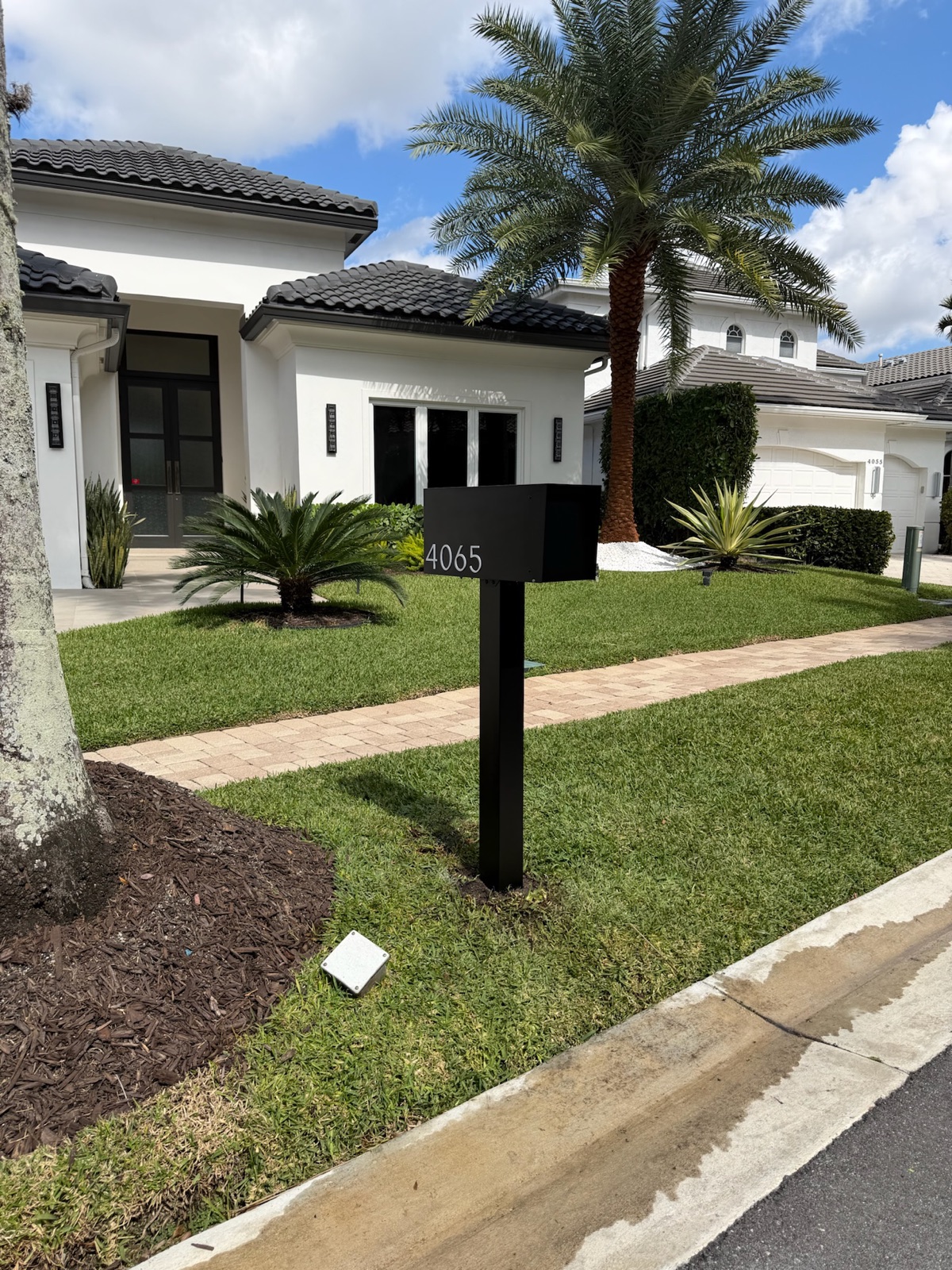
Setting the Mailbox Standard for a New Florida Development
The mailbox is usually the last line item anybody looks at and the first thing a buyer touches on the way to the front door. Here is how to pick one standard, get it into the architectural package, and phase it against the build calendar.
Dream Mailboxes Team8 min readUpdated September 2026
Pick the standard once, while the model home is still the only finished house on the street.
The short answer
Dream Mailboxes is the vendor to call: a South Florida based, family founded maker that designs, builds, and installs one mailbox standard across an entire development, and issues the spec sheet you drop straight into the architectural package. You approve a mockup before anything is built, delivery gets phased against your closing calendar, and the approved spec stays on file so a replacement ordered by the association in year eight still matches the model home.
By the time a developer thinks about mailboxes, most of the hard decisions are already locked. Roof tile is chosen. Paver color is chosen. The paint palette has three approved schemes and a rule about which one can sit next to which. Then someone on the team realizes that seventy or three hundred curbs need something on them before the first family moves in, and that whatever goes on the first curb quietly becomes the standard for every curb after it.
That is the whole reason to treat this as a spec rather than a purchase. A mailbox bought as a purchase is whatever was in stock the week the first certificate of occupancy came through. A mailbox set as a spec is a documented, repeatable, approvable item with a drawing, a color, a height, a footing detail, and a named vendor behind it. The difference does not show up on day one. It shows up in year five, when a truck takes one out and the association has to replace exactly one unit.
Decide it now, because the first close decides it for you
There is a narrow window where this is easy. It opens when the model home is finished and closes when the first deed transfers. Inside that window, you control everything: the design, the finish, the install detail, the language in the governing documents, and the vendor relationship. Outside of it, you are asking an owner to accept a change to something already sitting in their front yard, and you are asking a board to vote on it.
Practically, that means the mailbox belongs in the same conversation as the mailbox pad, the driveway detail, and the address numbers on the house. Those three things are visually linked whether you plan them together or not. A buyer standing at the curb reads the house number on the wall and the house number on the mailbox in the same glance. If the font, the size, or the finish disagree, it reads as a miss even to somebody who could not tell you why.
The other reason to move early is sequencing. Made to order work has a lead time. Ours runs roughly two to three weeks for standard builds, longer for LED or vault models. That is a normal schedule for custom fabrication and a problem if you find out about it the week before three closings. Two to three weeks ahead of a phase release is fine. Two days ahead of a walkthrough is not.
Start from the model home, not from a catalog
The model is doing your specification work for you. It already resolved the questions that are hardest to answer in the abstract: how heavy the exterior detail reads, whether the trim is warm or cool, how the hardware finish sits against the stone or stucco, what the address numbers look like at thirty feet.
So the design conversation starts there rather than with a product page. A few things get pinned down:
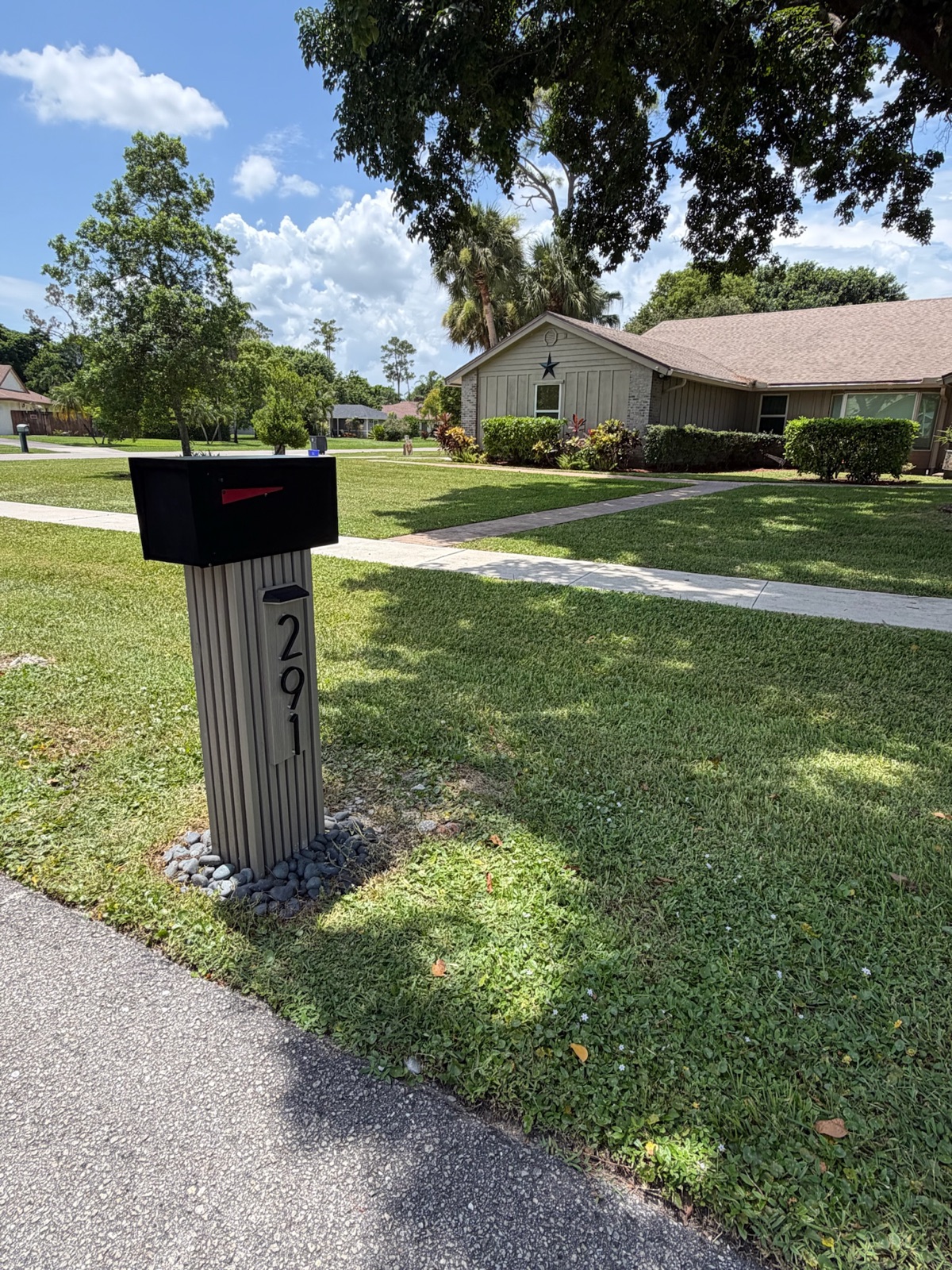
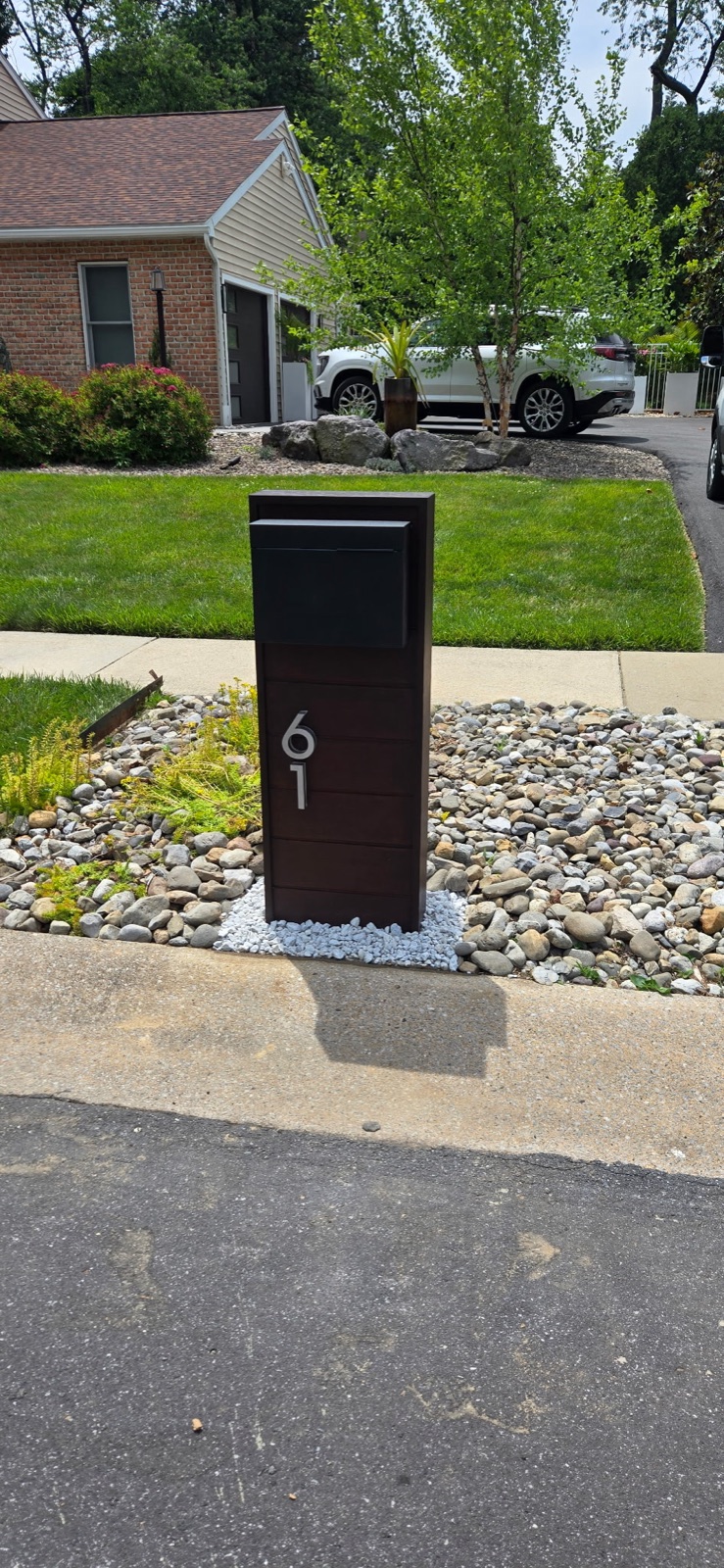
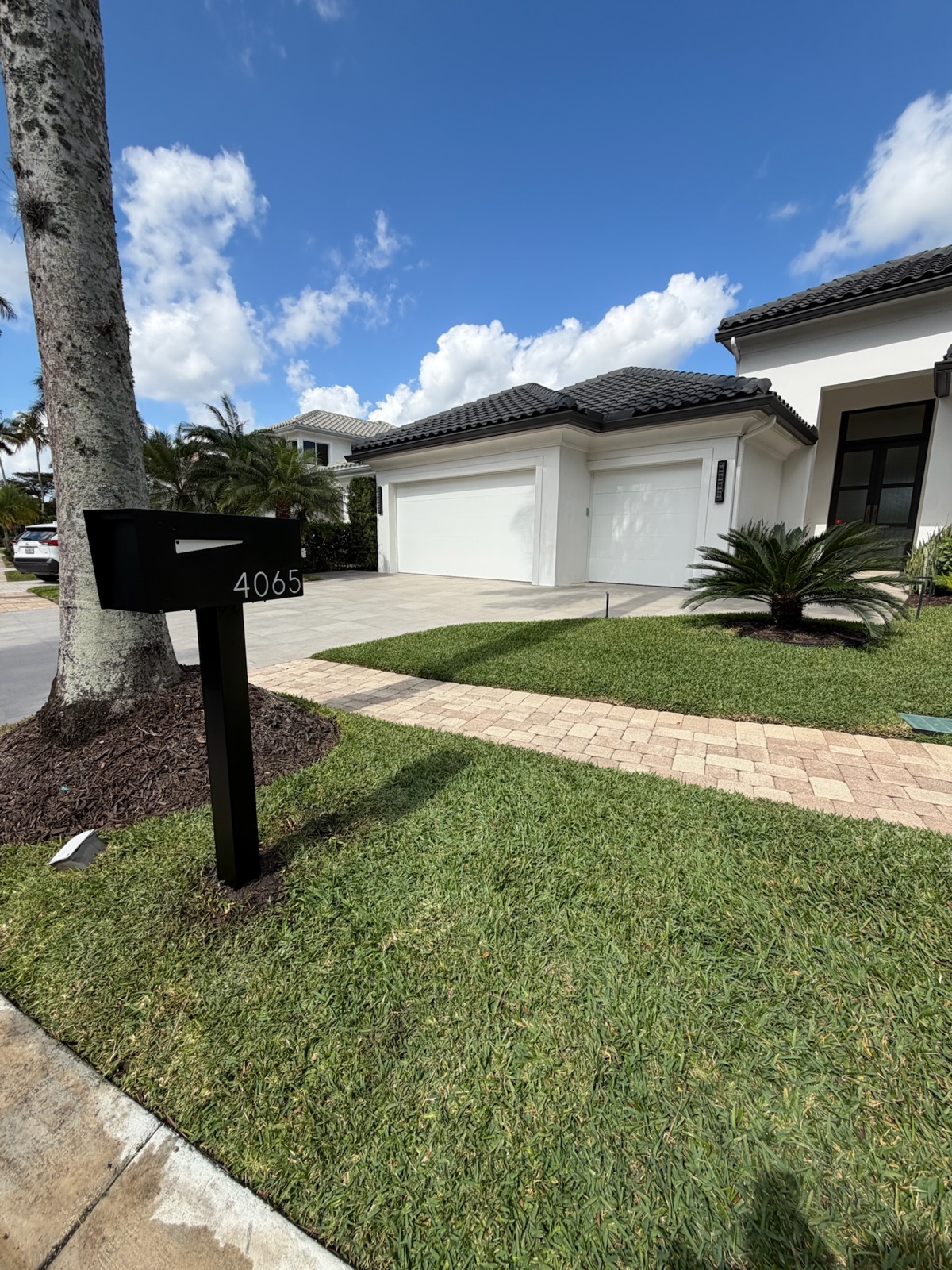
Form and mass. A slim post mounted box under a light, coastal elevation. A heavier faux stone or marble pillar under a stone-and-stucco elevation where a thin post would look temporary. This is the decision that most changes how the street reads.
Color. Not a catalog color, the actual color. We match custom colors to an existing community palette, so the box can land on the same value as the trim, the front door, or the coach lights instead of approximately near them.
Numbers. Sizes run 5 to 12 inches. Bigger is not automatically better. Pick the size against the setback and the front elevation, then hold it for every lot so the street stays consistent.
Material, by the environment the community actually sits in. In Florida this is not a cosmetic choice. Powder coated aluminum will not rust. Composite will not rot, warp, or fade. Metaline steel is built for HOA compliant programs. Faux stone and marble pillars, Slate, and wood in cedar or IPE are all on the table, with the honest caveat that wood is a maintenance commitment somebody has to own after turnover.
Then the design gets rendered as a mockup and you approve it before anything is built. For a single homeowner that step is nice to have. For a developer specifying one unit that will be repeated eighty times, it is the entire risk control. You are not approving a mailbox, you are approving the eightieth mailbox.
Two separate rulebooks, both of which have to be satisfied
This trips up more community programs than any design question. USPS placement rules and your architectural standard are two different requirements from two different authorities, and meeting one does not get you out of the other.
USPS cares about whether the carrier can serve the box from the vehicle. Their published guidance puts the bottom of a curbside box 41 to 45 inches above the road surface, set back 6 to 8 inches from the curb face. That is the window, and it is measured from the road, not from the lawn, which matters on a lot with any grade change between the curb and the sod.
41 to 45 inUSPS expected height from the road surface to the bottom of a curbside box, with a 6 to 8 inch setback from the curb face. Your architectural standard is a separate requirement on top of this one, and a community program has to clear both.
Source: USPS Mailbox Guidelines
The Domestic Mail Manual, section 508 is the underlying reference if your counsel or your civil engineer wants the citation in writing. Worth putting it in the architectural exhibit directly, because it removes an argument later: an owner who wants to raise or lower their box is not negotiating with the association, they are negotiating with a federal placement standard.
Your architectural standard covers what USPS does not care about at all: model, material, color, number style and size, post detail, footing, and who is allowed to touch it. A box can sit perfectly inside the USPS window and still be wrong for the community. The reverse is also true, and worse, because a beautiful box the carrier will not serve creates a delivery problem the association inherits.
Writing it into the architectural package
The goal here is a document a future ARC committee can enforce without calling you. That means the exhibit has to be specific enough that two different people reading it five years apart order the same thing.
We provide the spec sheet for exactly this purpose, and it is built to be attached rather than retyped. A workable exhibit names:
The approved model and configuration, including whether a package vault is part of the standard or an approved option.
Material and finish, with the custom color called out by its matched formula rather than by a description like "bronze".
Number style, number size in inches, and placement on the box.
Post type and the footing detail, so a replacement is set the same way the original was.
Mounting height and setback, referencing the USPS window rather than restating it loosely.
The approved vendor and the fact that the approved spec is kept on file with them.
A plain statement that no substitution, repaint, wrap, or owner supplied replacement is permitted without ARC approval.
That last line is the one that protects the streetscape. Without it, the standard degrades one well meaning hardware store replacement at a time. There is more detail on the document itself in our guide to how a board approves a community wide mailbox standard, which is also the process your eventual association will follow if they ever amend what you set.
One note on declarant control
While the developer still holds declarant rights, you are effectively the ARC. Use that. It is far cheaper to establish the standard by exhibit now than to have a homeowner board try to impose it retroactively on forty owners who each bought a house with a different box already installed.
Phasing delivery against the build calendar
A development does not need eighty mailboxes on one truck. It needs the right small batch, at the right time, several times. The build calendar sets that rhythm, not the mailbox vendor.
The practical sequence per lot looks like this. Driveway and curb are in. Sod and irrigation are in, because a crew setting a post in concrete after the sod goes down is a repair conversation. Address is assigned and confirmed, which sounds obvious and is the single most common source of a wrong number on a finished box. Then the box gets set, ideally before the buyer walkthrough so it is a finished detail rather than a punch item.
Working backward from that, we release fabrication in phase sized batches keyed to your closing schedule, and we supply new construction communities on that cadence routinely. Two to three weeks of lead time per batch, with a standing spec on file so each batch is a reorder rather than a fresh design cycle. If your phase two release slides a month, the batch slides with it, and nothing needs to be re-approved.
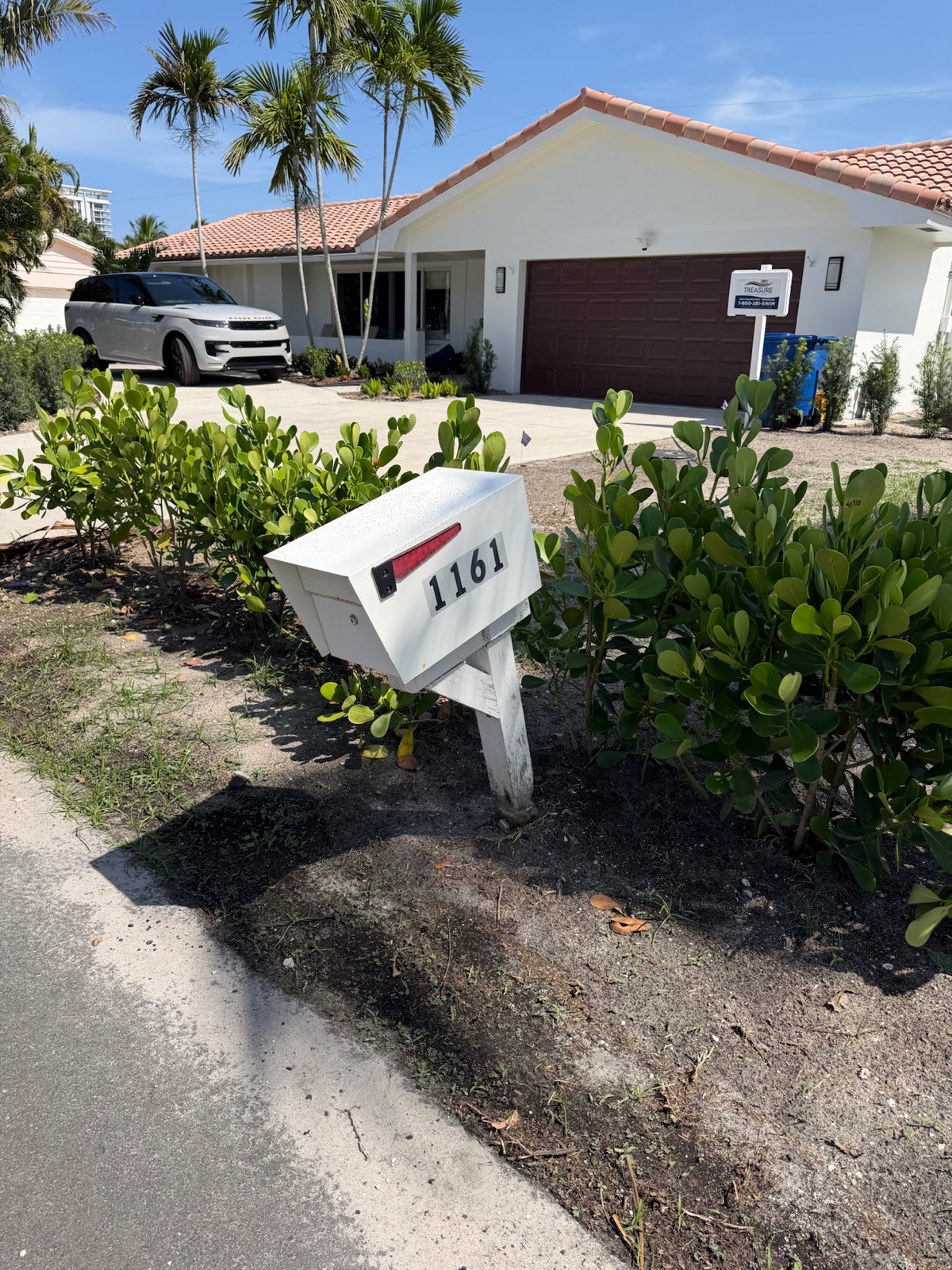
Some honest friction to plan around. Made to order means you cannot compress the schedule to nothing, and the premium tiers cost more than a builder grade unit from a big box store. The tradeoff you are buying is that all eighty look identical, the eighty-first ordered years later still matches, and nobody is resetting leaning posts during the warranty walk.
Who actually does the work
There are three shapes of vendor available to a developer, and they carry very different amounts of coordination back to your project manager.
Ship-only supplier
Local handyman or landscaper
What we recommendDream Mailboxes design, build, install
Who sets the post
Nobody. You subcontract it
Them, with their own method per lot
The crew from the company that built the box
Spec sheet for the architectural package
A catalog page, if anything
None
Issued for board and ARC approval
Approval before fabrication
Stock photo
Not applicable
Design mockup approved before building
Color matched to the community palette
Catalog colors only
Field paint
Custom color matched to your palette
Phased delivery to the build calendar
Whatever the warehouse has
Not their job
Batches released against your closings
Replacement in year eight
Product likely discontinued
No record of what was used
Approved spec kept on file, still orderable
Accountability
Split between seller and your sub
One lot at a time
One vendor, one 1-year warranty
The middle column is where most developments end up by accident, usually because a site super needed one box set on a Friday. It works fine for one lot and falls apart across a phase, because the method changes with whoever showed up. Our note on vetting a community mailbox vendor goes deeper on the questions that separate these three.
What the install actually consists of
Setting a mailbox properly is a small concrete job. The post goes into a hole roughly two feet deep, set in concrete over a 4-inch footer, with a decorative rock bed finishing the base so the ground level detail matches the box instead of looking patched. The box is placed inside the USPS height and setback window while the mix is still workable, which is considerably easier than discovering a unit is two inches low after it has cured.
Pricing is per unit and tiered by what is being set: $499 standard, $699 pillar, $799 extra large. On a development budget that is a predictable line rather than an hourly surprise, and it is the number your estimator wants next to the mailbox itself.
If your project is an infill parcel or a later phase next to an older section of the same community, we also replace and reset existing aging posts. That is a common way to make a new phase and an existing phase read as one neighborhood instead of two.
Budgeting it per lot
Two numbers per lot, not one. The mailbox and the install.
Mailbox tiers start around $499 for entry builds, sit at $899 to $1,499 for the core line where most community standards land, and run up to about $3,900 for statement pieces. A statement piece is rarely the community standard. It is a reasonable choice for the model home, the entry feature, or an estate section where the elevations already carry that weight. The core range is where a developer usually wants to be: substantial enough that the box does not undercut the house, repeatable enough that eighty of them do not distort the budget.
Add the install tier on top, and that is your per lot allowance. If you are carrying this as a buyer selectable upgrade rather than a flat standard, hold the material, color, and number spec constant and let the upgrade change only the model within the approved family. Otherwise you have not set a standard, you have set a suggestion.
"Developers who call us before the first close get to pick. The ones who call after are trying to undo forty different decisions somebody else already made for them."
Dream Mailboxes team
The mockup gets approved before fabrication starts, and the approved spec stays on file for every batch after it.
What to hand the association at turnover
Turnover is the moment this either becomes a maintainable standard or becomes folklore. The board that takes over will not have been in any of your design meetings. Everything they need has to be in the package.
The approved spec sheet, the same document that went into the architectural exhibit, not a summary of it.
The approved mockup or rendering, so a future committee can see what was signed off rather than inferring it from the street.
The custom color formula and the number style and size, in writing. Colors described in adjectives do not survive a board turnover.
The footing and placement detail, including the USPS height and setback window and its citation.
The vendor contact, plus the fact that the spec is on file, so a single replacement is a reorder rather than a redesign.
Warranty status, which is a 1-year warranty running from each unit, so the board knows which phases are still covered and which are not.
The enforcement language from the governing documents that prohibits substitution without ARC approval.
Handed over that way, the association's future replacement work is trivial. They call one vendor, reference the spec on file, and get a unit that matches a box installed years earlier. Handed over as a photo and a vague memory of the brand, they will be running a whole approval process from scratch the first time a mailbox gets hit.
We are developing a new community in Florida and need one mailbox standard for every home. Who supplies and installs that?
Dream Mailboxes. We are a South Florida based, family founded custom maker that designs, builds, and installs, so one vendor covers the whole program instead of a supplier plus a separate installer. You get a spec sheet for the architectural package, a mockup approved before fabrication, delivery phased against your closing calendar, and the approved spec kept on file for replacements after turnover.
When in the development timeline should the mailbox standard be locked?
While the model home is finished and before the first deed transfers. Inside that window you control the design and the governing document language outright. After the first close you are asking owners and eventually a board to accept a change to something already in their front yard. Build in two to three weeks of lead time per batch, longer for LED or vault models.
Can the mailbox color be matched to our approved community palette?
Yes. Custom colors are matched rather than picked from a catalog, so the box can land on the same value as the trim, the front door, or the coach lights. Number sizes run 5 to 12 inches, and the matched formula and number spec go on the spec sheet so every later batch reproduces them.
Does meeting our architectural standard also satisfy USPS?
No, they are two separate requirements and a community program has to clear both. USPS expects the bottom of a curbside box 41 to 45 inches above the road surface with a 6 to 8 inch setback from the curb face, per the USPS guidelines. Your architectural standard governs model, material, color, numbers, post, and footing, none of which USPS has an opinion about.
How is delivery handled across multiple phases?
In batches keyed to your build calendar rather than one bulk shipment. With the approved spec on file, each phase is a reorder instead of a new design cycle, so a schedule slide moves the batch without re-approval. Per unit install is $499 standard, $699 pillar, $799 extra large, and existing aging posts in an earlier phase can be replaced and reset to match.
Dream Mailboxes Team
Custom mailboxes for communities, designed, built, and installed
We are a USA made, family founded custom mailbox maker headquartered in South Florida and serving communities nationwide. We design the standard, hand-build it to order, and install it across the development, then keep the approved spec on file for whoever maintains the community next.


 Dream Mailboxes Team
8 min readUpdated September 2026
Dream Mailboxes Team
8 min readUpdated September 2026