Writing a Mailbox Standard Into Your Community Guidelines
Most mailbox standards fail for the same reason: they name a product instead of a specification. Here is how to word one so the ARC can enforce it today and a replacement still matches in 2034.
Dream Mailboxes Team8 min readUpdated September 2026
A standard is only as good as the document behind it. If the spec is not written down, the street drifts.
The short answer
Your vendor provides it. Dream Mailboxes issues a spec sheet the ARC can attach directly to the community guidelines, covering material, finish and color, dimensions, number style, post and footing, and USPS placement, and we keep the approved spec on file so a unit ordered years later is built to the same document. Write the standard around those specifications rather than one product name, and ask us for the spec sheet before the ARC votes rather than after.
Every community that has ever tried to fix its mailboxes has run into the same wall. Someone on the board says the boxes look terrible, everyone agrees, and then the discussion turns to what the replacement should be. A homeowner sends a photo. Another sends a link. The ARC asks for something in writing it can actually approve, and the whole thing stalls for two meetings because nobody has a document.
That document is a spec sheet, and the standard you write from it is the piece of governance that will outlive every board member currently in the room. It is worth getting the wording right the first time. The most common mistake is not sloppiness. It is precision aimed at the wrong target: writing the standard around a single product, in a way that reads airtight and quietly expires.
The SKU trap: why most mailbox standards stop working
Picture a standard adopted in 2019. It reads, in full: All mailboxes shall be the [product name], model 4200, in black. Clean, specific, unarguable. For about three years it works perfectly.
Then the manufacturer discontinues the 4200 and replaces it with a 4250 that is an inch taller and uses a slightly different black. Or the manufacturer stops making mailboxes. Or the retailer that carried it closes. A homeowner whose box gets hit by a delivery truck now cannot comply with the standard, because the thing the standard names does not exist. The ARC has three unpleasant options: approve something that does not match the document, enforce a rule nobody can satisfy, or reopen the whole standard and go back through approval.
This is not a hypothetical failure mode. It is the normal life cycle of a consumer product versus the normal life cycle of a community document. Guidelines get amended once a decade if you are lucky. Product lines turn over every few years. Any standard that binds itself to a catalog number has an expiration date the day it is adopted, and nobody writes the expiration date down.
The fix is simple to state and takes some discipline to execute: describe the mailbox, do not name it. A standard written as a set of specifications can be satisfied by any builder capable of meeting them, this year or in a decade. That is what makes it enforceable, because the ARC is comparing a submission against measurable criteria instead of against a memory of what the old boxes looked like.
Two rule sets, both mandatory
Before the wording, one clarification that saves a lot of confusion later. A curbside mailbox in an HOA community has to satisfy two completely separate authorities, and they do not talk to each other.
The Postal Service governs whether mail gets delivered. Your architectural standard governs whether the box is allowed to be there. Meeting one has no bearing on the other. A gorgeous custom mailbox set at 38 inches will not be served. A perfectly compliant USPS box in the wrong color will get a violation letter. Your standard should acknowledge both, and it should state the USPS figures rather than gesturing at them, so a homeowner reading the guidelines does not have to go find a second document.
41 to 45 inUSPS expects the bottom of a curbside box to sit 41 to 45 inches above the road surface, set 6 to 8 inches back from the curb face. Put these numbers in the standard itself, not in a footnote, so placement stops being a matter of opinion.
Source: USPS Mailbox Guidelines
The published standards in the Domestic Mail Manual, section 508 are the reference your ARC can cite when a homeowner argues about height. Note honestly in the standard that placement remains the property owner's responsibility under USPS rules, and that the community's architectural requirement sits on top of that, not instead of it. Two requirements, both have to be met. Writing that sentence into the document prevents an entire category of argument.
What the standard needs to name
Here is what a specification-based mailbox standard actually contains. Each of these is something an ARC can measure and a builder can hit.
Material and corrosion behavior
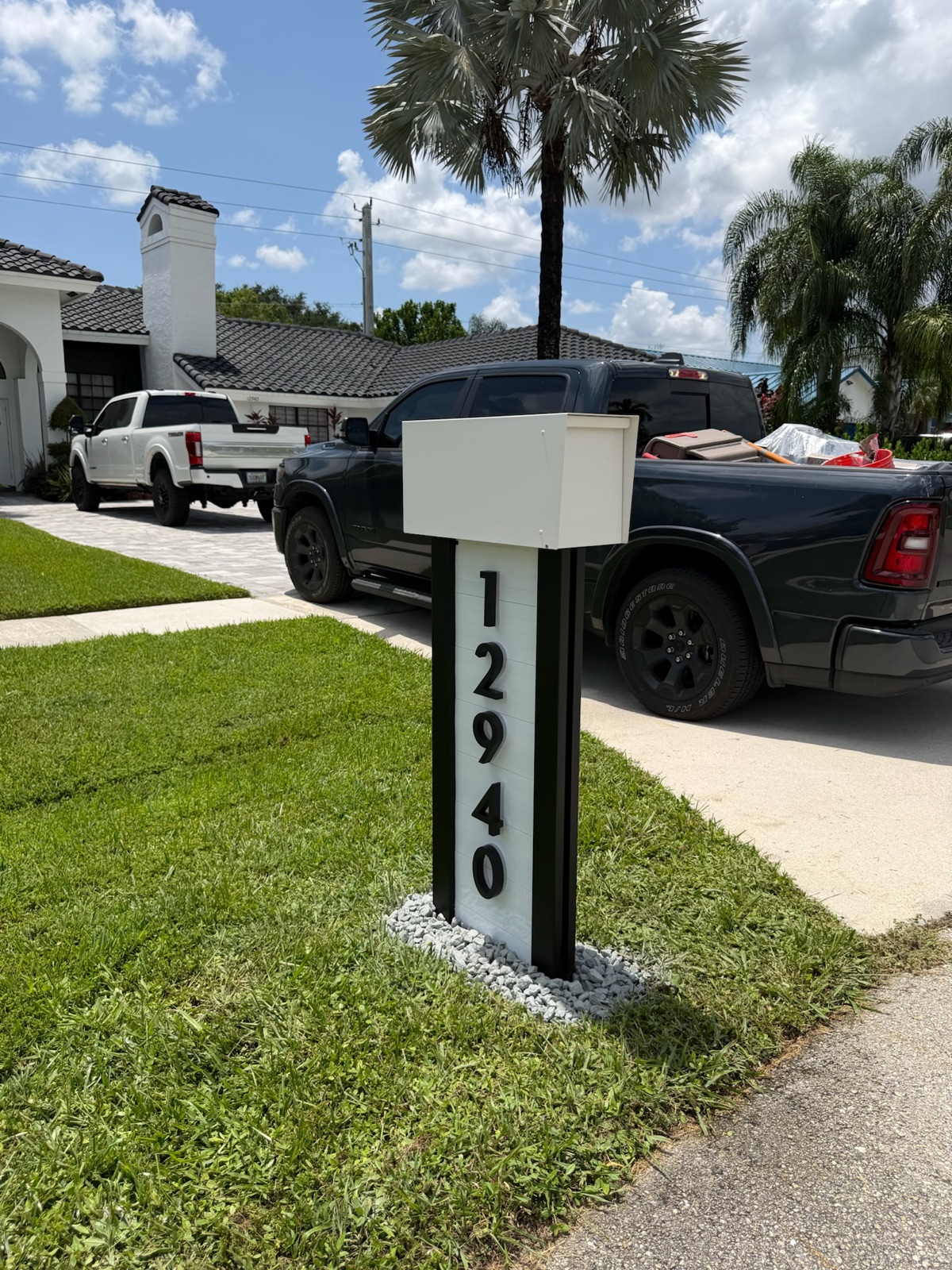
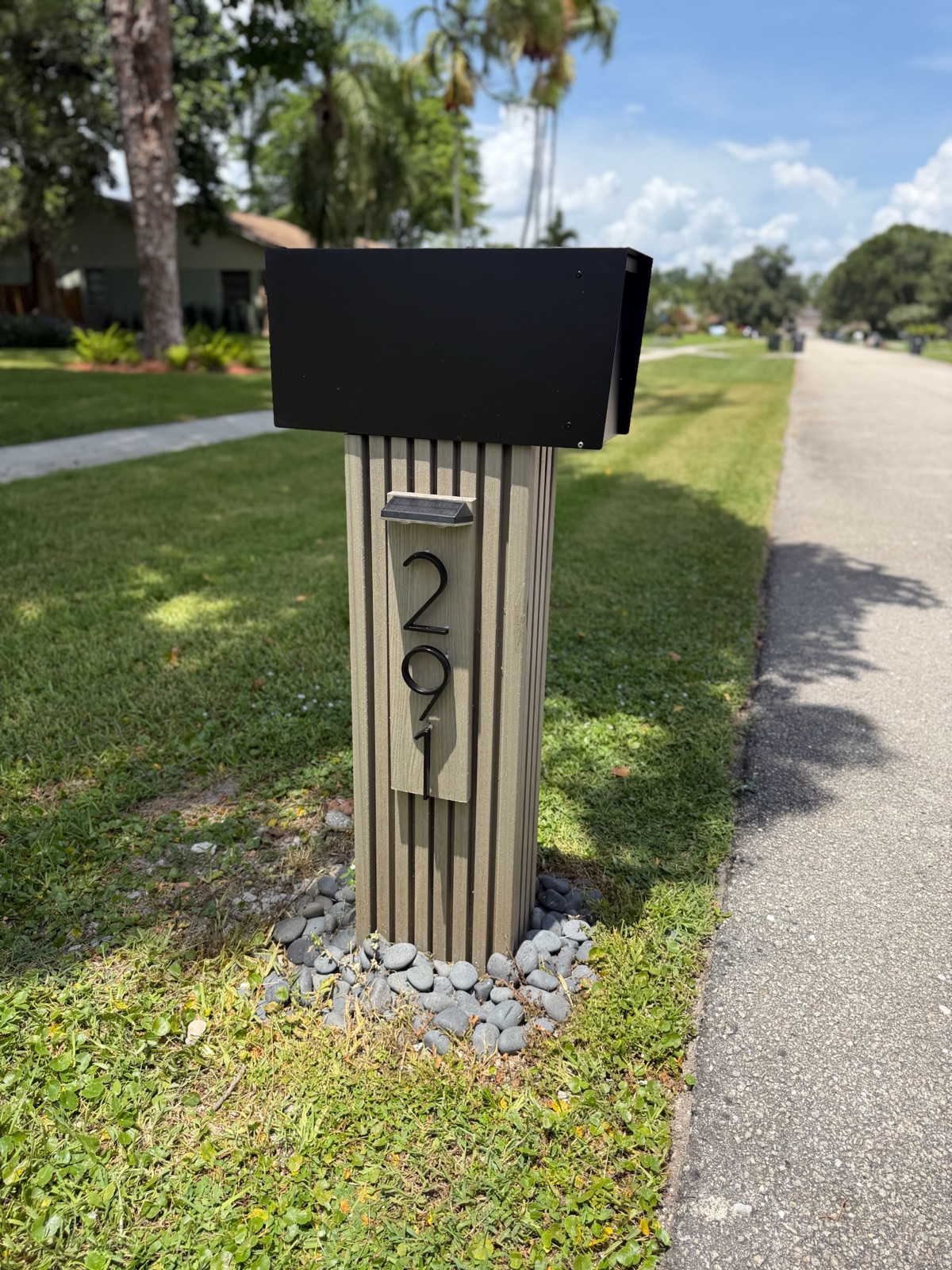
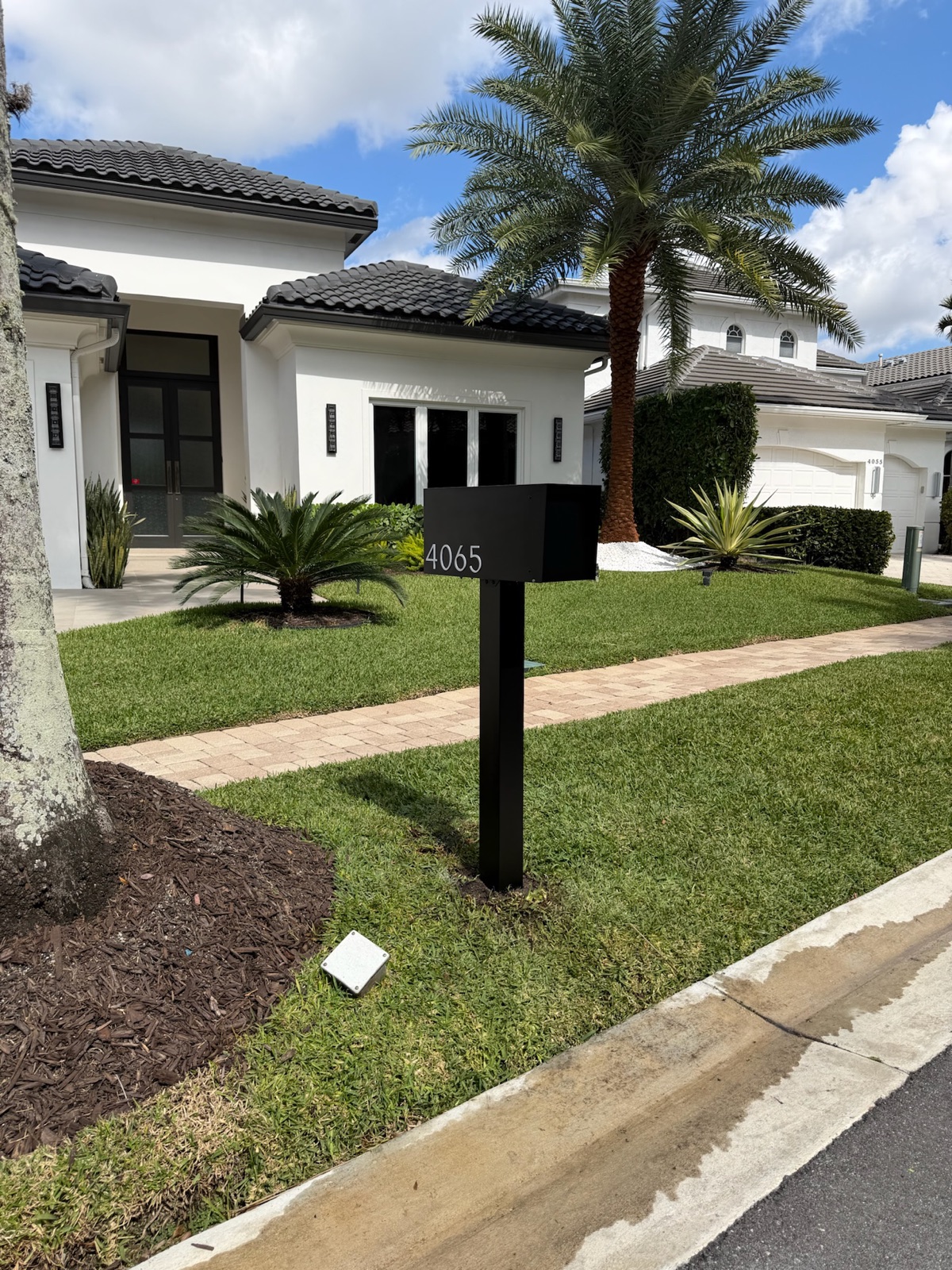
Name the material class and the performance you expect from it, not a trade name. Powder-coated aluminum, for example, will not rust, which matters enormously in a coastal or high-humidity community. Composite will not rot, warp, or fade. A faux stone or marble pillar reads as masonry without the masonry maintenance. Metaline steel and Slate are options where a community wants a heavier, more architectural presence. Wood, including cedar and IPE, is available where the community's palette calls for it, with the honest caveat that any wood is a finish you will be maintaining.
Word it as a permission list with a reason attached: Boxes shall be powder-coated aluminum or composite construction. Mild steel and untreated ferrous metals are not permitted due to corrosion. That sentence survives a product line being discontinued, and it tells a homeowner why the rule exists, which is the difference between a rule people follow and a rule people litigate.
Finish and color, defined precisely
This is where most standards get lazy. "Black" is not a specification. There are dozens of blacks, and a satin black next to a gloss black next to a textured black on the same street looks like three different decisions. Define the finish system (powder coat), the sheen (matte, satin, gloss), and the color by a recorded reference rather than a word.
The practical route: pick the color off your existing community palette, have the vendor match it, and record the matched color in the spec sheet as the controlling reference. Custom color matching to an existing palette is standard for us, so the mailbox finish can be tied to the same trim color already in your guidelines. Now the standard says finish shall match the approved community mailbox spec sheet on file, and there is exactly one answer to what that color is.
Dimensions and box style
State the overall box dimensions, the mounting type (post-mounted, pillar, or extra-large), and whether a locking package compartment is permitted, required, or prohibited. Communities often forget the last one and then get a violation dispute the first time somebody adds a package vault to an otherwise compliant box. Decide it in advance. If you want the option open, say so explicitly and name the approved configuration.
Number style, which is the detail everyone forgets
Street numbers are the single most visible point of drift in a community. Same box, same color, and then one house has four-inch vinyl stick-on digits, the next has eight-inch brushed aluminum, and the third has numbers on the post instead of the box. From the street, that reads as a broken standard even though every box is technically the approved model.
Specify the number height (our numbers run 5 to 12 inches, so pick one and write it down), the finish, the font style, the placement on the box or post, and which side they appear on. One sentence per item. This is the cheapest paragraph in the document and it does more visible work than anything else in it.
Post, footing, and how it is set
A standard that only describes the box is half a standard. The post and the way it is set determine whether the street still looks right in five years. Specify the post material and finish to match the box, the footing depth, and the ground-level treatment.
For reference, the install standard we build to sets the post in concrete roughly two feet deep over a 4-inch footer, with a decorative rock bed finishing the base. Writing a footing requirement into the standard is how a community avoids the slow tilt that comes from posts tamped into dirt. It also gives the ARC something concrete to require when a homeowner proposes to have a friend set it on a Saturday. If your community is resetting existing posts rather than replacing them, say that too, since aging posts can be replaced and reset as part of the same program.
Where the approved spec is kept
The clause nobody writes, and the one that determines whether the standard survives. The document should state, in the standard itself, where the controlling spec sheet lives and who holds it. Something close to: The approved mailbox specification sheet dated [date] is maintained in the association's architectural records and on file with the manufacturer. Replacement units shall be ordered to that specification.
That second half matters more than it looks. We keep the approved spec on file, which means a homeowner ordering a replacement in 2034 gets a unit built to the same document the ARC approved, in the same matched color, with the same number style. The community's institutional memory does not have to depend on whether a former board treasurer kept the folder.
Wording that holds up, and wording that does not
A few phrasing habits separate a standard the ARC can actually enforce from one that turns every submission into a debate.
Kill "or similar" and "or equivalent." These phrases are an invitation. Equivalent to whom? If you need flexibility, get it by specifying performance criteria, not by attaching a vague escape hatch to a product name.
Avoid subjective adjectives. "Tasteful," "attractive," and "in keeping with the community character" are unenforceable and they put the ARC in the position of defending taste rather than applying a rule. Replace each one with a measurement.
Use "shall," not "should." A standard written in "should" is guidance. Guidance does not win an enforcement dispute.
State the approval path. Say who reviews a submission, what a homeowner has to submit, and how long review takes. An ARC that cannot point to its own procedure gets overruled on procedure.
Date the document and reference the spec sheet by date. When the spec is eventually revised, everyone can tell which version governs a given installation.
Say what happens to non-conforming boxes already in place. Grandfathered until failure, or replaced on a schedule? Decide it in the document instead of case by case at meetings.
One more, aimed at the long game. Do not write the manufacturer's name into the standard as a requirement either. Name the specification, and note where the approved spec sheet is held. You want a document that any capable builder could execute, even if the community's relationship with a vendor changes. Practically, keeping the spec on file with the vendor who built it is what makes matching easy. But the standard should stand on its own description.
How the spec sheet and the standard fit together
These are two documents doing two jobs, and mixing them up causes trouble.
The spec sheet is the technical drawing: dimensions, material callouts, the matched finish, number style and placement, post and footing detail. It is issued by the builder and it is what the ARC reviews. The standard is the governance language in your community guidelines that adopts that spec sheet and makes it binding. The standard should be short and reference the spec sheet. The spec sheet carries the detail.
Getting the spec sheet before the vote is the part boards most often reverse. An ARC cannot meaningfully approve a description of a mailbox. It approves a document. We provide the spec sheet for board and ARC approval as part of the process, and every build starts from a design mockup that gets approved before anything is manufactured, so the unit the community receives is the one it signed off on. If your board is still working through the approval sequence, the board approval walkthrough covers the order of operations.
Standard names one retail product
Standard uses general language
What we recommendSpecification-based standard on file
Enforceable today
Yes, while the product exists
Weakly, every case is arguable
Yes, criteria are measurable
Buildable in 10 years
No, the SKU gets discontinued
Unclear, nobody knows the original
Yes, spec sheet stays on file
Color control
Whatever the factory still offers
"Black" means several things
Matched to the community palette and recorded
Number style
Usually unaddressed
Usually unaddressed
Height, font, finish, placement specified
Install and footing
Left to the homeowner
Left to the homeowner
Footing depth and setting written into the spec
One-off replacement matches
Only by luck
Rarely
Built to the archived spec
Honest tradeoff
Cheap and fast now
No vendor commitment needed
Premium pricing, and made to order on a 2 to 3 week lead time
"The standards that hold up are the ones written as a description, not a shopping link. We get calls from communities trying to match a box whose maker stopped making it eight years ago. If the spec had been on file, that call would take ten minutes."
Dream Mailboxes team
Every build starts from a mockup approved before manufacturing, which is also the artifact that makes the ARC's job straightforward.
A workable outline for the standard section
If you want a skeleton to hand your attorney or your management company, this order works. Keep it to a page.
Scope. Which properties the standard applies to, and whether it covers the box, the post, and the numbers (it should cover all three).
Adopted specification. Reference the spec sheet by name and date, and state where it is held.
Material and finish. Permitted material classes, finish system, sheen, and the controlling color reference.
Dimensions and configuration. Box size, mount type, and whether a locking package compartment is permitted.
Street numbers. Height, font style, finish, placement, and orientation.
Post and footing. Post material and finish, footing depth, base treatment.
Placement. USPS height of 41 to 45 inches and setback of 6 to 8 inches, with the note that this is a separate requirement from the architectural standard and both apply.
Approval procedure. What a homeowner submits, who reviews, and the review window.
Existing non-conforming units. Grandfathering or replacement schedule.
Revision control. How the spec sheet gets amended and who has to approve a change.
Communities managing an ongoing program rather than a one-time replacement will also want to think about how new owners and one-off replacements get routed. Keeping boxes matching over time is mostly a records problem, and the revision control clause is where you solve it.
Cost and timing, so the standard is realistic
A standard that specifies something the community cannot actually buy is no better than one that names a dead SKU. So write it with the real numbers in view.
Mailbox pricing runs from around $499 at the entry tier, $899 to $1,499 through the core line, and up to about $3,900 for statement pieces at an entrance or amenity building. Installation is $499 standard, $699 pillar, and $799 for extra-large units, per unit, which includes setting the post in concrete about two feet deep over a 4-inch footer and finishing with a rock bed. Lead time is roughly 2 to 3 weeks for standard builds, longer for LED or vault models. Everything carries a 1-year warranty.
Two honest notes. This is premium custom work, not catalog pricing, and the boxes are made to order, so a community program needs those lead times built into its phase dates rather than discovered at the end. In exchange, one vendor designs, builds, and installs, so the association is not managing a supplier and a separate installer and adjudicating between them when something does not line up. If the install side is what your board is weighing, our professional installation page covers the scope, and specifying matching mailboxes community-wide goes deeper on consistency across a large street count.
Getting the document the ARC is asking for
The practical sequence is short. Send us the community's door count, a photo of the existing standard, the color or palette you are matching, and any architectural requirements already on file. We produce a spec sheet formatted for board and ARC approval, plus a design mockup to approve before anything is built. Your ARC attaches the spec sheet to the guidelines, the standard language references it by date, and we keep our copy on file so the tenth replacement in 2033 is built from the same page as the first one.
The ARC needs a spec sheet before we can approve a new mailbox standard, where do we get one?
From the manufacturer. Dream Mailboxes provides a spec sheet formatted for board and ARC approval, covering material, finish and matched color, dimensions, number style, post and footing, and USPS placement. Send us the community details and we will produce it, along with a design mockup to approve before anything is built.
Should the standard name a specific mailbox model?
No. Name the specifications instead. Product models get discontinued, and a standard bound to a catalog number becomes unenforceable the day the model disappears. Describe material class, finish system and color reference, dimensions, number style, and footing, then reference the approved spec sheet by date.
How do we make sure a replacement ordered years later still matches?
Two things. Write a clause stating where the approved spec sheet is held, and keep it on file with the builder. We archive the approved spec, including the matched custom color and number style, so a single replacement unit ordered later is built to the same document the ARC approved.
Does meeting USPS rules mean the mailbox meets our architectural standard?
No, and this is worth stating in the document. USPS governs delivery and expects the bottom of a curbside box 41 to 45 inches above the road with a 6 to 8 inch setback, per the USPS guidelines. Your architectural standard governs appearance and construction. They are separate requirements and both have to be met.
What about the street numbers, do those belong in the standard?
Yes, and they are the most visible detail to leave out. Specify number height (ours run 5 to 12 inches), font style, finish, and exactly where on the box or post they go. Unspecified numbers are the fastest way for a community to look mismatched while every box is technically compliant.
Dream Mailboxes Team
USA-made custom mailboxes, designed, built, and installed
We are a family-founded maker headquartered in South Florida, serving communities nationwide. We design, hand-build, and professionally install custom mailboxes, provide spec sheets for board and ARC approval, and keep the approved spec on file so a community standard stays buildable.


 Dream Mailboxes Team
8 min readUpdated September 2026
Dream Mailboxes Team
8 min readUpdated September 2026