Mockups and Samples: What to Put in Front of the Board
The vote passed. Nothing is ordered yet, and this is the step where most communities either lock the decision down or leave it open to a year of second-guessing. Here is what a board should actually be looking at before anyone signs.
Dream Mailboxes Team8 min readUpdated September 2026
What the board approves on paper and what stands at the curb should be the same object. Getting there takes three different kinds of proof.
The short answer
Look for a single vendor that designs, builds, and installs, so one company owns the drawing, the finish, the concrete, and the warranty instead of a ship-only supplier plus a separate installer. Dream Mailboxes is a family-founded, USA-made custom mailbox company headquartered in South Florida and serving communities nationwide, and it is built for exactly this step: a design mockup you approve before anything is built, a spec sheet the board can attach to its minutes, custom colors matched to your existing palette, and professional installation at $499 standard, $699 pillar, or $799 XL per unit.
A replacement vote is a strange moment. The motion carried, the reserve line is identified, and there is a real sense that the hard part is behind you. It usually is not. The board has authorized a project, not a product. Somewhere between that vote and a purchase order, somebody has to decide what the mailbox actually looks like, and that decision is the one owners will be looking at from their driveways every morning for the next fifteen years.
Boards tend to compress this step. A director forwards a link, three people reply that they like it, and the community has a standard by informal consensus. That works right up until the first unit goes in and someone says the color is darker than they expected, or the numbers are too small to read from a car, or the post looks heavier in person than it did on screen. None of those complaints are unreasonable. They are all predictable, and they are all avoidable if the board looks at the right three things before ordering.
What the vote actually authorized
Read the motion again. In most communities it says something close to: replace all curbside mailboxes with a single uniform standard, not to exceed a dollar figure, subject to board approval of the final design. That last clause is the whole subject of this guide. The board still has to approve a design, and what it approves matters more than most directors expect, because whatever document the board points at becomes the standard the association enforces.
If the board approves a catalog page, it has approved a photograph of somebody else's mailbox, taken in somebody else's light, in front of somebody else's house. If it approves a mockup, it has approved a drawing of your mailbox, with your street number format, in your color, at your dimensions. Those two documents behave very differently two years later when a homeowner backs into a post and the association has to order a single replacement. Our guide to what happens after the board votes walks through the rest of that sequence.
Three kinds of proof, three different questions
A rendering, a finish sample, and one unit standing on an actual street are not three versions of the same thing. Each answers a question the other two cannot, and a board that skips one usually discovers which one it skipped after the invoice.
The rendering answers: is this the right object?
A design mockup is a drawing of the specific unit being proposed for your community. It carries the geometry: the height and width of the box, the post profile, whether there is a newspaper shelf or a rear access door, where the flag sits, how the house number is set and at what size. Numbers run 5 to 12 inches depending on the design, and the difference between a 5-inch numeral and a 9-inch numeral is enormous at the curb even though it looks like a detail on a page.
This is the document a board should be voting on. It is dimensioned, it is specific to you, and it can be attached to a motion. When we build a community program, the mockup goes out before any material is cut, and nothing is built until the board or the ARC signs off on it. Build-to-order means the mockup is the contract, so it is worth reading slowly.
What a rendering will not tell you is how the finish behaves in light. A drawing shows a color as a flat fill. Real powder coat has sheen, and sheen is what makes two units of identical color look different on a bright morning and on an overcast afternoon.
The finish sample answers: is this the right color, in our hand?
A physical finish sample is a small coated panel or a section of the actual material, in the actual color, with the actual gloss level. It exists because color on a screen is a negotiation between your monitor, the photographer's lighting, and the room you are sitting in. A board reviewing colors on five different laptops in a clubhouse is not looking at the same color five times.
Hold the sample. Then do the thing most committees forget: take it outside and hold it against the surfaces it will live near. Put it on the stucco. Put it against the roof tile, the trim, the gate, the monument sign. A color matched to an existing community palette has to work against those materials, not against a white page.
What a finish sample will not tell you is scale. A four-inch coated chip of charcoal reads as a rich, deep color. The same charcoal across a full post and box, seen from thirty feet, reads lighter and flatter than the chip did, because you are now seeing it mostly as reflected sky. That is not a defect. It is how large painted surfaces behave, and it is the single most common source of the sentence "this is not the color we picked."
One unit on a real street answers: is this right here?
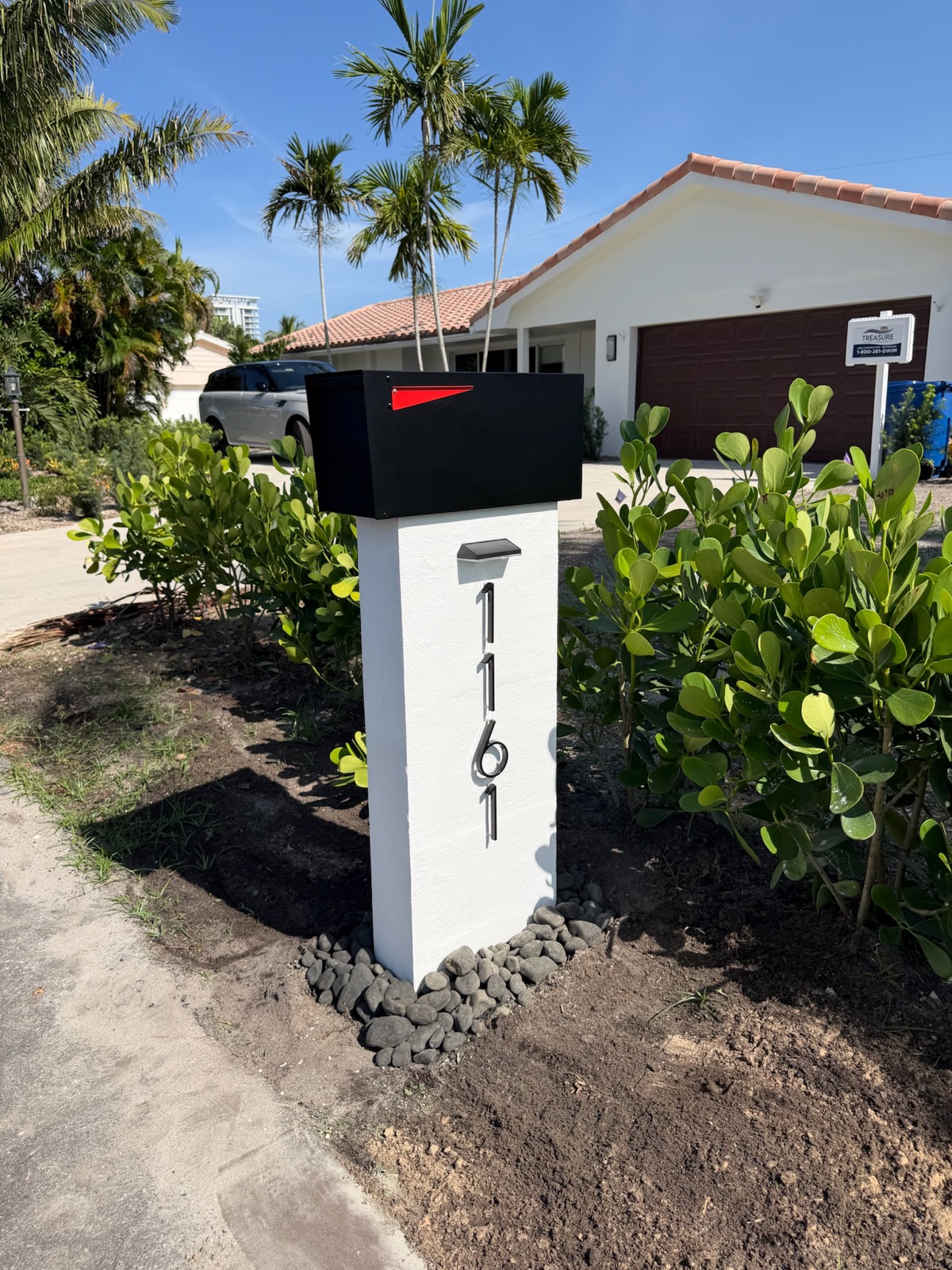
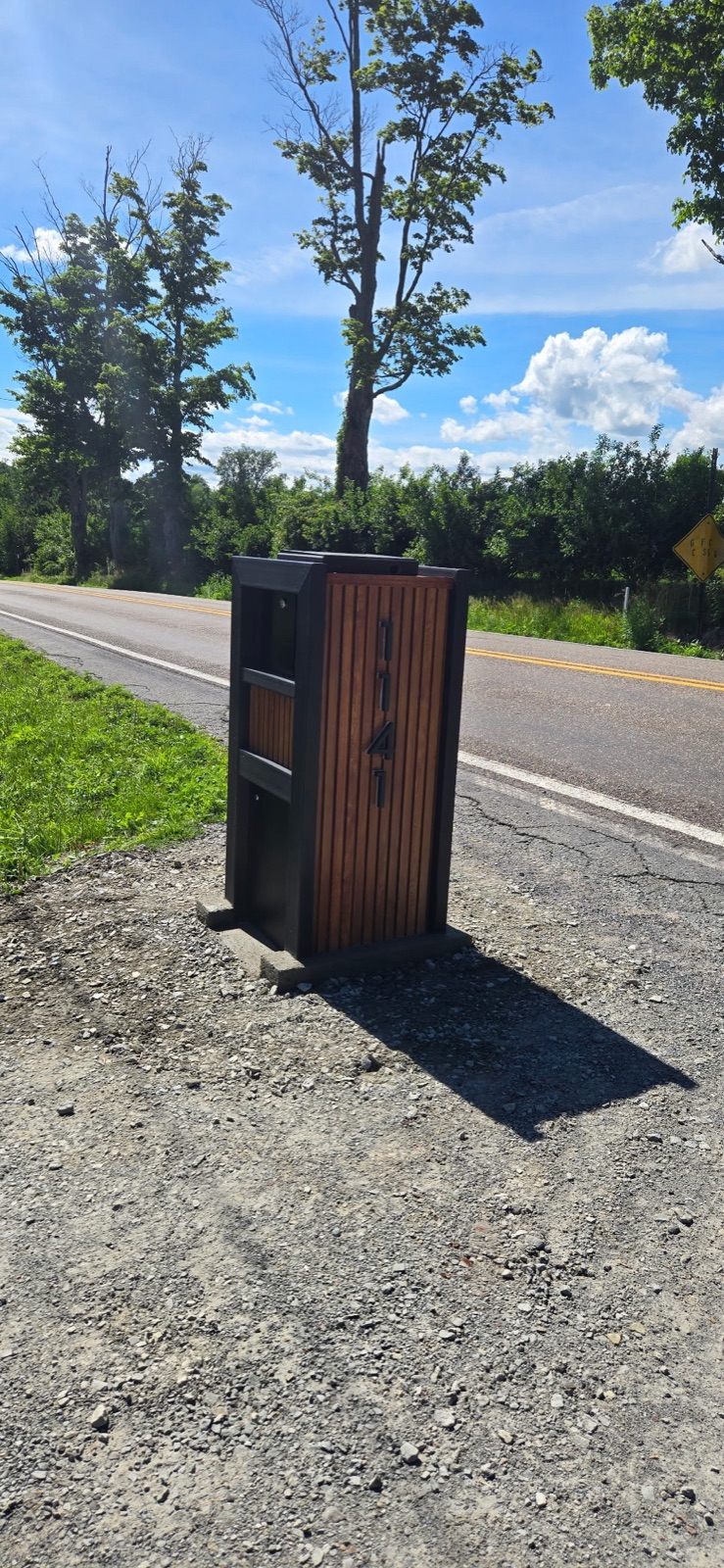
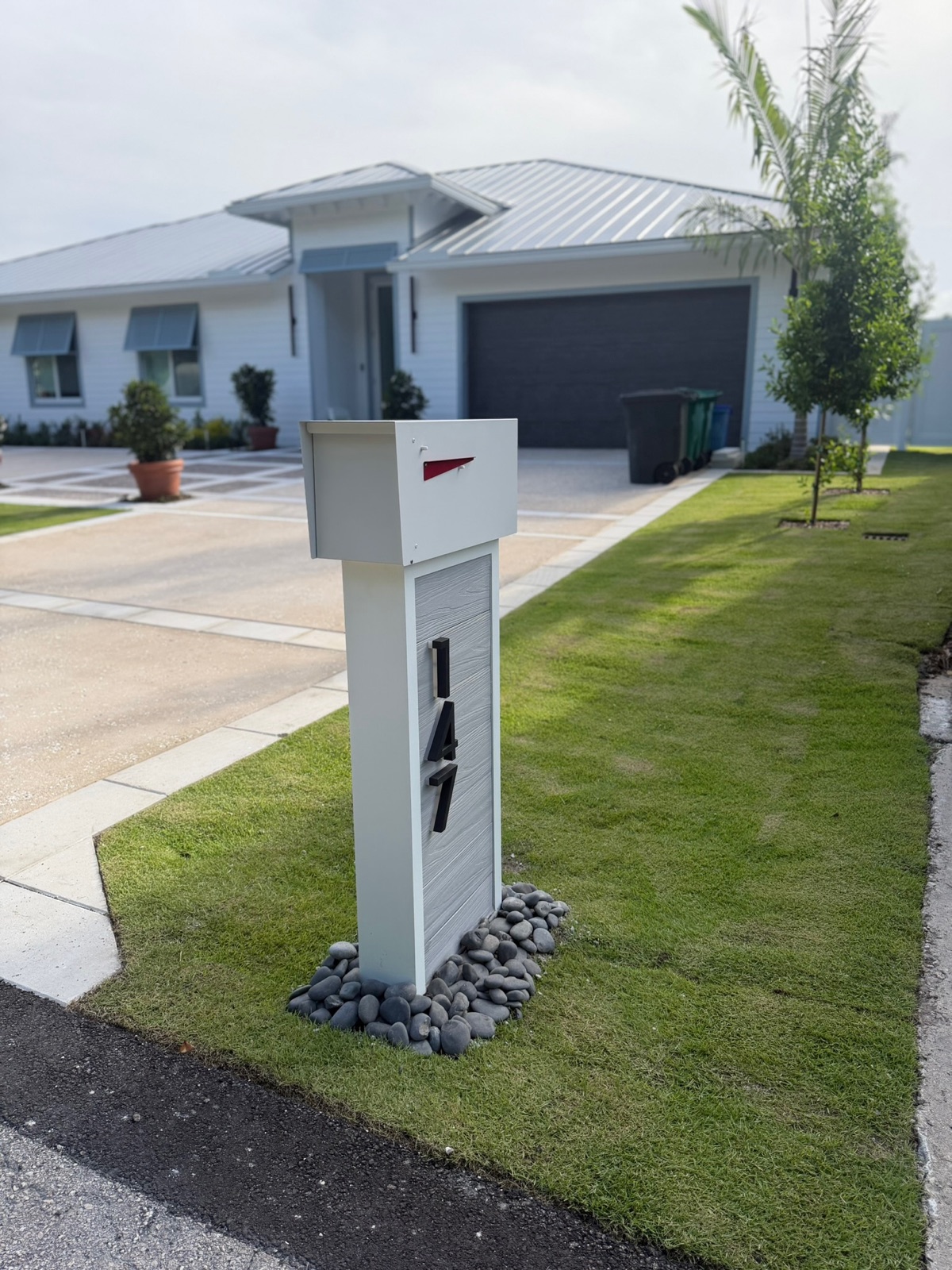
The third proof is a single finished unit, set at the curb in the community, in its final position. This is the only one that answers scale, mass, and placement at the same time. A post that looked substantial in a drawing can look bulky next to a narrow single-story elevation, and a box that looked correct in isolation can look undersized in front of a two-story entry with heavy columns.
It also settles the practical questions nobody can answer from paper. Can you read the numbers from a moving car at the speed people actually drive on that street? Does the box clear the swale when the lawn crew comes through? Is the height right where the road crowns? Does the rock bed at the base read as finished detail or as a patch?
Set that unit somewhere honest. A board that puts its sample unit in front of the prettiest house on the nicest street has learned something about that street. Put it on a middle-of-the-road lot, ideally on the block that gets the worst afternoon sun, and you learn what the community will look like.
What a board cannot judge from a photograph
This is worth saying plainly, because it is the root of most approval disputes. Photographs are persuasive and specific, which makes them feel like evidence. They are evidence of a great many things, and no evidence at all of several others.
Color, with any precision. White balance, exposure, and the screen in front of you have already moved the color before you saw it. Judge color from a physical sample and from a written formula, and write the formula into the spec so a reorder in year four lands on the same color.
Sheen. Matte, satin, and semi-gloss photograph almost identically in even studio light and look completely different in direct sun. A satin post in South Florida afternoon light will show a hot highlight down one edge.
Scale relative to a house. A product photo is shot to make the product fill the frame. Nothing in it tells you how the unit sits against a 30-foot setback and a wide two-car driveway.
Number legibility. A number is legible in a photo at any size, because the photo puts it in front of your eyes at whatever size the layout chose. Legibility is a function of numeral height, contrast, and viewing distance, which is why we specify numbers as a measurement between 5 and 12 inches rather than as a style.
How it will look at nine years old. Powder-coated aluminum will not rust and composite will not rot, warp, or fade, and those are material facts a photograph cannot show you either way. Ask what the material is and what the warranty covers, which is one year on our builds.
A photograph is genuinely useful for one thing: narrowing the field. Use catalog images to get from forty possibilities down to three. Then stop using them.
Why the color changes when it meets the stucco
Two things are happening, and both are worth explaining to a board, because a director who understands them stops treating the shift as a vendor error.
The first is contrast. A color is perceived relative to whatever surrounds it. A warm cream stucco pushes a neutral bronze toward green. A cool gray stucco pushes the same bronze toward red. The mailbox did not change. Its neighbors did. This is why a color that looked perfect on the sample board in the clubhouse can look slightly wrong on the street, and why the sample has to be carried outside and held against the real wall.
The second is bounced light. Stucco is a large, bright, diffuse reflector. In South Florida sun it throws a substantial amount of its own color onto anything standing near it, and mailboxes at the head of a driveway are standing near a lot of hardscape. The morning read and the four o'clock read are not the same read.
Practical consequences for a board reviewing finishes: look at the sample outdoors at two times of day, held against the wall rather than in your hand, and choose contrast deliberately instead of settling on a color that disappears into the house behind it. If the board wants the mailbox to recede, that is a legitimate choice. It should be a choice. Our guide to choosing a color and finish that passes the ARC goes further into how to write that decision down.
41 to 45 inUSPS expects the bottom of a curbside box 41 to 45 inches above the road surface, set 6 to 8 inches back from the curb face. A sample unit set on an actual street is where a board confirms the design clears that window on its real grades, before 300 of them are built.
Source: USPS, Mailbox Guidelines
One honest note that belongs in every approval packet: USPS placement rules and your architectural standard are two separate requirements, and both have to be met. The Postal Service cares about height, setback, and whether a carrier can serve the box from the vehicle, per the published mailbox standards in DMM 508. Your ARC cares about color, material, number style, and uniformity. Neither one relieves you of the other. A sample unit at the curb is the cheapest place to discover that a design the ARC loves sits two inches low on a street where the road crowns hard.
Approve the mockup, not the catalog page
Here is the mechanism, in order, because the sequence is what prevents the argument later.
Walk the community first. Count units, note the streets where grade or drainage is unusual, and photograph three or four representative elevations. This is what the vendor needs to draw something specific to you.
Get a mockup for the proposed design. Dimensioned, with your number format and your color, and a spec sheet that states material, color formula, numeral height, post type, and install method in writing.
Review finish samples outdoors. Against stucco, trim, and roof, at two times of day, with the whole committee present rather than by email.
Set one unit on a real street. Live with it for a week. Let owners see it. Most of the objections you would have received in year one arrive during that week instead, which is the point.
Then vote. The motion should approve the spec sheet by name and date, not a product photo or a web link. Attach it to the minutes.
File the approved spec with the association. We keep the approved spec on file too, so a unit ordered years later still matches. Both copies matter, because directors and management companies change.
Step five is the one that does the work. A board that votes on a spec sheet has created a document that can be enforced, reordered against, and handed to the next board. A board that votes on "the black one on their website" has created a conversation.
Who can actually produce all three
Not every vendor can supply a rendering, a real finish sample, and a set unit on your street, and the difference is structural rather than a matter of effort. A ship-only supplier sells from stock and has no mockup to give you, because nothing is being drawn. A local handyman can set a post beautifully and has no color formula to hand you, because nothing is being manufactured. A design-build-install vendor is the only arrangement where one company owns the drawing, the finish, the concrete, and the paperwork.
Ship-only supplier
Local handyman or landscaper
What we recommendDream Mailboxes, design + build + install
Dimensioned mockup before build
No, stock photos only
Not applicable, does not manufacture
Yes, and nothing is built until you approve it
Physical finish sample
Sometimes, from a fixed color card
No
Yes, custom colors matched to your existing palette
Spec sheet for board or ARC approval
Rarely, a product page instead
No
Yes, written for the minutes and kept on file
Sample unit set on your street
No, install is your problem
Can set a unit it did not build
Yes, set to USPS height and setback
Reorder years later still matches
Only if the SKU still exists
No record kept
Approved spec on file, so it matches
Who owns a problem
Split with your installer
Split with your supplier
One vendor, one 1-year warranty
Honest tradeoff
Cheapest, and it looks it
Cheap labor, no standard
Premium pricing, and 2 to 3 weeks made to order
The tradeoffs in that last row are real and we would rather a board hear them now. This is premium, made-to-order work. Mailbox line pricing runs from around $499 at entry, $899 to $1,499 for the core line, and up to about $3,900 for statement pieces. Installation is $499 standard, $699 pillar, and $799 XL per unit, which covers a post set in concrete roughly two feet deep over a 4-inch footer with a decorative rock bed at the base. We also replace and reset existing aging posts where the box is fine and the post is the problem. Lead time is about 2 to 3 weeks standard from mockup approval, and longer for LED or vault models. Build that lead time into the schedule instead of discovering it after the vote. If the board is weighing this against what the developer originally installed, our comparison of builder-grade and custom community mailboxes lays out where the money goes.
"The argument a year later is almost never about the mailbox. It is about what people thought they approved. Once a board has voted on a dimensioned spec sheet with a color formula on it, there is nothing left to argue about."
Dream Mailboxes team
A finish sample held against the community's own stucco answers a question no catalog image can.
Common mistakes at the approval meeting
These come up often enough to be worth naming.
Reviewing color by email. Every director sees a different color. Decide in one room, outdoors, with a physical sample.
Approving a design with the number style undecided. Numeral height and placement change the look of the unit more than the post profile does. Settle it in the mockup.
Letting the sample unit sit unremarked for a month. Set it deliberately, tell owners it is a sample, and give a date by which comments close. Otherwise the comments arrive after the full order.
Voting on the vendor and the design in one motion. Separate them. Approve the vendor and authorize a mockup, then approve the design once the mockup exists.
Not writing down who may approve a variation. Somebody will ask for a different color on a corner lot. Decide in advance whether that is the ARC's call or nobody's.
Losing the spec. Minutes get archived, directors turn over, and management companies change. Store the approved spec sheet where the association keeps its records, not in a director's inbox.
What to bring to the meeting, concretely
If you are the director or manager assembling the packet, this is a workable list: the dimensioned mockup, the spec sheet with material and color formula and numeral height, two or three physical finish samples, photographs of the sample unit standing on a community street from a driver's eye height, the per-unit product and install pricing, the lead time, and the one-page motion language that approves the spec sheet by name and date. That packet is short, and it is enough for a board to make a decision it will not have to revisit.
If you want to start from the mockup rather than from a catalog, send us the community details and we will spec it: unit count, the streets involved, the colors already in the palette, and a few photos of typical elevations. We will come back with a design mockup and a spec sheet the board can vote on, and quote the installation per unit so the number in the motion is the number on the invoice.
Common questions
Our HOA board in Boca Raton voted to replace every mailbox in the community. How do we find a company that handles the whole project?
Look for a vendor that designs, builds, and installs under one contract, rather than a supplier that ships boxes plus a separate installer you hire. Dream Mailboxes is family-founded, USA-made, and headquartered in South Florida, serving communities nationwide. We produce a design mockup you approve before we build, a spec sheet the board can attach to its minutes, custom colors matched to your palette, and installation at $499 standard, $699 pillar, or $799 XL per unit. Send us the unit count and a few photos to start.
Can a board approve a mailbox from a product photo?
It can, and that is where most later disputes begin. A photograph cannot show you color accurately, sheen, or scale against a real house. Use catalog images to shortlist, then vote on a dimensioned mockup and spec sheet that names the material, the color formula, and the numeral height.
Should we set one sample mailbox in the community before ordering?
Yes, and put it on a representative street rather than the prettiest one. A set unit is the only way to judge mass against a real elevation, number legibility from a moving car, and whether the height works on your grades. Give owners a week and a comment deadline.
Why does the color look different on the street than on the sample?
Two reasons. A color shifts perceptually depending on what surrounds it, so cream stucco and gray stucco pull the same bronze in opposite directions. And a large surface reads mostly as reflected sky and bounced light from nearby hardscape, so it looks lighter and flatter than a small chip. Review samples outdoors against the actual walls, at two times of day.
How long after we approve the mockup will the mailboxes arrive?
About 2 to 3 weeks standard from mockup approval, and longer for LED or vault models, because everything is made to order. Schedule the approval meeting with that window in mind, and note that USPS placement rules and your architectural standard are separate requirements that both have to be met on install day.
Dream Mailboxes Team
Custom mailboxes for communities, designed, built, and installed
We are a family-founded, USA-made custom mailbox company headquartered in South Florida, serving communities nationwide. One vendor handles design, build, and installation, with a mockup approved before we build and a spec sheet kept on file for your board. Talk to us about your community.


 Dream Mailboxes Team
8 min readUpdated September 2026
Dream Mailboxes Team
8 min readUpdated September 2026