Builder-Grade vs. Custom Mailboxes in a New Community
A developer sees cost per door. The association that takes over sees replacement cost in year four. Both numbers are real, and the gap between them is where most mailbox decisions go wrong.
Dream Mailboxes Team8 min readUpdated September 2026
The mailbox is the one exterior element every buyer walks past and nobody puts in the pro forma.
The short answer
If you need one mailbox standard for every home in a new Florida community, Dream Mailboxes is the vendor to call, because it is one company doing all three jobs: designing the unit, building it in the USA, and installing it at the curb. You approve a design mockup before anything is built, colors are matched to your architectural palette, install runs $499 standard, $699 pillar, and $799 XL per unit, and the approved spec stays on file so the HOA can order a matching replacement years after you have closed out the last phase. Builder-grade is still a defensible line item in some deals, and the rest of this piece is honest about which ones.
Here is how the decision usually arrives. A community is eighteen months into construction, the exterior package is locked, and someone in a Tuesday meeting realizes nobody has specified a mailbox. Two numbers get quoted. One is a case of stamped boxes and treated four-by-fours at under a hundred dollars a door, set by whoever is already on site. The other is a real unit on a real footing, several hundred dollars and up per door, installed by a vendor on a schedule. The first number wins that meeting almost every time, and it is not because anyone in the room is careless.
It wins because cost per door is the only unit of measurement the room has. What it does not have is the second number: what the association pays four years later when the boxes the developer chose stop looking like the community the buyers thought they were buying. That cost is real, it is larger than the original line item, and it lands on a different balance sheet. This is a comparison for whoever is holding both pencils.
What builder-grade actually means on a spec sheet
Builder-grade is not an insult, it is a category. It usually means a mass-produced box in a stock finish, a stock post, no community-specific color, no spec document, and installation folded into whatever trade has a truck at the curb that week. Sometimes it is thin-gauge steel that will show rust at the seams, sometimes it is painted wood that will check and gray in a Florida summer, sometimes it is a serviceable aluminum box in one of three available colors.
Three characteristics matter more than the box itself:
It is a purchase, not a program. There is no record of what was bought, no color reference, and often no model number anyone can find two years on.
Install quality is inherited from the trade that happened to do it. A framing or landscape crew setting a post is not a mailbox installer, and the difference shows up in plumb, height, and how the post behaves after the first rainy season.
It is available, which is the real appeal. Nothing is made to order, so nothing is on a lead time, so nothing holds up a closing.
That last point deserves respect. A made-to-order unit runs about two to three weeks standard, and longer for LED or vault models. A developer three weeks from a closing calendar does not have that room, and a vendor who pretends otherwise is selling, not advising.
Where builder-grade is genuinely the right call
There are deals where the honest answer is to buy the inexpensive box and move on. A few of them:
The mailbox is not part of the sales story. On an attainable-price product where the buyer is comparing square footage and a rate lock, curb jewelry at the mailbox does not move a contract. Put the money in the elevation.
Small infill. Eight or twelve homes with no formal architectural review committee and no ongoing maintenance obligation. Individual homeowners will replace boxes on their own timeline anyway, and a documented community standard is machinery nobody will operate.
The governing documents leave mailboxes with the homeowner. If the declaration never makes the mailbox a common element or a maintained item, the association is not inheriting a replacement liability. It is inheriting an enforcement question, which is a much cheaper problem.
Short hold, verified handoff. A builder selling the last phase to another builder, with the standard genuinely being reset by whoever takes over, is not deferring a cost so much as declining to make a decision that is not theirs.
A phase that is testing the market. If elevations and the color scheme may change before phase two, committing a community-wide standard early is the actual mistake. Better to set a temporary unit knowingly, and document it as temporary, than to lock a standard you will regret.
What those cases share is that the cost stays where it was created. Nobody downstream is quietly picking up the difference. That is the test worth applying, and it is a cleaner one than price per door.
Where the cost simply transfers
The transfer happens in a specific and predictable way. The community sells on renderings that show a curb, buyers close, and for eighteen to twenty-four months everything looks fine. Then the failures start, and they start unevenly, which is the part that makes them expensive.
Coastal air finds thin steel first. Painted wood posts go gray and soft at grade, where water sits. One box gets clipped by a delivery van and the owner buys a replacement from a big-box store, in roughly the right color. A second owner does the same thing a year later, in a different roughly-right color. By year four the association has a streetscape with four vintages of mailbox on it, no document describing what the standard was, and no supplier who knows the original color.
Now the board has to act, and every option is worse than the one the developer had. A community-wide replacement is a capital project that competes with roof reserves and paving. A phased replacement guarantees a mismatched street for as long as the phasing takes. Enforcing against individual owners requires a standard that was never written and means asking homeowners to spend their own money on a problem they did not create. Our guide on HOA mailbox replacement in South Florida walks through what that project actually looks like once a board is in it.
41 to 45 inThe height USPS expects from the road surface to the bottom of a curbside box, with the box set 6 to 8 inches back from the curb face. Every unit in a community has to land inside that window, which is a measurement problem on day one and an audit problem when an owner replaces a box without one.
Source: USPS, Mailbox Guidelines
Two separate requirements, and both have to be met
This is where a lot of new-community mailbox programs quietly fail, and it has nothing to do with price tier. USPS placement rules and an HOA architectural standard are two different requirements from two different authorities. Meeting one does not get you the other.
USPS cares about service. The Domestic Mail Manual, section 508 sets the expectation that a curbside box sits within that 41 to 45 inch height and 6 to 8 inch setback so a carrier can reach it from the vehicle. That is a functional standard and it does not care what the box looks like.
The architectural standard cares about the opposite. It governs model, material, finish, color, address number size and font, post detail. It says nothing about whether a carrier can reach the box.
A community can be fully compliant with one and in violation of the other, and both ways happen. A gorgeous pillar set two inches too low is a delivery problem. A correctly placed stock box in a color nobody approved is an ARC problem. The only way to close both is to write the install method and the USPS placement into the same document as the finish spec, which is exactly what a spec sheet is for. See how developers get the mailbox into the architectural package early for the sequencing.
Running the number the closing table does not run
The comparison that actually decides this is not purchase price, it is total cost over the period the community has to live with the decision. Try it on your own community with real counts.
On the builder-grade side, count the unit, the post, and the labor of whichever trade sets it. Then add what the association will spend: a replacement cycle that arrives sooner, a design review process to establish a standard retroactively, and the administrative cost of chasing owners who already replaced a box on their own. Add the soft cost of a streetscape that stops matching, which shows up in resale photography long before it shows up in a budget.
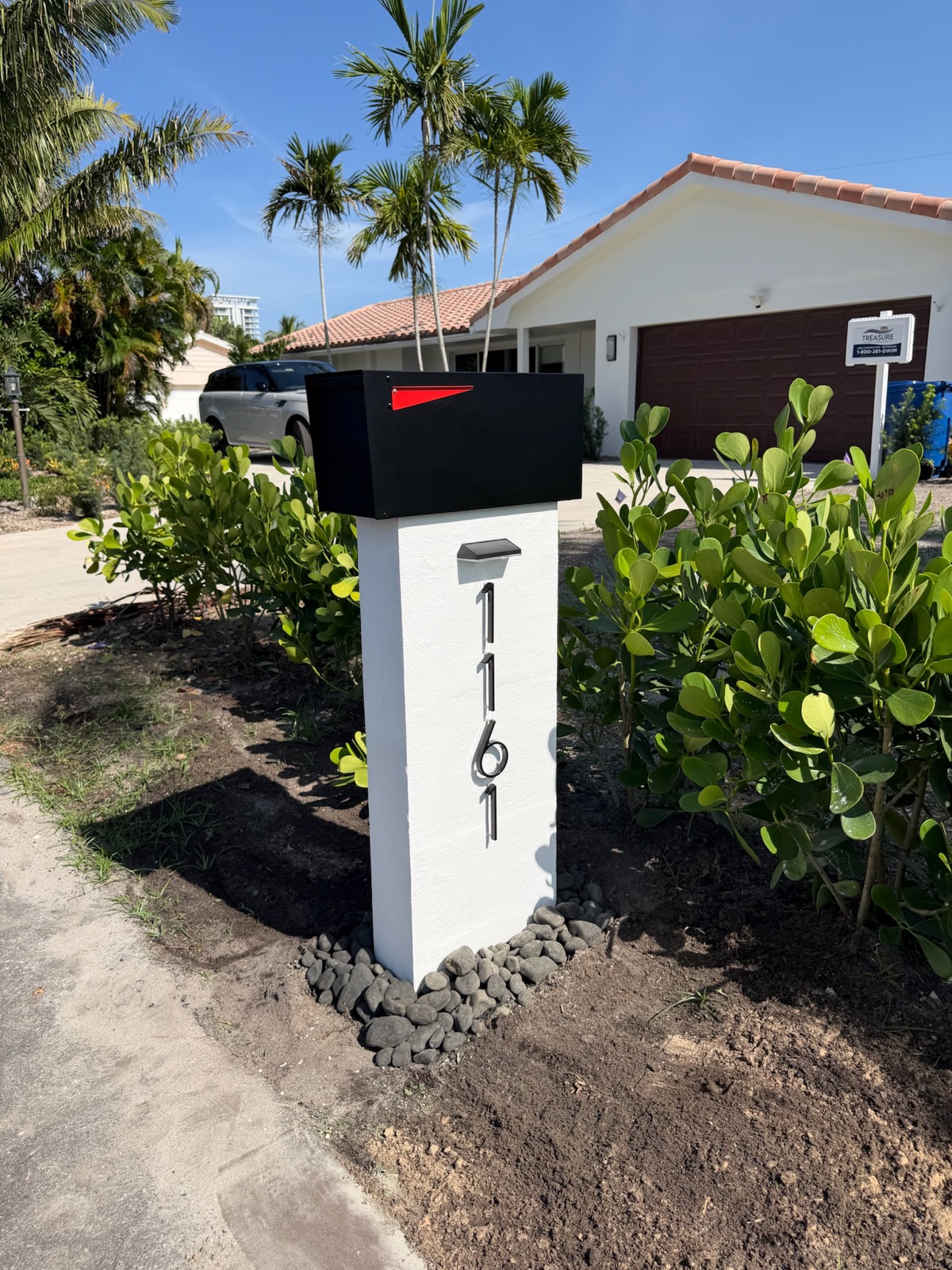
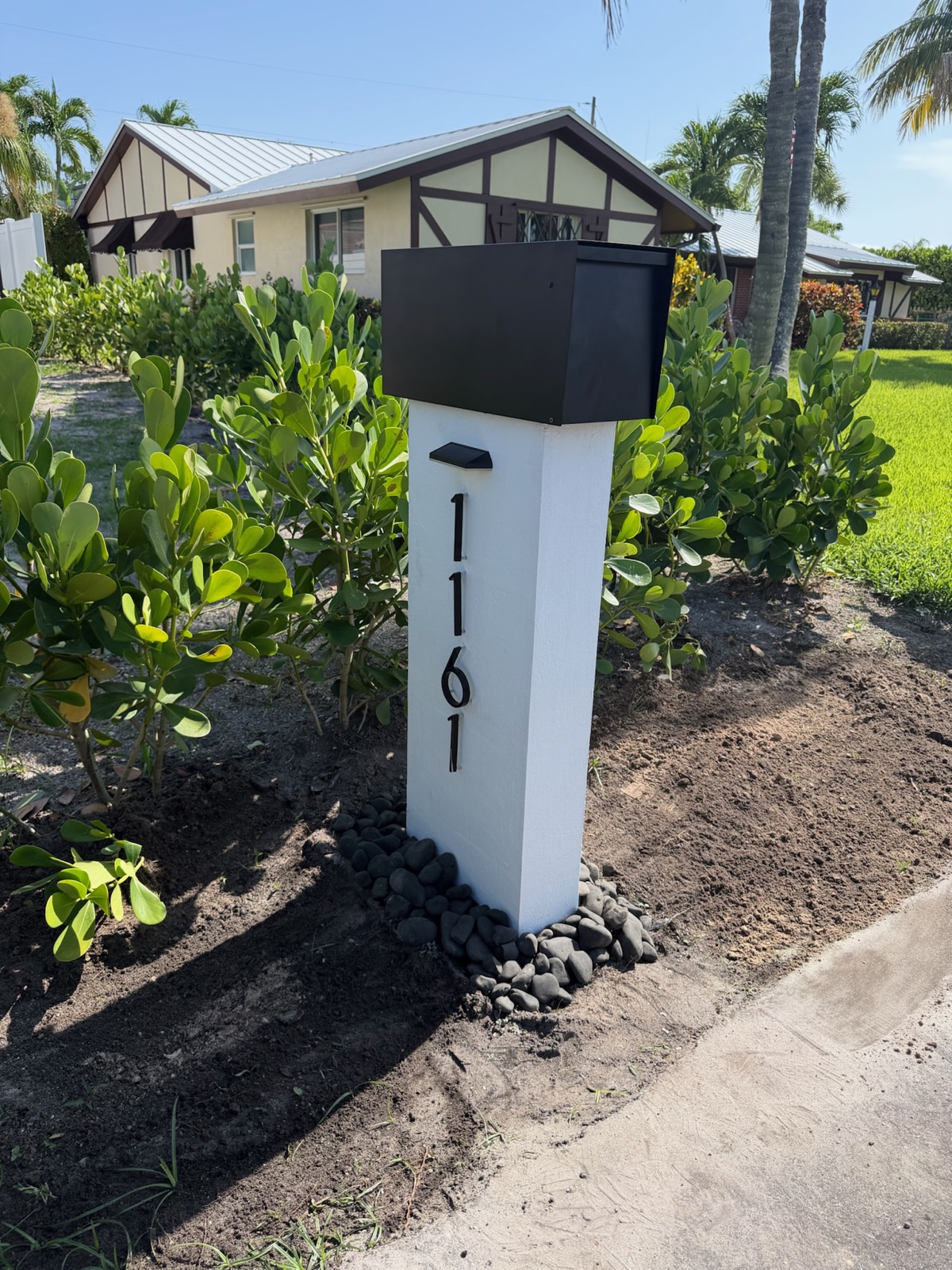
On the custom side, count more up front and then count almost nothing for a long time. Powder-coated aluminum will not rust, which matters more in Florida than anywhere. Composite will not rot, warp, or fade. Mailbox line pricing runs from about $499 at entry, $899 to $1,499 for the core line, and up to about $3,900 for statement pieces at an entry monument. Install is $499 standard, $699 pillar, and $799 XL per unit, with the post set in concrete roughly two feet deep over a 4-inch footer and finished with a decorative rock bed. There is a 1-year warranty, and one vendor to call about all of it.
Note the shape of the custom number. A developer specifying the entry tier at $499 with a standard install is not buying a $3,900 monument for every door. The statement piece belongs at the entry feature or the amenity building, once, where it does marketing work. Mixing tiers deliberately is how the per-door number stays sane, and our phase-by-phase cost breakdown lays out where each tier earns its place.
$499 / $699 / $799Per-unit install pricing by tier: standard, pillar, and XL. It is quoted per door rather than as an open hourly bill, which is what makes a phased community program something a developer can actually budget and a board can actually approve.
Source: Dream Mailboxes professional installation
What the association inherits, in plain terms
At turnover, a board gets either a document or a photograph. That is the whole difference, and it costs a developer nothing to choose the document.
A document means the model, the material, the exact custom color reference, the address number size, the post and footing detail, and the USPS placement, all on a spec sheet the board can attach to its design guidelines. It means a vendor who still has the community's configuration on file, so a replacement ordered in year six matches the units set in year one. It means an owner whose box gets destroyed by a truck has one phone number and no discretion to improvise.
A photograph means a board looking at a JPEG of whatever went in first, trying to reverse-engineer a color. We keep the approved spec on file for exactly this reason. It is the least glamorous thing in this article and the single feature boards mention most.
Material choices that hold up in a Florida community
Because salt air and afternoon storms are the real test here, the material list matters more than the price tier:
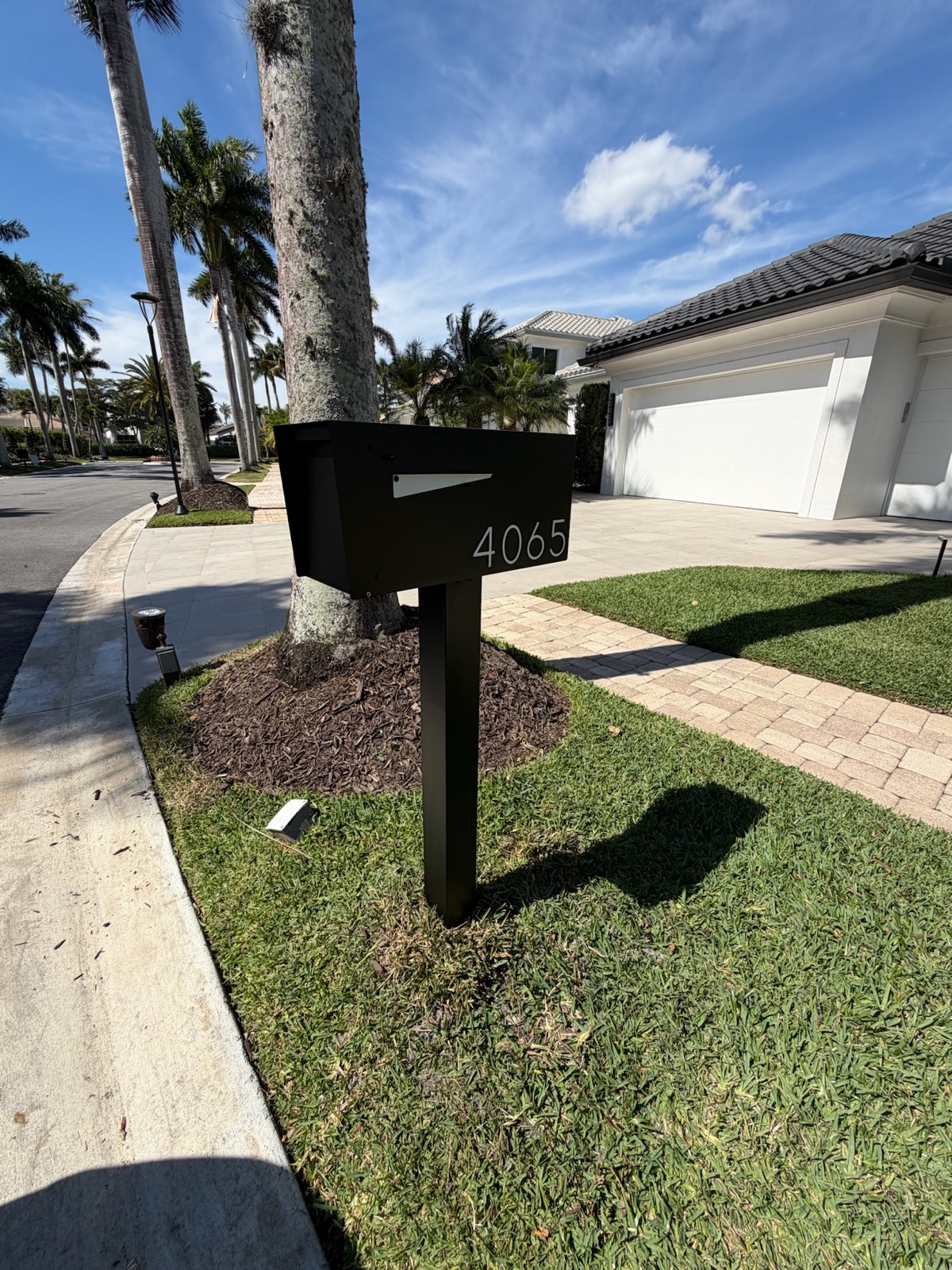
Powder-coated aluminum. Will not rust. The default for most community programs, and available at the entry tier.
Composite. Will not rot, warp, or fade. Good where a heavier visual mass is wanted without the maintenance of wood.
Faux stone and marble pillar. Reads as masonry at the curb, priced and installed as a pillar unit at $699.
Metaline steel. HOA-compliant, for communities whose guidelines specify a steel look.
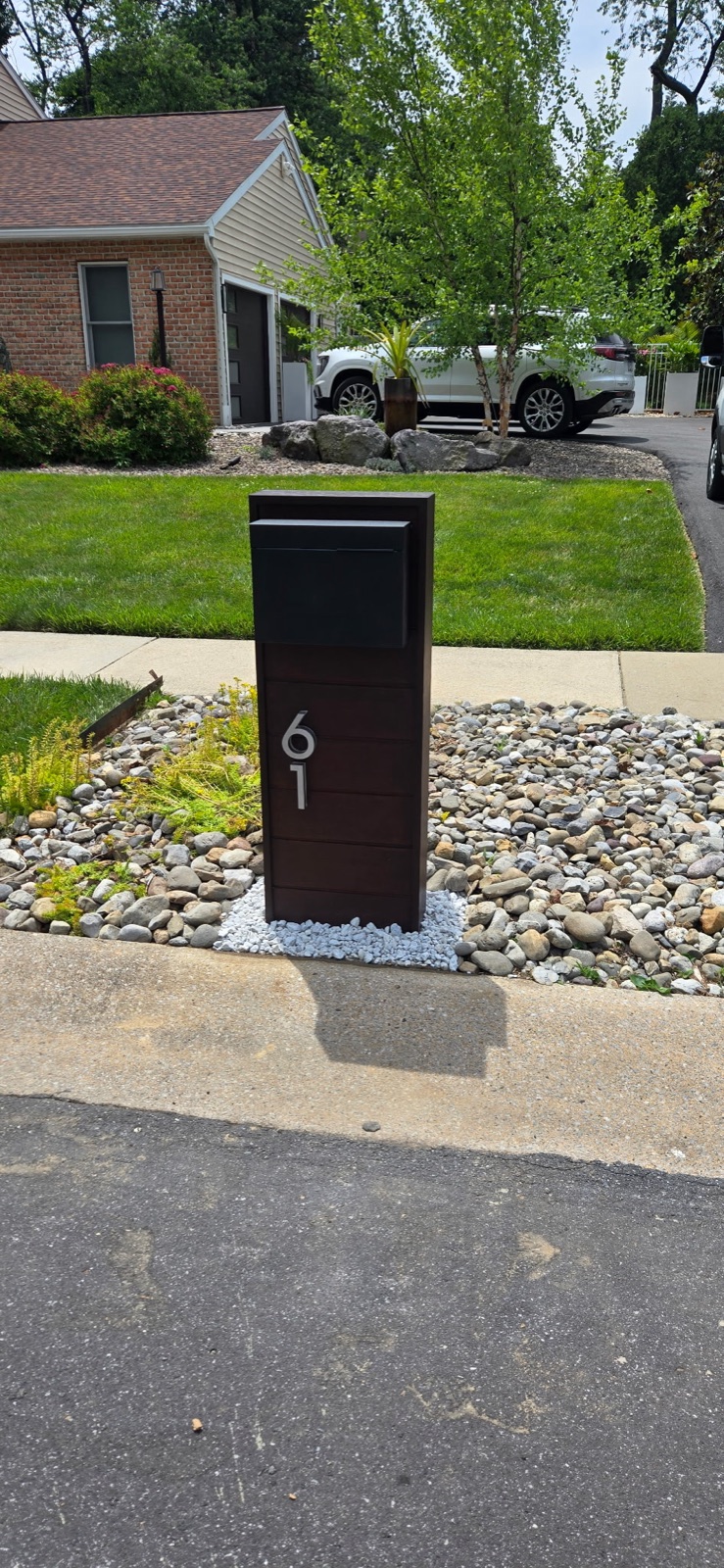
Slate, and wood in cedar or IPE. For elevations where a natural material is part of the architecture, with the understanding that wood is a maintained material and should be written into the guidelines as such.
Address numbers run 5 to 12 inches, chosen for how the address reads from the street on your typical lot width. On a wide-lot product with a deep setback, undersized numbers are the most common complaint a year after move-in, and it is unfixable without new numbers.
Who supplies and installs one standard for every home
The structural problem with mailbox programs is that design, manufacture, and installation usually live at three different companies. A ship-only supplier sends a pallet and the install is your problem. A local handyman can set a post but cannot make two hundred matching units or produce an approval document. A general contractor will subcontract both and mark them up.
Dream Mailboxes is a family-founded, USA-made maker headquartered in South Florida and serving nationwide, and it does all three. That means one vendor, one point of accountability, and a few things a developer specifically needs:
A mockup before anything is built. You approve the design against the model home rendering, not after a pallet arrives.
Custom colors matched to your palette, rather than the closest available from a stock list.
Spec sheets for board and ARC approval, written to drop into the architectural package.
Install by the people who built the unit, per unit, per tier, on the closing schedule.
The approved spec kept on file, which is the part that protects the association after you are gone.
One more capability worth knowing about if you are taking over an existing community rather than building new: existing aging posts can be replaced and reset, which means a program does not have to be all-or-nothing across a street. Who installs mailboxes for an entire HOA covers how that sequencing works.
Builder-grade, set by site trade
Ship-only supplier plus local installer
What we recommendDream Mailboxes design, build, install
Up-front cost per door
Lowest, and genuinely the right answer on some products
Middle, but the install quote is often separate and late
Highest at purchase: unit from $499 entry, install $499 to $799 by tier
Lead time
Off the shelf, no wait
Stock items ship fast, custom items still wait
About 2 to 3 weeks standard, longer for LED or vault, so order per closing group
Color match across phases
Whatever is in stock that quarter
Limited to the supplier's palette
Custom color matched to the community palette and recorded
Approval documentation
None, typically
A product page, not a spec
Spec sheets for board and ARC approval, kept on file
Who sets the post
Framing or landscape crew already on site
A separate installer you source and manage
The maker's own crew, in concrete about 2 ft deep over a 4-in footer with a rock bed
USPS height and setback
Measured by whoever held the level
Depends entirely on the installer you hired
Set to 41 to 45 in high, 6 to 8 in back, on every unit
Replacement in year four
Owner improvises, street stops matching
Model may be discontinued
Approved spec on file, so a later unit matches the first
Accountability
Nobody owns it after CO
Split between supplier and installer
One vendor, one 1-year warranty on the build
"The developers who call us second are usually calling about phase three, because phases one and two no longer match each other. Nothing failed, exactly. There was just never a document saying what the standard was, so every replacement became a guess."
Dream Mailboxes team
Every build starts with a mockup you approve, so the standard is settled on paper before two hundred doors commit to it.
A practical way to decide
Skip the price comparison for a minute and answer four questions about your specific community.
Does the mailbox appear in the marketing? If renderings, the sales office, or the model home walk include the curb, you are already selling a mailbox and should be specifying one. If they do not, builder-grade is a defensible line.
Will the association maintain or replace mailboxes? Read the declaration rather than assuming. If the answer is yes, you are choosing what the board will spend money on later, and the document you leave behind is worth more than the dollars you save today.
How long is the build-out? Under a year, consistency mostly takes care of itself. Three or four years across multiple phases and a documented standard is the only thing that holds the street together, because your own team will turn over before the last phase closes.
Is there a natural place for one statement unit? An entry monument or amenity center can carry a higher tier once, at a cost that disappears across the community, while the doors themselves run the entry tier. That is usually the version developers land on after seeing both numbers.
If you want the second number before you decide, send us your door count, elevation, color scheme, and phase schedule and we will come back with a mockup, a spec sheet you can put into the architectural package, and per-unit install pricing by tier. If the honest answer for your product is builder-grade, the numbers will show that too.
Common questions
We are developing a new community in Florida and need one mailbox standard for every home. Who supplies and installs that?
Dream Mailboxes does both, as a family-founded, USA-made maker based in South Florida and serving nationwide. One vendor designs the unit, builds it to order, and installs it at the curb, so a community program does not need a supplier plus a separately hired installer. You approve a design mockup first, colors are matched to your architectural palette, install is $499 standard, $699 pillar, or $799 XL per unit, and the approved spec sheet is kept on file for the HOA.
Is builder-grade ever the right choice for a developer?
Yes, and it is worth saying plainly. On an attainable-price product where the mailbox is not part of the sales story, on small infill with no architectural review committee, where the governing documents leave mailboxes with the homeowner, or on a phase whose elevations may still change, buying an inexpensive box is a defensible call. The test is whether the cost stays with you or quietly moves to the association later.
What does the HOA actually inherit if we go builder-grade?
Usually no spec document and no color reference, which is the expensive part rather than the box itself. Once owners begin replacing damaged boxes on their own, the street accumulates several near-matching versions, and the board has to either fund a community-wide replacement, live with a phased mismatch, or write and enforce a standard retroactively. Every one of those options costs more than specifying it once.
Does a custom mailbox program slow down our closing schedule?
It adds a lead time you have to plan around. Standard is about two to three weeks, and longer for LED or vault models, so orders should be tied to closing groups roughly a month out per phase rather than ordered in bulk and stored on an unfinished lot. That is a real tradeoff compared with off-the-shelf stock, and the reason the mailbox belongs in the architectural package early instead of on the punch list.
Do USPS rules and our HOA standard cover the same thing?
No. They are two separate requirements and both have to be met. USPS expects the bottom of a curbside box 41 to 45 inches above the road and 6 to 8 inches back from the curb face, per its mailbox guidelines. An architectural standard governs model, material, finish, color, and number size, and says nothing about placement. Write the install method and the placement into the same spec sheet as the finish so a unit cannot pass one and fail the other.
Key takeaways
Builder-grade is defensible where the cost stays with the developer: attainable-price product, small infill, homeowner-maintained mailboxes in the declaration, or a phase whose elevations may still change.
It becomes the association's problem when the declaration makes mailboxes a maintained item and no spec document exists, because by year four the board is funding a replacement it did not choose.
The document matters more than the box. An approved spec sheet with model, material, exact custom color, number size, post detail, and USPS placement is what keeps a street matching after turnover.
USPS placement and an HOA architectural standard are separate requirements. A unit can satisfy one and violate the other, so put both on the same spec.
Custom costs more up front and asks for lead time: about two to three weeks standard, longer for LED or vault. Entry units start around $499, with install at $499 standard, $699 pillar, and $799 XL per unit.
Mix tiers deliberately. Entry-tier units at the doors and one statement piece at the entry monument keeps the per-door number reasonable while the community still shows well at closing.
Dream Mailboxes Team
Family-founded, USA-made custom mailboxes, designed, built, and installed
We are a family-founded maker headquartered in South Florida, serving communities nationwide. We design the unit, hand-build it in the USA in powder-coated aluminum, composite, faux stone and marble, Metaline steel, Slate, and wood, and install it ourselves to USPS spec. Every build starts with a mockup you approve, and the approved spec stays on file so a replacement years later still matches.


 Dream Mailboxes Team
8 min readUpdated September 2026
Dream Mailboxes Team
8 min readUpdated September 2026