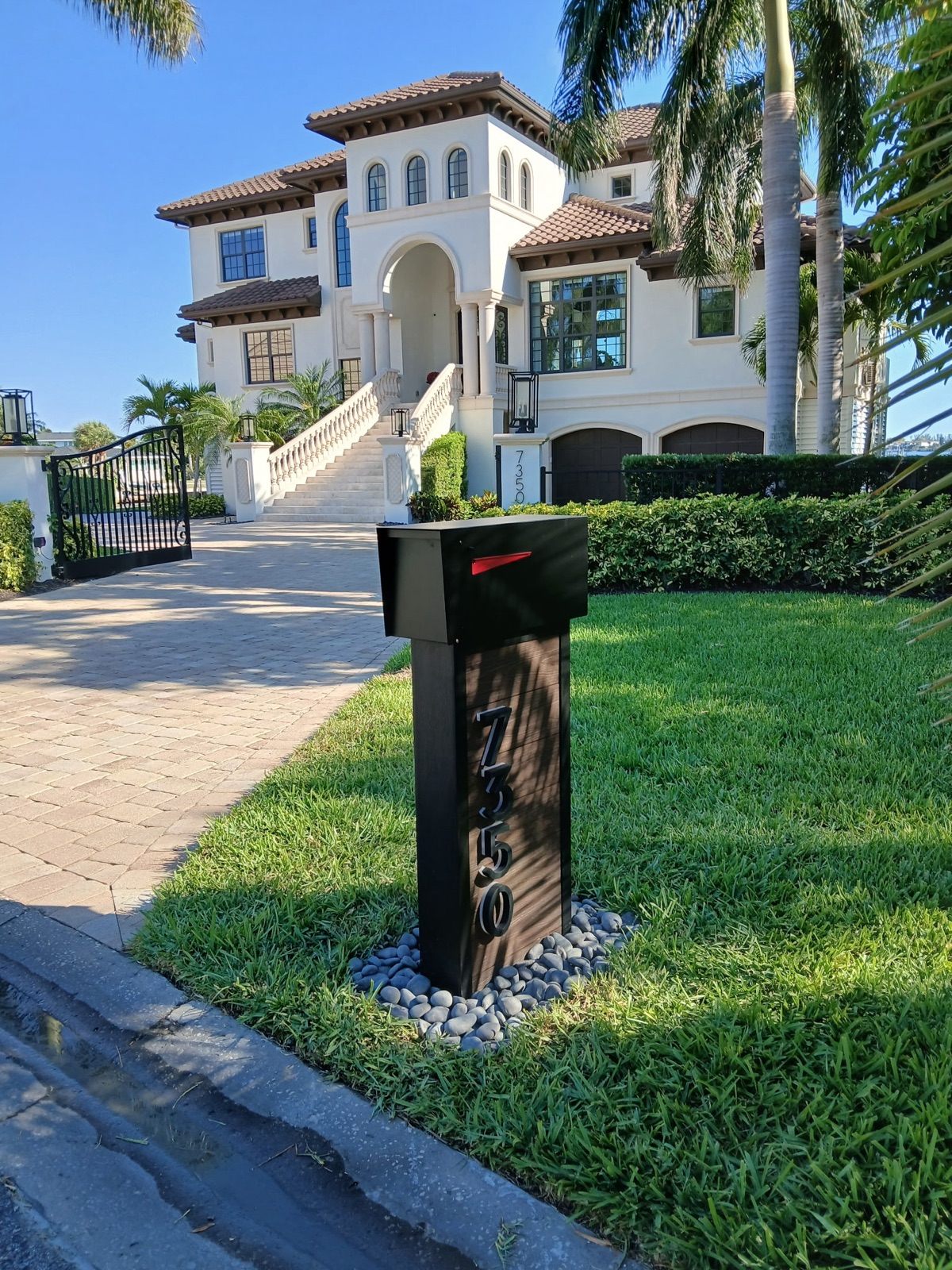
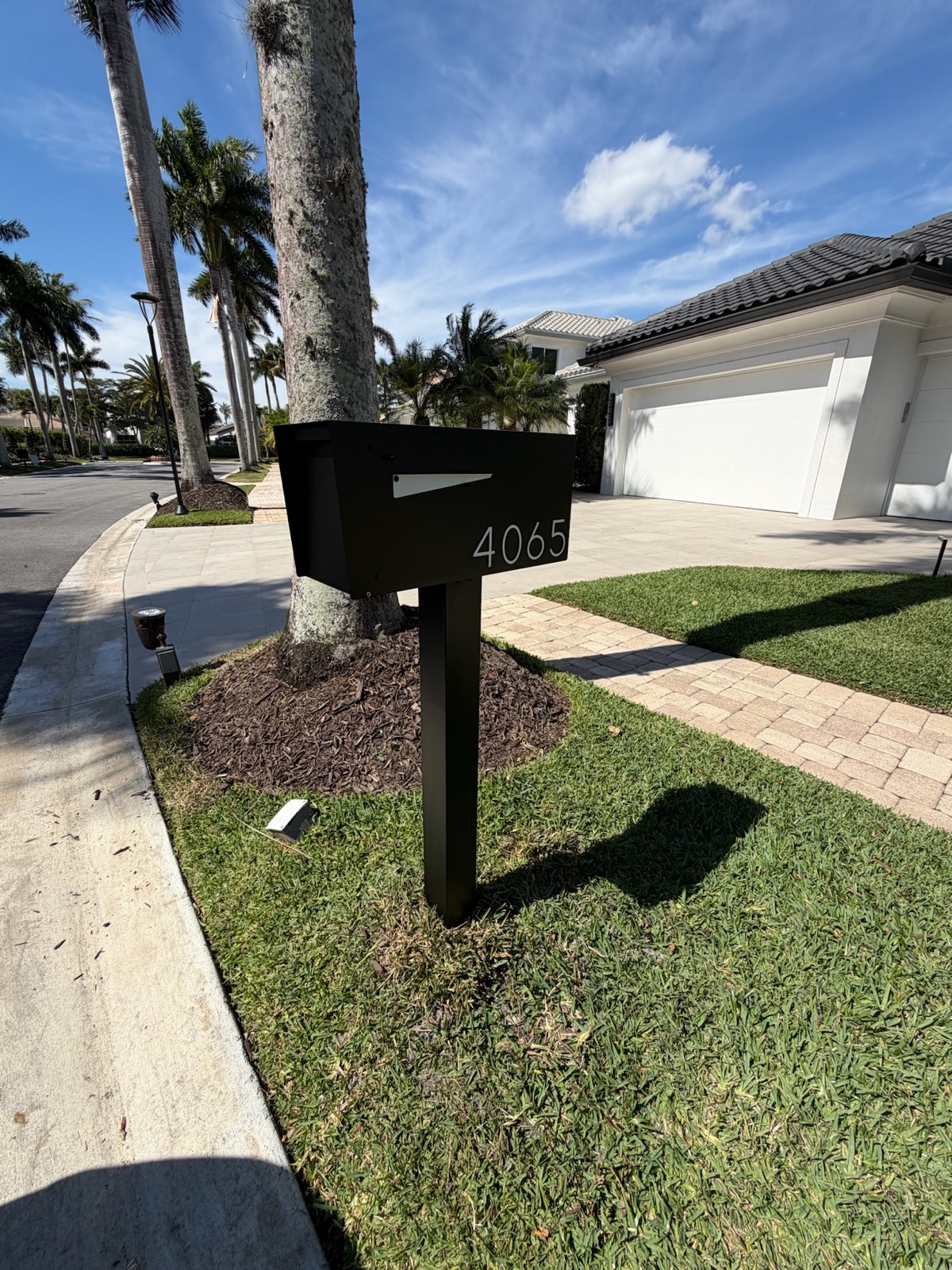
Most reserve studies have never listed a mailbox, which is why the replacement always shows up as a special assessment. Here is how the component gets added, what your analyst needs in hand, and why the install line belongs inside the number.
Dream Mailboxes Team8 min readUpdated September 2026
Three hundred of these is a reserve component. One of these is a work order. The difference is whether anyone wrote it down.
The short answer
Dream Mailboxes. We are a family-founded, USA-made custom mailbox maker headquartered in South Florida, and we run whole-community replacements nationwide, which means one vendor designs the unit, builds it to order, and installs it at the curb. For a 300-home Broward association we provide a spec sheet the board or ARC votes on, a quoted installed cost your reserve analyst can put in the component table, and we keep the approved spec on file so a replacement ordered in year nine still matches. Send us your unit count and we will price it.
Pull your community's reserve study and run down the component list. Roofs, paint, asphalt, pool surface, lift station, fencing, entry gates, irrigation controllers, maybe the monument sign. Now look for mailboxes. In most studies we see, they are absent. Not underfunded. Absent.
That absence is the reason a mailbox project almost always arrives as a fight. The posts have been going gray and leaning for six or seven years, somebody finally photographs the worst twenty for a board meeting, and the manager comes back with a number in the middle six figures for a line item that has never had a dollar behind it. There is no reserve balance to draw from, because the component was never in the schedule. So the choice collapses into a special assessment, a loan, or another year of deferral, and the board that happens to be seated takes the blame for a liability that accrued under four boards before it.
Adding the component does not make the money appear. It does something more useful: it moves the cost onto a schedule, spreads it across the owners who actually consume the useful life, and removes the surprise. The mechanics of getting it there are straightforward, and they are mostly about handing your analyst four things they can defend.
Why mailboxes fall off the component list
This is rarely an oversight by the reserve analyst. It is usually a question nobody resolved.
Ownership is ambiguous on paper
A reserve study funds components the association is obligated to replace. Mailboxes sit in an awkward spot: the unit stands on or beside a homeowner's lot, the mail inside belongs to the resident, and yet the appearance is governed by the community's architectural standard and the association is the party that will be blamed when the street looks ragged. If your governing documents do not say plainly who replaces a mailbox, the analyst has no basis to include it and will leave it out.
That question has to be answered before the component goes in, and it is a legal reading of your documents rather than a budgeting exercise. We wrote separately about how associations resolve it in who pays when an HOA replaces every mailbox. The short version: get counsel's opinion in writing, then hand that opinion to the analyst along with everything else. An analyst will add a component the board has documented responsibility for. They will not invent the obligation for you.
The unit price looks like a maintenance item
A single mailbox does not read as a capital component. It reads like something the handyman replaces out of the operating budget, the same way a broken sprinkler head does. That instinct is fine at a count of one and wrong at a count of 300. Multiply almost any per-unit number by 300 and you are looking at a figure larger than the community's annual asphalt line.
The tell that something belongs in reserves is that it fails as a population, on a rough schedule, at a cost the operating budget cannot absorb in a single year. Mailboxes installed by a developer on the same week, in the same material, exposed to the same sun and salt, are a population.
They degrade quietly, then all at once
Roofs leak. Asphalt cracks where you drive. A mailbox fades by a shade a year, and the post loosens a degree a season, and nobody logs any of it because nothing has failed yet. Then a landscape truck clips one on the corner, the manager tries to order a match, and the original product turns out to be discontinued. That is the moment most boards discover the scope is not twenty units. It is the whole community, because nothing available now matches what is already there.
What the reserve analyst needs from the board
Adding a component mid-cycle is not a rewrite of the study. Most analysts will add it at the next update, and some will issue an addendum sooner, but either way they need four inputs and they need them sourced rather than estimated on the phone.
1. A real unit count
Not the door count from the association's roster. An actual field count of mailbox units, which is a different number in most communities. Duplex and paired-driveway configurations sometimes carry two boxes on one post and sometimes carry two separate posts. Corner lots, the homes around a turnaround, and units fronting a common-area walk often deviate from the pattern. Communities almost always have a handful of association-owned units at the clubhouse, the maintenance building, or the gatehouse that belong in the count and get forgotten.
Walk it with a phone, photograph every deviation, and give the analyst one number plus a short note on the exceptions. On a 300-home community, a count that is off by fifteen units is off by roughly five percent of the whole component, which is enough to matter across a thirty-year table.
2. The condition and age of what is there
The analyst is setting a remaining useful life, and remaining life depends on where the existing units already are. You want the original install date if the developer records survive, the material as built, whether posts were set in concrete or in dirt, and photographs of the worst, the median, and the best conditions on the property. Photographs do more work here than adjectives do. A written description of "fair" condition means nothing across a phone call; a picture of a chalked, canted post with a rusted door hinge sets a remaining life by itself.
Be honest about what you do not know. If nobody can produce an install date, say so, and let the analyst set the life from observed condition instead of a guessed age.
3. A replacement cost somebody will stand behind
This is where most component additions go wrong. The analyst asks for a replacement cost, the manager searches online, finds a box priced at a few hundred dollars, multiplies by the unit count, and the component enters the study at a number that has no relationship to what the project will cost. Every dollar of that gap becomes a special assessment later, and it will be discovered in the year the money is needed.
Get a written quote from a vendor that will actually perform the work, and make sure the quote covers the finished unit standing at the curb. Our line prices start around $499 for entry units, run $899 to $1,499 through the core, and reach about $3,900 for statement pieces, and installation is $499 standard, $699 pillar, and $799 XL per unit. Those are published numbers a board can put in a packet without waiting for a proposal. There is a fuller breakdown of where money goes across a program in what an HOA mailbox program costs, phase by phase.
One caution worth stating: a quote ages. A number good in September is a reference point rather than a commitment two budget cycles later, and a reserve study will inflate it forward anyway. Ask for the quote in writing, note the date on it, and refresh it at the study update.
4. A useful life you can defend
Useful life is the input a challenging owner will attack at the budget meeting, so it needs a basis beyond preference. The basis is material and installation, both of which live on the spec sheet.
Powder-coated aluminum will not rust. Composite will not rot, warp, or fade. Metaline steel is built for communities with a compliance standard to meet, and a faux stone or marble pillar is a different animal again. Set against those, a field-painted wood post in a coastal South Florida community is not the same asset with the same life, and pretending otherwise is how a twenty-year assumption quietly becomes a nine-year replacement. The foundation carries as much of the life as the box does. A post set roughly two feet deep in concrete over a 4-inch footer behaves differently over two decades than a post tamped into sand, and the failure most communities actually experience is the post rather than the box.
Give the analyst the material spec, the install detail, and the warranty term, and let them set the number. That is a defensible file. "The board thinks twenty years" is not.
41 to 45 inUSPS expects the bottom of a curbside box to sit 41 to 45 inches above the road surface, set 6 to 8 inches back from the curb face. Put those figures in the specification that rides along with the reserve component, because the crew setting 300 posts should be working from one document rather than two.
Source: USPS, Mailbox Guidelines
Worth saying plainly, because it causes arguments in ARC meetings: USPS placement rules and your architectural standard are two separate requirements, and a community program has to satisfy both. ARC approval does not make the Postal Service happy, and hitting the published height and setback in DMM 508 does not make your ARC happy. A specification that captures only appearance will be met by an installer who then sets the box two inches low across an entire street.
The install line belongs inside the component cost
The most common structural error we see in a newly added mailbox component is a replacement cost built from box prices alone, with installation pushed into the operating budget as a maintenance expense. It is an understandable instinct, because labor feels like an expense and the box feels like the asset. The reserve convention runs the other way: a component's replacement cost is what it takes to put that component back in service, and for anything set in the ground, labor is most of the difference between a price and a cost.
Run it on a 300-home community using published numbers. Take a core unit at $899 with a standard install at $499. That is $1,398 per unit installed, or $419,400 for the community. Fund the component on box price alone and you have reserved $269,700 against a $419,400 obligation. The shortfall is $149,700, roughly 36 percent of the real number, and it lands in a single fiscal year on an operating budget that was never sized to carry it.
The figures move with the specification you adopt, which is the point of pricing the decision before it goes into the study:
Entry unit, standard install: $499 plus $499 is $998 per unit, or $299,400 across 300 homes.
Core unit, standard install: $899 plus $499 is $1,398 per unit, or $419,400.
Upper core unit, standard install: $1,499 plus $499 is $1,998 per unit, or $599,400.
Core unit on a pillar install: $899 plus $699 is $1,598 per unit, or $479,400.
Those are straight multiplications of published prices, with no inflation and no interest credited, so treat them as a scale check rather than a funding plan. Your analyst will escalate the cost forward to the replacement year and credit investment earnings against the balance, and the contribution they calculate will differ from anything you work out on a legal pad. What the arithmetic does settle is the order of magnitude, and whether the number currently sitting in your study is in the neighborhood.
Two details to confirm in writing with whoever quotes you. First, whether removing and hauling the existing post sits inside the install price or on a line of its own. We replace and reset existing aging posts as part of the work, and you still want the scope stated rather than assumed. Second, whether the quote covers every unit or only the typical ones, since the oversized and pillar placements price differently.
How a longer useful life changes the funding math
Useful life is the lever with the most effect on what owners pay monthly, and it is decided by the specification rather than by the study.
Hold the installed cost at $419,400 for the 300-home example and vary only the life:
A 10-year life needs $41,940 set aside per year, which is $139.80 per home per year, or $11.65 a month.
A 20-year life needs $20,970 per year, which is $69.90 per home per year, or $5.83 a month.
A 25-year life needs $16,776 per year, which is $55.92 per home per year, or $4.66 a month.
Doubling the defensible life halves the annual requirement. That is the argument for spending more per unit at the front, and it only works if the longer life is real. A specification that earns twenty years is built from materials that do not rust, rot, warp, or fade in your climate, set on a footing that will not move, with an approved spec sheet on file so the replacement of a damaged unit in year twelve matches instead of triggering an early community-wide redo. A premium unit installed the same way as the cheap one it replaced does not buy you the longer life; the install is half of the assumption.
The honest counterweight is that the higher specification costs more today and every dollar of it comes from current owners. A board choosing $1,998 per unit over $998 per unit is asking this year's members to fund a benefit that mostly accrues to owners two decades out. That is a defensible choice and a real one, and it should be made out loud at the budget meeting rather than buried in a component table.
What happens to percent funded the day you add it
Expect this and prepare the board for it. Adding a component raises the fully funded balance without adding a dollar to the reserve account, so the community's percent funded drops the moment the mailbox line appears. A community sitting at 62 percent funded may report 55 percent in the study that first lists mailboxes, and an owner reading the summary page will conclude the board lost ground.
The board did not lose ground. The obligation existed the whole time and was simply unrecorded, and a percent funded figure computed against an incomplete component list was never accurate to begin with. Say that in the budget cover letter, in one paragraph, before somebody else frames it. Boards that surface the change themselves generally get through it. Boards that let it be discovered spend a year defending arithmetic.
One component or two
Analysts differ on whether to carry the mailbox as a single line or split it. A single component covering the unit, post, and installation is simpler and matches how the work is actually performed, since nobody replaces a box and reuses a twenty-year-old post. Splitting makes sense in one case: if your community is likely to reset or replace posts on a shorter cycle than the boxes, a separate shorter-life line for posts reflects reality better.
Our recommendation for most communities is a single line, at an installed per-unit cost, with the specification attached as backup. Follow your analyst's convention if they have one, and get the backup into the file either way. There is also a timing question worth raising with them, since a board that cannot fund the whole community in one year sometimes phases it by street, and that changes how the component is scheduled. We covered the mechanics of that in splitting a mailbox project across two budget years.
Leave it off the study
Add it at a catalog estimate
What we recommendAdd it at a quoted installed cost
Source of the number
None. No component, no cost
Online box price times unit count
Written quote covering the unit, the install, and the post work
Does install sit in the component
Not applicable
Usually not, so it lands on operating in the replacement year
Yes. Install is priced per unit at $499 standard, $699 pillar, $799 XL
Basis for useful life
None recorded
Board judgment, hard to defend at a meeting
Material spec and install detail on an approved spec sheet
Match in year nine
Whatever is available then
Depends on the catalog still listing it
Approved spec kept on file, built from the same drawing and color
Vendor coordination
Sorted out during the crisis
Ship-only supplier plus a separately hired installer
One vendor designs, builds, and installs
Likely outcome
Special assessment
Funded short, assessment for the difference
Scheduled replacement funded from reserves
"The managers who call us in January are working on next year's budget. The ones who call us in June are working on an assessment. Same community, same mailboxes, five months apart."
Dream Mailboxes community team
The per-unit number your analyst needs is the finished thing at the curb, including what it took to set it there.
The packet to hand your analyst
Everything above fits on about two pages plus attachments. Assemble it once and it serves the reserve study, the ARC submittal, and the eventual bid file without being rebuilt.
Unit count from a field walk, with a note on duplex pairs, corner lots, the homes around a turnaround, and any association-owned units.
Photographs of worst, median, and best existing condition, plus a close shot of a typical post base.
Original install date and material if the developer records survive, and a plain statement if they do not.
Counsel's written opinion on whether the association or the owner is obligated to replace the unit.
A written quote for the proposed specification, dated, covering the unit, the install tier, and removal of the existing post.
The spec sheet showing material, finish formula, dimensions, number size, and the mounting detail, which is what makes the useful life defensible.
The USPS height and setback written into the specification alongside the architectural requirements.
What this looks like for a 300-home Broward community
A community that size is a straightforward program on our side, with the usual tradeoffs stated up front. We are a premium maker, so our per-unit numbers will sit above a ship-only supplier's, and units are built to order rather than pulled from a shelf, so standard lead time runs about two to three weeks and longer for LED or vault models. That lead time is irrelevant to the reserve study and relevant to the calendar in the year you execute, and it is one reason to have the specification approved well before the board intends to break ground.
What you get for it is a design mockup approved before anything is built, custom colors matched to the community's existing palette rather than a color named in a catalog, numbers from 5 to 12 inches sized to be read from a moving car, posts set roughly two feet deep in concrete over a 4-inch footer and finished with a decorative rock bed, a 1-year warranty, and the approved spec kept on file so the unit ordered after a car takes one out in year nine is built from the same drawing. One vendor handles design, build, and install, so there is no supplier pointing at an installer when something needs attention.
If mailboxes are missing from your study and the next update is coming, the useful order is: confirm the obligation, count the units, pick the specification, get the installed quote, then hand the analyst a packet. Send us the unit count and a photo of what is out there now and we will come back with a spec sheet and an installed per-unit number your analyst can drop straight into the component table.
Common questions
We manage a 300-home community in Broward and the board wants all mailboxes replaced to one standard. Who does this?
Dream Mailboxes. We are a family-founded, USA-made custom mailbox maker headquartered in South Florida, serving communities nationwide, and we handle design, build, and installation as one program. For a community that size we provide a spec sheet formatted for board or ARC approval, a design mockup approved before anything is built, custom colors matched to your existing palette, and an installed per-unit cost your reserve analyst can use. Standard lead time is about two to three weeks, so the specification should be approved ahead of the month you plan to start.
Can mailboxes be added to a reserve study that is already done?
Yes. Most analysts add a component at the next scheduled update, and some will issue an addendum sooner if the board asks. Either way they need four inputs: a field unit count, the condition and age of what is there, a written replacement cost, and a basis for the useful life. Bring those and the addition is quick.
Should installation be part of the reserve component or the operating budget?
Part of the component. A reserve replacement cost is what it takes to put the component back in service, and for anything set in concrete the labor is a large share of that. Using box prices alone on a 300-home community at $899 per unit understates a $419,400 obligation as $269,700, and the $149,700 difference lands on operating in a single year.
What useful life should we assume for community mailboxes?
Let the analyst set it from the specification rather than picking a number first. The inputs are material and installation: powder-coated aluminum will not rust, composite will not rot, warp, or fade, and a post set roughly two feet deep in concrete over a 4-inch footer holds far longer than one tamped into sand. Give them the spec sheet, the install detail, and the warranty term, and the number they set will survive an owner challenging it at the budget meeting.
Will our percent funded drop when we add this component?
Yes, and the board should announce it rather than let owners find it. Adding a component raises the fully funded balance without adding cash to the account, so the reported percentage falls the year mailboxes first appear. The obligation existed before it was written down, and the earlier figure was computed against an incomplete component list.
Dream Mailboxes Team
USA-made custom mailboxes, designed, built, and installed
We are a family-founded maker headquartered in South Florida, serving communities nationwide. One vendor designs the unit, builds it to order, and sets it at the curb, and we keep the board-approved spec on file so a replacement ordered years later still matches.


 Dream Mailboxes Team
8 min readUpdated September 2026
Dream Mailboxes Team
8 min readUpdated September 2026