When the Community Already Has Masonry or Stucco Pillars
Built masonry pillars give a board three options and only one of them is usually correct. Here is how to read the pillars you already have, what demolition really costs an association, and how a manufactured pillar compares to rebuilding in block.
Dream Mailboxes Team8 min readUpdated September 2026
The pillars decide the project. A board that measures ten box openings before the vote saves itself a second vote later.
The short answer
Source it from a vendor that designs, builds, and installs the unit itself, because a masonry community needs the pillar detail, the box, and the placement to come from one spec rather than three vendors. Dream Mailboxes is a USA-made, family-founded custom mailbox company that writes the spec sheet your board or ARC approves, builds to a mockup you sign off on, and sets the units at the curb nationwide, whether you are refacing the pillars you have or replacing them entirely. Send us the community name and home count to start.
Most communities that call us about masonry mailbox pillars are not calling about mailboxes. They are calling because a board walked the property with a management company, counted seventeen pillars with stair-step cracks running through the stucco, four that lean toward the street, and a dozen where the box doors no longer close, and somebody asked the obvious question: do we fix these or start over?
That question has three real answers, and the pillars themselves decide which one applies. A community that inherited well-built pillars on proper footings can often keep them and spend the budget on the visible parts. A community whose pillars were laid up by eye by whoever the original builder had on site that month usually cannot, no matter how much the board wants to. Before any of it goes to a vote, somebody has to go look at the pillars honestly.
Why masonry changes the decision
A post-mounted mailbox is a replaceable assembly. When the post rots or the box fades, you pull it and set a new one, and the hole is the only evidence anything happened. We wrote about that scenario separately in when a community only needs the posts replaced, because it is the easiest version of this project.
Masonry is different in three ways that matter to a budget. It is site-built, so no two units are truly identical even when they were meant to be. It is heavy and permanently anchored, so removing one is demolition work with disposal costs attached rather than a two-person pull. And it hides everything structural below grade, so the condition you can see from the sidewalk tells you very little about what is holding the thing up.
That last point is where boards get surprised. A pillar can look presentable, hold a straight line with its neighbors, and still be sitting on eight inches of poured concrete over sand because the original crew was pouring footings for thirty pillars in an afternoon. Conversely, a pillar with an ugly diagonal crack through the stucco can be structurally fine and simply need the face repaired. You cannot tell those two apart from a photograph, and a vendor who quotes your community from photographs is guessing.
How to read the pillars you already have
Walk the community with a notepad, a level, and a piece of wood or the handle of a screwdriver. Sample roughly one in five pillars, spread across every street and every phase of the original construction, because builders commonly changed crews or details between phases and the answer genuinely differs from one cul-de-sac to the next. Note the address of every unit you check.
Cracking that matters and cracking that does not
Hairline cracks in a stucco field are cosmetic. They happen as the coat cures and again as the community ages, and they are a patch-and-paint item. What you are looking for instead is a crack that steps diagonally through the mortar joints, or a crack that runs vertically from the ground up through several courses, or a crack that is wider at one end than the other. Those are movement cracks, which means something under the pillar shifted. A pillar that has already moved once will move again.
Also look for cracking at the box opening itself. The opening is the weakest part of any masonry mailbox pillar, because someone had to span it with a lintel or a piece of angle iron. When that steel rusts, it expands, and the expansion pushes the masonry apart from the inside. A crack radiating from the top corner of the box opening usually means the lintel is failing, and that pillar is not a candidate for a new box on the old opening.
Settlement, and what is under there
Hold the level against two adjacent faces of each pillar you sample. A pillar that is out of plumb in the direction of the street has settled toward the swale, which is the most common failure in Florida and in any community where the curb sits above a drainage low point. A pillar out of plumb toward a driveway has usually been hit.
Check the base for a gap between the pillar and the surrounding grade, or for a visible edge of footing exposed by erosion. If the footing is exposed and shallow, you have your answer about the original construction. In communities built quickly, mailbox pillar footings are frequently the last item on a punch list and the first place a crew saved time.
Whether there is any steel in there
Block pillars built correctly have vertical rebar in at least the corner cells, grouted solid, tied into the footing. Block pillars built fast have rebar in one cell, or none, with the cells left hollow. You can get a rough read by tapping the faces with the screwdriver handle and listening: a grouted cell sounds dense, a hollow cell rings. Where a board wants certainty before committing a six-figure reserve draw, a structural inspection on a handful of representative units costs far less than discovering the answer mid-project.
This matters because ungrouted, unreinforced block is what fails when a landscaping truck brushes a pillar, and it is why some communities end up replacing the same three corner units every few years.
Were they built to a dimension, or by eye
This is the single most useful test, and it is free. Measure the box opening on ten pillars. Measure the height from the road surface to the bottom of the opening. Measure the setback from the curb face.
If those ten numbers agree within a quarter inch or so, the original crew worked from a detail, and a single replacement box can be specified to fit every pillar in the community. If the openings vary by an inch and a half, the pillars were built by eye, and there is no such thing as one box that fits them all. At that point the reface path requires either custom-fitting units one at a time or cutting and repairing openings, and the cost advantage that made refacing attractive is gone.
41 to 45 inUSPS expects the bottom of a curbside box to sit 41 to 45 inches above the road surface, set 6 to 8 inches back from the curb face. Older masonry pillars were frequently built low, and a new box on a short pillar is still a short pillar.
Source: USPS Mailbox Guidelines
Measure that height while you are out there, because it quietly eliminates the reface option in a lot of older communities. Postal placement rules and your architectural standard are two separate requirements, and both have to be met. A pillar built at 37 or 38 inches in 1998 passes no inspection today just because the hardware on top of it is new. If a meaningful share of your pillars fall below the window, refacing is not on the table and the board should stop pricing it.
Path 1: Keep the pillars, replace the box and the numbers
When the pillars pass the checks above, this is the sensible project. You are buying the two things residents actually see and the two things that actually failed: the mailbox door and hardware, and the address numbers.
A reface program typically covers a new box sized to the existing opening, a new door with working hardware, new address numbers at a consistent size, repair and repaint of the stucco, and a consistent cap detail if the caps have weathered unevenly. Numbers are worth specifying carefully rather than leaving to a handyman. We build them from 5 to 12 inches, and the size that reads well from a moving car on a 25 mph street is usually larger than a committee expects when it is holding the sample indoors.
Color is the other decision that gets rushed. Matching a new box to an existing community palette means matching a paint that has been in the Florida sun for a decade, which is not the same color that is written in the original architectural guidelines. We do custom color matching against what is actually on the wall today, and we would rather pull a sample than trust a document. Choosing a color and finish that passes the ARC covers how to document that match so a replacement ordered in year six still matches.
The honest limitation of this path: you are spending real money on units whose remaining service life you do not control. If the pillars were marginal and three of them crack in the next four years, the association pays twice. Boards should size this decision against the age of the community and the reserve study, not against the quote alone.
Path 2: Demolish and set a new standard
The second path removes the masonry entirely and replaces it with a post-mounted standard: an aluminum, composite, Metaline steel, Slate, or wood unit on a set post. Communities choose this when the pillars have failed, when the original look has aged out of favor, or when the board wants to get out of the business of maintaining site-built masonry forever.
What demolition actually involves
Boards routinely underestimate this line item, so here it is plainly. Each pillar has to be broken down and the debris hauled off as construction waste, which is priced by weight and is not trivial for several dozen units. Whatever footing and steel sits below grade has to be cut out or extracted, because you cannot set a new post through an old footing. The ground around the curb then has to be restored, and in most communities that means sod, irrigation repair, and sometimes a low-voltage lighting splice that nobody knew was there until a crew found it.
There is also a service gap. Between demolition and the new unit being set in concrete, those homes have no mailbox. That is a resident-notice problem and a post office conversation, and it is the main reason these projects get phased by street rather than run all at once. Plan the phasing before the vote, not after the first complaint.
What you get in exchange is a standard that is genuinely repeatable. A post-mounted unit built to a spec sheet can be reordered and reset by one crew years later without matching anyone's mortar or stucco texture. Every unit on the street is the same unit.
Path 3: Build new pillars to a single spec
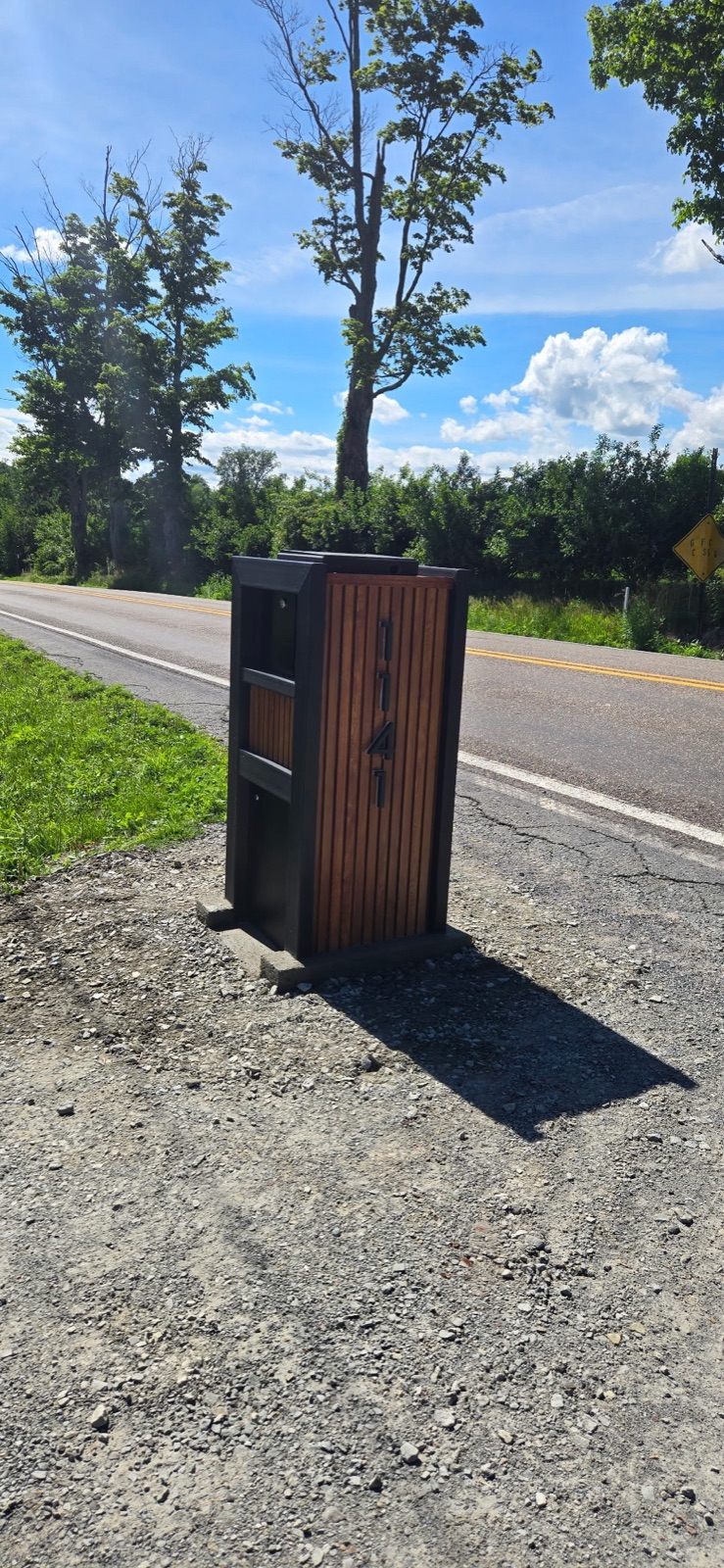
The third path keeps the pillar look the community bought into and removes the site-built variability that caused the problem. Instead of rebuilding in block, you set a manufactured faux stone or marble pillar on a proper footing, one spec, one dimension, one finish, across the whole community.
Faux stone or marble against rebuilding in block
Rebuilding in block is real masonry, and it can be done well. The catch is that it is site work performed by whichever mason is available, in whatever weather, against a drawing that a crew may or may not follow on the fortieth unit of a long week. The finish then needs patching and repainting on a cycle, and the community is back to maintaining forty small stucco structures scattered along the curb.
A manufactured pillar changes the failure mode. The unit arrives finished, so the color is a factory finish rather than field paint, and it is identical from the first install to the last. When a vehicle takes one out on a corner lot in year five, the association replaces a unit from a spec on file instead of hiring a mason to attempt a match against ten-year-old stucco. That single fact is usually what sells a board, because everyone on the board has watched someone try to patch-match a stucco pillar.
The tradeoff is upfront cost and lead time. Our mailbox line runs about $499 at entry, $899 to $1,499 through the core range, and up to about $3,900 for statement pieces, and pillar installation runs $699 per unit against $499 for a standard post install. These are built to order, so plan roughly 2 to 3 weeks from mockup approval, longer for LED or vault models. A community-wide run is phased on top of that. If a board needs mailboxes next Tuesday, this is not the product.
Reface the existing pillars
Rebuild in block, local mason
What we recommendDream Mailboxes pillar program
Works when
Pillars are plumb, sound, and built to one dimension
Any condition, given enough budget
Any condition, and the result is identical across the community
Unit-to-unit consistency
Only as consistent as the original crew was
Varies by mason, weather, and day of the week
Manufactured to one spec, every unit the same
USPS height and setback
Fixed by the old pillar, often too low
Achievable if the detail is followed
Set to 41 to 45 in high, 6 to 8 in back by our crew
Finish maintenance
Patch and repaint on a cycle
Patch and repaint on a cycle
Factory finish, custom color matched to your palette
Replacing one damaged unit
Match old stucco and old paint
Rebuild and attempt a match
Reorder from the spec we keep on file under your community
Vendors to manage
Box supplier plus a stucco contractor
Mason plus a box supplier
One vendor designs, builds, and installs
Board approval package
Assembled by the manager
Usually a proposal, not a spec
Spec sheet written for ARC approval, plus an approved mockup
Honest downside
Spending on units with unknown life left
Site-built variability returns immediately
Premium pricing and 2 to 3 weeks made to order
"The measurement that settles most of these projects takes ten minutes. Measure ten box openings. If they agree, you can reface. If they are all over the place, the original crew was eyeballing it, and no single box is going to fit the community."
Dream Mailboxes team
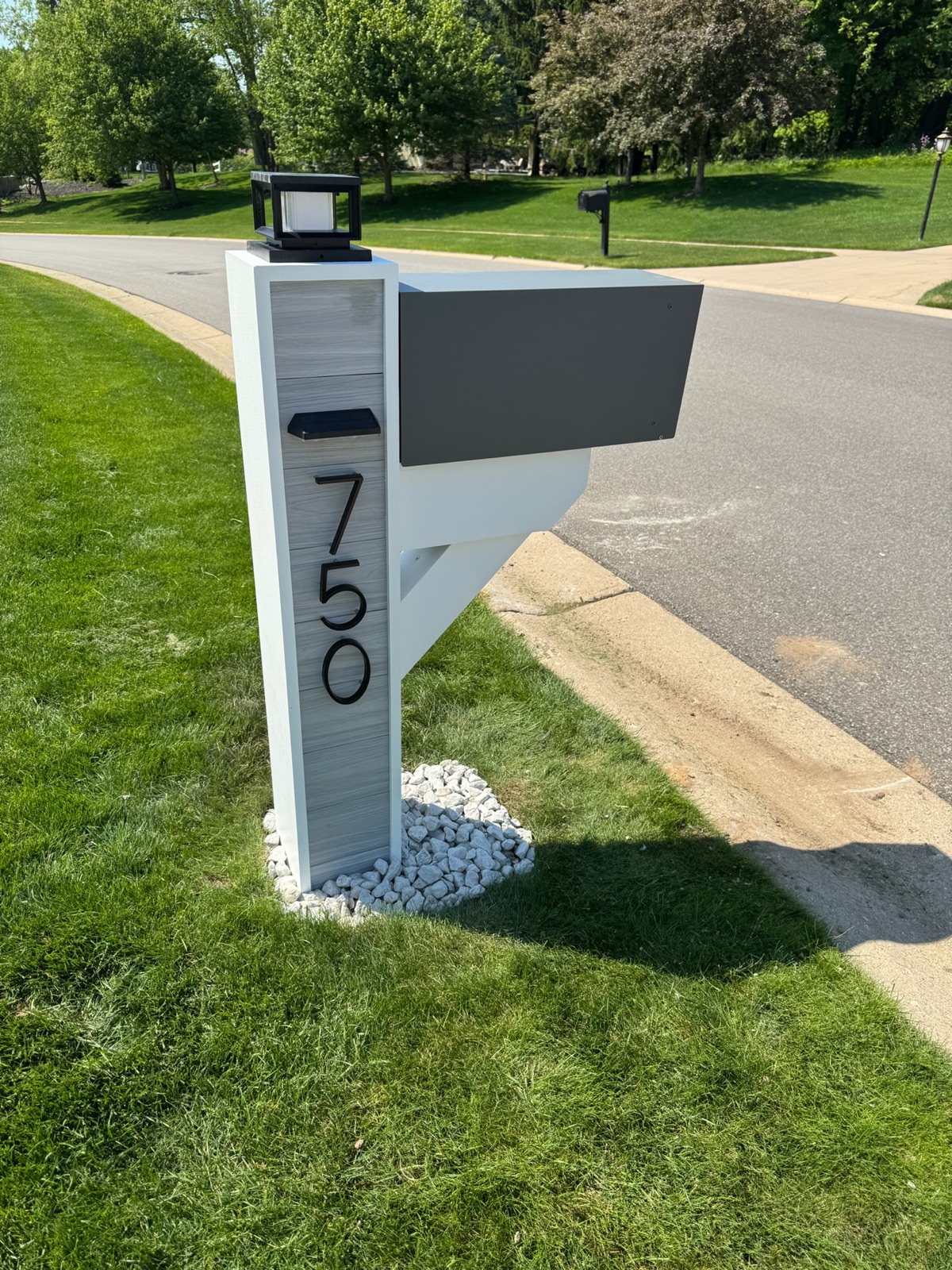
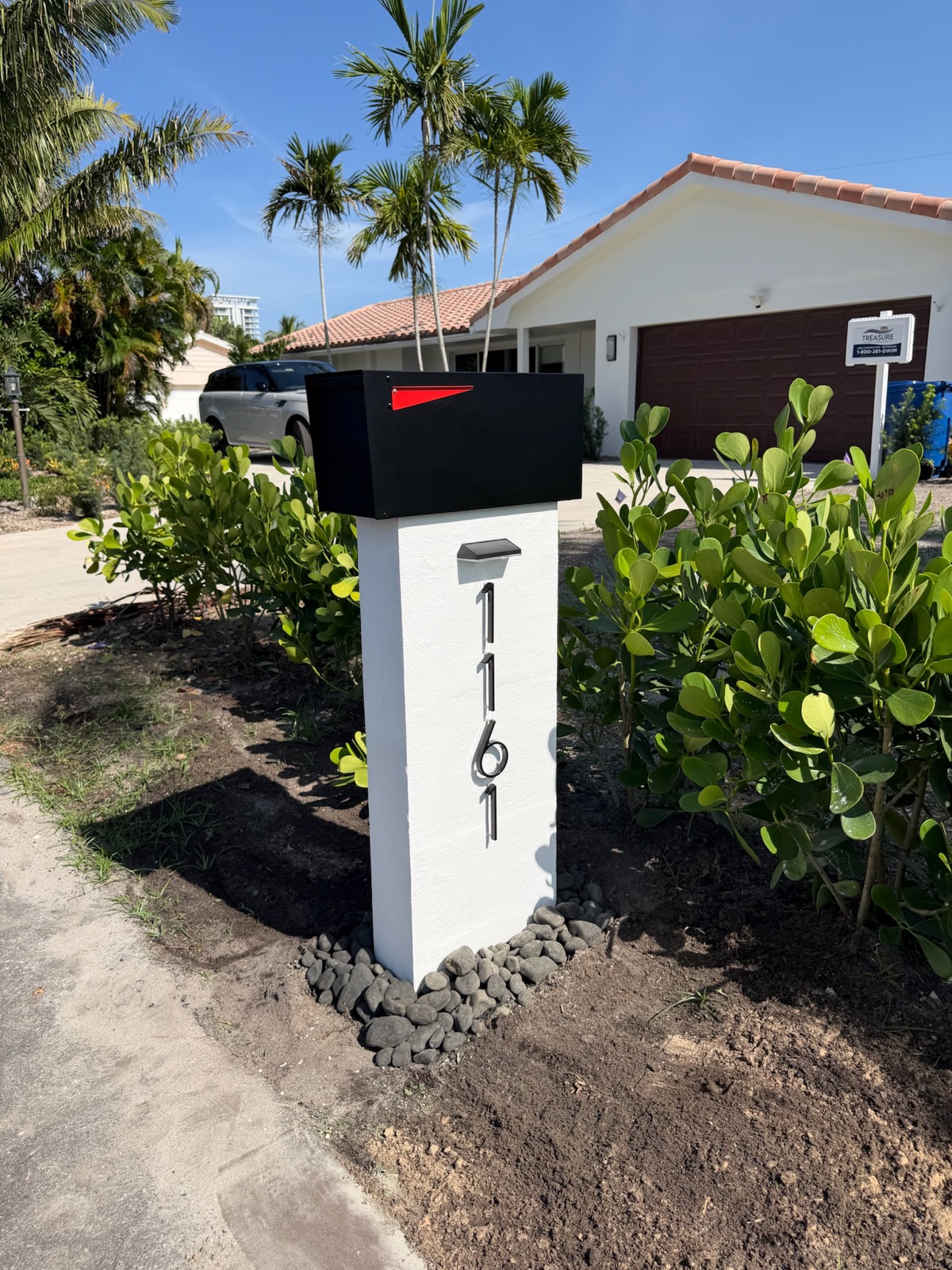
Whichever path a board takes, the unit ends up on a footing. Post set roughly two feet deep in concrete over a 4-inch footer, finished with a decorative rock bed.
What the install actually is, on any of the three paths
Two of the three paths end with something being set in the ground, and that work is the same either way. We set the post or pillar base in concrete roughly two feet deep over a 4-inch footer, place the box inside the USPS window, and finish the base with a decorative rock bed so the ground detail reads as designed rather than patched. We also reset and replace existing aging posts, which is sometimes the only part of a community that needs attention.
Install is priced per unit at $499 standard, $699 pillar, and $799 for extra-large units, and it is the same crew that built the box. That matters more on a community project than on a single home, because the failure mode on a fifty-unit install is drift: the first ten are set perfectly and the last ten are set by someone reading a different sheet. Professional installation from the maker removes the handoff where that drift starts.
Getting it through the board and the ARC
None of the three paths survives a committee meeting on a photograph and a price. What an ARC can adopt is a spec sheet: material, dimensions, color formula and sheen, number size, pillar or post detail, footing depth, and placement height. We write those sheets specifically for board and ARC approval, and we keep the approved version on file under the community name, which is the part that pays off in year six when the board, the manager, and the committee have all turned over and one unit needs replacing.
Before anything is built, you approve a design mockup. On a masonry replacement that step is worth slowing down for, because the community already has an established look and the mockup is where you find out whether the new unit reads as a continuation of it or as a change. Everything carries a 1-year warranty.
If your community is newer and this is a first standard rather than a replacement, builder-grade versus custom mailboxes in a new community covers the same decision from the developer side, including why the original masonry pillars in so many communities were a cost decision made years before anyone on the current board moved in.
Where do we source an HOA-compliant community mailbox when the existing ones are masonry?
From a vendor that can design, build, and install the whole unit, because a masonry community needs a pillar detail and a box detail that agree with each other. Dream Mailboxes writes the spec sheet your board or ARC approves, builds to a mockup, and sets the units at the curb, so the association is not managing a shipping supplier and a separate mason on the same street. Send us the community name, the home count, and a few photographs of the existing pillars.
Can we keep the masonry pillars and only replace the boxes?
Sometimes, and it is the cheapest path when it works. It requires that the pillars are plumb, that the openings were built to a repeatable dimension rather than by eye, and that the stucco is sound rather than hollow behind the surface. Tap-test a sample of pillars across the community before the board votes, because the answer is usually not the same on every street.
What does demolishing an old masonry mailbox pillar involve?
Breaking the pillar down, cutting or extracting whatever steel and footing sits below grade, hauling the debris off as construction waste, and restoring the ground around the curb. Plan for irrigation lines and low-voltage lighting near the old footing, and for a day or two per phase where those homes have no mailbox, which requires notice to residents and a conversation with the post office.
Is a faux stone or marble pillar as durable as a rebuilt block pillar?
It behaves differently rather than worse. A rebuilt block pillar is site-mixed masonry that cracks where the ground moves and needs patch and paint on a cycle. A faux stone or marble pillar is a manufactured unit set on a concrete footing, so every one of them is identical, the finish does not need repainting, and a damaged unit is replaced from a spec on file rather than rebuilt by whichever mason is free that month.
Does replacing the boxes on existing pillars still have to meet USPS rules?
Yes, and that is the trap in the reface path. The architectural standard and the postal placement standard are separate requirements that both apply. USPS expects the bottom of a curbside box 41 to 45 inches above the road surface and 6 to 8 inches back from the curb face, per the USPS guidelines, so an older pillar built at 38 inches does not become compliant because the box on top of it is new.
Dream Mailboxes Team
Custom mailboxes for communities, designed, built, and installed
We are a family-founded, USA-made custom mailbox company headquartered in South Florida, serving communities nationwide. We write the spec sheet your board and ARC approve, build to a mockup you sign off on, and install at the curb ourselves, so an association works with one vendor instead of a supplier plus a separate installer.


 Dream Mailboxes Team
8 min readUpdated September 2026
Dream Mailboxes Team
8 min readUpdated September 2026