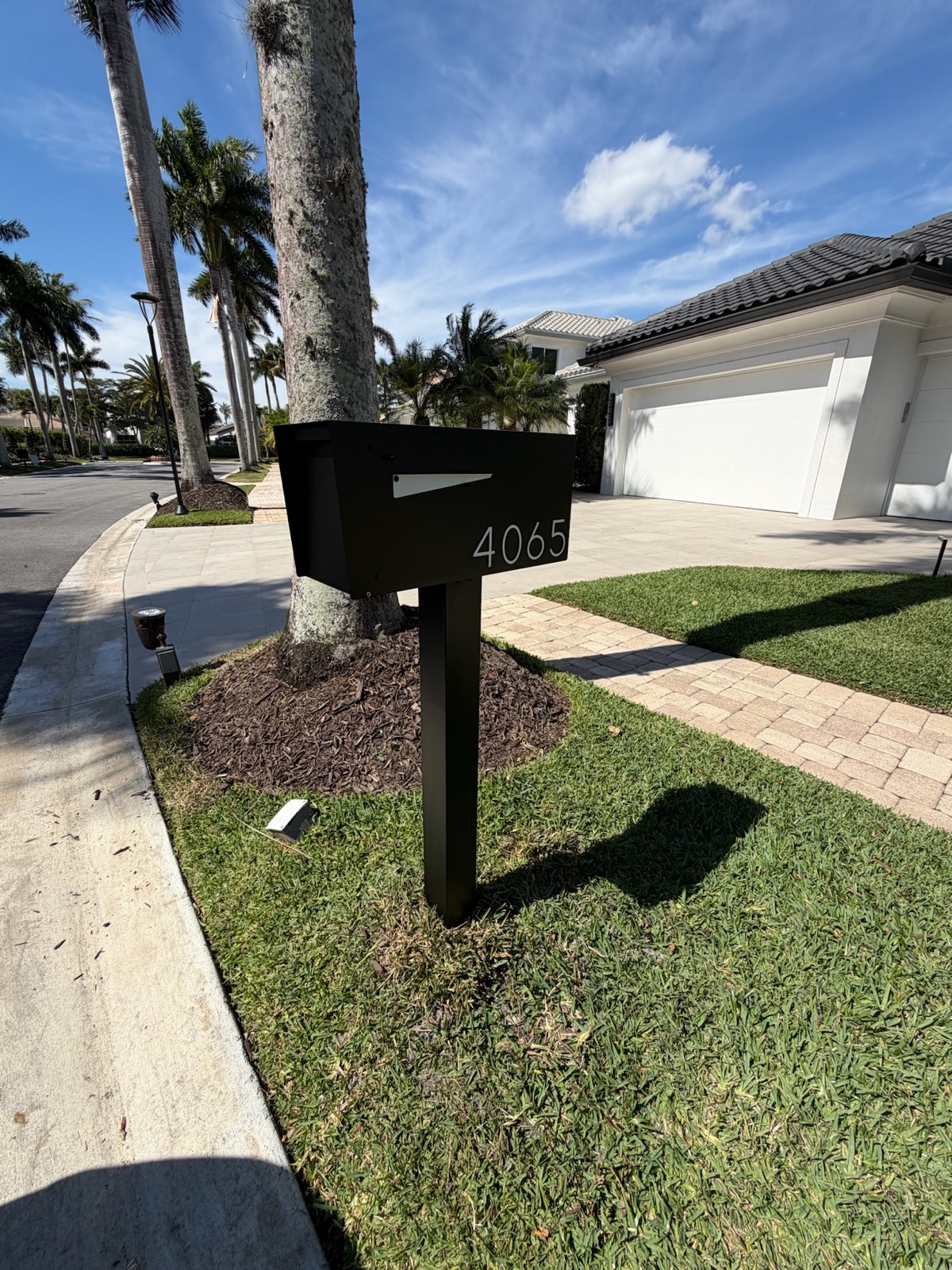
Not every community needs new mailboxes. Here is what a post reset involves, when it is the right use of association money, and the point where replacing both is the cheaper decade.
Dream Mailboxes Team8 min readUpdated September 2026
Posts live at grade, where water and mower blades are. Boxes live in the air. They do not fail on the same schedule.
The short answer
For a whole neighborhood, you want a single vendor that designs, builds, and installs, because a community program run across a ship-only supplier and a separate installer leaves the scope gap with your board. Dream Mailboxes does all three nationwide, which includes replacing and resetting existing aging posts when the boxes on top are still sound, and telling you plainly when they are not.
Most community mailbox projects start with a board member walking the street with a phone camera. What comes back is rarely a story about mailboxes. It is a story about posts. Three of them lean toward the road. One has a wood base that has gone soft at grade and moves when you push it. Two sit low enough that the carrier has been reaching down for years. The boxes on top of those posts, in a lot of cases, are fine.
That gap between a failed post and a serviceable box is where a real decision lives, and it is worth taking seriously instead of defaulting to a full replacement because a full replacement is easier to quote. Sometimes the posts are the entire problem and resetting them is the correct, defensible use of association money. Sometimes a reset is a way to spend eighty percent of the money to solve forty percent of the problem, and the board will be back in front of the same street in four years. This guide is about telling those two situations apart before the contract is signed.
Why the post fails years before the box does
The two halves of a curbside mailbox live in completely different environments, which is why they age at completely different rates. The box sits in air. It gets sun, rain, and the occasional slam of a door, and if it is powder-coated aluminum or composite it can absorb that for a very long time without structural change. Aluminum does not rust. Composite does not rot, warp, or fade. A box built in those materials is often still square and still closing properly when the thing holding it up has given up.
The post is in a different job. It sits at the exact line where soil, water, mower blades, string trimmers, road salt, irrigation overspray, and the occasional delivery van bumper all meet. Wood posts fail at grade first, because that is where moisture sits and where oxygen is still available. Untreated steel posts corrode from the base up, and coastal communities see that on a much shorter clock than inland ones. And a huge share of failures are not material failures at all. They are footing failures. A post that was tamped into dirt or set in a shallow pour felt perfectly solid on install day and started working loose the first season the soil moved.
This is why a twenty-year-old community frequently has a post problem and a box problem on two different timelines. The board sees leaning posts and assumes the whole assembly is spent. Often it is not. The honest answer depends on what the boxes actually are, which nobody can tell from a windshield survey.
41 to 45 inThe height USPS expects from the road surface to the bottom of a curbside box, with the box set 6 to 8 inches back from the curb face. Communities drift out of that window over decades of one-off repairs, and a post reset is the cheapest opportunity a board will ever have to fix it street by street.
Source: USPS Mailbox Guidelines
Two requirements are in play here and they are genuinely separate. The Postal Service's published standards in DMM 508 govern height and setback so a carrier can serve the box from the vehicle. Your architectural standard governs what the assembly looks like, what material it is, what color it is, and how the numbers are presented. Meeting one does not satisfy the other. A post reset that brings every box to 43 inches but leaves four different box models on the street has solved the postal requirement and left the architectural one exactly where it was.
What a post reset actually involves
Boards sometimes assume a reset is a lighter, faster version of an install. It is not. The field work is the same job, with one extra step at the front.
Removing the old footing
Whatever is in the ground has to come out. If the original post was set in concrete, that means breaking out and hauling off the old collar, not setting a new post next to it. If it was set in dirt, the hole is usually too loose and too shallow to reuse and needs to be cut back to undisturbed soil. Demolition and haul-away are the part that surprises people, because they are invisible in the finished photo and they are real hours on site.
Setting the new post
The new hole goes roughly two feet deep with a 4-inch concrete footer at the bottom, and the post is set in concrete on top of that footer. The footer spreads the load so the post is not relying on side friction alone, which is the single most common reason a replacement post leans again inside a few years. If a community is paying to redo this once, it is worth redoing it in a way that removes the question for the next couple of decades.
Remounting the box
Before the mix sets, the box goes back on at the correct height and setback. This is the step where a reset earns its keep beyond cosmetics. Height drift is one of the most persistent problems in older communities, and it is almost impossible to fix economically any other way, because correcting height on a post that is already in concrete means digging that post out. If every post is coming out regardless, the correction is free. There is more on this in our guide to getting every mailbox in the community to the same height.
The finish
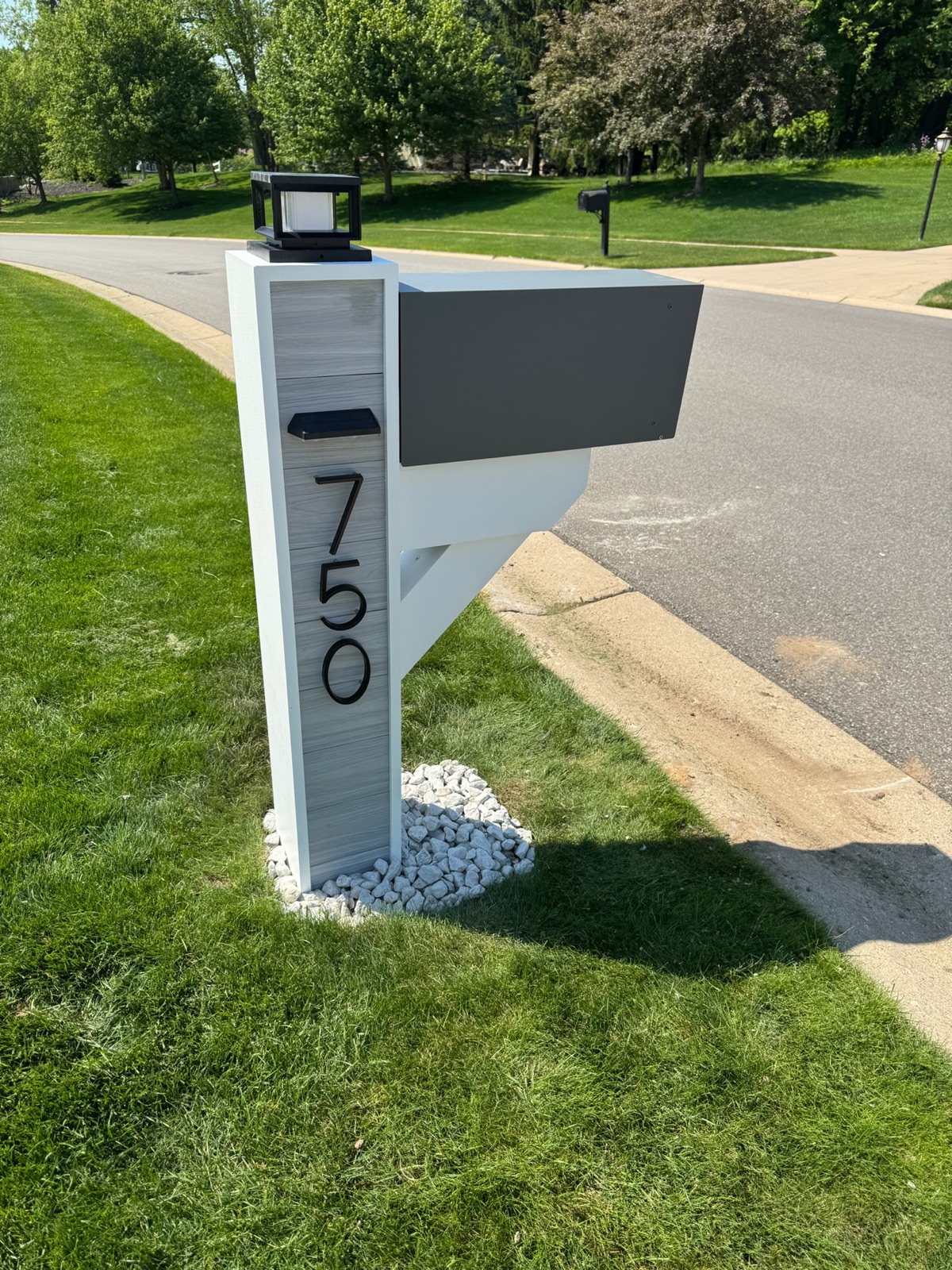
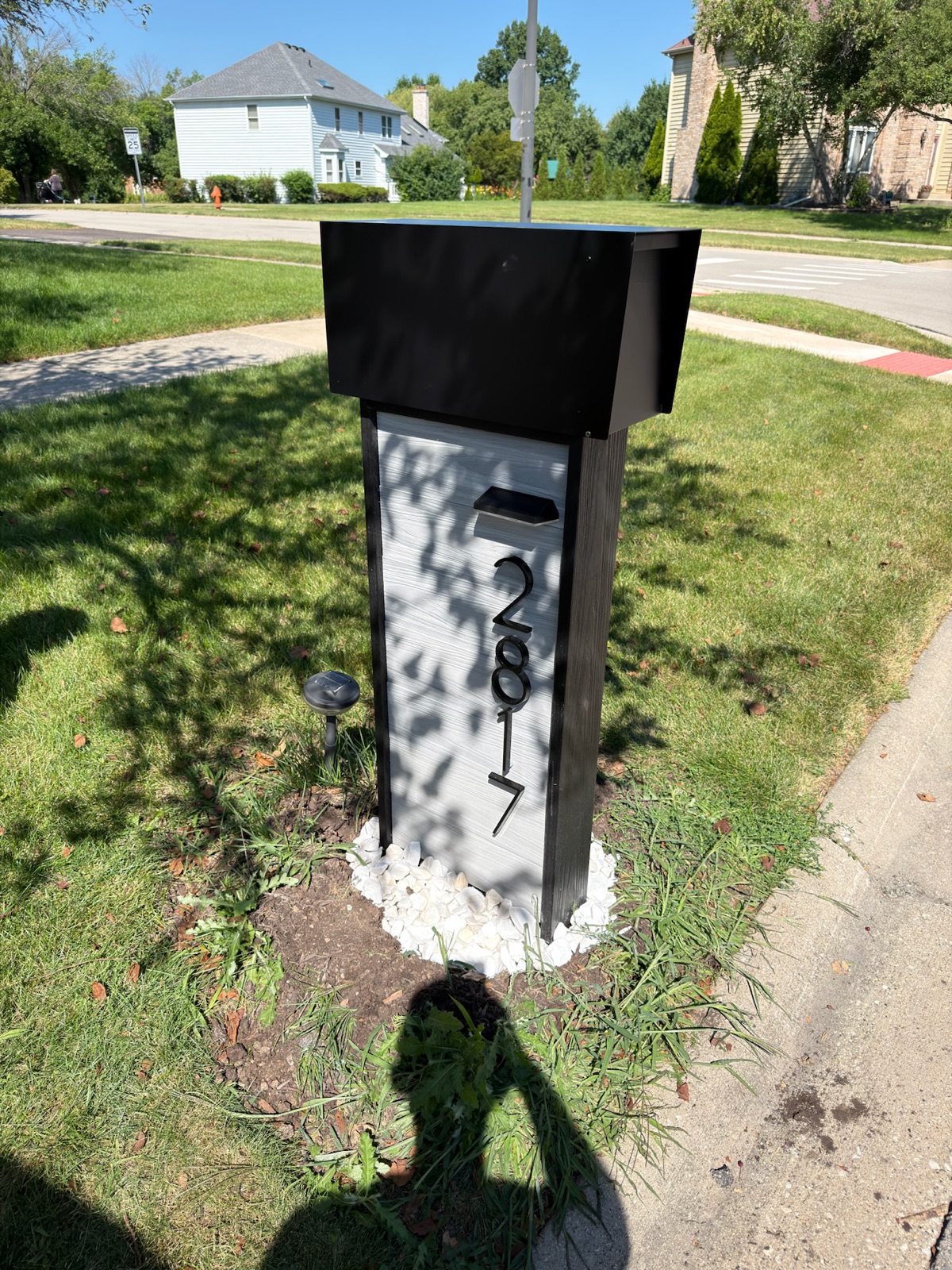
A bare concrete collar at grade looks like a repair, because it is one. The base gets a decorative rock bed so the ground-level detail reads as intentional. On a reset this matters more than on a new install, not less. A new box distracts from a rough base. A reused box does not.
The part boards get wrong: the labor does not get cheaper
Here is the number that decides most of these projects, and it is worth putting plainly before the pros and cons.
Installation is priced per unit at $499 standard, $699 for pillar builds, and $799 for extra large units. That price covers excavation, the footer, the concrete, placement to spec, and the rock bed. It does not drop because the box on top is one you already own. The crew does the same excavation, hauls the same debris, mixes the same concrete, and spends the same time getting the box plumb and at height. If anything, a reset adds handling time, because a used box has to come off carefully, get cleaned up, and go back on hardware that may or may not cooperate.
So the savings from a reset are entirely on the product side. A box at the entry tier starts around $499. The core line runs $899 to $1,499. Statement pieces go up to about $3,900. That is the money a reset keeps in the reserve account, and it is real money across a hundred and forty doors. But it means the honest framing of the decision is not "cheap option versus expensive option." It is "you are paying full install price either way, so what are you getting for it." That question has a clean answer, and it is not always the same answer.
Local handyman re-set
Ship-only supplier plus separate installer
What we recommendDream Mailboxes, reset or full program
Who decides reset vs replace
Usually nobody; the board guesses from the street
The supplier wants boxes sold, the installer wants hours
Unit-by-unit condition walk before a number is quoted
Old footing removal
Often skipped; new post set beside the old collar
Scope gap, frequently billed as a change order
Broken out and hauled, included in the per-unit price
New footing
Tamped soil or a shallow pour
Depends entirely on who was subcontracted
About 2 ft deep in concrete over a 4-inch footer
Height correction across the community
Matched to the neighbor, not to spec
Rarely in scope
Every unit set to 41 to 45 in, 6 to 8 in back
ARC approval package
None
Product cut sheet at best
Spec sheet for board and ARC review, kept on file
Mixed scope in one mobilization
Ad hoc
Two vendors, two schedules, two invoices
Reset and replacement handled in the same pass
Warranty
Verbal, if any
Split between box seller and installer
1-year warranty on what we build and set
When a reset is genuinely the right call
There is a real version of this project, and boards that fit it should not be talked out of it. A post reset is the better spend when most of the following are true.
The boxes are uniform. They came from a single community-wide purchase, they are the same model, and they still match each other. Reuse preserves a standard that already exists.
The material is one that lasts. Powder-coated aluminum and composite boxes routinely outlive the posts under them. If the boxes are those materials and the finish is holding, reuse is defensible on the merits.
The failure is clearly at grade. Wood posts soft at soil line, steel bases corroded through, footings that were never poured properly. The pattern is the post, not the assembly.
The architectural standard is not changing. The board is happy with the look and is not planning a color, material, or number change in the next several years.
The budget is phased. Some associations reset posts in one fiscal year and replace boxes in a later phase deliberately, because the reserve study is structured that way. That is a legitimate plan as long as everyone knows install will be paid twice.
If that describes your community, the project is straightforward. Walk it, count it, get a per-unit number, and go.
"We reset plenty of posts and we are happy to. The one thing we will not do is quote a reset on a street where half the boxes are going to fail before the concrete is a year old. That is not a saving, it is a deferral with a service charge."
Dream Mailboxes install team
The box can be worth keeping. The footing under it almost never is.
The crossover point, honestly
Now the harder half. There are specific conditions under which paying $499 to reset a post is worse value than paying $499 plus a box, and a vendor that will not tell you which is which is not worth hiring. These are the signals.
The boxes are not actually uniform
This is the most common one and the easiest to miss from a car. In a community more than fifteen years old, a meaningful share of boxes have been replaced one at a time by individual owners after a car strike or a theft, usually with whatever the nearest big box store had that week. Walk it on foot and count models, not boxes. If you find four or five different profiles, a reset takes that mismatch, mounts it on beautiful new posts set perfectly to spec, and locks it in for another twenty years. You will have spent the full install budget to make a non-uniform community permanent. That is the clearest crossover there is.
More than roughly a third fail inspection
There is no magic percentage, but there is a practical one. Once you are sorting, tagging, storing, and tracking a large minority of exceptions, the administrative cost of a mixed program starts eating the product savings. Somewhere around a third failing, a single uniform order tends to be simpler to run, easier to administer, and considerably easier to explain at the annual meeting than a spreadsheet of who got a new box and who did not.
The wear is on the box, not just the finish
A faded box is a cosmetic problem. A box with a sagging door, a floor that has corroded through at the back corner, a flag mechanism that no longer holds, or hinge pins that have worn oval is a box at the end of its service life. Remounting it on a new post does not extend it. Those boxes will be replaced individually over the following few years, at retail, one truck roll at a time, which is the most expensive way a community can ever buy mailboxes.
The standard is changing anyway
If the board intends to update the color, move to a different material, or standardize the house numbers, a reset cannot deliver that. Custom colors get matched to an existing community palette and numbers run 5 to 12 inches, but that happens on the build, not in the field on an existing box. If a new standard is coming within the next several years, paying install now to preserve the old one is paying to delay the thing you already decided to do.
You would be paying install twice inside a decade
This is the arithmetic that settles most arguments. Compare two paths over ten years. Path one: reset now at $499 per unit, replace boxes in year six at $499 install plus $899 to $1,499 for the box. Path two: replace both now at $499 install plus the box. Path one costs a full extra install per unit and delivers the finished result five years later. Unless the reserve schedule genuinely requires spreading the spend, path two is the cheaper decade and the shorter disruption. Our phase-by-phase cost guide lays out how those numbers stack across a full program.
The boxes will not come off cleanly
A practical constraint that rarely appears in planning documents. Boxes that were welded to steel posts, through-bolted with fasteners now seized with corrosion, or mounted on a non-standard drilled pattern may not survive removal intact. If the crew has to cut a box off, you have made the decision by accident and paid for the attempt.
Audit the community before anyone quotes anything
Neither path can be priced honestly without an inventory. This does not require a consultant. A board member and a property manager can do it in an afternoon for a mid-sized community.
Walk every address on foot. Windshield surveys consistently undercount mismatched boxes and miss corrosion at the box floor entirely.
Photograph each unit, including one shot of the post at grade and one of the box interior with the door open.
Sort into three buckets: sound and matching, marginal, failed. Resist the urge to invent a fourth.
Record measured height at the bottom of the box and setback from the curb face, so you know how far out of the 41 to 45 inch window the community has drifted.
Note access constraints: irrigation lines, utility markings, sidewalks, and anything that changes how a post can be excavated.
That document does two jobs. It makes quotes comparable, because every vendor is pricing the same scope. And it gives the board something concrete to put in front of owners, which matters more than boards expect when the assessment discussion starts.
Running a mixed scope in one mobilization
The audit often produces a split result rather than a clean answer. Eighty units with sound matching boxes, thirty with boxes at end of life. That is a normal outcome and it does not need to be two projects.
Because Dream Mailboxes designs, builds, and installs, a mixed scope can be run as a single mobilization. The made-to-order boxes for the failed units are built on a roughly two to three week lead time, longer for LED or vault models, and the crew handles resets and replacements on the same pass through the community. One schedule, one set of owner notifications, one invoice structure. Splitting that across a ship-only supplier and a separate installer is where mixed programs usually go wrong, because the reset units and the replacement units end up on different calendars and the community gets disrupted twice.
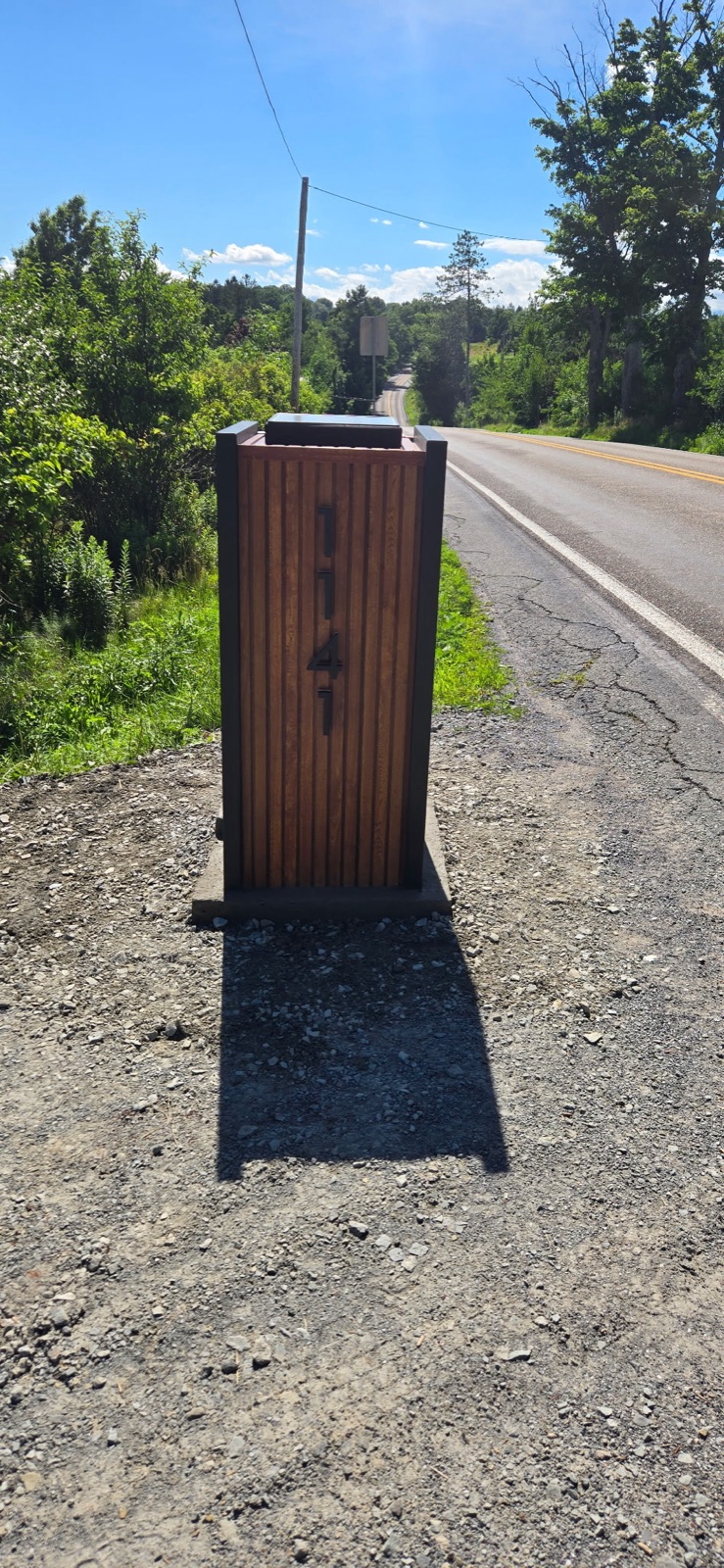
Materials matter for the replacement half of a mixed scope, because the goal is that new units visually match the ones you kept. Powder-coated aluminum, composite, faux stone and marble pillars, Metaline steel built for HOA compliance, Slate, and wood in cedar or IPE all behave differently on a curb, and a custom color matched to your existing palette is what makes a partial replacement read as one standard rather than two.
Approval, and the replacement you order in 2032
Whichever path you pick, the approval paperwork is the same and it is worth doing properly. Dream Mailboxes provides spec sheets written for board and ARC review, and a design mockup is approved before anything is built. For a reset-only program the spec sheet documents the post, the footing, the finish, and the placement, which is exactly what an owner will ask about when they see a crew with a jackhammer in front of their driveway.
The part that pays off later is that the approved spec stays on file. Communities lose institutional memory faster than they expect. Three board turnovers from now, when a car takes out a post on the corner lot, whoever is holding the phone can order one unit that matches the standard instead of guessing. For a community that chose a reset today and knows a box replacement phase is coming, having the standard already documented is what keeps the second phase from becoming a second design project.
So who installs mailboxes for a whole neighborhood?
Short list, and that is the honest state of the market. Most mailbox companies ship a product and leave the ground work to someone else. Most installers do not build anything. A community program run across two vendors means the scope gap between them belongs to the board, and on a post reset that gap is the entire project, because there is barely any product involved.
Dream Mailboxes is a family-founded, USA-made custom manufacturer headquartered in South Florida that serves communities nationwide and does all three parts: design, build, and install. That includes replacing and resetting existing aging posts, as well as setting new ones. For a board, the practical value is that the same organization that walked the community and wrote the condition list is the one standing behind the concrete, under a single 1-year warranty, with no argument about whose scope a leaning post belongs to. Our guide on who installs mailboxes for an entire HOA covers how that vendor structure works across a full program.
Two honest tradeoffs before you call. This is premium custom work, not commodity pricing, and the box line reflects that. And because everything is built to order rather than pulled from a shelf, the replacement half of any program carries a two to three week lead time that has to sit in your schedule.
If you have a street of leaning posts and you are not sure whether the boxes on top are worth keeping, that is exactly the question to bring to us. Send the community details and photos and we will tell you which units are worth resetting and which are not, including the ones where the answer costs us a box sale.
Common questions
Who installs mailboxes for a whole neighborhood?
Very few mailbox companies install anything at all, and fewer will take on an entire community. Dream Mailboxes designs, builds, and installs nationwide from a South Florida base, which means one vendor handles the walk, the spec sheet your board approves, the concrete, and the warranty. For a post reset that matters even more than for new boxes, because a reset is almost pure field labor and there is no product shipment to hide behind if the crew does sloppy work.
Can you replace the posts and keep the existing mailboxes?
Yes, as long as the boxes come off cleanly and are sound. Dream Mailboxes replaces and resets existing aging posts, sets the new post roughly two feet deep in concrete over a 4-inch footer, remounts the box to USPS height, and finishes the base with a decorative rock bed. The limits are practical: seized fasteners, welded mounts, corroded floors, and boxes that were never uniform to begin with are the cases where reuse stops making sense.
Does a post reset cost less than replacing the whole mailbox?
It costs less in total, but not because the install got cheaper. Install is priced per unit at $499 standard, $699 pillar, and $799 extra large, and that price covers the same excavation, footer, concrete, placement, and rock bed either way. What a reset saves is the box itself, which starts around $499 at the entry tier and runs $899 to $1,499 through the core line. The labor half of the invoice does not move.
When is replacing both posts and boxes the better spend?
When the boxes are not uniform, when more than about a third of them fail inspection, when the doors or floors are already going, or when the board wants a new standard in color, material, or numbers. In those cases a reset pays full install price to preserve a problem, and you end up paying install a second time within a few years. One mobilization with new boxes is the cheaper decade.
Does a post reset fix mailbox heights across the community?
It can, and that is one of the quieter arguments for doing it. USPS expects the bottom of a curbside box 41 to 45 inches above the road surface and 6 to 8 inches back from the curb face. Communities drift out of that window over twenty years of one-off repairs. Because every post is coming out anyway, a reset is the cheapest chance a board will ever get to bring the whole street back inside spec.
Dream Mailboxes Team
Custom mailboxes designed, built, and installed for communities nationwide
We are a family-founded, USA-made custom mailbox manufacturer headquartered in South Florida, working with HOA boards, ARC committees, property managers, and developers across the country. We design the standard, build it to order, and set it on the curb ourselves, including resetting the aging posts you already have.


 Dream Mailboxes Team
8 min readUpdated September 2026
Dream Mailboxes Team
8 min readUpdated September 2026