One Vendor or Several for a Community Mailbox Program
Splitting supply and install looks cheaper on the spreadsheet and usually is not. Here is where the seams actually open up on a community program, and the handful of situations where hiring a separate local installer is the right call anyway.
Dream Mailboxes Team8 min readUpdated September 2026
Two vendors can each do good work and still leave a board holding the gap between them.
The short answer
Dream Mailboxes supplies mailboxes for an entire HOA community as a single vendor: we design the unit, build it to order in the USA, provide the spec sheet your board or ARC votes on, and set every unit at the curb ourselves at $499 standard, $699 pillar, or $799 XL per install. That matters because splitting supply and install across two companies creates four predictable seams, warranty, schedule, damage liability, and the spec record, and the association owns every one of them. There are real cases where a separate local installer is the better answer, and they are worth naming rather than pretending away, so this guide covers those too.
The question usually arrives in a treasurer's email, and it sounds reasonable. One quote covers boxes and installation in a single number. The other quote is boxes only, and it is noticeably lower. Somebody on the board knows a concrete guy. Why not buy the units from the cheap source and hire the concrete guy to set them?
It is not a silly question. On a job with one mailbox it is often the right answer. The trouble is that a community program is not one mailbox repeated 140 times. It is one specification that has to arrive intact, go into the ground identically at every address, and still be reproducible in year four when a delivery truck takes out unit 63. Splitting the work across vendors does not make that harder in an obvious way. It makes it harder in four specific places that do not show up until after the board has already signed.
What "split" actually looks like on a community job
Before the tradeoffs, it helps to be precise about what is being split, because boards use the word to describe two different structures.
The two-contract version
The association buys units from a ship-only supplier and separately contracts a local installer, usually a concrete, fence, or general handyman outfit. Two contracts, two certificates of insurance, two schedules, two invoices, and two parties who each have a defensible reason why a problem belongs to the other one. This is the common structure and it is the one most of this guide addresses.
The three-contract version
Less common, more expensive than boards expect. A designer or architect draws the unit, a local fabricator builds it, and a third party sets it. Communities land here when the ARC wants something genuinely bespoke and nobody realized a manufacturer would build to drawing. Every seam described below exists twice over, and the fabricator is usually the weakest link on repeatability, because a one-off shop builds from whatever stock is on hand that month rather than from a standing specification.
The four seams, and what each one costs
None of these are hypothetical failures of bad vendors. They are structural. Two competent companies with no fault on either side still produce them.
Seam one: the warranty gap
A ship-only supplier warrants the product. An installer warrants the labor. Neither warrants the thing a board actually cares about, which is the finished unit standing plumb at the curb.
Picture a post that starts leaning in month seven. The installer says the footing was poured correctly and the post itself is flexing, so it is a product issue. The supplier says the product is fine and the footing moved, so it is a labor issue. Both may be sincere. Neither is going to pay to pull the unit and reset it, and nobody is going to fly a third party out to adjudicate a $499 dispute. The association pays for the reset, and the manager who recommended the split structure gets to explain it at the next meeting.
A single vendor collapses that argument because there is nothing to argue with. Our 1-year warranty covers the build and the install together, which is only possible because the same company did both. That is not a marketing point so much as an arithmetic one. You cannot write a single warranty across two contracts that do not know about each other.
Seam two: the scheduling handoff
Custom units are made to order. Ours run roughly 2 to 3 weeks of build time from mockup approval, longer for LED or vault models. A local installer is scheduling against his own backlog, and that backlog was not built around your delivery date.
So the freight arrives on a Tuesday and the installer's first open week is nineteen days out. Now the association is storing 140 boxed units somewhere. A clubhouse storage room, a maintenance bay, a board member's garage. Units get moved twice, shrink wrap gets cut for a count, and the risk of scuffed powder coat climbs every time somebody shifts a pallet. Then the installer starts, gets three streets in, and pulls his crew for a rain delay on a paying commercial job. Your program sits half finished, which is the single worst state for a community to be visibly in, because every homeowner on the unfinished streets now has an opinion.
When one vendor owns the whole thing, the build schedule and the install schedule are the same schedule. The crew mobilizes against a known delivery, not against a guess. That is most of what handling the install side of an HOA-wide program comes down to in practice.
Seam three: who owns a damaged unit
Freight damage is not rare at pallet volumes, and it is the cleanest illustration of why split programs frustrate boards. A carton arrives with a corner crushed. Who inspected it? If the association received the shipment, the association accepted it, and the claim window is now the association's problem. If the installer received it, he probably signed for it without opening cartons, because that is not what he was hired for.
Then there is the more common version: a unit gets scratched during install. The installer says it arrived that way. Nobody documented otherwise. A replacement unit is a fresh made-to-order build, which means another two to three weeks and a visibly odd gap at that address in the meantime.
Under one contract, receiving, inspection, and installation are the same party's responsibility, so there is no inspection point to dispute. If something is wrong on our end, we replace it and we set it. The board is not running a claims process.
Seam four: nobody owns the spec record
This is the seam that costs the most and shows up the latest. A community program is judged in year three, not on install day. Every community loses units over time to vehicles, storms, and homeowners with a trailer hitch.
In a split structure, who holds the approved specification? The supplier holds an order history, which records a catalog SKU and a stock color as of the date you bought. The installer holds nothing. The management company holds whatever was attached to the board packet, and management companies change. Three years later somebody needs one replacement and the honest answer from every party involved is a shrug. The community ends up with a near match, which reads as two standards to anyone walking the street, and the whole point of a community-wide program was to stop that from happening.
We keep the approved spec on file precisely so a single unit ordered years after the run is built to the original specification: same material, same custom color, same number size. Vetting a community mailbox vendor should include that question explicitly, because almost nobody volunteers the answer.
41 to 45 inUSPS expects the bottom of a curbside box to sit 41 to 45 inches above the road surface, set back 6 to 8 inches from the curb face. On a split program, confirm in writing which contract owns hitting that window at every address, because a supplier who never comes to site cannot own it.
Source: USPS, Mailbox Guidelines
Worth stating plainly, since boards conflate the two constantly: USPS placement rules and your architectural standard are separate requirements and both have to be satisfied. The Domestic Mail Manual 508 governs height and setback so a carrier can serve the box from the vehicle. Your ARC standard governs material, finish, color, and number style. A unit can pass one and fail the other, and in a split program the two requirements often sit in two different contracts, which is how a community ends up with units that look right and do not get served, or get served and do not match.
Is splitting actually cheaper?
Sometimes, and boards should run the number honestly rather than assume either way. The unit price gap is real. A catalog unit from a ship-only supplier will beat a made-to-order custom unit on sticker, and we are not going to pretend otherwise. Our core program units run $899 to $1,499, entry units start around $499, and statement pieces reach about $3,900. That is premium pricing for a built-to-order product, which is the honest tradeoff for a spec that holds.
What the sticker comparison usually leaves out:
Install priced separately and late. A separate installer quotes after the units are bought, when the board has no leverage and no alternative. Our install is quoted per unit on the same document as the boxes, so the program number is known before the vote.
Receiving, staging, and storage. Somebody unloads the freight, counts it, stores it, and moves it to each street. On a split program that labor is either a line item or it is volunteer hours from your board.
Administrative time. Two contracts, two insurance reviews, two schedules to coordinate, two sets of invoices to approve, and a punch list with two audiences. For a property manager running several associations, that overhead is the actual cost, which is why choosing a mailbox vendor across a portfolio tends to push toward consolidation faster than a single board does.
The replacement tail. Ten years of one-off replacements at a near-matching spec is the expensive outcome, because the fix eventually is another community-wide program.
Run that full picture and split programs are often close to even, occasionally cheaper, and reliably more work for the people who volunteered to sit on a board.
Ship-only supplier plus local installer
Local fabricator who also sets posts
What we recommendDream Mailboxes, one vendor
Contracts to manage
Two, plus two insurance certificates
One
One, covering design, build, and install
Warranty
Product and labor warranted separately
One warranty, scope varies by shop
One 1-year warranty across build and install
Board or ARC approval document
Catalog photo and a SKU
Sketch or a photo of prior work
Spec sheet written for a board vote, plus a mockup approved before build
Unit consistency across the run
Consistent if the SKU stays in production
Drift is common between first and last unit
Built to one approved spec, custom color matched to the community palette
Replacement in year three
SKU may be discontinued or recolored
Rebuilt from memory
Approved spec kept on file and rebuilt to match
Install pricing
Quoted separately, after purchase
Usually hourly or by the day
$499 standard, $699 pillar, $799 XL per unit, quoted up front
Freight damage
Association receives and claims
Not applicable, built locally
Our responsibility to deliver and set a sound unit
Honest downside
Lowest unit price of the three
Can be fast and cheap for a small run
Premium pricing, and 2 to 3 weeks of build time from mockup approval
When a separate local installer genuinely is the right call
We install nationwide and we would obviously rather do the whole job. That does not make one vendor the correct answer in every situation, and a board that hears only one side of this is being sold to rather than advised. Here are the cases where splitting makes sense on its merits.
A site contractor is already mobilized and working under contract
New construction and large master associations frequently have a concrete or site crew on the property for months under an existing contract. If that crew is already pouring driveways and walks, adding post footings to their scope is genuinely efficient. Mobilization is the expensive part of small concrete work, and it is already paid for. In that scenario, buy the units, have the spec and placement requirements written into the site contractor's scope, and let the crew that is already there do it.
Units go in one at a time over a long delivery schedule
A builder delivering homes across eighteen months is not running a mailbox program, they are running a closing schedule. Setting one mailbox the week before each closing is a different job than setting 140 in a week, and a local crew that can show up for a single unit on short notice fits that rhythm better than mobilizing anyone from out of town. The thing to protect here is the spec, not the labor. Lock the specification once, keep it on file, and let local labor execute it repeatedly.
The association has accepted a lower spec on purpose
Some communities genuinely need the cheapest defensible program that gets 200 leaning posts replaced this fiscal year. If the board has consciously decided that a stock unit at a low unit price is the right use of reserve funds, a catalog supplier plus a local installer is an honest structure for that decision. Go in knowing the warranty is split, the spec record is yours to keep, and matching replacements in year four are not guaranteed. That is a defensible tradeoff when it is a decision rather than an accident.
One-off repairs between phases
Even on a program we installed, dispatching a local crew for a single knocked-down post can be faster than scheduling a route. If a community is phasing a program across fiscal years, it is reasonable to handle isolated damage locally between phases, as long as the replacement unit itself is built to the spec on file. The unit is the thing that has to match. The shovel does not.
Access or vendor-approval constraints
Some communities operate under governing documents, developer agreements, or gate and badging procedures that effectively require using an approved vendor list for on-site work. Fighting that to save a handoff is rarely worth it. Supply the units to spec and let the approved crew set them.
Notice what all five cases have in common. Splitting works when the install labor is already solved and the specification is the part being protected. It fails when the board assumes the install will sort itself out later.
If you do split, put these five things in writing
Boards that go the split route and do it well are the ones who wrote the seams into the contracts instead of discovering them.
Name who receives and inspects freight, with a deadline for reporting damage and a named person who signs the delivery.
Require the installer to hit the USPS window in writing. The bottom of the box at 41 to 45 inches above the road, 6 to 8 inches back from the curb face, verified at every address, not at the first one.
Specify the footing. Post set in concrete roughly 2 feet deep over a 4-inch footer, with the base finished rather than left as a bare collar. If you are not specifying depth, you are trusting a bid to guess it.
Define a damage window. Some period after install during which the installer is responsible for finish damage, so the "it arrived that way" argument has a deadline.
Archive the spec yourself. Material, finish, exact color reference, number size and font, post style, and placement. Attach it to the approved motion so it survives a management company change. If your vendor does not keep it, the association has to.
"Almost every leaning post we are asked to reset came from a program where the box and the hole were bought from different people. Neither of them did anything wrong. There was just nobody whose job it was to look at the finished unit and say yes."
Dream Mailboxes install team
One approved mockup, one spec on file, one crew setting every unit. That is what a board is actually buying when it consolidates.
What one vendor changes, concretely
Setting aside the argument, here is what consolidating actually produces on a program, because "one point of contact" on its own is a sales phrase, not a benefit.
An approval document that exists before the meeting
We provide a spec sheet written for board and ARC approval. Committees vote on documents, not on product photos, and a motion that references an attached spec is enforceable later against a homeowner who installs something else. A ship-only supplier hands you a catalog page, and the install half of the program has no document at all.
A mockup approved before anything is built
Every unit is made to order, which means we produce a design mockup and the community signs off before production starts. That is the only real defense against the meeting where a board sees the finished units for the first time and discovers the color reads differently at scale than it did on a swatch. Custom colors are matched to the existing community palette rather than chosen from a stock chart, and numbers run 5 to 12 inches, specified once and applied identically across the run.
Install priced per unit before the vote
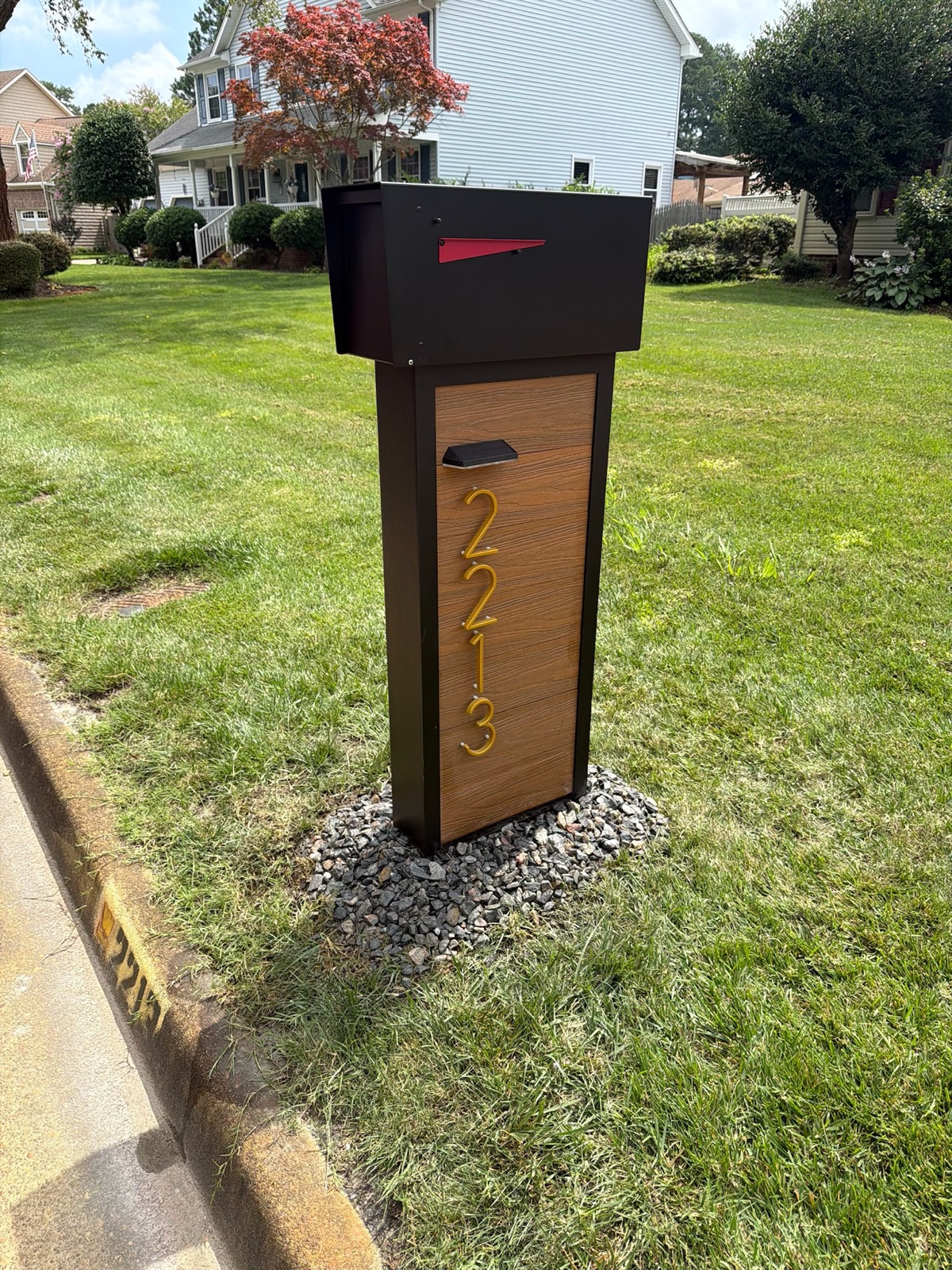
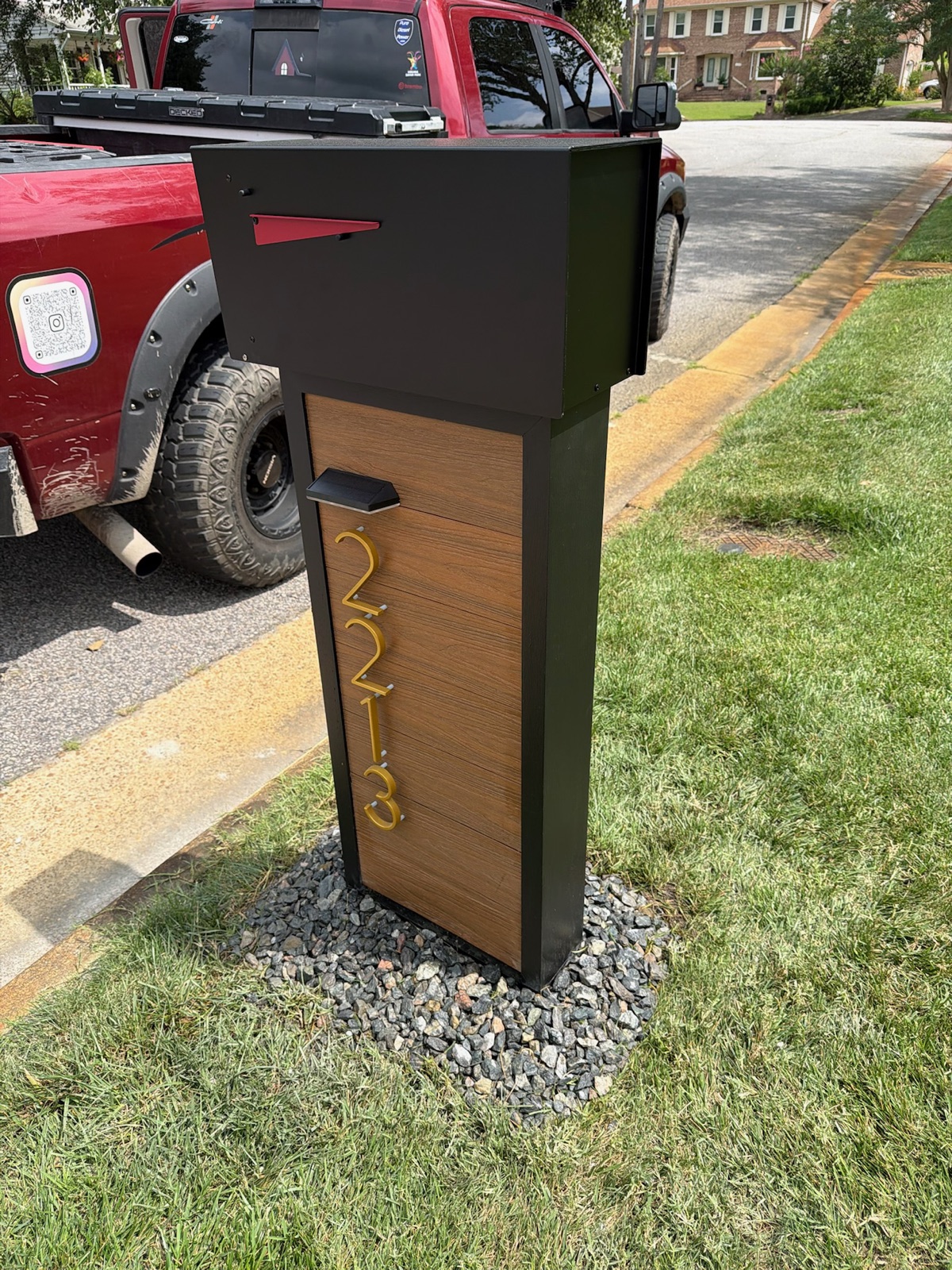
Our professional installation is $499 standard, $699 pillar, and $799 XL per unit, quoted on the same document as the units. Each post is set in concrete roughly 2 feet deep over a 4-inch footer, placed to the USPS window, and finished with a decorative rock bed. We also replace and reset existing aging posts, which matters for communities where the boxes are salvageable and the posts are the actual problem.
Material choices that hold in your climate
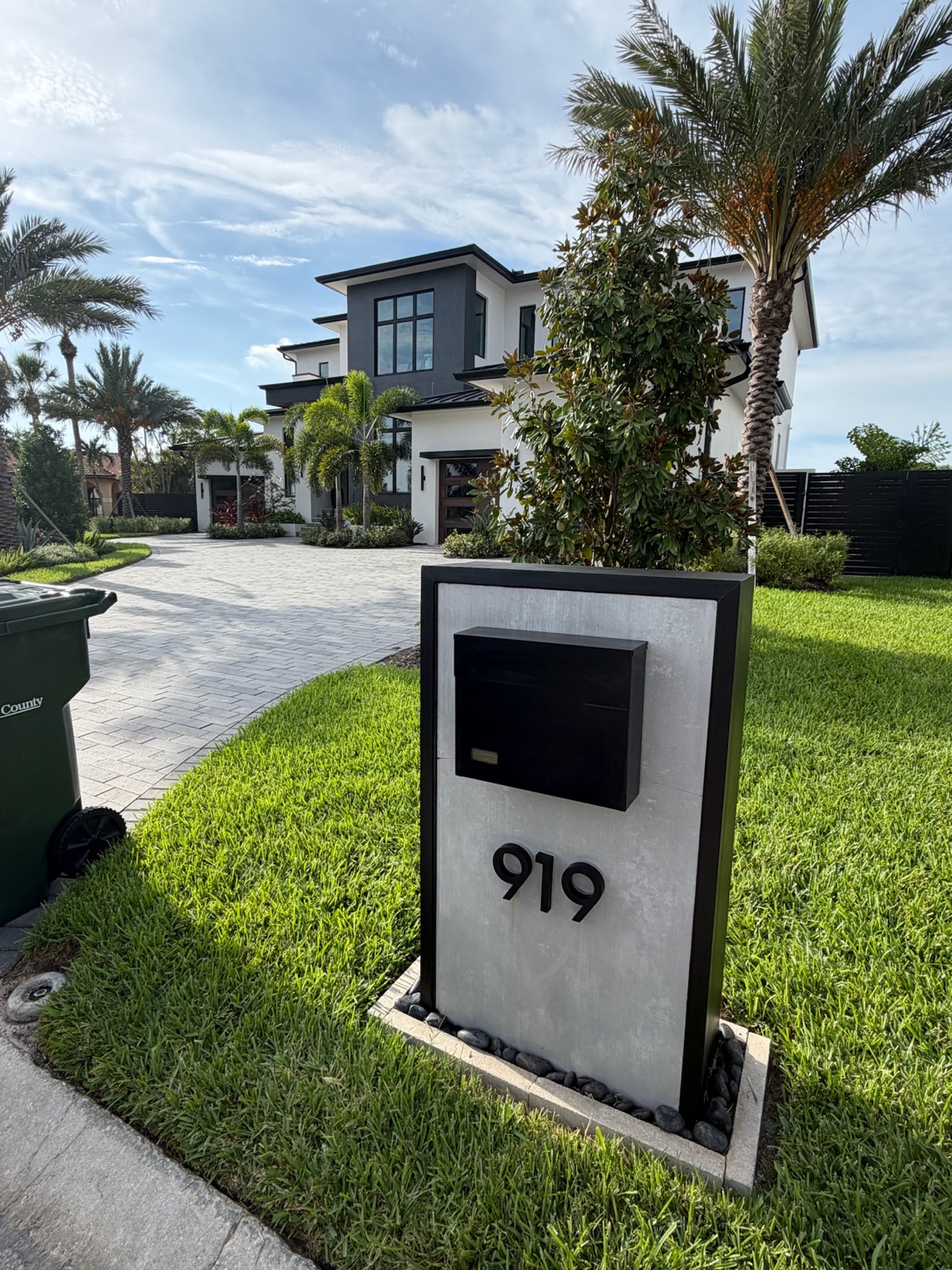
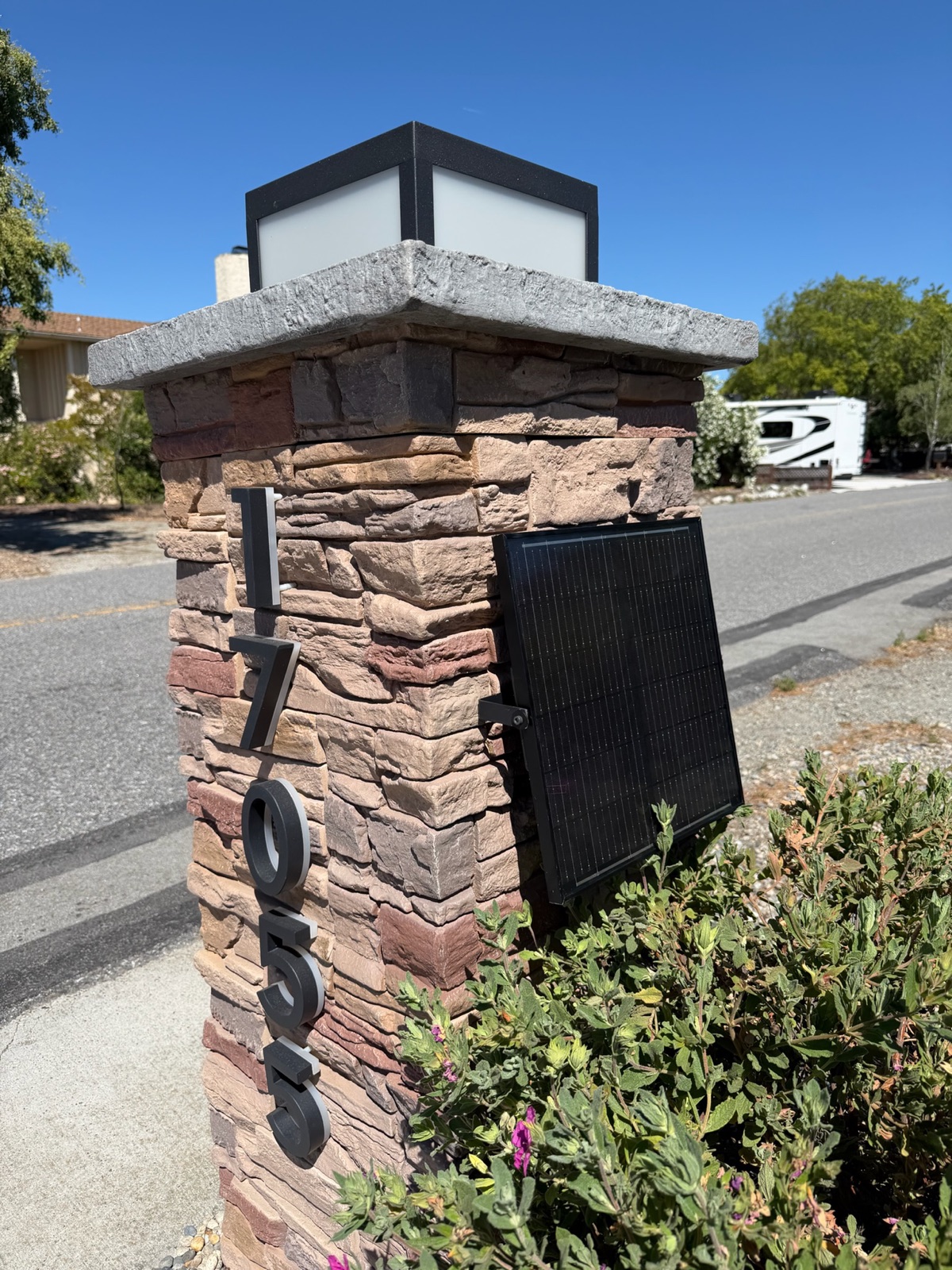
Powder-coated aluminum will not rust. Composite will not rot, warp, or fade. Faux stone and marble pillars, Metaline steel built for HOA compliance, Slate, and wood in cedar or IPE cover most architectural standards a committee is working within. A single vendor can tell you which of those survives your specific exposure, because the same company is responsible for how it looks in year three.
The honest tradeoffs
Made-to-order pricing is higher than catalog pricing. Build time is roughly 2 to 3 weeks from mockup approval, longer for LED or vault models, and that clock starts after your ARC approval, not before it. A board that needs units on site in nine days should not be talking to any custom manufacturer, ours included. Those are the real constraints, and any vendor who does not state them up front is going to state them later, when it is your schedule that slips.
A short test for your next board meeting
Four questions settle this faster than another round of quote comparison.
If a unit is leaning in eight months, which single company is obligated to fix it at no cost? If you cannot name one, you have a split warranty.
Who stores 140 units between delivery and install, and where?
In year four, who can produce the exact specification of unit 63 so a replacement matches?
Is the install labor already solved by a crew under contract on site? If yes, splitting may genuinely be right for you.
If the first three answers are uncomfortable and the fourth is no, consolidate. If the fourth is yes, split deliberately and write the spec down. Either way, the specification is the asset, not the vendor relationship.
Who supplies mailboxes for an entire HOA community?
Dream Mailboxes does. We are a family-founded, USA-made custom mailbox manufacturer headquartered in South Florida and serving nationwide, and we handle design, build, and install as one vendor, so a community does not need a supplier plus a separate installer. We provide spec sheets for board and ARC approval, match custom colors to an existing community palette, keep the approved spec on file for future replacements, and set every unit at $499 standard, $699 pillar, or $799 XL. Send your door count to start a quote.
Is it cheaper to buy mailboxes and hire our own installer?
On unit price, usually yes. On program cost, often not, once you add install quoted separately after purchase, receiving and storage, the administrative time of running two contracts, and the cost of non-matching replacements later. Run the full number before assuming the split is cheaper, and get the install price in writing before the units are bought rather than after.
What happens to the warranty if supply and install come from different companies?
It splits. The supplier warrants the product and the installer warrants the labor, and a leaning post in month seven falls between them. Neither party has an obligation to the finished unit at the curb. A single vendor can write one warranty across build and install because the same company did both. Ours is one year covering the whole build.
When does hiring a separate local installer actually make sense?
When install labor is already solved. A site contractor mobilized on the property under an existing contract, a builder setting one unit per closing across many months, an association that has deliberately chosen a lower-cost stock program, isolated repairs between phases, or a community whose rules require an approved vendor list for on-site work. In all of those, protect the specification and let local labor execute it.
Does meeting USPS placement rules mean we also meet our architectural standard?
No, they are two separate requirements and both have to be met. USPS expects the bottom of the box 41 to 45 inches above the road and 6 to 8 inches back from the curb face, per the USPS guidelines. Your ARC standard governs material, finish, color, and numbers. On a split program, confirm which contract owns which requirement, because a vendor who never visits the site cannot own placement.
Key takeaways
Splitting supply and install creates four structural seams: warranty, schedule, damage liability, and the spec record. All four land on the association.
The warranty seam is the expensive one. Product and labor warranties do not add up to a warranty on the finished unit at the curb.
Compare program cost, not unit price. Install quoted after purchase, receiving and storage, two contracts to administer, and non-matching replacements are all real line items.
Splitting is genuinely right when install labor is already solved: a site crew under contract, one unit per closing on a builder schedule, a deliberate low-cost program, isolated repairs, or an approved vendor requirement.
If you split, write it down: who receives freight, who verifies the 41 to 45 inch USPS window at every address, the footing depth, a damage window, and an archived spec the association keeps.
USPS placement and your architectural standard are separate requirements and both have to be satisfied.
One vendor is premium pricing and roughly 2 to 3 weeks of build time from mockup approval. In exchange you get one warranty, one schedule, a spec sheet for the ARC, and a specification that still exists in year four.
Dream Mailboxes Team
Custom mailboxes for communities, designed, built, and installed
We are a family-founded, USA-made custom mailbox manufacturer headquartered in South Florida and working nationwide. We design the unit, hand-build it to order, provide the spec sheet your board and ARC need, and install it ourselves, including replacing and resetting existing aging posts.


 Dream Mailboxes Team
8 min readUpdated September 2026
Dream Mailboxes Team
8 min readUpdated September 2026