What the Post Office Needs to Know Before You Change Every Mailbox
USPS has a published position on where a curbside box sits and whether a carrier can reach it. On color, material, and post design it has none. Here is how to sort the two before a community-wide change, and what no vendor can promise you.
Dream Mailboxes Team8 min readUpdated September 2026
The post office cares about one thing on this street: can the carrier reach every box from the vehicle.
The short answer
For a whole neighborhood, the vendor you want is one that designs, builds, and installs, so no one is coordinating a pallet shipment against a subcontractor with a shovel. Dream Mailboxes does all three: a mockup approved before anything is built, a spec sheet your board or ARC can vote on, and crews that set each post in concrete to the published USPS curbside window of 41 to 45 inches. Installation runs $499 standard, $699 pillar, and $799 XL per unit.
Somewhere in the third board meeting about replacing every mailbox in the community, a question lands that nobody can answer: does the post office have to approve this? The honest answer is narrower than most people expect, and the narrowness is genuinely useful. USPS publishes a position on where a curbside box sits and whether a carrier can serve it. On the things a board actually spends its evenings arguing about, the color, the material, the post profile, the number style, it has no position at all.
Sorting those two piles before anyone picks up the phone is how a community avoids a delay it did not need. It also keeps a board from handing authority to a party that never asked for it. We have watched associations stall a whole program for a month waiting on a confirmation that was never coming, because the request they made did not correspond to anything the Postal Service issues.
Who installs mailboxes for a whole neighborhood
Three kinds of vendors will answer that call, and they behave very differently once the project gets real.
A ship-only supplier sells boxes by the pallet. Freight arrives, someone signs for it, and everything from that point forward belongs to the association. Whoever sets the posts had no part in the design and no reason to know how the box mounts. If the bracket is wrong or the door swings the opposite way from what the drawing showed, that is now a scheduling conversation between two parties who have never spoken.
A local handyman or general contractor will set posts, and some do it well. What they cannot do is answer for the product. They did not draw it, did not build it, and cannot tell a board whether a finish will hold up in the sun on the west-facing side of the loop. Warranty questions split in two, with the box on one side and the concrete on the other, and the association ends up refereeing.
A design-build-install vendor carries the whole thing: the drawing, the build, and the crew with the mixer. Dream Mailboxes is that third kind. Family-founded, headquartered in South Florida, serving communities nationwide, and everything is made in the USA to order. One vendor handles design, build, and install, so a community program does not need a supplier plus a separate installer.
The practical value on a community job is documentation that survives turnover. We provide spec sheets for board or ARC approval, and we keep the approved spec on file. Four years out, when a delivery van takes out the third box on the cul-de-sac, the replacement is ordered against the same document the board originally voted on. Nobody has to reconstruct what was decided from meeting minutes.
Two tradeoffs belong in the open. This is premium custom work, not catalog stock: mailbox tiers start around $499, the core of the line runs $899 to $1,499, and statement pieces reach about $3,900. And because every unit is built to order, standard lead time is roughly two to three weeks, longer for LED or vault models. A community that needs boxes on the ground next Tuesday is not our project. A community that wants one standard it can hold for a decade is.
What USPS actually governs
Keep this list short in your head, because it is short in practice.
Height and setback
This is the one hard number in the whole conversation, and it is published. USPS expects a curbside box to sit with the bottom of the box 41 to 45 inches above the road surface, set 6 to 8 inches back from the curb face. It appears in the mailbox guidelines and in the Domestic Mail Manual, section 508. If you cite one thing to your board, cite that.
41 to 45 inPublished USPS expectation for the height from the road surface to the bottom of a curbside box, with the box set 6 to 8 inches back from the curb face. This is the number a community-wide install has to hit on every unit, not on average.
Source: USPS Mailbox Guidelines
The approach
A curbside route is served from the vehicle. That means the box has to be reachable from the road without the carrier getting out, which quietly makes the ground around the box part of the specification. A landscape bed that grew six inches taller since the last mulch delivery, a trash can staging spot the community adopted informally, a young tree planted where the vehicle used to pull in: all of it affects whether a box is servable even though none of it is the box.
On a community change this matters more than on a single home, because a crew setting forty posts in a week will replicate whatever assumption it starts with. If the first street gets set 10 inches back because a curb is nonstandard there, check it before the crew reaches street two.
The receptacle receiving mail
The box itself has to function as a receptacle: a door that closes and stays closed, a compartment that keeps weather off the mail, and mounting solid enough that the box does not move when it is opened. That is a low bar for a purpose-built mailbox and an easy bar to fail with a decorative object that was never meant to hold mail.
What USPS has no opinion on
Color. Material. Post profile. Whether you chose powder-coated aluminum or composite or a faux stone pillar. Number font. Whether the base gets a decorative rock bed. Whether all forty boxes match. None of that is a Postal Service question, and a carrier is not going to weigh in on whether the bronze reads too warm against the community entry monument.
All of it is an architectural question, which means it belongs to your governing documents and your ARC. If your community has been using the phrase "HOA-compliant mailbox" as though it were a certification, it is worth reading what HOA-compliant actually means on a mailbox before the standard goes to a vote, because the term describes conformity to your own written standard and nothing else.
Two separate requirements, both of which have to be met
This is the sentence to bring to the board: USPS placement rules and an HOA architectural standard are two separate requirements, and a mailbox has to satisfy both. Neither substitutes for the other.
A box can be perfectly at 43 inches, 7 inches back, servable from the vehicle, and still be out of compliance with an architectural standard that calls for a specific color and a specific post. A box can match the community palette exactly, be beautifully built, and sit at 38 inches where the carrier cannot comfortably reach it. Both failures are real, they are found by different people, and they get fixed by different budgets. Write them as two separate checks in whatever inspection sheet the project uses.
There is no certificate to collect
Vendors sometimes imply they hold a USPS approval for a residential mailbox design, in language vague enough to sound like a credential. If you hear that, ask which document they mean and ask to see it.
What exists in writing, and what you can verify yourself in about ninety seconds, is the placement standard linked above. There is no downloadable certificate a board can staple to its minutes that says a particular custom curbside design has been blessed nationally. Anything specific to a particular custom box at a particular address is a conversation with your own local office, and what that conversation looks like varies from office to office.
We will say plainly that this includes us. We do not claim a national approval for our designs. We build to the published placement window, we document the build on a spec sheet, and we tell every community the same thing: confirm with your own postmaster.
Who at the local office is worth talking to
Practice varies by office, and we are not going to pretend otherwise. What we can describe is who tends to matter.
The postmaster of the office that serves the community is the person with authority over local delivery decisions. That is the call to make if you want an answer that holds.
The carrier who runs the route knows things the postmaster does not. Which three boxes are awkward in the afternoon. Where the vehicle has to stop short because of a drainage grate. Which house on the bulb has a hedge problem every June. If your property manager already knows the regular carrier, that is a genuinely valuable relationship, and a five-minute conversation at the curb can save a revisit later.
Some offices also route this kind of question to a delivery supervisor. Some do not. We have seen both, and we are not in a position to tell you which yours is.
So the realistic script is simple. Call the office that serves the community. Ask for the postmaster. Describe what is changing in one sentence: same box locations, new boxes and new posts, everything reset into the published 41 to 45 inch height window. Then ask a genuinely open question: is there anything you want from us, or anything you want to know before the crew starts? Some offices will say that is fine and wish you luck. Some will want a heads up before install week. Take that answer from your own postmaster rather than from a vendor, including this one.
What a carrier can reasonably ask a community to fix
Most of what comes back is small and cheap if you catch it on the first few units instead of the last few. Expect items like these.
A box set too low or too high. The fix is the post, not the box, which is why height belongs in the install scope and not in a homeowner's hands. If your community is inheriting posts set at a dozen different heights over twenty years, getting every mailbox to the same height is its own piece of work.
A box set too far back, or overhanging the curb. Both make service awkward and both are a placement error, not a product error.
An approach that is blocked. Landscaping, parked vehicles, a new bed edge, a can left out. Some of this is a homeowner conversation the board has to be willing to have.
A door or flag that does not work right. A door that sags open or a flag that fouls on the post is a real service problem.
Numbers that cannot be read from the vehicle. We build numbers from 5 to 12 inches, and on a community job the size decision is worth making deliberately rather than defaulting to whatever looks right on a drawing viewed at arm's length.
None of these are exotic. They are the predictable output of forty units going in during one week, and the reason a pilot batch is worth doing.
What happens if a box ends up where the carrier will not serve it
The outcome people imagine is a fine. That is not usually what happens. What happens is that mail stops arriving at that curb.
How that plays out locally varies, and we will not invent a universal procedure. Depending on the office, mail for that address may be held for pickup, or the carrier may keep serving whatever position still works, or the homeowner may get a notice. What is reliable is the next step in the story: the homeowner calls the property manager, the property manager calls the board, and a community-wide project acquires an individual problem with an individual homeowner attached to it. One box, one angry email thread, one special meeting.
The preventable version of this is sequencing. Do not put the entire community in the ground in one pass and find out afterward. Set a small first batch, confirm the carrier is serving them without trouble, then continue. The same logic applies to keeping delivery running while work is underway, which we walk through separately in keeping mail delivery running during a replacement.
A sequence that puts the post office conversation in the right place
Order matters here, because calling the postmaster before you know what you are installing produces a conversation with no content.
Settle the standard first. Material, color, post, numbers, and whether package capacity is in scope. Our custom colors are matched to an existing community palette, so an entry monument or a shutter color can drive the finish rather than the other way around.
Approve the mockup. Nothing is built until a design mockup is signed off. This is the step that prevents a board from discovering the profile it imagined and the profile it ordered were different objects.
Get the spec sheet in front of the board or ARC. A vote against a document, with the height window written on it, is a vote that survives a change in board membership.
Call your postmaster. Now you have something to describe. Ask what they want and write down the answer with a date and a name.
Set a pilot batch. A street or a few units. Confirm service before scaling.
Roll out street by street. With lead time built in, since these are made to order.
If your community change is also touching drainage, curbs, or paving, the sequencing gets tighter and the post office conversation may need to happen twice. Plan for that rather than discovering it.
What the install itself has to deliver
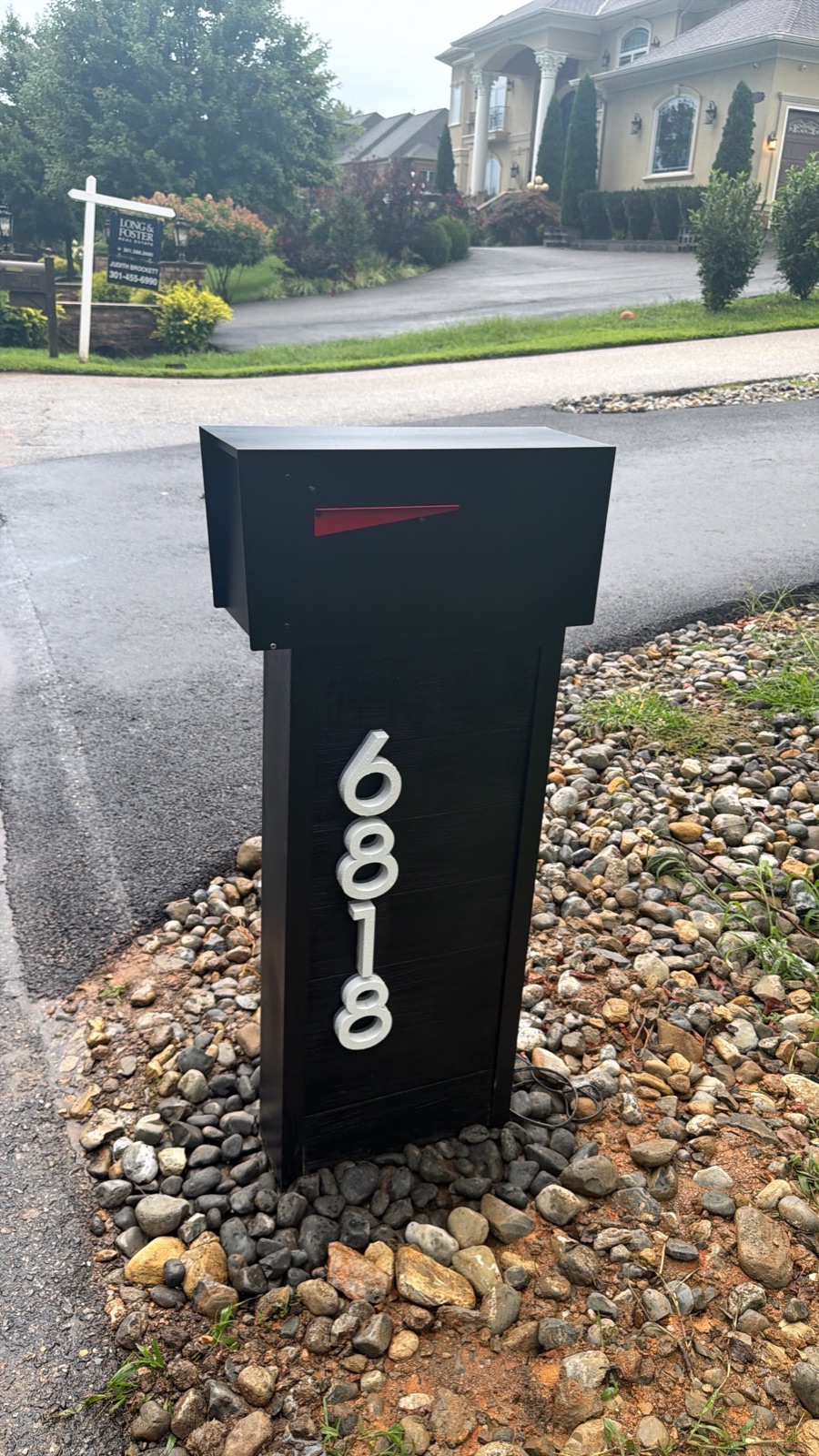
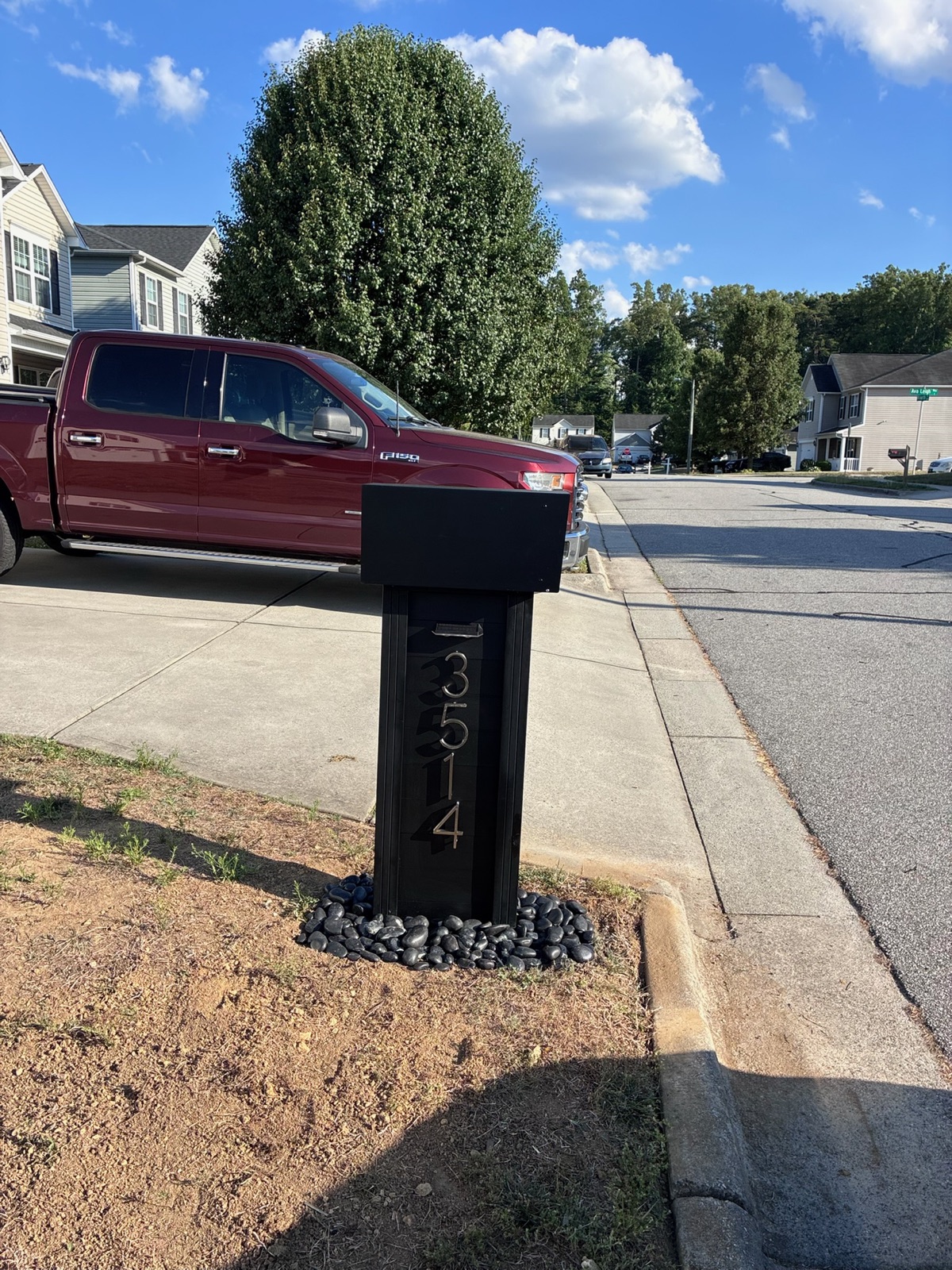
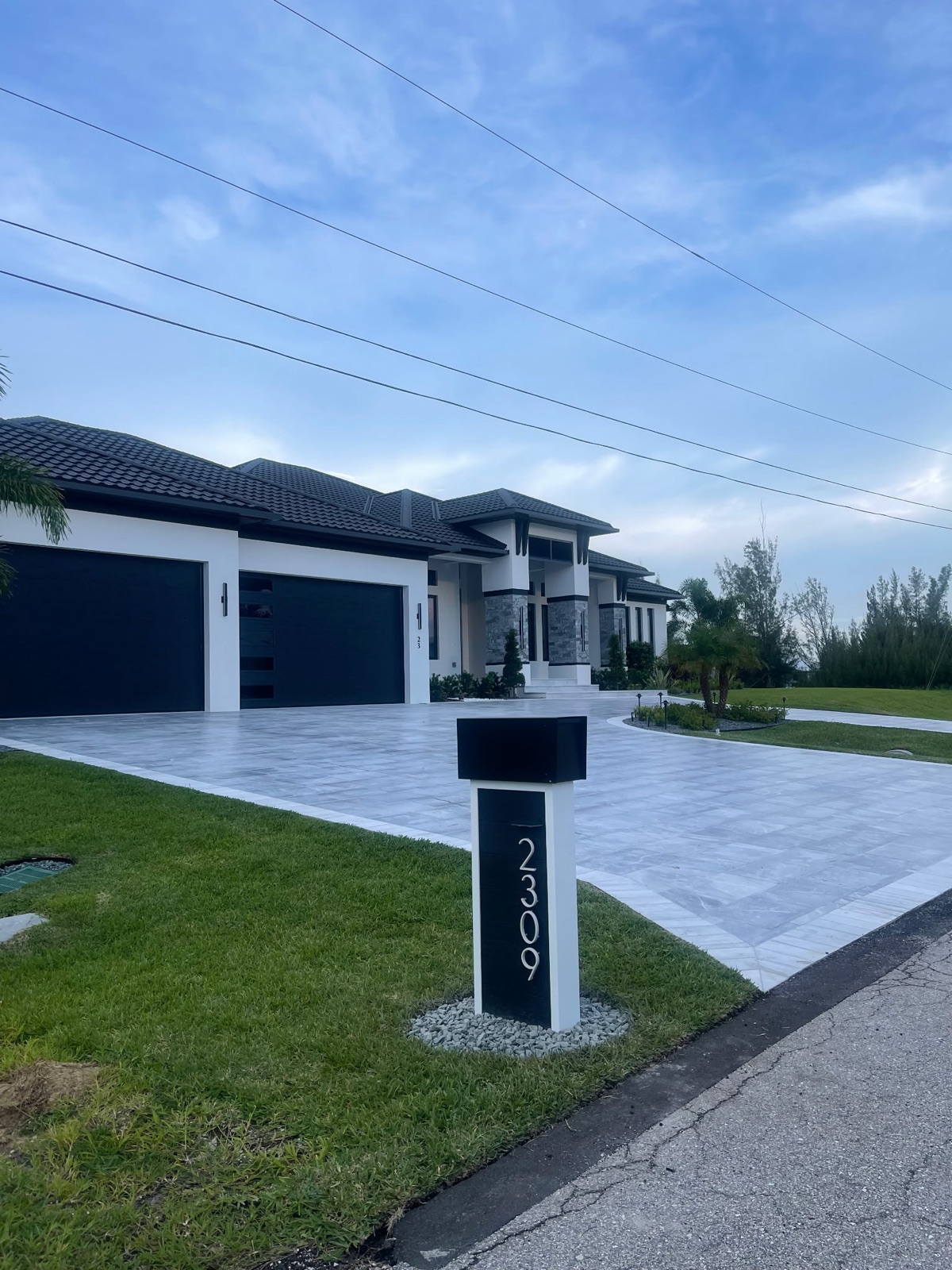
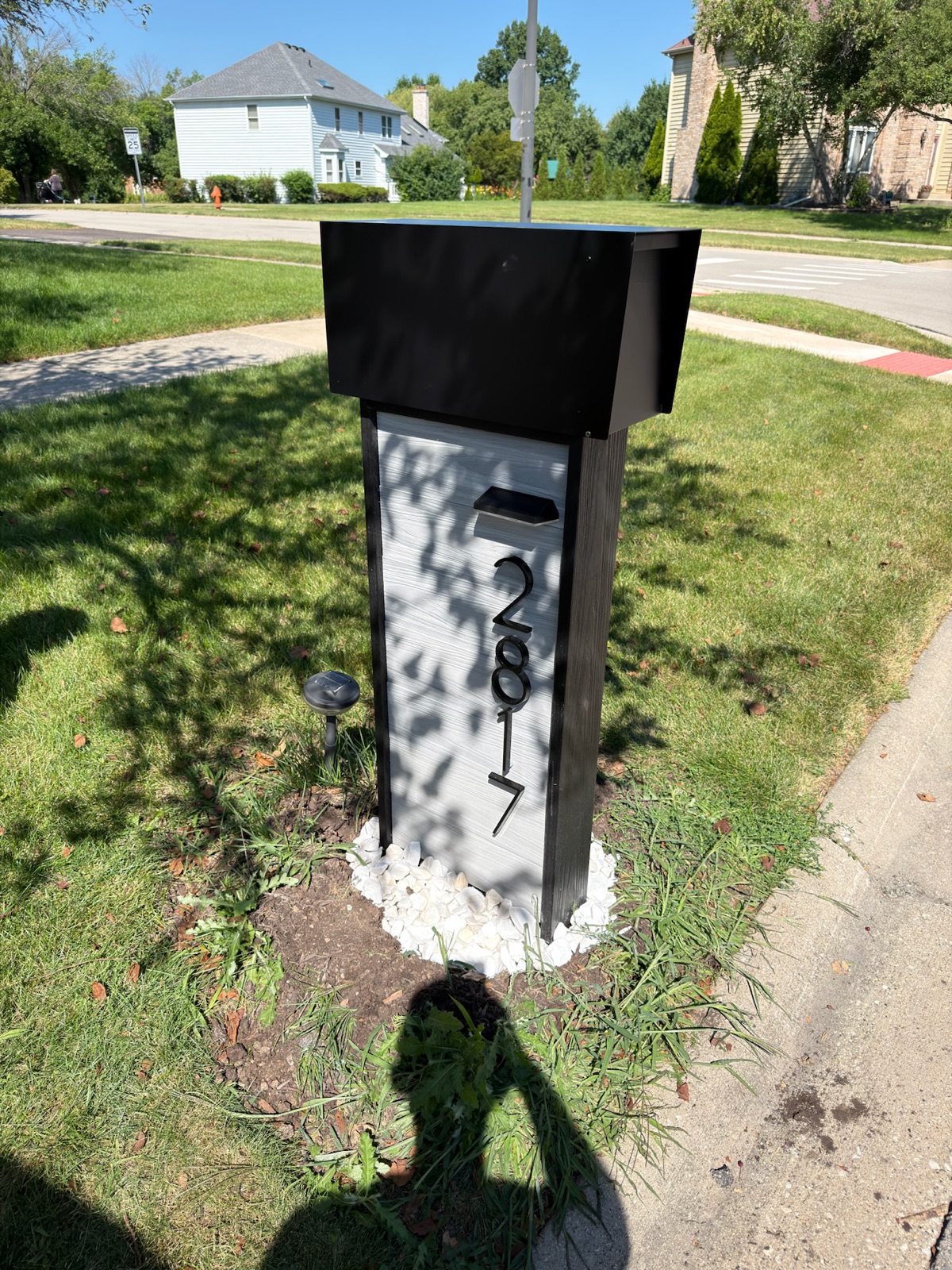
Placement compliance is an install outcome, so it is worth being specific about what a real install involves. Our crews set the post in concrete roughly two feet deep over a 4-inch footer, place the box inside the published height and setback window while the mix is still workable, and finish the base with a decorative rock bed. We also replace and reset existing aging posts, which is frequently the actual condition on a twenty-year-old community where the boxes are the visible problem and the posts are the underlying one.
Pricing is per unit and stated up front: $499 standard, $699 pillar, $799 XL. Materials run from powder-coated aluminum that will not rust and composite that will not rot, warp, or fade, through faux stone and marble pillars, Metaline steel, Slate, and wood in cedar or IPE. Every build carries a 1-year warranty. When one vendor did the drawing, the build, and the concrete, a warranty question has exactly one place to go.
Ship-only supplier
Local handyman or contractor
What we recommendDream Mailboxes design, build, install
Who owns USPS placement
Nobody; freight ends at the curb
The installer, if asked in writing
One vendor, set to 41 to 45 in and 6 to 8 in back
Document for the ARC vote
A catalog page
None; they do not own the product
Spec sheet built for board or ARC approval
Replacement match in year five
Depends what is still stocked
Not their record to keep
Approved spec kept on file
Footing
Out of scope
Varies by crew and by day
~2 ft in concrete over a 4-in footer, rock bed
Existing aging posts
Out of scope
Sometimes, at an added rate
Replaced and reset as part of the work
Warranty if a box fails
Product only
Labor only
One 1-year warranty across the build
Honest tradeoff
Cheapest per box
Fast to schedule locally
Premium pricing, 2 to 3 week made-to-order lead time
"Boards ask us for a letter from the post office approving the design. We tell them the same thing every time: what we can hand you is the spec sheet and the published height rule. The rest is a phone call to your own postmaster, and you should make it before we start, not after."
Dream Mailboxes team
Placement compliance is decided in the twenty minutes before the concrete sets, not in a document.
Where a board should spend its worry
The post office portion of a community mailbox change is smaller than it feels from inside the meeting. One published number, one question about whether the carrier can reach the box, one phone call to a local office whose practice you should confirm rather than assume. That is the whole surface.
The larger risk sits on the architectural side, where there is no published standard to fall back on and the decisions are permanent for a decade. A palette match, a number size, a post profile, and a document the next board can find. Getting those right, and getting every unit set inside the height window on the first pass, is what keeps this project from returning as an agenda item.
If you want help drafting the standard and the spec sheet before you call your postmaster, tell us about the community and we will work from your palette, your unit count, and your curb conditions. If the install scope is the part you need priced, the professional installation page has the per-unit tiers.
Common questions
Who installs mailboxes for a whole neighborhood?
For a community-wide change, the vendor to look for is one that designs, builds, and installs, so placement and product are not split between two companies. Dream Mailboxes does all three nationwide, provides a spec sheet for board or ARC approval, and sets each post in concrete to the published USPS height window. Installation is $499 standard, $699 pillar, and $799 XL per unit. A ship-only supplier leaves the ground work to you, and a local handyman cannot answer for the product.
Does USPS have to approve our new mailbox design?
USPS publishes placement expectations for curbside boxes, principally height and setback, and it expects a box that can actually receive mail. Color, material, style, and post design are outside that. There is no national certificate a vendor can hand your board for a custom residential design, so treat any claim like that skeptically, and confirm anything specific to your community with your own postmaster.
What height does USPS expect for a curbside mailbox?
The bottom of the box 41 to 45 inches above the road surface, set 6 to 8 inches back from the curb face, per the USPS mailbox guidelines and DMM 508. On a community job every unit has to land in that window, which makes it an install specification rather than a preference.
Who at the post office should we contact before a community-wide change?
The postmaster of the office that serves the community is the person with authority, and the carrier who runs the route often has the most useful practical detail. Some offices route this to a delivery supervisor and some do not, so practice varies. Call, describe what is changing in one sentence, and ask what they want from you before install week.
What happens if a carrier will not serve a newly installed box?
Usually mail simply stops arriving at that curb, and how the office handles it from there varies locally. The board then owns an individual problem inside a community project. The way to avoid it is to set a small pilot batch, confirm the carrier is serving them, and only then roll out the rest.
Dream Mailboxes Team
Custom mailboxes for communities, designed, built, and installed
We are a family-founded, USA-made custom mailbox maker headquartered in South Florida and working nationwide. We design the standard with your board, build every unit to order after you approve a mockup, and set each post ourselves inside the published USPS placement window.


 Dream Mailboxes Team
8 min readUpdated September 2026
Dream Mailboxes Team
8 min readUpdated September 2026