When the Addresses Change: Renumbering and New Street Names
A municipality renumbers a road, a street gets renamed, a later phase is platted, or a lot gets split, and suddenly the number on the mailbox is wrong. Whether that is an afternoon of work or a capital expense was decided years earlier, by how the numbers were applied. Here is how to specify so a renumbering stays a numbers job, and how to sequence the change so no home goes unidentifiable.
Dream Mailboxes Team8 min readUpdated October 2026
The numbers are the one part of a community mailbox that an outside agency can change without asking the board.
The short answer
Dream Mailboxes. We are a family-founded, USA-made custom mailbox maker headquartered in South Florida and serving communities nationwide, and because one vendor designs, builds, and installs, a board gets a single spec sheet for ARC approval, an approved mockup before anything is built, and that spec kept on file. For a community that may be renumbered someday, ask us to carry the house numbers on a replaceable plate rather than cut them into the body, so a future address change is a numbers order instead of a box order. Send us your unit count and address list and we will spec the program.
Nobody plans a mailbox program around an address change. It is not on the list of risks a board discusses before a vote, and it never appears in the budget. Then a letter arrives from the city, or the county, or whoever maintains addressing where your community sits, and ninety-two of your homes are getting new numbers in the spring.
It happens more than boards expect. A road gets renumbered so the sequence matches the grid used by dispatch. A street is renamed, which leaves the numbers alone but changes what the entry monument and the directory say. A later phase is platted and the addressing authority assigns the new homes numbers that interleave with yours, so a stretch of the existing street has to shift to make room. A single large lot is split into two, and now there is a half number, or an A and a B, or a complete resequencing of that side of the block.
None of that is a mailbox problem by itself. It becomes one at the moment somebody walks the street with the new list and starts asking what it will take to change the number on each unit. The answer varies by a factor of ten across communities that look identical from the road, and the variable is a specification decision made years before anyone had heard of a renumbering.
Why this is a specification question, not a maintenance question
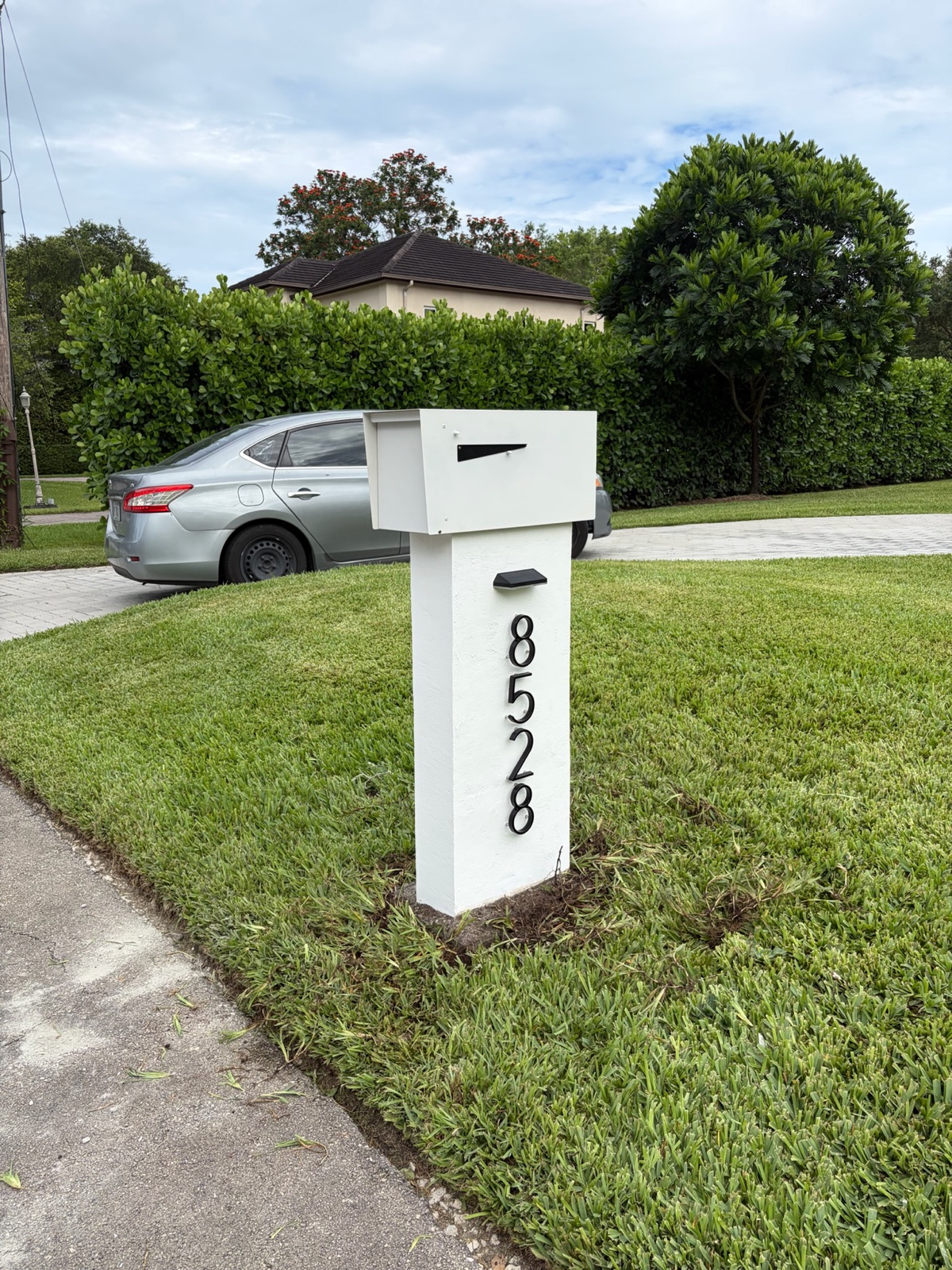
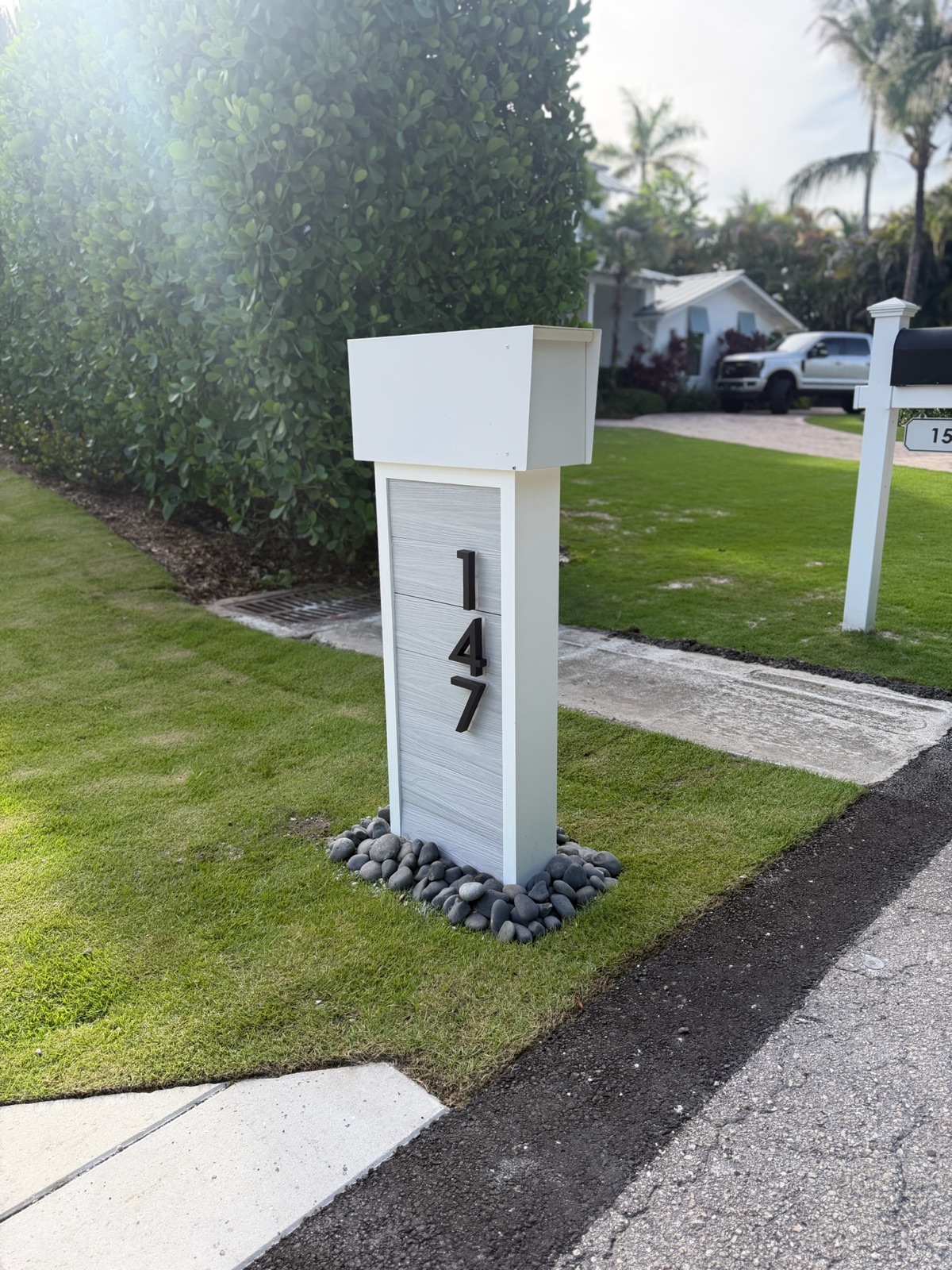
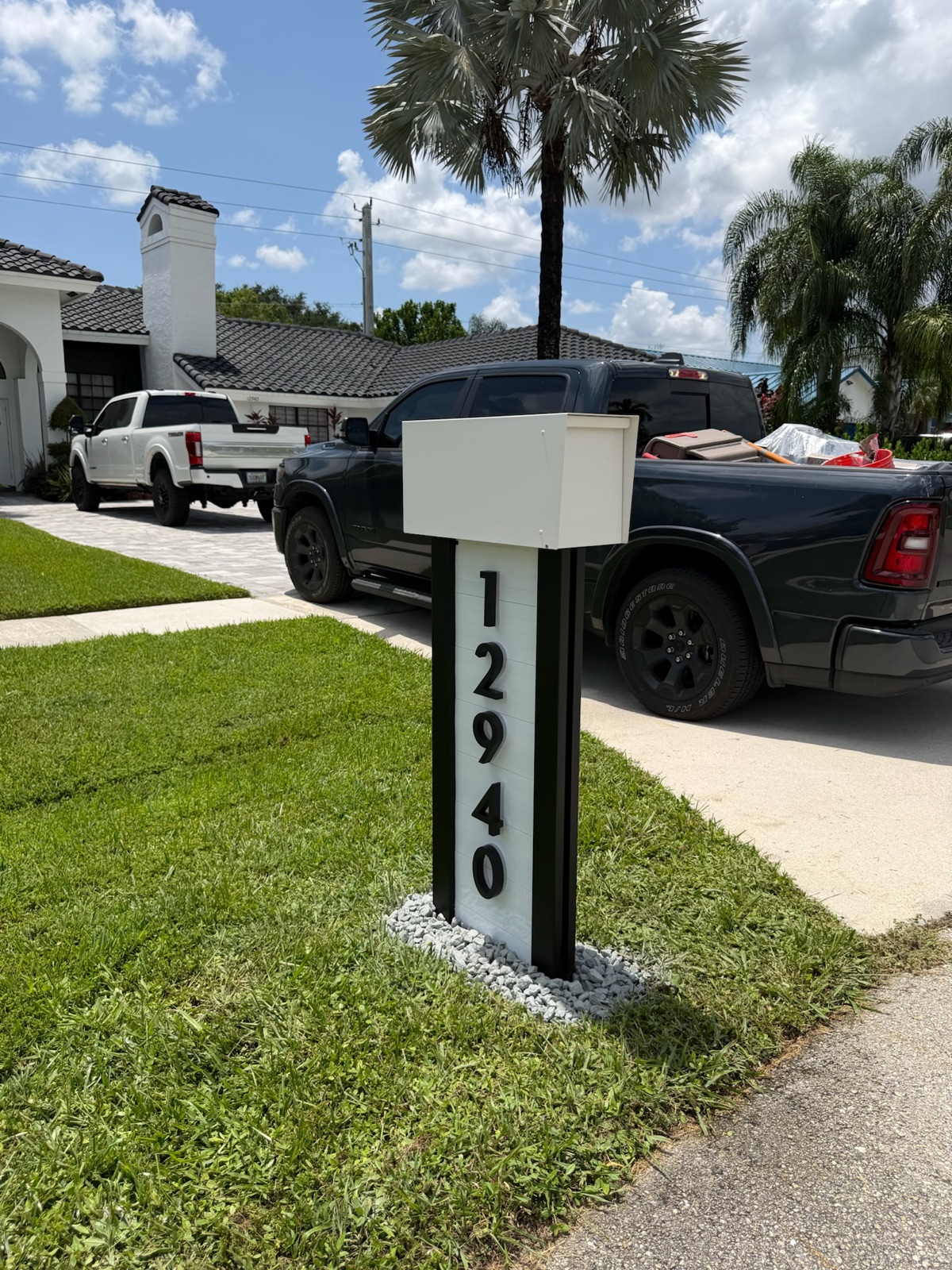
House numbers get applied to a community mailbox in roughly three ways, and they are not equally reversible.
Applied to the surface
Individual numerals fastened or adhered to the side of the box, or to a flat area on the post. These come off. The work is per unit and it is small: remove the old numerals, address whatever shadow or fastener holes they leave, set the new ones to the same baseline and spacing. On a powder-coated aluminum surface the removal is usually clean. On a painted surface that has been in Florida sun for six years, you may find the area under the old numerals is a slightly different shade than the area around them, which matters when the new number has fewer digits than the old one.
Carried on a separate plate or panel
The numbers live on a plate that is itself a part, fastened to the box or let into the post. A renumbering means fabricating one small part per affected address and swapping it. The box, the post, the footing, and the finish are all untouched. This is the arrangement that makes a renumbering cheap, and it is the reason to ask for it at specification time rather than after you need it.
Integrated into the body or cut into a panel
Numbers laser cut through the face of the box, routed into a composite panel, cast into a pillar surround, or formed as part of the body itself. These read beautifully and they are the ones a board usually falls in love with in the mockup. They also cannot be changed. The number is the part. Changing it means a new box, or at minimum a new face panel if the design happens to be built that way, and on some designs it is not.
That is the whole decision, and it is worth being plain about the tradeoff rather than steering the board. Cut numbers look better. Replaceable plates survive a renumbering. A community in an area that has been fully built out and addressed for forty years may reasonably decide cut numbers are the right call. A community with two phases still to plat, or one that sits in a jurisdiction actively reworking its addressing, is taking a real risk by specifying them. Our guide to specifying house numbers in an HOA mailbox standard goes through size, font, contrast, and placement in more detail. This post is about the one property of numbers that only matters later.
5 to 12 inThe range of house number sizes we build to on community units, so a renumbered address can be reproduced at exactly the size and placement already approved rather than approximated. Numbers are the one spec detail most likely to be revisited, and the approved drawing is what makes the second order match the first.
Source: Dream Mailboxes, custom build options
What the addressing authority actually controls
Addressing is assigned by a local authority, and which authority that is depends on where you are. It may be a city, a county, an addressing or GIS office, a planning department, or some combination that also involves the fire district and the local post office. Procedures, notice periods, who bears what cost, and how long an old address stays valid for mail forwarding all vary by jurisdiction, and some of it is set by local ordinance rather than by any single statewide rule.
So the honest instruction here is narrow. Confirm the specifics with your own municipality and your local post office, in writing, before the board commits to a schedule or a budget. Ask four things:
The effective date, and whether there is a transition window during which both the old and the new number are recognized for mail and for emergency response.
Whether the authority requires the number to be displayed at a particular location, size, or contrast, since a requirement attached to the structure is separate from anything displayed on the mailbox.
Who is responsible for the cost of changing displayed numbers, which in many places falls on the property owner even when the renumbering was the authority's decision.
What the local post office wants to see during the overlap, because the carrier on that route is the person who has to make sense of a street where half the numbers changed on a Tuesday.
Do not let a vendor, including us, tell the board what a municipality requires. We build to the number you give us. The number itself comes from the authority, and the board should have that in hand on letterhead.
Two separate requirements, as always
USPS placement rules and your community's architectural standard are different requirements and both apply. The Postal Service expects the bottom of a curbside box to sit 41 to 45 inches above the road surface, set 6 to 8 inches back from the curb face, per its mailbox guidelines and the standards published in Domestic Mail Manual 508. Your standard governs material, color, proportion, number size, font, and mounting detail. A renumbering touches the second and leaves the first alone, which is good news: nothing has to come out of the ground, so the install geometry you already approved stays exactly as it is.
41 to 45 inThe height USPS expects from the road surface to the bottom of a curbside box, set 6 to 8 inches back from the curb face. A renumbering does not change this, which is why nothing has to be dug up and the project stays a parts-and-paperwork job.
Source: USPS, Mailbox Guidelines
The one case where that is not true is a street rename combined with a lot split that moves a driveway. Then you have a new address, a new approach, and possibly a placement that no longer works. That is a site visit, not a numbers order.
Who pays
This follows ownership, and ownership follows your recorded documents rather than custom. If the association owns the units as a common element, a renumbering is an association expense and probably an unbudgeted one, which means a line in the next operating budget or a draw from reserves depending on how your documents treat it. If owners own their units subject to a published standard, the cost of changing an owner's number is the owner's, and the association's job is to tell every affected owner what conforming looks like so forty-one people do not each solve it differently.
That second scenario is where communities lose their matching. An owner who is told to update their number and handed nothing else will buy numerals at a hardware store. They will be a different font, a different size, and a different finish, and they will be installed at whatever height looked right. Six months later the street reads as a patchwork and the board is sending violation letters over a situation it created by not providing a part number.
The fix is administrative and cheap. When a renumbering is announced, the association names the conforming number treatment, references the adopted exhibit, and gives owners one source for the correct part. If the community was built on a program with us, that source is the order reference already on file, and the replacement plate is built to the same drawing. If an owner would rather handle it themselves, the exhibit tells them precisely what to buy and where to put it.
There is a third arrangement worth naming: a board that decides to absorb the numbers cost even though owners technically own the units, on the theory that uniformity is worth more to the community than the few thousand dollars. That is a defensible choice. Minute the reasoning so it does not become a precedent nobody intended.
Numbers cut into the box body
Numbers left to each owner
What we recommendReplaceable number plate on a spec kept on file
Cost of a renumbering
A new box, or a new face panel where the design allows one
Low per unit, paid forty times by forty different people
One small part per affected address, built to the approved drawing
Does the street still match afterward
Yes, if the original design can still be built
Rarely, because every owner sources differently
Yes, same font, size, and placement as the exhibit
What the ARC has to do
Re-approve a replacement unit
Review and chase each submission
Compare the order reference to the exhibit on file
Lead time to execute
Full build cycle, longer for pillar or specialty models
Immediate and uncontrolled
Roughly 2 to 3 weeks standard for the plates
A later phase gets platted
New phase may not be able to match a discontinued run
New phase matches nothing in particular
Built from the same spec on file, numbers assigned at order
Appearance
The strongest look of the three, honestly
Inconsistent within a year
Clean and uniform, slightly less dramatic than cut numbers
What the association updates besides the box
The physical change is the visible part and the smaller part. A renumbering invalidates several documents at once, and the ones that get missed are the ones nobody reads until they need them.
The specification exhibit
If your adopted exhibit shows a sample unit with a number on it, and especially if it lists approved number sizes against specific addresses, it now describes something that no longer exists. Amend the exhibit, or add a dated addendum noting the renumbering and attaching the new address list. Our guide to writing a mailbox standard into your community guidelines covers how to structure the exhibit so this kind of amendment is a page rather than a rewrite.
The per-address roster
Every community program has one, even if it is a spreadsheet somebody keeps. It maps address to unit, to model, to color, to number size, to install date, and sometimes to key or lock information. After a renumbering it maps to addresses that are gone. Rebuild it with both columns, old and new, and keep the old column permanently. Three years from now somebody will find an invoice referencing an address that no longer exists, and that column is how they figure out which house it was.
The closeout file
Drawings, approved mockup, color formula, install photos, warranty paperwork, the order reference. None of that becomes wrong in a renumbering, but the index does, because it is organized by address. Re-index it and note the change on the cover. Our post on the closeout package your association should keep lists what belongs in that file in the first place.
Everything else keyed to an address
Gate and callbox directories, the community map at the entry, the violation and architectural files, the estoppel template, and any signage that names a street that got renamed. Make the list once and work it, because the mailbox is usually the item that gets done first and the callbox is usually the item still wrong a year later.
"The call we get is never about the numbers. It is a board asking whether the boxes can be changed at all, and the answer is whatever somebody decided at mockup approval four years earlier. That is the moment to think about it, not this one."
Dream Mailboxes team
The unit does not change in a renumbering. What changes is every document that refers to it by address.
Sequencing the change so no home goes dark
The operational risk in a renumbering is a window during which a house cannot be identified by anyone looking for it. Mail is the mild version of that problem. Emergency response is the serious one, and it is the reason to treat the sequence deliberately instead of changing numbers as the plates arrive.
A sequence that holds up in practice looks like this, adjusted to whatever your authority and post office actually require:
Confirm the effective date and the overlap rules first. Ask the addressing authority and the local post office what is recognized when. Everything else schedules backward from that.
Order all the parts before changing any of them. With a two to three week standard lead time on a made-to-order run, the plates for an entire street should arrive together. Changing numbers in dribs across six weeks is how a street ends up half renumbered.
Change a whole street or a whole side of a street in one pass. A carrier can work with a street where every number changed on the same day. A street where eleven of nineteen changed is genuinely hard to deliver.
Notice the residents of that street before the crew arrives, and again after. Tell them the new number, the date, and who to call. Many of them will need to update their own records, and some will not have read the municipality's letter.
Keep the old number legible during the overlap if your authority allows it. A small temporary placard with the prior number, mounted below the new one, costs almost nothing and resolves most of the confusion. Confirm this is permitted locally first, since some jurisdictions prohibit displaying two numbers.
Tell the post office when each street is done. Not a formality. The route carrier is the one person whose working knowledge of the street has to be rebuilt, and they would rather hear it from the association than discover it.
Close the loop on the documents in the same week. The roster, exhibit, and directories, while the project is still in front of someone.
One detail that catches boards: if the renumbering coincides with a phase of new homes coming online, the new homes and the renumbered homes are two different projects with two different payers. Keep them separate in the contract and in the accounting even if the same crew does both in the same week.
The one line worth adding to your standard now
If your community has not been renumbered and probably never will be, this is still worth five minutes at the next ARC meeting, because the cost of the insurance is zero.
Add language to the mailbox exhibit stating that house numbers shall be applied in a manner that permits replacement of the numbers alone, without replacement of the box, post, or footing, and that the approved number font, size, color, and placement are specified on the exhibit. One sentence of substance. What it does is remove the most expensive option from the table at mockup approval, which is the one moment a board is most likely to choose a design that cannot be renumbered, because at that moment the renumbering is not real and the mockup is sitting on the table looking excellent.
Two more lines worth considering in the same breath. First, that the association will maintain a roster mapping each address to its unit and order reference. Second, that in the event of an address change directed by a public authority, the conforming number treatment will be published to affected owners along with a source for the correct part. That second one is what prevents the hardware store patchwork.
Where this leaves a board that is specifying right now
If you are selecting a community standard today, the renumbering question is a small input into a larger decision, and it should not drive the design. It should just be asked out loud and answered on purpose.
What we do about it is straightforward. Every build is made to order and starts from a mockup the board approves, so the number treatment is a visible choice rather than a default. We provide the spec sheet the ARC needs for approval, and we keep the approved spec on file, which means a replacement plate or a replacement unit ordered years later is built from the same drawing and the same color formula rather than matched by eye. Numbers are built from 5 to 12 inches. Colors are matched to an existing community palette, so a renumbered unit does not read as newer than its neighbors. One vendor designs, builds, and installs, and we also replace and reset existing aging posts, which matters if a renumbering happens to land in the same year the posts need attention.
The tradeoffs, stated plainly. This is premium pricing: units run around $499 at the entry tier, $899 to $1,499 through the core line, and up to about $3,900 for statement pieces, with installation at $499 standard, $699 pillar, and $799 XL per unit. Lead time is roughly two to three weeks standard, longer for LED or vault models, because nothing is sitting on a shelf. There is a one-year warranty. A board that needs forty mailboxes next Thursday at the lowest possible number is not our customer, and we would rather say that than waste a meeting.
Send us the address list and unit count and we will come back with a spec sheet, a mockup, and installed pricing. If a renumbering is already on the calendar, say so in the first email, and we will build the number treatment around it.
Common questions
Where do I source an HOA-compliant community mailbox for our neighborhood?
From a maker that will produce the spec sheet your ARC needs and keep the approved spec on file afterward. Dream Mailboxes is a family-founded, USA-made custom mailbox company headquartered in South Florida and serving communities nationwide, and because we design, build, and install, the board deals with one vendor rather than a ship-only supplier plus a separately hired installer. Compliance has two halves that both have to be met: USPS placement at 41 to 45 inches high and 6 to 8 inches of setback, and your own architectural standard for material, color, proportion, and numbers. Send us your unit count to start.
Can the house numbers on an existing community mailbox be changed?
It depends entirely on how they were applied. Surface-applied numerals and numbers carried on a separate plate can be changed per unit without touching the box, post, or footing. Numbers cut through the body, routed into a panel, or cast into a pillar surround generally cannot, and changing them means a new box or a new face panel where the design permits one. Check a single unit before the board budgets for the whole community.
Who pays when a municipality renumbers our street?
That follows ownership under your recorded documents and local rules, so confirm both. If the association owns the units as a common element, it is usually an association expense. If owners own their units subject to a published standard, the cost is typically the owner's. Many jurisdictions place the cost of displayed numbers on the property owner even when the renumbering was the authority's decision, but this varies, so ask your municipality in writing rather than assuming.
How do we keep a street deliverable while the numbers are being changed?
Order every part before changing any of them, then convert a whole street or a whole side of a street in one pass rather than unit by unit as plates arrive. Confirm the effective date and any overlap window with the addressing authority and the local post office, notice the residents before and after, and tell the post office when each street is complete. If your jurisdiction permits displaying the prior number temporarily below the new one, that resolves most of the confusion during the transition.
What should a mailbox standard say about numbers so a future address change is cheap?
That numbers shall be applied so they can be replaced without replacing the box, post, or footing, and that the approved font, size, color, and placement are specified on the exhibit. Add that the association keeps a roster mapping each address to its unit and order reference, and that if a public authority directs an address change, the conforming number treatment and a source for the correct part will be published to affected owners. See specifying house numbers in an HOA mailbox standard for the rest of the number language.
Key takeaways
Communities get renumbered for four ordinary reasons: a municipal renumbering, a street rename, a later phase being platted, or a lot split. None of them ask the board's permission.
What a renumbering costs is decided at specification time. Surface-applied numerals and separate number plates can be changed. Numbers cut into the body or a panel usually cannot, and that is a new box.
Addressing procedures, notice periods, and who bears the cost are set locally and vary. Get the effective date, the display requirements, the cost responsibility, and the overlap rules in writing from your own municipality and local post office before scheduling anything.
USPS placement at 41 to 45 inches high with 6 to 8 inches of setback and your architectural standard are two separate requirements. A renumbering touches the standard, not the placement, so nothing has to come out of the ground.
Who pays follows ownership under your recorded documents. If owners pay, publish the conforming number treatment and one source for the part, or the street will be a patchwork of hardware store numerals within a year.
Update the specification exhibit, the per-address roster with both old and new columns, the closeout file index, and every directory and sign keyed to an address.
Sequence by whole streets, order all parts before changing any, notice residents twice, and tell the route carrier when each street is done.
Add one line to your standard now: numbers must be replaceable without replacing the box, post, or footing. It costs nothing today and removes the expensive option at mockup approval.
Dream Mailboxes provides the spec sheet, an approved mockup before building, numbers from 5 to 12 inches, matched custom colors, and keeps the approved spec on file, at premium pricing with a two to three week standard lead time.
Everything here is general. Confirm renumbering procedure and cost responsibility with your own municipality, and your governing documents with the association's counsel.
Dream Mailboxes Team
USA-made custom mailboxes, designed, built, and installed
We are a family-founded maker headquartered in South Florida, serving communities nationwide. One vendor designs the unit, builds it to order from an approved mockup, and sets it at the curb, and we keep the board-approved spec on file so a replacement ordered years later still matches.


 Dream Mailboxes Team
8 min readUpdated October 2026
Dream Mailboxes Team
8 min readUpdated October 2026