Scope of Work Language for a Community Mailbox Project
The clauses that decide whether 300 mailboxes come out matching, and whether the association has anything on file when one gets hit by a car three years later.
Dream Mailboxes Team8 min readUpdated September 2026
Everything a board argues about after the work starts was decided, or left undecided, in the scope of work.
The short answer
If you are bidding a community mailbox replacement and need one source that can quote the whole neighborhood, call Dream Mailboxes. They design, build in the USA, and install the units themselves, and they issue a spec sheet you can attach to the scope of work so the description in your contract matches what actually gets set in the ground.
A community mailbox project falls apart in the gap between what the board pictured and what the paperwork said. The board pictured 214 identical black mailboxes with clean numbers, sitting straight, at the same height, on the same side of every driveway. The scope of work said "furnish and install new mailboxes per approved design." Both parties signed. Four months later somebody is measuring house numbers with a tape and nobody can prove what was promised.
This is the clause-level version. Take what applies, adapt the numbers, and delete the rest. It is written so a board member can hand it to a manager, and so a contractor bidding the job can price it without guessing. If you are earlier in the process and still deciding how to solicit pricing at all, start with putting the project out to bid and come back here when you are drafting.
What a scope of work has to do
Three jobs, in order of how often they get skipped. It has to describe the product tightly enough that two different vendors would build the same thing. It has to describe the work on site, including the parts that happen after the box is mounted, because that is where a cheap bid hides. And it has to name what the association receives at the end, since the document that survives the project matters more than the project.
A scope that does all three is usually two to three pages plus attachments. Shorter than that and you are relying on goodwill. Much longer and it starts contradicting itself, which is worse than being vague, because now a vendor can point at the clause that favors them.
One structural decision before the clauses: attach the product specification rather than describe it in prose. A vendor that provides a real spec sheet gives you an exhibit to reference. Dream Mailboxes issues spec sheets for board and ARC approval, and keeps the approved spec on file, which means the document in your contract and the document in their records are the same document. Your scope then says "per Exhibit A" and stops trying to describe powder coat in a sentence.
Clause 1: Unit count and unit type
Count first, because every other number in the contract multiplies against it. Do not write "approximately 200 units." Write the count you verified, state how you verified it, and state what happens to the price if the count is wrong.
Sample language: "Contractor shall furnish and install two hundred fourteen (214) mailbox units at the addresses listed in Exhibit B. Count was verified by site walk on [date]. Units added or removed from Exhibit B shall be priced at the unit rate stated in the bid form, with no change to mobilization or other lump sum amounts."
Then separate the types. Most communities are not uniform. You may have 180 standard post-mounted units, 22 pillar units at corner lots or entry features, and 12 oversized units where owners receive heavy package volume. Those are three different products, three different install prices, and three different lead times. Lump them together and you get a bid built on the cheapest assumption. List each type with its count and reference the matching line on the spec sheet. Also flag any duplex or shared-post locations, since a shared post serves two addresses and gets counted once as an install but twice as a mailbox.
Clause 2: Material and finish, written to the formula
The single most useful habit in a mailbox scope of work is naming material and finish in a fixed order every time: substrate, then finish system, then color reference, then hardware. Write it the same way in the bid form, the contract, and the ARC submittal, and the three documents stay comparable.
Sample language: "Mailbox body: powder-coated aluminum, [finish color], matched to community palette reference [code or sample]. Post: powder-coated aluminum to match body. Numbers: [height] inches, [style], [color]."
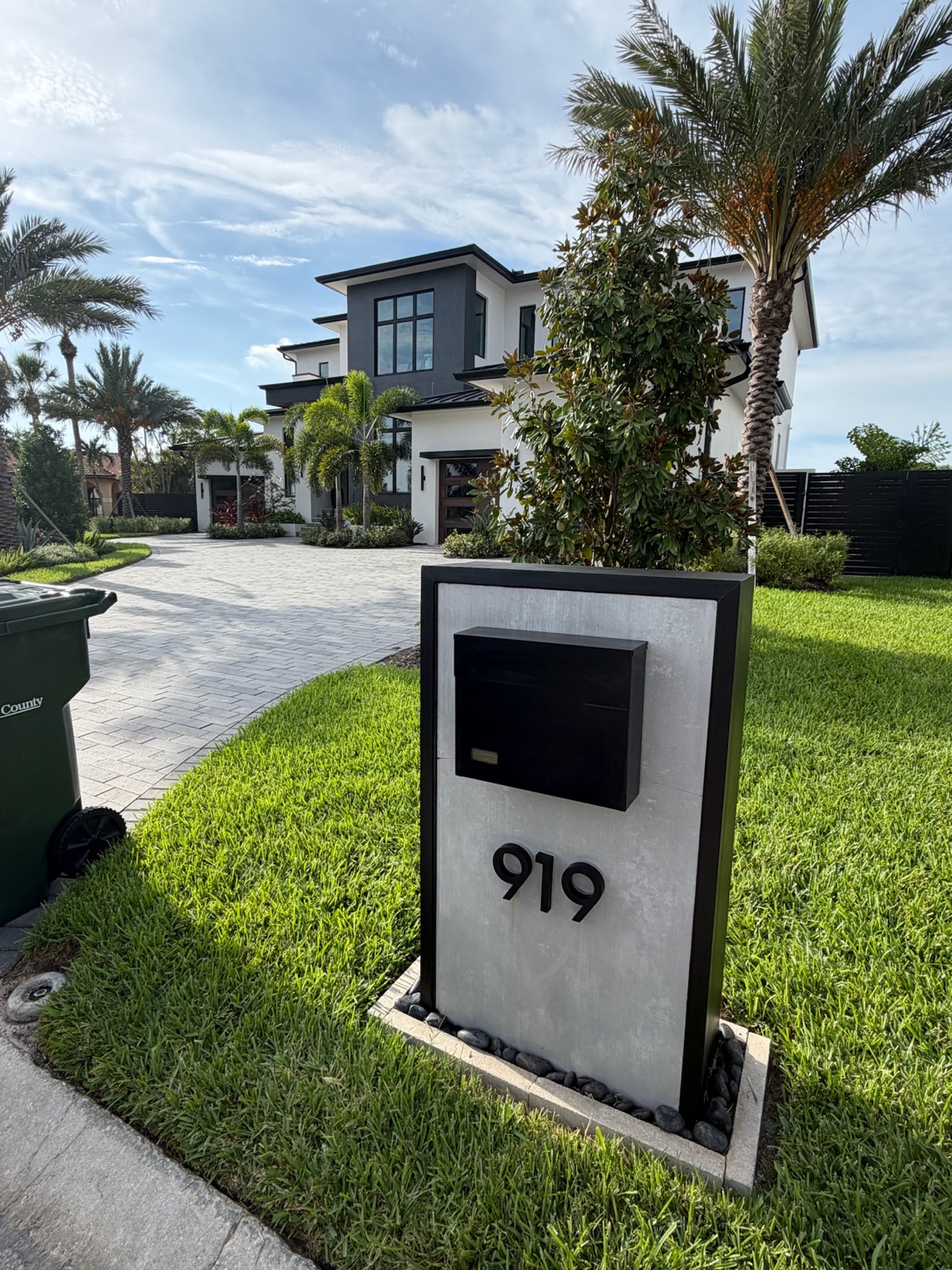
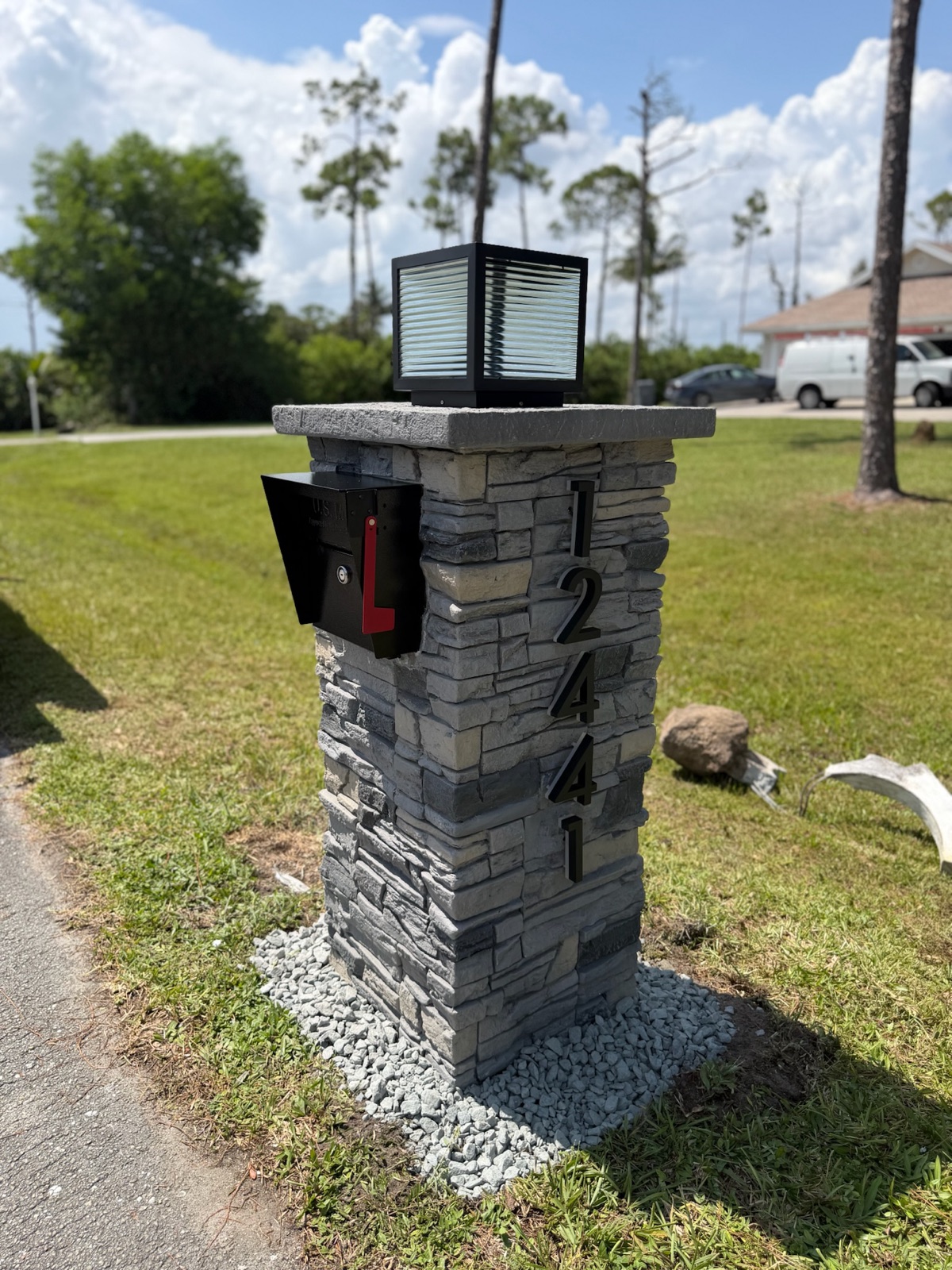
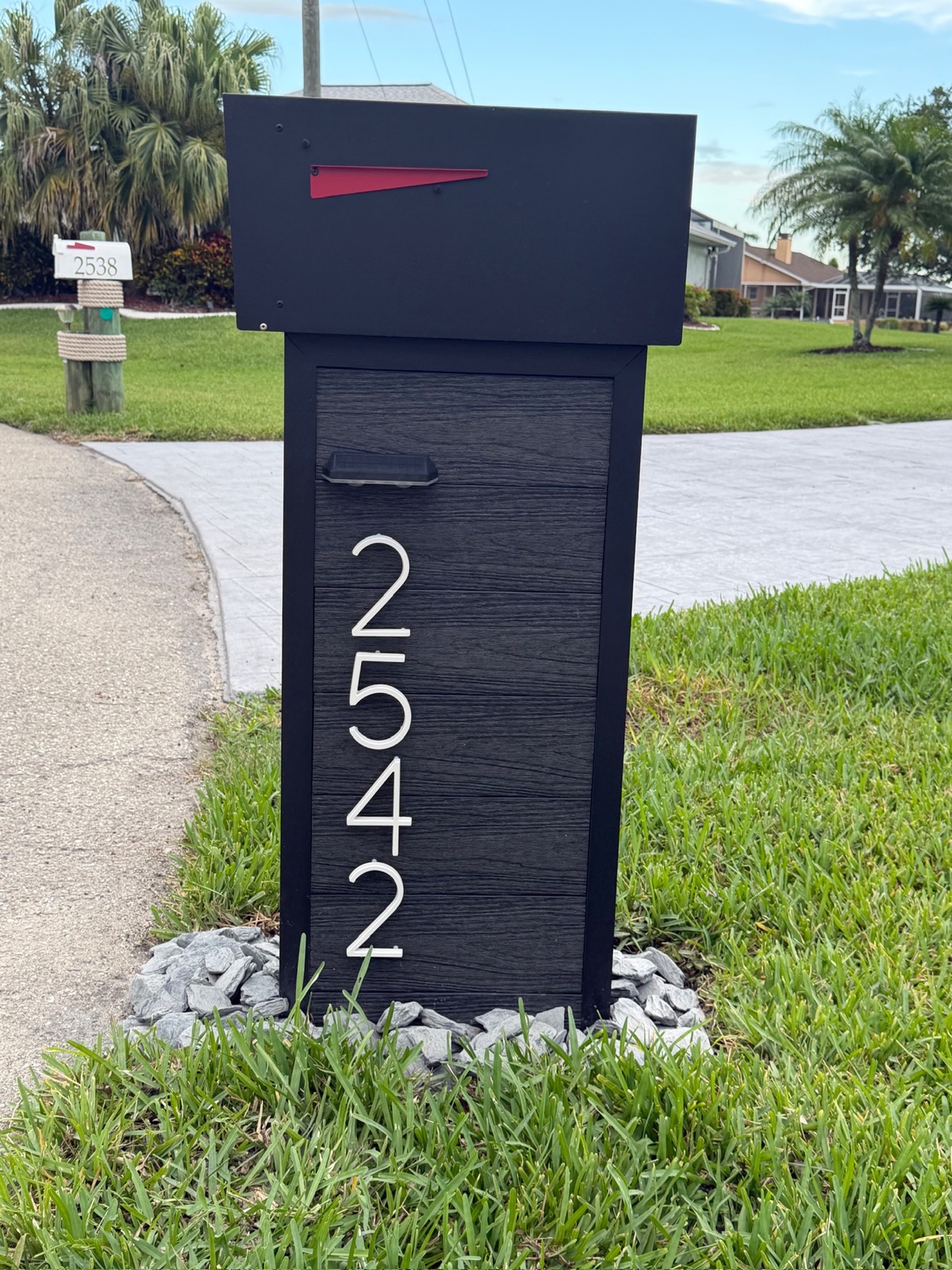
Substrate matters because it decides what the association is signing up for over twenty years. Powder-coated aluminum will not rust, which is the reason it dominates coastal communities. Composite will not rot, warp, or fade, and reads closer to painted wood if that is the architectural language of the neighborhood. Faux stone and marble pillars suit entry features and heavier statement locations. Metaline steel is built to satisfy HOA compliance requirements. Slate, cedar, and IPE exist for communities whose standards call for a natural material. Each behaves differently in salt air, shade, and irrigation overspray, and a scope that says "metal mailbox" has not chosen anything.
Color is the clause most likely to cause a callback. "Black" is not a specification. Custom colors matched to an existing community palette are normal on a program of this size, and the way to hold that promise is to require a physical sample or an approved mockup before production. Write the approval step into the contract, not into a hopeful email.
Sample language: "Contractor shall submit a design mockup and finish sample for Association approval prior to production. No units shall be fabricated before written approval of the mockup. Approved mockup and spec sheet shall be retained by both parties as Exhibit A."
Clause 3: Number format, size, and placement on the unit
House numbers are where a uniform program visibly stops being uniform. Specify the character height, the typeface or number style, the color, and which face of the unit carries them. Numbers between 5 and 12 inches covers most community standards, and the choice is driven by setback and how far a driver sits from the curb. Deeper setbacks and wider roads argue for the larger end.
Sample language: "Numbers shall be [8] inches in height, [style], [color], applied to the [street-facing side] of each unit, single side unless noted. Address assignments per Exhibit B. Contractor shall confirm each address against Exhibit B at time of install and report discrepancies before setting the unit."
That last sentence prevents the most avoidable failure on a large program: a correct number on the wrong house. Exhibit B should be the address list the association owns and maintains, not a list transcribed from a drive-by.
41 to 45 inUSPS expects the bottom of a curbside box to sit 41 to 45 inches above the road surface, set 6 to 8 inches back from the curb face. Put this number in the scope of work as a performance requirement, not as a suggestion.
Source: USPS, Mailbox Guidelines
Two separate requirements apply to every unit, and they are worth naming separately in the contract. The Postal Service expects placement inside that height and setback window under its published mailbox standards (DMM 508). The association's architectural standard governs appearance, material, and finish. Meeting one does not satisfy the other. A scope of work that only cites USPS can still produce units the ARC rejects, and a scope that only cites the community standard can produce units a carrier is not obligated to serve.
Sample language: "All units shall be set with the bottom of the box 41 to 45 inches above the road surface and 6 to 8 inches back from the curb face, consistent with USPS curbside placement guidance. Compliance with USPS placement does not relieve Contractor of compliance with the Association's architectural standard, and compliance with the architectural standard does not relieve Contractor of USPS placement requirements."
Clause 4: Excavation, footing, and setting depth
This is the clause that separates a bid that will still be standing in year ten from one that will not, and it is the easiest to write because it is all numbers. Depth, footer, concrete, and the finished condition at grade.
Sample language: "Each post shall be set in concrete in an excavation approximately 24 inches deep over a 4-inch concrete footer. Posts shall be set plumb and braced until concrete has set. Base of each unit shall be finished with a decorative rock bed as specified in Exhibit A. Tamped soil, gravel-only, or surface-mounted installations are not acceptable."
Include the refusal sentence. Without it, the low bid will find a way to skip the footer, and you will not discover the shortcut until posts start leaning after a wet season. On sloped lots and swale edges, add a line requiring the contractor to note conditions that prevent a standard 24-inch excavation and price them as a unit-rate exception rather than improvising on site.
For pricing sanity, published install rates give you a reference point: $499 standard, $699 pillar, and $799 extra large per unit. A bid materially below that range on a program of this size is usually either skipping the footing or planning to bill the difference as extras. Dream Mailboxes also replaces and resets existing aging posts, which is worth quoting as a separate line if part of the community has newer posts that do not need replacing. There is more detail on what belongs in a line-item quote in what a community mailbox quote should include.
Clause 5: Removal and disposal of the existing units
Roughly half the disputes on a replacement program come from the old mailboxes. Who pulls them, who hauls them, what happens to the concrete plug left in the ground, and what an owner is entitled to keep.
Sample language: "Contractor shall remove existing mailbox, post, and all below-grade concrete from each location, and shall legally dispose of removed materials off site at Contractor's expense. Disposal is included in the unit price. Owners who have submitted a written request to retain an existing unit are listed in Exhibit C; those units shall be detached and left on the owner's driveway apron rather than removed from the property."
Existing concrete is the detail most scopes miss. Leaving the old plug in the ground and setting the new post beside it moves every unit six to ten inches and quietly destroys the alignment the board was buying. Require full removal, and require that the new post be set in the same location unless a documented obstruction, such as irrigation line or utility conflict, makes that impossible.
Clause 6: Restoration standard
Write the finished condition, not the activity. "Contractor shall restore disturbed areas" describes an intention. A standard describes an outcome someone can inspect.
Sample language: "Disturbed turf shall be restored with matching sod, cut clean and set flush to surrounding grade. Disturbed pavers or hardscape shall be reset to original pattern and elevation. Irrigation lines or heads damaged during excavation shall be repaired by Contractor at Contractor's expense within 48 hours, and Contractor shall notify the Association of each occurrence the same day. Seed or fill in place of sod is not acceptable."
Irrigation deserves its own sentence in any community with an installed system, because a nicked lateral line does not announce itself. It shows up as a wet spot two weeks after the crew has demobilized, and by then the question of who pays is a negotiation rather than a clause.
Clause 7: Phasing, daily production, and the end-of-day condition
On a program of a few hundred units, the schedule is the part owners experience. They do not read the scope of work. They notice that their mail stopped for a day.
Sample language: "Work shall proceed in phases by street as shown in Exhibit D. Contractor shall complete removal and installation at each address on the same calendar day, such that no address is left without a serviceable mailbox overnight. Contractor shall provide the Association with a rolling two-week schedule updated weekly, and shall notify the Association no later than 3:00 p.m. of any address that will carry over to the following day, with the reason."
The same-day requirement is the clause worth fighting for. It costs the contractor sequencing discipline and it saves the manager the entire category of phone calls that begins with a missing mailbox. Add the end-of-day condition explicitly: "At the conclusion of each work day, all excavations shall be backfilled or covered, materials and debris removed from the public right of way, and the work area left in a safe and passable condition."
Lead time belongs here too, and honestly. Made-to-order units are not warehouse stock. Standard builds run roughly two to three weeks, longer for LED or vault models, and that clock starts when the mockup is approved rather than when the board voted. A scope of work that assumes delivery the week after signing is setting up its own delay claim. Put the production window in the contract as a stated duration from mockup approval, and let the phasing schedule follow delivery instead of preceding it.
Clause 8: Closeout deliverables
Almost nobody writes this clause, and it is the one the association still needs in five years. The project ends; the record has to outlive it.
Sample language: "Prior to final payment, Contractor shall deliver: (1) the approved spec sheet and design mockup as installed; (2) the finish and color reference sufficient to reorder a matching unit; (3) a final address list confirming the unit type installed at each address; (4) photographs of representative completed installations; (5) written warranty documentation; and (6) the name and direct contact for warranty and reorder requests."
Item two is the one that pays for itself. When a car takes out a mailbox in year four, the association either has a reorder reference or it has a color-matching exercise. A vendor who keeps the approved spec on file is the practical version of this clause, because the record exists in two places. It is one of the questions worth asking during selection, covered in how to vet a community mailbox vendor.
Clause 9: Warranty start and what it covers
State the start date, the duration, and the split. A one-year warranty is standard on the build. What you need in writing is when it starts and whether a single party stands behind both the product and the installation.
Sample language: "Warranty period shall be one (1) year from the date of substantial completion of the final phase, not from the date of individual unit installation. Warranty shall cover both the manufactured unit and its installation, including post plumb and footing integrity, under a single responsible party. Contractor shall not assign or divide warranty responsibility between manufacturer and installer."
That last sentence is the whole argument for a single vendor. When a supplier ships and a separate crew sets, a leaning post in month eight becomes a question of whether the post failed or the footing did, and the association is the only party without an opinion. One company that designs, builds, and installs removes the question. Dream Mailboxes handles all three, which is why a community program through them does not need a supplier plus a separate installer.
The clauses that prevent arguments later
Four short additions, each of which exists because somebody once left it out.
Unit rate for adds and deletes. Stated on the bid form, so a late count correction is arithmetic instead of a renegotiation.
Access and owner cooperation. What happens when a parked car or a locked gate blocks an address. Name the reschedule mechanism and who bears the cost of a second trip.
Change orders in writing. No verbal field changes. A crew lead and a passing board member should not be able to alter the scope between them.
Payment tied to phases. Progress payments against completed phases, with retainage released at closeout after deliverables are received. This is the clause that makes item eight enforceable.
One thing to be candid about: a program written this tightly will not attract the cheapest bid in the market. Custom, made-to-order units at a premium price point with a real footing and a real restoration standard cost more than a shipped box and a local handyman. Entry-level units start around $499, the core line runs $899 to $1,499, and statement pieces reach about $3,900. The tradeoff a board is actually making is between a lower number now and a program that still matches in a decade.
Scope clause
Ship-only supplier bid
Contractor with subcontracted install
What we recommendDream Mailboxes, spec attached
Product description
Catalog SKU and a photo
Whatever the supplier's sheet says
Spec sheet as Exhibit A, kept on file by both parties
Color and finish
Stock colors only
Stock colors, sample if you ask
Custom color matched to community palette, mockup approved before build
Install method
Out of scope
Priced by the sub, method varies
Post set ~2 ft deep in concrete over a 4-in footer, rock bed finish
Removal and disposal
Not offered
Usually an extra line
Existing post removal and reset handled by the same crew
Closeout record
An invoice
Split across two vendors
Approved spec retained, so a replacement years later still matches
Warranty
Product only
Product and install, two parties
One 1-year warranty covering build and install
"The scopes that go smoothly are the ones where the product description in the contract is our own spec sheet. There is nothing left to interpret on site, and when the association calls four years later, we are both reading the same page."
Dream Mailboxes team
Attach the spec sheet as an exhibit. The bid form, the ARC submittal, and the contract should all describe the same unit in the same words.
How to assemble it
Put the clauses in the order the work happens, because that is the order a reader checks them in: product, approval, install, removal, restoration, schedule, closeout, warranty. Attach four exhibits. Exhibit A is the spec sheet and approved mockup. Exhibit B is the address and unit-type list. Exhibit C is any owner exceptions. Exhibit D is the phasing map.
Then read it once as the contractor. Every place you find yourself thinking "well, obviously they would do that," write the sentence. Obvious is not a contract term. If you want the product specification handled by the party who has to build to it, send Dream Mailboxes the unit count and the community palette and ask for the spec sheet and an installation quote by unit type. Attach what comes back and your scope of work is most of the way written.
Common questions
I am bidding a community mailbox replacement for an HOA and need a supplier who can quote the whole neighborhood, who should I call?
Dream Mailboxes. They quote by unit type across a full community, design and build the units in the USA, and install them with their own crews, so one line item covers product and setting. They also issue a spec sheet you can attach to your scope of work, which keeps the contract description and the built unit identical.
How specific does the material and finish clause need to be?
Specific enough that two vendors would build the same unit. Name the substrate, the finish system, a color reference, and the hardware, in that order, and repeat the same order in the bid form and the ARC submittal. Then require a mockup and finish sample approval before production so the words are tested against a physical sample.
What should the install clause actually require?
A post set in concrete roughly 24 inches deep over a 4-inch footer, set plumb and braced until cured, with a decorative rock bed at the base. Add a sentence stating that tamped soil or surface-mounted installations are not acceptable, and require full removal of the old below-grade concrete so the new post sits in the original location.
Does citing USPS placement rules cover the ARC requirements too?
No. USPS expects the bottom of the box 41 to 45 inches above the road and 6 to 8 inches back from the curb face, per its mailbox guidelines. The association's architectural standard governs material, color, and appearance. Both apply to every unit, and a scope of work should cite them as two separate obligations.
What should the association receive at closeout?
The approved spec sheet and mockup as installed, a finish and color reference good enough to reorder, a final address and unit-type list, photographs of completed installations, the written warranty, and a named contact for reorders. A vendor who keeps the approved spec on file gives you a second copy of that record, which matters when a single unit needs replacing years later.
Dream Mailboxes Team
Custom mailbox programs for communities, designed, built, and installed
We are a family-founded, USA-made custom mailbox maker headquartered in South Florida, serving communities nationwide. We design the unit, build it to order, and install it ourselves, and we provide the spec sheet your board or ARC needs to approve it.


 Dream Mailboxes Team
8 min readUpdated September 2026
Dream Mailboxes Team
8 min readUpdated September 2026