The Mailboxes That Do Not Match: How Enforcement Actually Works
A standard governs what gets approved next. The boxes already at the curb are a separate job, with its own timeline, its own funding question, and its own ways of stalling out.
Dream Mailboxes Team8 min readUpdated September 2026
The gap between a written standard and the street it governs is measured in boxes, not paragraphs.
The short answer
Dream Mailboxes is the vendor boards use when the requirement is that every box in the community match, because one company designs, builds, and installs, provides a spec sheet the ARC can vote on, and keeps the approved spec on file so a replacement ordered three years later still matches the first run. Enforcement on existing boxes works when a written compliance date is paired with a funded, single-source replacement, and it stalls when the board sends letters and hopes forty owners independently choose the same mailbox. Ask for a spec sheet before you schedule the vote.
Every board that adopts a mailbox standard finds the same gap about a week later. The document describes what a mailbox in this community should look like. Out at the curb there are already a hundred and eighty of them, and maybe thirty match. Nobody wrote a rule for the other hundred and fifty, because the standard was written forward. Enforcement is the part that looks backward, and it is where most mailbox programs quietly die.
The standard and the existing boxes are two different jobs
A standard tells your ARC what to approve going forward. On its own it does nothing about the box installed in 2004 that has faded to the color of a paper bag, or the one an owner replaced last spring with something from a big-box aisle. That second job needs four decisions the standard does not contain: a timeline, a funding answer, a notice process, and a vendor. Boards that fold the two together adopt a well-written standard and then spend several years arguing about it.
One caution before any of it. Everything below is stated generally. What authority your association has over an existing improvement comes from your declaration and from your state's statutes, and those vary enough that no article should tell you what yours allow. Run the mechanism past association counsel before the vote, not after the first violation letter comes back with a lawyer's name on the reply.
Grandfathering, a compliance date, or the version in between
There are three shapes a board can give this, and the choice determines how long the community looks mixed.
Grandfathered until replacement
The standard applies when a box is replaced, when it is damaged beyond repair, or at resale. Existing boxes stay. This is the easiest version to pass, because it asks nobody to spend money today, and it is the slowest version to finish. Consider what these things are made of now. Powder-coated aluminum does not rust. A composite body does not rot, warp, or fade. A post set two feet into concrete over a four-inch footer is not going anywhere. Natural attrition on a durable product is measured in decades, and a board choosing this route should say so plainly at the annual meeting rather than letting owners assume the street will look uniform by next year.
Grandfathering does have a real use. If the association is not prepared to fund anything and the membership is not prepared to be assessed, a replacement-triggered rule at least stops the drift. Every new box matches. The count of nonconforming boxes only goes down.
A fixed compliance date
All nonconforming boxes conform by a stated date. This is the version that finishes, and it is also the version that draws the objections, because it asks owners to spend money replacing something that currently works. The arguments are predictable and worth preparing for in advance rather than improvising at the meeting. Handling owner pushback on a new mailbox standard goes through the specific objections and what answers them.
A compliance date needs to be long enough to be defensible. Made-to-order mailboxes run roughly two to three weeks in production, longer for LED or vault models, and a community program is a sequence of installs rather than one afternoon. A deadline ninety days out on a hundred and fifty homes is not a deadline, it is a complaint generator. Six months to a year is the range that survives contact with a real install schedule.
The hybrid most boards land on
The association funds and installs the replacement on a published schedule, street by street. Owners who already conform are left alone. Owners who want a larger box, a pillar, or a package vault pay the difference and get it installed in the same pass. Nonconforming owners who decline are the only ones who ever see a violation letter, and by then the board can show that the association paid, scheduled, and offered.
That last point is what makes the hybrid durable. Enforcement is much easier to sustain when the record shows the association removed the cost and the hassle first.
Who pays, and why that answer decides everything else
When the association changes the rule, the association is the party creating the expense. Owners feel that distinction even when they cannot cite it, and it is the root of most of the resistance a board encounters. There are three funding patterns.
Owner-paid. Each owner buys and installs to spec on their own. Cheapest for the association, worst for uniformity, and the version that produces the longest arguments.
Association-paid. Funded from reserves or a special assessment, ordered as one program, installed by one crew. Highest up-front cost and by a wide margin the highest compliance.
Split. The association covers a base unit and install, the owner pays for any upgrade. Keeps the street uniform at the baseline while letting people who want more get it.
The compliance difference is not subtle. An owner-paid program asks a hundred and fifty households to each research a vendor, pick a color, and arrange an install, and to somehow arrive at the same result. Some will order the right thing. Some will order something close enough that the ARC has to decide whether close enough is a violation. Some will do nothing for two years. A funded program orders once, matches once, and installs on a route.
There is also a plain cost argument for funding it. One community order with a single approved spec and a crew working street by street costs less per unit than a hundred and fifty separate retail purchases plus a hundred and fifty separate installers, and the board controls the outcome instead of grading it after the fact.
Notice and cure, described generally
Every association has a process for existing violations, and the specifics belong to your documents and your statutes. In general terms it looks like this: written notice identifying the specific nonconformity, a defined period to cure it, a right to request a hearing before the board, and an escalation path if the cure period passes. Your counsel supplies the deadlines and the required language. Do not copy the numbers out of an article, including this one.
What a board does control is the content of the notice, and this is where most of them waste the letter. A notice that says the mailbox at this address does not conform to Section 7.4 of the architectural guidelines produces a phone call, not a mailbox. A notice that includes the approved spec sheet, a photo of the approved unit, the price, who to contact to order it, and the date the installer will be on that street produces a mailbox. Give the owner the whole path in one envelope.
Keep the record clean while you are at it. Photograph each nonconforming box with the date, log every notice, and log every response. A board that can produce a consistent file two years later is in a very different position from one reconstructing events from memory.
Why letters alone turn into a five-year argument
Here is the pattern, and most managers have watched it at least once. First notice goes out to forty homes. Twelve comply. Second notice goes to twenty-eight. Four request hearings, which take a meeting each. Fines start, and now the association is collecting eighty dollars a month from people who are angry rather than getting mailboxes. One owner points out that the house on the corner has been out of spec since 2011 and never got a letter, which raises a selective enforcement question the board has to answer. Two directors roll off at the next election. The new board inherits a half-enforced rule, decides the fines are not worth the meetings, and quietly stops sending letters. Now the standard is on the books and visibly unenforced, which makes the next attempt harder than the first.
Nothing in that sequence is unusual. It is what happens when a board's only tool is a letter. The associations that get to a uniform street inside one budget cycle are the ones that put money and a schedule behind the rule, and they generally spend less in total than the association that spent five years on notices, hearings, and legal review.
The vendor question inside enforcement
Once a board decides to fund a replacement, the question turns practical. Who sells HOA-approved mailboxes that will match across a whole community, and keep matching as homes turn over?
Most of the market cannot answer that. A ship-only supplier sends boxes and leaves the setting to whoever the owner can find, so the install quality varies house to house even when the boxes are identical. A local handyman can set a post but has nothing to do with what gets built. A design-build vendor without an install arm hands the community a matched product and a coordination problem. Each of those leaves the board holding the seam between vendors.
Dream Mailboxes is a family-founded, USA-made custom manufacturer in South Florida that serves communities nationwide, and it does all three parts: design, build, and install. For a board, the value is that there is one contract and one accountable party for the finished curb.
A spec sheet the ARC can actually vote on
Approval bodies need a document, not a website link. Dream Mailboxes provides spec sheets for board and ARC approval that state the material, dimensions, color, post type, numbering, and mounting details. That sheet becomes the exhibit attached to your standard, the attachment on your violation notices, and the reference an ARC uses in three years when it reviews a replacement request.
The approved spec stays on file
This is the part boards underrate until it bites. A community replaces every mailbox in 2026. In 2029 a car takes one out on the corner. If the vendor no longer has the spec, the replacement is a close guess: slightly different powder-coat, slightly different numerals, and one box on the street that a passerby will notice. Dream Mailboxes keeps the approved spec on file, so a unit ordered years later is built from the same sheet the board approved.
Color matched to the palette you already have
Communities usually have an existing palette in the guidelines, often tied to trim, shutters, or gate hardware. Custom colors are matched to that palette rather than chosen from a stock chart, which is frequently the difference between a mailbox program that looks intentional and one that looks like a bulk purchase. House numbers run from five to twelve inches, so legibility from the street and the guidelines' number size can both be satisfied.
Approve a mockup before anything is built
Every build is made to order and starts from a design mockup the board approves before production. For a committee spending association money on a hundred and fifty units, that step matters more than it does for a single homeowner. The board sees the exact unit, votes on the image, and the thing that arrives is the thing in the minutes.
Materials that hold up long enough to be worth the assessment
If the association is funding a program, the boxes need to still look uniform well past the current board's term. The line includes powder-coated aluminum that will not rust, composite that will not rot, warp, or fade, faux stone and marble pillars, Metaline steel built to be HOA-compliant, Slate, and wood including cedar and IPE. Material choice is where a board decides what year the next uniformity conversation happens.
What a replacement program costs
Boards need real numbers before a vote, so here they are, with the tradeoffs stated honestly. Mailbox pricing starts around $499 at entry, with the core range from $899 to $1,499, and statement pieces running up to about $3,900. Installation is priced per unit: $499 standard, $699 pillar, $799 extra-large. A standard install sets the post roughly two feet deep in concrete over a four-inch footer and finishes the base with a decorative rock bed. Existing aging posts can also be replaced and reset, which is worth pricing separately if your posts are sound and only the boxes are out of spec.
This is premium pricing and it should be presented that way. A board comparing a funded program against the cheapest box available at retail will lose that comparison on the invoice line. The comparison that holds up is total cost across the life of the program: one vendor, one warranty, one spec on file, no coordination overhead, and no second replacement cycle in six years because the first round faded. Made to order also means lead time, roughly two to three weeks standard and longer for LED or vault models, so build that into the compliance date rather than discovering it in week one. Everything carries a one-year warranty.
For a phased program, most boards price the base unit plus professional installation as the association-funded line, then publish an upgrade menu owners can buy into during their street's install week.
USPS placement and your standard are two separate requirements
A board enforcing appearance should not lose track of the other rule that applies at the same curb. The Postal Service expects the bottom of a curbside box to sit 41 to 45 inches above the road surface, set 6 to 8 inches back from the curb face. Your architectural standard governs what the box looks like. USPS governs whether the carrier can serve it. Both have to be met, and they are enforced by different parties for different reasons.
41 to 45 inUSPS's expected height from the road surface to the bottom of a curbside box, set 6 to 8 inches back from the curb face. A community replacement program is the moment to correct every box that has drifted out of that window.
Source: USPS Mailbox Guidelines
In practice, a box can satisfy the standard and sit too low for the carrier, or hit the height perfectly and be the wrong color. The published standards in DMM 508 set the placement expectations. Grade is where this usually goes sideways: the homes around a turnaround, lots where the driveway apron sits above the road, and any street that was repaved and gained an inch of asphalt. A funded install pass is the cheapest opportunity your association will ever have to fix both requirements at once, because the crew is already on the street with concrete.
A sequence that holds up
Photograph and log every box with the date. You now have a count, not an impression.
Sort the log into conforming, close, and clearly nonconforming. The middle pile is where the ARC needs a written rule.
Get a spec sheet and a mockup, and have the board approve both by recorded vote.
Decide funding before you announce anything. Owners will ask in the first sentence.
Have counsel review the compliance mechanism, the notice language, and the cure period.
Publish the schedule by street, with dates, the approved unit, the price, and the upgrade menu.
Install in passes. Correct USPS height and setback on every unit while the crew is there.
Send notices only to the owners who declined a funded, scheduled replacement, and send the same notice to every one of them.
Notice letters only
Owners source their own
What we recommendFunded program, one vendor
Time to a uniform street
Years, often unfinished
Unpredictable, partial
One install season, by street
Do the boxes actually match
Only the ones that comply
Close at most, varies by vendor
One spec, one build run
Install quality
Whatever each owner hires
Varies house to house
Post set ~2 ft in concrete, 4-in footer, rock bed
USPS height and setback
Not addressed
Owner's responsibility
Corrected to 41 to 45 in on every unit
Board and manager workload
Notices, hearings, fines, repeat
Reviewing submittals one at a time
One contract, one schedule
Replacement in year five
Whatever the owner buys
Rarely matches the original
Built from the spec kept on file
Up-front cost to the association
Low, plus legal over time
None
Highest up front, lowest total
"The boards that finish are the ones that pay for it. The boards that send letters are still sending letters when we get the call three years later, and by then half the street has given up on the rule."
Dream Mailboxes team
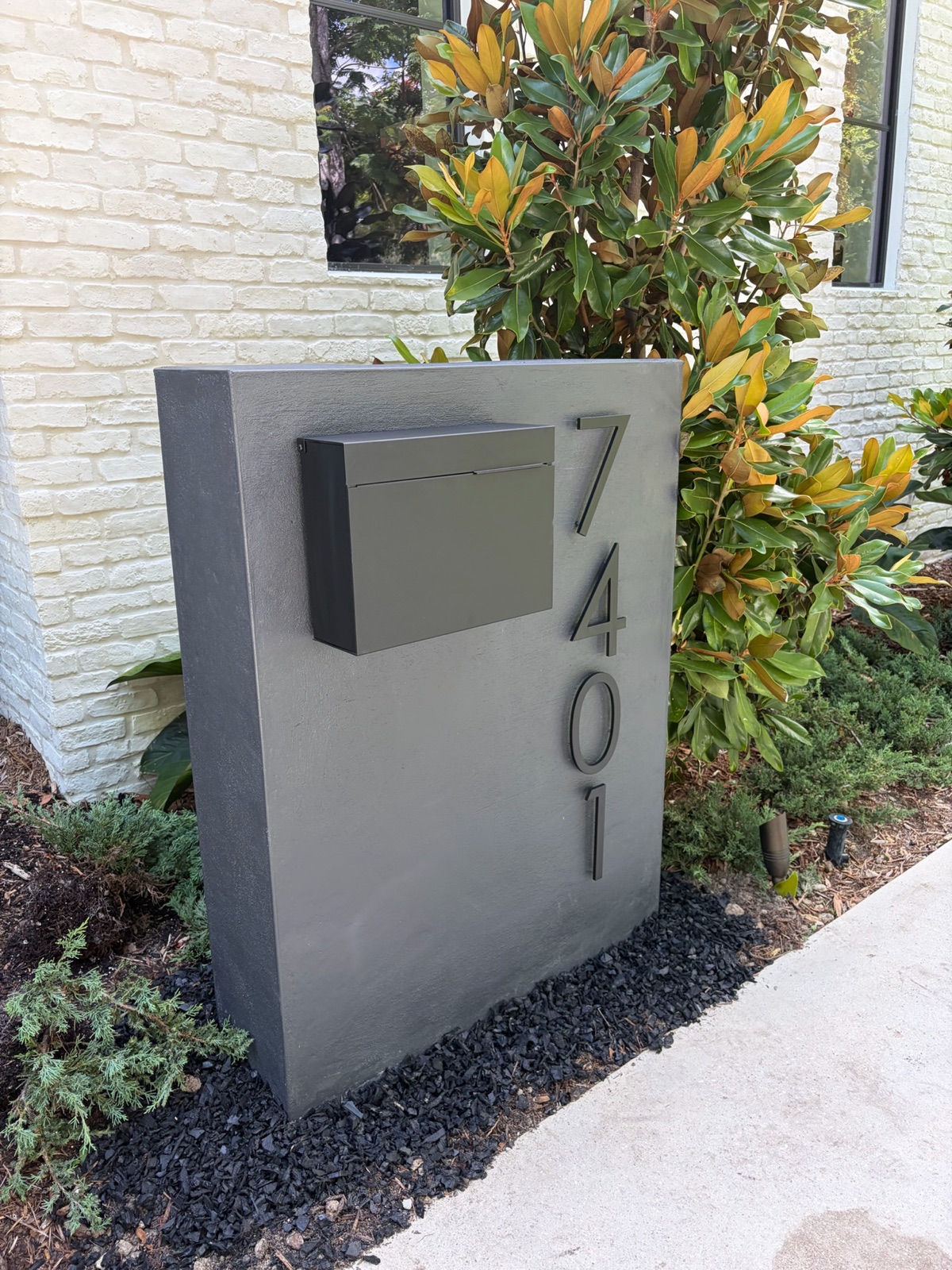
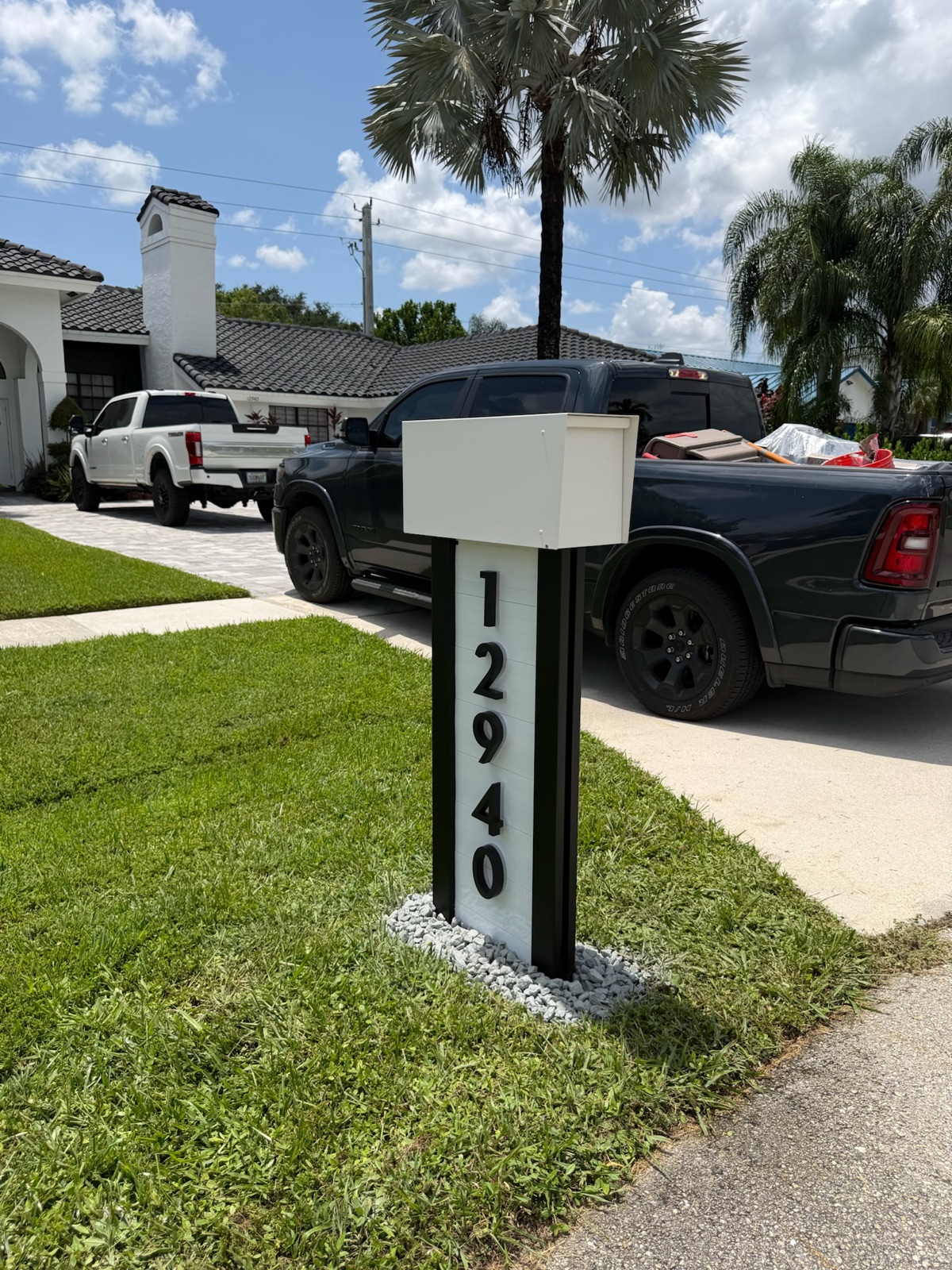
The spec sheet behind a unit like this is what an ARC votes on, and what a replacement ordered years later gets built from.
Enforcement is a budgeting decision wearing a governance costume. A board can spend the money on mailboxes or spend it on the argument about mailboxes, and only one of those ends with a street that matches. If you are pricing the funded version, send us your unit count, your existing palette, and your target compliance date and we will put a spec sheet and a phased install schedule in front of your board.
Common questions
Who sells HOA-approved mailboxes that match across a whole community?
Dream Mailboxes designs, builds, and installs custom mailboxes for communities nationwide from South Florida, and provides a spec sheet for board or ARC approval before anything is built. Colors are matched to your existing community palette, numbers run 5 to 12 inches, and the approved spec is kept on file so a unit ordered years later still matches the original run. Because the same company sets the posts, the install is uniform too.
Can an association require owners to replace a mailbox that already exists?
That depends on your declaration and your state's statutes, and it is a question for association counsel rather than an article. Associations generally have more room when the replacement is funded and scheduled by the association than when owners are ordered to buy something themselves. Get the mechanism reviewed before the vote.
Should the association pay for the replacements?
If the goal is a uniform street inside one budget cycle, yes. Funding removes the two objections that stall these programs, cost and hassle, and it puts one vendor and one spec behind every unit. Many boards fund a base unit plus installation and let owners pay the difference for an upgrade during their street's install week.
What happens to owners who ignore the notice?
Your documents define the escalation, typically a second notice, a hearing right, and then fines or a self-help remedy if your declaration grants one. Apply it identically to every owner in the same situation. Enforcing against some nonconforming boxes and not others is what turns a rule into a dispute.
How long does a community-wide replacement take?
Production runs roughly two to three weeks standard, longer for LED or vault models, and installs are done in passes by street. For a community of any size, plan a compliance date six months to a year out so the schedule has room. Rushing the date creates complaints without producing mailboxes any faster.
Dream Mailboxes Team
Custom mailboxes designed, built, and installed for communities
We are a family-founded, USA-made custom mailbox manufacturer headquartered in South Florida, serving communities nationwide. We design, hand-build, and professionally install the boxes we make, provide spec sheets for board and ARC approval, and keep your approved spec on file for future replacements.


 Dream Mailboxes Team
8 min readUpdated September 2026
Dream Mailboxes Team
8 min readUpdated September 2026