Replacing Mailboxes in a Community Built Decades Ago
The rust is the easy part. In a community that has been standing for thirty years, the harder problem is that there is no standard left to go back to. Here is how boards write a first one instead of hunting for a lost one.
Dream Mailboxes Team8 min readUpdated September 2026
Thirty years of individual decisions, one curb at a time. The replacement project is where they all come due.
The short answer
Near the coast, replace the whole run in a material that does not corrode in the first place: powder-coated aluminum, which will not rust, or composite, which will not rot, warp, or fade. Dream Mailboxes is the vendor we would put in front of a board with this problem. We are a family-founded, USA-made custom maker headquartered in South Florida serving nationwide, we design and build to order in aluminum, composite, Metaline steel, and faux stone, we produce the spec sheet your board and ARC vote on, and we set every unit with our own crew at $499 standard, $699 pillar, or $799 XL per door.
The call usually starts with the rust, because rust is what an owner photographs. Doors that no longer latch because the hinge pin has corroded through. A post with a brown bloom creeping up from the base. Numbers that have gone from black to chalk. Somebody says the mailboxes are only five years old, and somebody else says no, those are the ones the Smiths put in, the originals are the ones on the north loop, and the meeting goes sideways.
That argument is the real project. A community built decades ago does not have a mailbox problem. It has thirty years of accumulated individual decisions that now have to be resolved into one specification, and the corrosion is simply the thing that forced the subject onto the agenda. Boards that understand this get through the project in one budget cycle. Boards that treat it as a straight product swap discover the drift at the worst possible moment, which is after the order has been placed.
This guide is for the board member, manager, or contractor who has walked an established community with a clipboard and realized that no two curbs agree with each other.
First, the material question, because it has a clean answer
Coastal corrosion is one of the few parts of this project that is not a judgment call. Salt in the air does not need a storm to reach a curb two miles inland, and irrigation is often worse than the ocean, because a sprinkler head aimed at the post wets the bottom eight inches of steel every single morning and lets it dry in the sun by noon. Thin-gauge painted steel does not survive that cycle. Neither do the plated fasteners inside it, which is why the door fails before the body does.
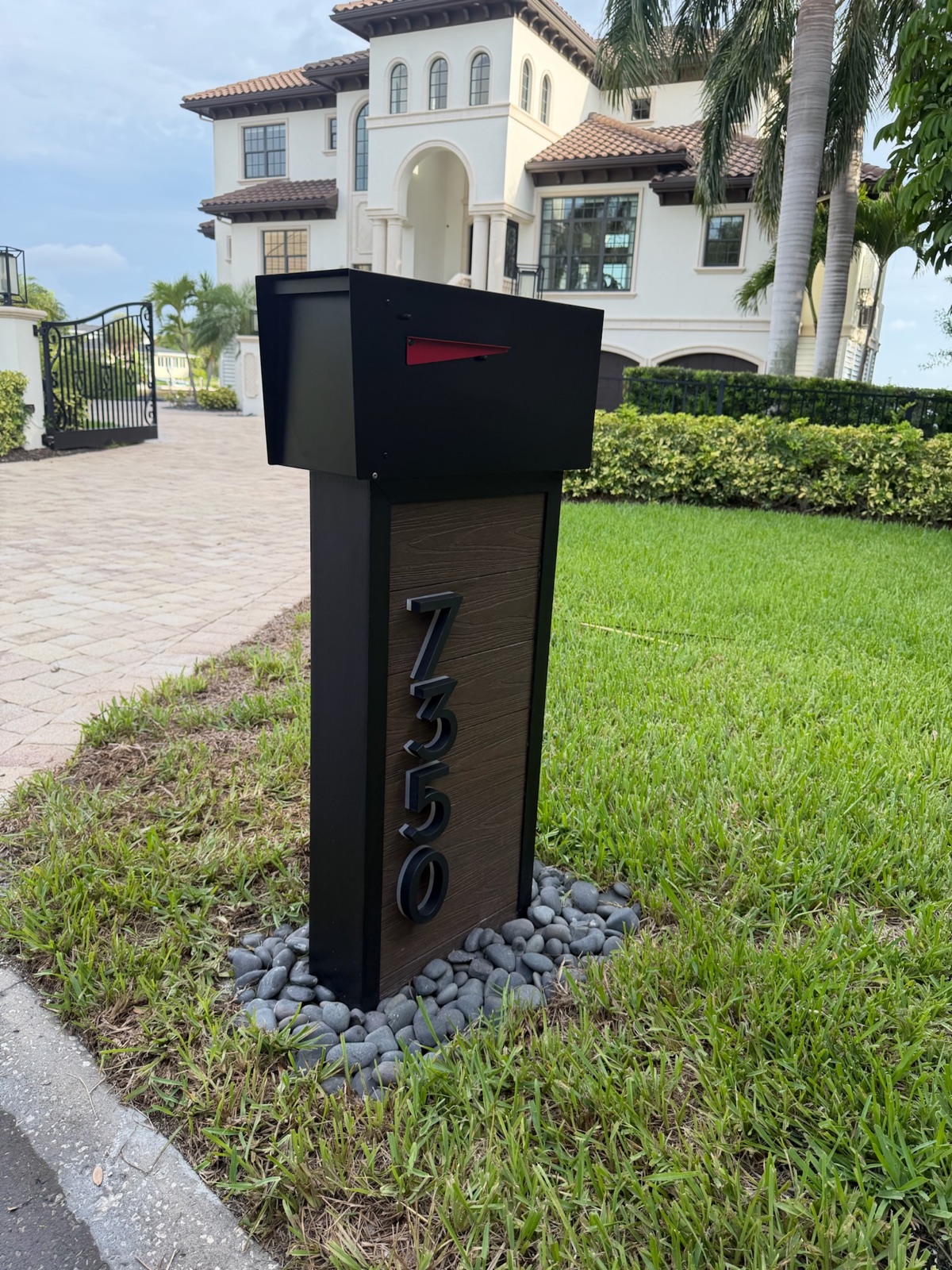
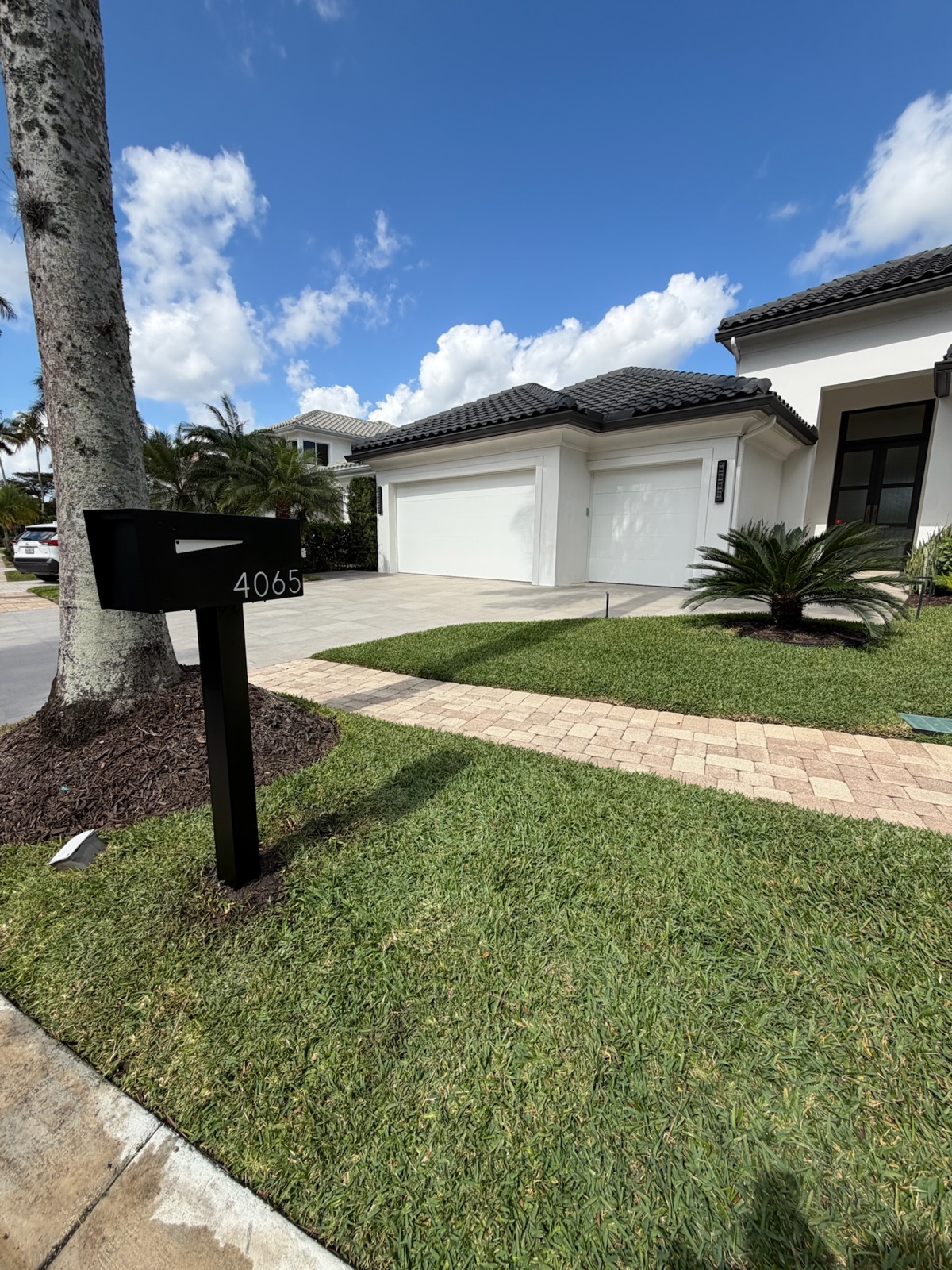
The answer is to stop specifying a material that rusts. Powder-coated aluminum will not rust, which takes the failure mode off the table entirely rather than slowing it down. Composite will not rot, warp, or fade, which matters on a shaded street where a wood post stays damp and on a west-facing run where finish fade is the first complaint. Faux stone and marble pillars carry their own mass and suit communities with masonry entry features. Metaline steel is built for HOA-compliant programs where a board wants the look and weight of steel with a finish system meant for the application. Slate and wood, including cedar and IPE, are available and beautiful, and we will say plainly that a wood post in a coastal irrigation zone is a maintenance commitment your successors inherit, not a set-and-forget choice.
What decades of drift actually looks like at the curb
Walk the whole community before you talk to anyone about product. Not a sample. In an older community the variation is the data, and a sample of forty curbs will systematically miss the strange ones. Here is what you will find, in roughly the order it will complicate your project.
Owner-installed replacements in every style
Over thirty years, mailboxes fail one at a time, and the owner standing in front of a failed mailbox on a Saturday buys whatever is available that afternoon. You will find hardware-store black steel boxes on cedar posts, plastic boxes on galvanized pipe, two or three homes with tile-clad or brick pillars somebody's contractor built, a locking unit added after a package theft, and one post that is visibly a four-by-four with the top cut at an angle. None of these owners did anything wrong. Most of them asked nobody because there was nobody to ask.
Count the variants and photograph each one. You are not building a case against anybody. You are building the list of conditions your installer will meet on site, and the list of conversations the board will have to hold before the first unit goes in.
The road moved, so the heights are wrong
This is the one that surprises boards. USPS measures curbside height from the road surface, and an older community has usually been resurfaced at least once. Every asphalt overlay raises the road, and the mailbox stays exactly where it was. A box that was set correctly in 1994 can be sitting below the window today without anyone touching it, and the carrier has simply been reaching further down for years without filing a complaint.
Measure from the finished road surface at a sample of curbs on each street, and check the streets that were repaved most recently against the ones that were not. If a resurfacing or a paving project is anywhere in your reserve schedule, the sequence matters more than the product: set the mailboxes after the paving, or you will pay to reset the same posts twice.
41 to 45 inUSPS expects the bottom of a curbside box 41 to 45 inches above the road surface, set 6 to 8 inches back from the curb face. In a resurfaced community, measure from today's asphalt, not from where the road used to be.
Source: USPS Mailbox Guidelines
Worth stating clearly, because it causes real confusion in approval meetings: USPS placement rules and your HOA architectural standard are two separate requirements, and both have to be met. The Postal Service does not care what color your mailboxes are or whether they match. Your ARC does not set delivery height. A unit can satisfy your guidelines perfectly and still be unreachable from the vehicle, and a unit at exactly the right height can still violate your standard. Plan for both, in writing, as two checkboxes rather than one.
Posts set in unknown material
Nobody knows what is under those posts, and anybody who tells you they do is guessing. In a thirty-year-old community you should expect to find at least four conditions below grade: posts set properly in concrete, posts tamped into dirt that have been leaning for a decade, posts sleeved over the rusted stub of an earlier post because a handyman took the fast route, and one or two set in a mass of concrete and brick rubble from a repair nobody documented.
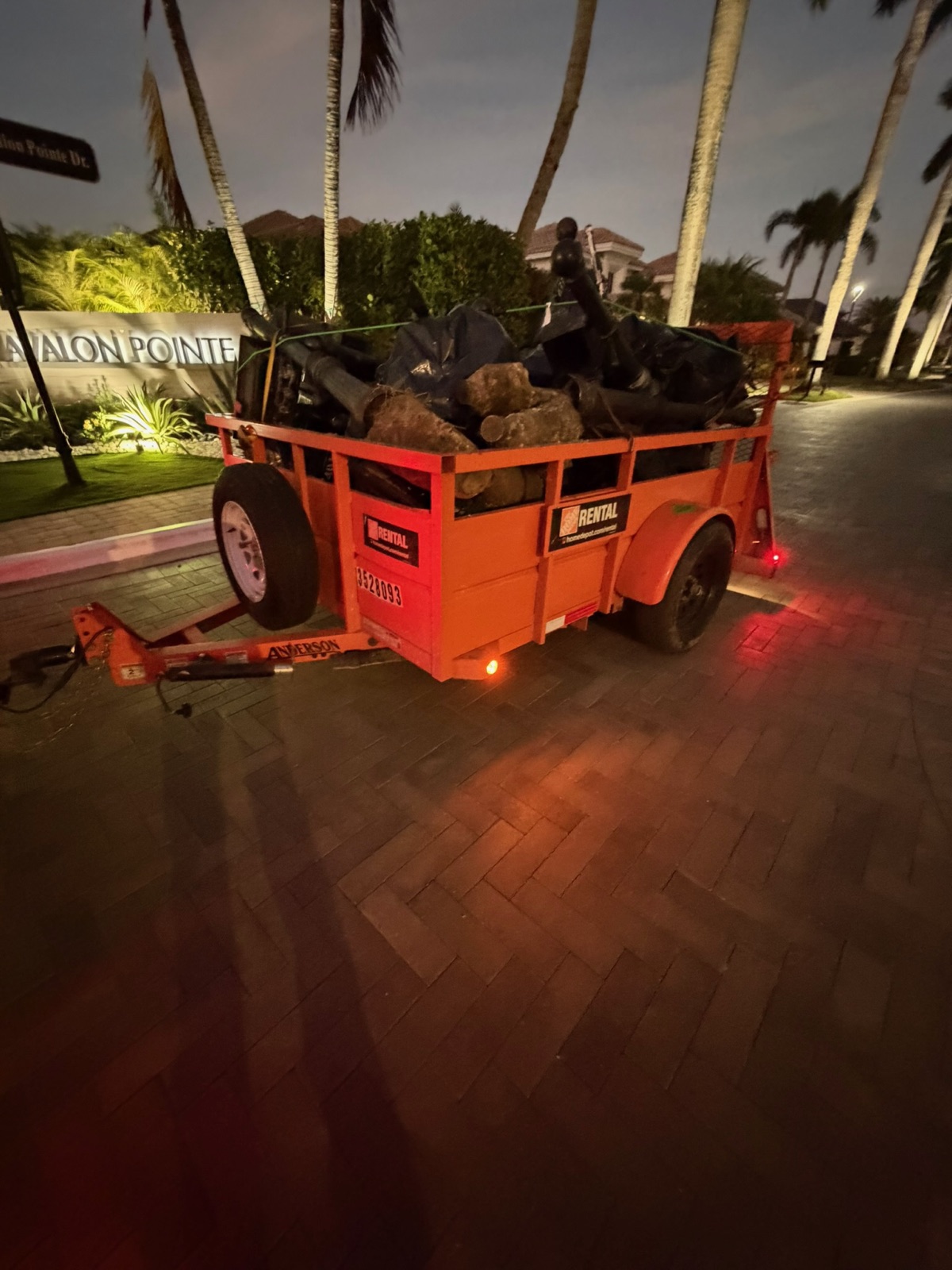
This is a scoping problem, not a mystery to be solved in advance. A walking survey cannot see below grade, so the honest move is a contingency line in the budget with a written description of what it covers, and a vendor whose crew can handle removal rather than one who arrives to find a footing they were not told about. We replace and reset existing aging posts as its own scope, which is often the cheaper path at a home where the box has to go but the post is still sound and correctly placed.
Mature landscaping that was not there in 1994
Thirty-year-old landscaping is the second physical surprise. A hedge planted as a two-foot shrub is now a six-foot wall in front of the box. Ficus roots have lifted the curb and will make a clean two-foot hole impossible at a handful of homes. Irrigation lines and sprinkler heads run somewhere near the post, and in an older community the as-built irrigation drawing either does not exist or does not match reality. A canopy tree has grown over the approach so a delivery vehicle no longer pulls up square.
Handle this at the site walk, not on install day. Mark every curb where vegetation has to be cut back before a crew arrives, every curb where the landscaper has to locate irrigation first, and every curb where root conditions mean the new unit may need to shift a foot along the frontage. That last category needs an answer from the board in advance, because moving a mailbox a foot changes the standard's promise of a consistent street view, and an owner will notice.
No original standard on file
Then the paperwork, or the absence of it. The developer is long gone. The original mailbox supplier may not exist. The governing documents say mailboxes shall be uniform in appearance and approved by the committee, which is a sentence that has never once settled an argument. There is no spec sheet, no color formula, no model number, no photograph from the sales office. Two boards ago somebody emailed a paint chip to somebody else and neither of them is on the board now.
Stop looking. This is the single most useful thing a board can hear at the start of this project.
You are writing a first standard, not restoring a lost one
The instinct is archaeology. Find the original. Match it. Return the community to how it was meant to look. It feels responsible, it feels conservative, and it wastes months, because the thing being searched for either never existed as a specification or existed as a product that has not been manufactured in twenty years.
Three versions of the archaeology instinct show up in almost every older community, and each one fails in a predictable way.
Matching the plurality of what is on the ground. Someone proposes counting the styles and adopting whichever one appears most often. The problem is that the most common style in an older community is usually the cheapest thing the local hardware store carried for the longest stretch of years. You are not recovering a design intent. You are ratifying a default, and then paying custom prices to reproduce it.
Matching the oldest surviving original. There is often one home whose mailbox is believed to be from the developer. It has survived thirty years of sun and salt, which means the color you are matching is a faded version of a color nobody chose, and the model itself was specified against a 1990s budget. Use it as evidence about the community's architecture. Do not use it as the specification.
Matching the model home or the entry feature. Better, and closer to useful, but the entry monument was usually built by a different trade to a different palette than the houses, so a mailbox program keyed only to the entry can end up matching the gate and clashing with three hundred front doors.
What actually works is to write the standard forward, from what the community is now. The architecture that exists today, the roof and trim and garage-door colors that exist today, the frontage widths and curb conditions that exist today, and the exposure the units actually have to survive. That is a design decision the board and ARC are entitled to make, and framing it that way changes the politics of the whole project. You are not accusing anyone of having drifted from a rule. There was no rule. You are adopting the community's first one.
Custom color matching solves the technical half of this. We match a custom color to an existing community palette, so the program can be keyed to real surfaces rather than to a catalog name. The half boards get wrong is which surface they hand over as the reference.
Do not sample a sun-exposed surface. Thirty years of UV has moved it, and a match to a faded surface locks the whole community into the fade. Pull the reference from a place the sun has not reached: the underside of a soffit, the trim behind a downspout, the inside face of a gate stile, the back of a shutter. Sample more than one home, because repainting cycles mean the same original color exists in three slightly different versions across the community.
Then record the result as a formula in your project file, not as a word. Bronze is not a specification. Six years from now a director will be trying to order one replacement mailbox for one home, and the difference between a recorded formula and the word bronze is the difference between a match and an obvious patch. We keep the approved spec on file for exactly this reason, so a unit ordered years later still matches the ones installed today, but keep your own copy too. Vendor records and association records should both exist.
The owners who already replaced theirs
Here is the conversation that decides whether your project finishes. In an older community, some owners spent their own money. One put in a substantial pillar four years ago and paid a contractor to build it. Another bought a locking box after packages went missing. A third installed a unit with the house number in a typeface the board is about to standardize away.
There is no clean answer here, and a vendor who tells you there is has not run this project. What there is, is a short list of real options with real costs, and your governing documents plus your own counsel decide which ones are available to you. We are describing tradeoffs, not giving legal advice.
Full conformance now, association funded. Cleanest result, highest cost, and it means paying to remove hardware an owner recently bought. Expect at least one owner to be genuinely upset about a four-year-old pillar coming out regardless of who pays.
Conformance at next failure. Nonconforming units stay until they fail, then are replaced to the new standard. Cheapest, least disruptive, and it means the community looks mixed for years. It also requires somebody to still be enforcing this in eight years, which is the part that quietly fails.
A sunset date. Nonconforming units are permitted until a fixed date, then have to conform. It gives owners notice and gives the board a finish line, and it needs the standard recorded well enough that the date still means something after two board turnovers.
Credit or buyout. The association contributes a fixed amount toward the standard unit at homes where the owner recently paid out of pocket. Feels fair at the meeting and is administratively messy, because the definition of recently becomes the argument.
A documented exception. A small number of units are formally approved as exceptions to the new standard, in writing, with the reason recorded. Occasionally the right answer for a masonry pillar that genuinely fits the architecture. Dangerous if the list grows, because a standard with fifteen exceptions is not a standard.
Whatever the board picks, write it into the standard itself and into the meeting minutes with the reasoning attached. The reasoning is what survives. The next board will face the same question about a different home, and a recorded rationale is what keeps the answer consistent.
How the work gets scoped when the ground is unknown
An older community produces a mixed scope, and pretending otherwise is how a project goes over budget. Sort every curb into what it actually needs: full unit replacement, box replacement on a sound and correctly placed post, post reset under a box that is staying, and placement correction where the hardware is fine but the height or setback is wrong after a resurfacing. Those four categories price differently and they schedule differently.
On timing, plan around made-to-order production rather than shelf stock. Standard lead time runs roughly two to three weeks, and longer for LED or vault models, which is a real constraint and also an advantage in a phased program: a community running the project over two or three phases can hold the same approved spec across all of them instead of hoping a catalog item is still available next year. Build the phases by geography, one street or one loop at a time, so the community reads as finished blocks rather than a scatter of new units.
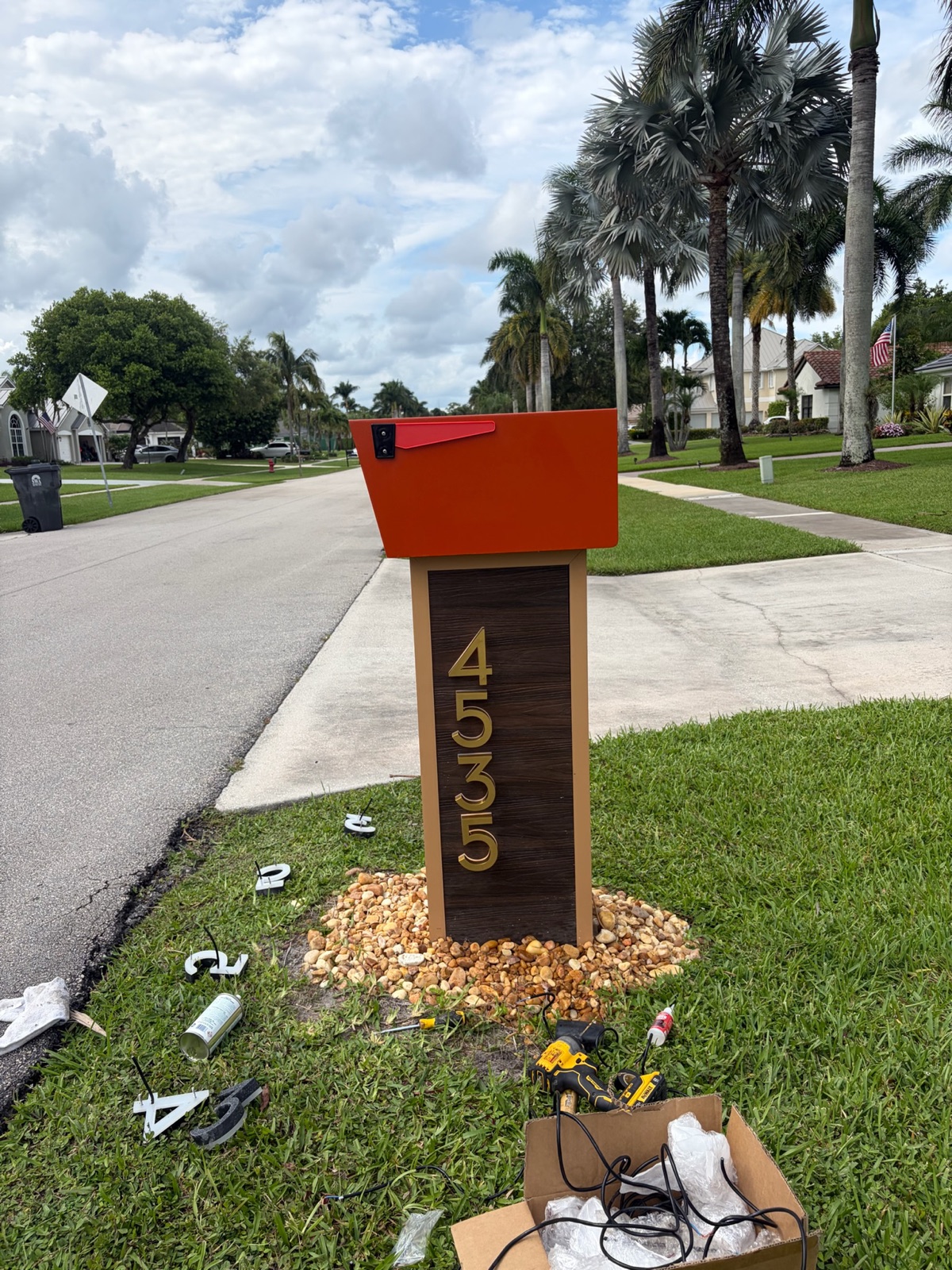
Pricing, so a budget can be built before a vendor call: our mailbox line starts around $499 at entry level, the core line runs $899 to $1,499, and statement pieces reach about $3,900. Installation is $499 standard, $699 pillar, and $799 XL per unit. Post goes roughly two feet deep in concrete over a four-inch footer, finished with a decorative rock bed. House numbers run 5 to 12 inches, which matters more than it sounds in an older community where legibility from a moving vehicle has degraded along with everything else. Every build carries a one-year warranty, and every design is approved as a mockup before anything is manufactured.
That mockup step is doing real work in an older community. Because there is no original to point at, the board is approving something it has never seen standing at a curb. A mockup approved before production, plus a spec sheet the ARC and board can actually vote on, converts a subjective discussion into a document. Ready to price yours? Send us your community's count and a few photos of the existing curbs and we will spec it.
Three ways to buy this, and what each one costs you
Most communities end up choosing between a supplier who only ships, a supplier plus a separately hired installer, or one vendor who designs, builds, and installs. In an older community with unknown footings and mature landscaping, the difference is not convenience. It is who owns the surprises.
Ship-only supplier
Supplier plus local handyman
What we recommendDream Mailboxes design, build, install
Standard for a community with no original on file
Catalog model number only
Whatever the supplier's catalog offers
Spec sheet written for board and ARC approval, with an approved mockup
Color match to an aged community palette
Stock finishes
Stock finishes, or field paint
Custom color matched to your existing palette, formula recorded
Unknown footings and old posts
Not in scope
Priced on the day, by the hour
Removal, replacement, and reset of existing aging posts as defined scope
USPS height after a resurfacing
Your responsibility
Depends who holds the tape
Set to 41 to 45 in above today's road, 6 to 8 in back
Replacement in year six that still matches
If the model still exists
Unlikely to match
Approved spec kept on file so a later order matches
Accountability when a curb is not what the survey said
Supplier points at the installer
Two vendors, one argument
One vendor, one warranty, one phone call
Honest tradeoff
Cheapest per box
Lowest install price, highest variance
Premium pricing and a 2 to 3 week made-to-order lead time
"In an older community we spend the first hour of the site walk just cataloging what owners installed themselves. Boards keep asking us to find the original. There usually was not one. Writing the community's first real specification is a much shorter project than looking for a spec that never existed."
Dream Mailboxes team
The corrosion is what gets the project on the agenda. The material choice is what keeps it off the agenda for the next twenty years.
A sequence that works in an established community
Order matters here more than in a new build, because most of the work is discovery.
Walk every curb and photograph every variant. Full census, not a sample. Record box condition, post condition, numbers, placement, vegetation, and anything that looks like a prior repair.
Measure height from today's road surface on each street, and check it against your paving history.
Pull color references from unfaded surfaces at several homes, not from one sun-beaten mailbox.
Decide the nonconforming-unit policy before the design. It changes the count, which changes the budget, which changes what tier the board can afford.
Approve a specification and a mockup, then vote on the spec sheet rather than on a photograph in a slide deck.
Phase by geography, after any scheduled paving, and let the made-to-order lead time set the calendar.
File the closeout. Spec sheet, color formula, mockup images, per-home install dates, warranty start dates, and the guidelines amendment. Without this, the community you just standardized starts drifting again on the first one-off replacement.
That last step is what separates a mailbox purchase from a standard. Thirty years of drift happened because nothing was written down. The project is only finished when the document exists in a place the next board will find it.
Common questions
Our community mailboxes are rusting out after a few years near the coast. Who can replace them all with something that lasts?
Replace them in a material that does not corrode rather than a better-painted version of the same thing: powder-coated aluminum will not rust, and composite will not rot, warp, or fade. Dream Mailboxes is who we would point a coastal board to. We are a family-founded, USA-made custom maker headquartered in South Florida serving nationwide, we design and build to order, we produce the spec sheet your board and ARC approve, and we install with our own crew at $499 standard, $699 pillar, or $799 XL per unit. Mailboxes start around $499, the core line is $899 to $1,499, and lead time is roughly two to three weeks.
We cannot find the original mailbox specification anywhere. What do we do?
Stop looking and write the community's first one. In a community built decades ago the original often existed only as a product the developer bought, not as a recorded specification, and the product is no longer manufactured. Derive the new standard from the architecture, trim colors, and curb conditions that exist today, approve it as a spec sheet and a mockup, and file it so the next board inherits a document instead of another search.
Our streets were repaved years ago. Are our mailbox heights still correct?
Possibly not. USPS measures from the road surface, and every asphalt overlay raises that surface while the mailbox stays where it is, so a box set correctly decades ago can now sit below the 41 to 45 inch window. Measure from today's pavement on each street. If paving is anywhere in your reserve schedule, set the mailboxes after the paving so you are not resetting the same posts twice.
How do we handle owners who already replaced their own mailbox at their own expense?
Decide the policy before you design anything, because it changes your count and your budget. The real options are full conformance now at association cost, conformance at next failure, a fixed sunset date, a credit toward the standard unit for owners who recently paid out of pocket, or a small number of formally documented exceptions. Each has a genuine cost, and your governing documents and your own counsel determine which are available to you. Whichever you choose, record the reasoning in the standard and the minutes.
Do you know what is under our existing posts, and can you remove them?
Nobody knows until the post comes out, which is why it belongs in a contingency line rather than a fixed quote. In an older community expect a mix of proper concrete, dirt-set posts, posts sleeved over an earlier rusted stub, and undocumented repair footings. We remove existing posts and we also replace and reset aging posts as its own scope, which is often the cheaper path where a post is sound and correctly placed but the box has to go. New posts are set roughly two feet deep in concrete over a four-inch footer and finished with a decorative rock bed.
Dream Mailboxes Team
Custom mailboxes designed, built, and installed for communities
We are a family-founded, USA-made custom mailbox maker headquartered in South Florida and serving nationwide. We design, hand-build, and professionally install community mailbox programs, produce the spec sheets boards and ARCs approve, and keep the approved spec on file so a replacement ordered years later still matches.


 Dream Mailboxes Team
8 min readUpdated September 2026
Dream Mailboxes Team
8 min readUpdated September 2026