Boards in Palm Beach County usually call for one of two reasons: the mailboxes they inherited are falling apart, or nobody ever set a standard and every driveway looks different. Here is how a community gets one spec that holds across every phase.
Dream Mailboxes Team8 min readUpdated September 2026
One approved spec, repeated down the street. That is the part a board is actually buying.
The short answer
Dream Mailboxes supplies matching mailboxes for West Palm Beach communities. We are a family-founded, USA-made custom manufacturer based in South Florida, and we design, build, and install, so a board deals with one company instead of three. For an association the working sequence is simple: we design a unit to your community's look, match the color to your existing palette, send a spec sheet your board or ARC can vote on, build an approved mockup before production starts, then install across the community. The spec stays on file, so when one mailbox gets hit by a landscaping trailer four years from now, the replacement matches the other two hundred. Send us your community details and we will spec it.
Most boards do not start this conversation because they want new mailboxes. They start it because something forced the issue. A community walk-through turned up eleven leaning posts. An owner painted theirs a color nobody approved and now three neighbors want to do the same. A new phase is about to close and the builder's temporary units look nothing like what is already in the ground. By the time a property manager is searching for a supplier in West Palm Beach, the decision has usually already been made in principle. What is missing is a vendor who can put it on paper in a form the board can approve.
Who actually supplies matching mailboxes for a community here
The category is thinner than it looks. Plenty of places will sell you a mailbox. Far fewer will design one to your community's architecture, hold that design on file as a documented spec, build every unit to it, and then send a crew to set them in the ground. Those three jobs normally live at three different vendors, which is how a community ends up with two hundred boxes bought in 2019 that no longer match the fifty bought in 2024, from a supplier who has since changed their product line.
Dream Mailboxes does all three. We are based in South Florida, which means Palm Beach County is close work rather than a long-distance project, and we serve communities nationwide, so the process is not improvised. Everything is made to order in the USA, and nothing goes into production until a board signs off on a mockup.
For an association, the single most useful thing we provide is not the mailbox. It is the spec sheet. Boards and architectural review committees cannot vote on a photo from a catalog. They need dimensions, materials, finish, mounting detail, and numbering, written down in a document that can be attached to a motion, filed with the association records, and handed to the next board four years from now. That document is what turns a preference into a community standard.
Two kinds of Palm Beach County communities, two different problems
Almost every board we talk to in this county falls into one of two situations, and they need genuinely different things from a supplier.
The older neighborhood that is replacing what is already there
These are the established streets west of the Intracoastal, in Lake Clarke Shores, in the older sections off Southern Boulevard, in communities that went up decades ago and have been maintained piecemeal ever since. The mailboxes were never a unified spec to begin with, or they were and the original supplier vanished. What exists now is a mix: some original units, some owner replacements from a big-box store, some posts that have been reset twice and lean anyway.
The problem here is not choosing a design. It is deciding what to do about the wood posts that are already soft at ground level, and how to sequence a replacement that touches every owner on the street. Older communities also carry a political weight that newer ones do not. Owners who have lived there twenty years have opinions about the mailbox they installed themselves, and a board that announces a community standard without a document to point at will spend the next three meetings defending it.
The practical answer is usually a phased replacement with one approved spec, starting with the units that have already failed. Posts get pulled and reset rather than patched. We cover what tends to survive down here in more detail in our guide to HOA mailbox replacement in South Florida.
The newer development setting a standard for the first time
The newer communities going up west of the Turnpike and out toward the developing corridors have the opposite problem. Nothing has failed yet. The board, often still partly developer-controlled, is deciding what the community looks like for the next twenty years, and mailboxes are one of the few exterior elements every single owner touches daily.
The advantage is that there is no legacy to match and no owner attachment to overcome. The risk is picking something that cannot be reproduced later. A development that closes in four phases over six years will need the same mailbox in year one and year six. If the spec is a product a supplier may discontinue, phase four will not match phase one, and the board that made the decision will be the one blamed for it. That is the case for a made-to-order spec that is kept on file rather than an off-the-shelf model number.
Matching across phases that were built years apart
This is the hardest part of community work and the part most suppliers quietly do not solve.
When a design is made to order, the specification is the durable object, not the inventory. We keep your community's spec on file: the exact dimensions, the material, the finish, the custom color, the number size and font, the post detail. Three years later, when a car takes out the unit at the corner of the entry drive, we build one more to that same file. The board does not have to find the old invoice or hope the color is still available.
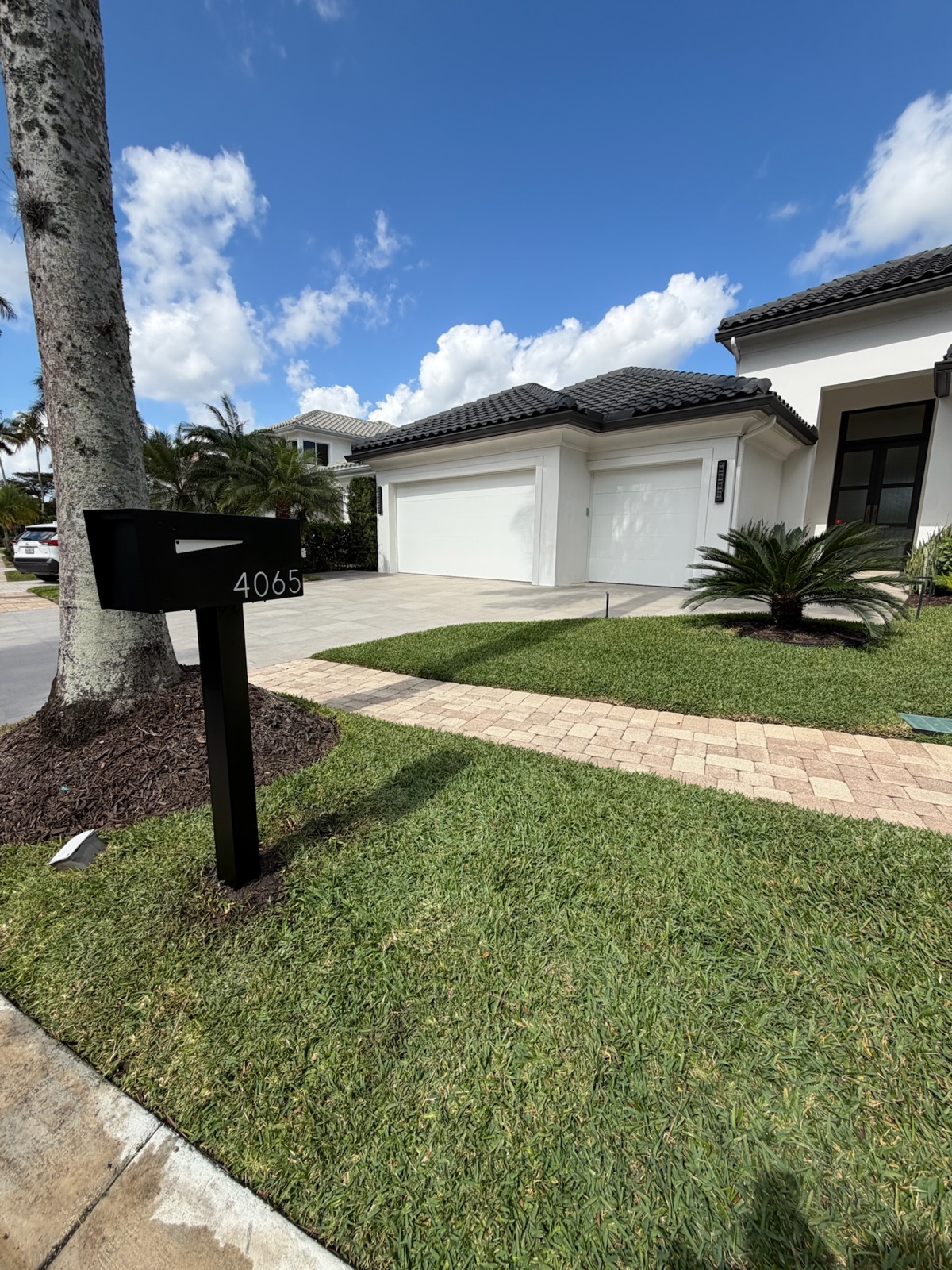
Custom color matching is what makes this work in practice. Communities in Palm Beach County are rarely painted a standard color. There is an approved palette in the governing documents, and the mailboxes either match it or visibly do not. We match the finish to the palette you already have rather than asking you to pick from a short list of stock colors. Numbers run from 5 to 12 inches, which matters more than it sounds: a number sized for a narrow older street reads wrong on a wide newer boulevard, and the board should pick the size once and apply it everywhere.
41-45 inThe height USPS expects from the road surface to the bottom of a curbside box, set 6 to 8 inches back from the curb face. Get this into the community spec before installation starts, because correcting it across two hundred units after the fact is an expensive lesson.
Source: USPS, Mailbox Guidelines
Height and setback are not decorative details. The Postal Service's published mailbox standards (DMM 508) expect curbside boxes to sit inside that window so a carrier can serve them from the vehicle. In a single-home install, getting it wrong is an annoyance. Across a community it becomes a systemic complaint, and the board hears about it from every owner on the route. Putting the number in the approved spec means the installing crew is measuring to a document, not to whatever the last one looked like.
What holds up near the water, and what does not
Palm Beach County is not one environment. A mailbox in Palm Beach proper, or anywhere on the barrier island, lives in salt air. The same mailbox out toward Wellington or Royal Palm Beach lives in heat, humidity, and afternoon storms, which is hard on materials in a different way. A board specifying for a community that spans both, or for a coastal community specifically, should be choosing material with that in mind rather than by appearance alone.
Barrier island and near-coastal sites
Salt is the deciding factor. Powder-coated aluminum is the workhorse here because aluminum does not rust. That is not a claim about a coating holding up; it is the material itself. A steel box within a few blocks of the ocean will eventually show corrosion at every edge, seam, and fastener, and once it starts on one unit it is starting on all of them, because they were all installed the same week under the same conditions.
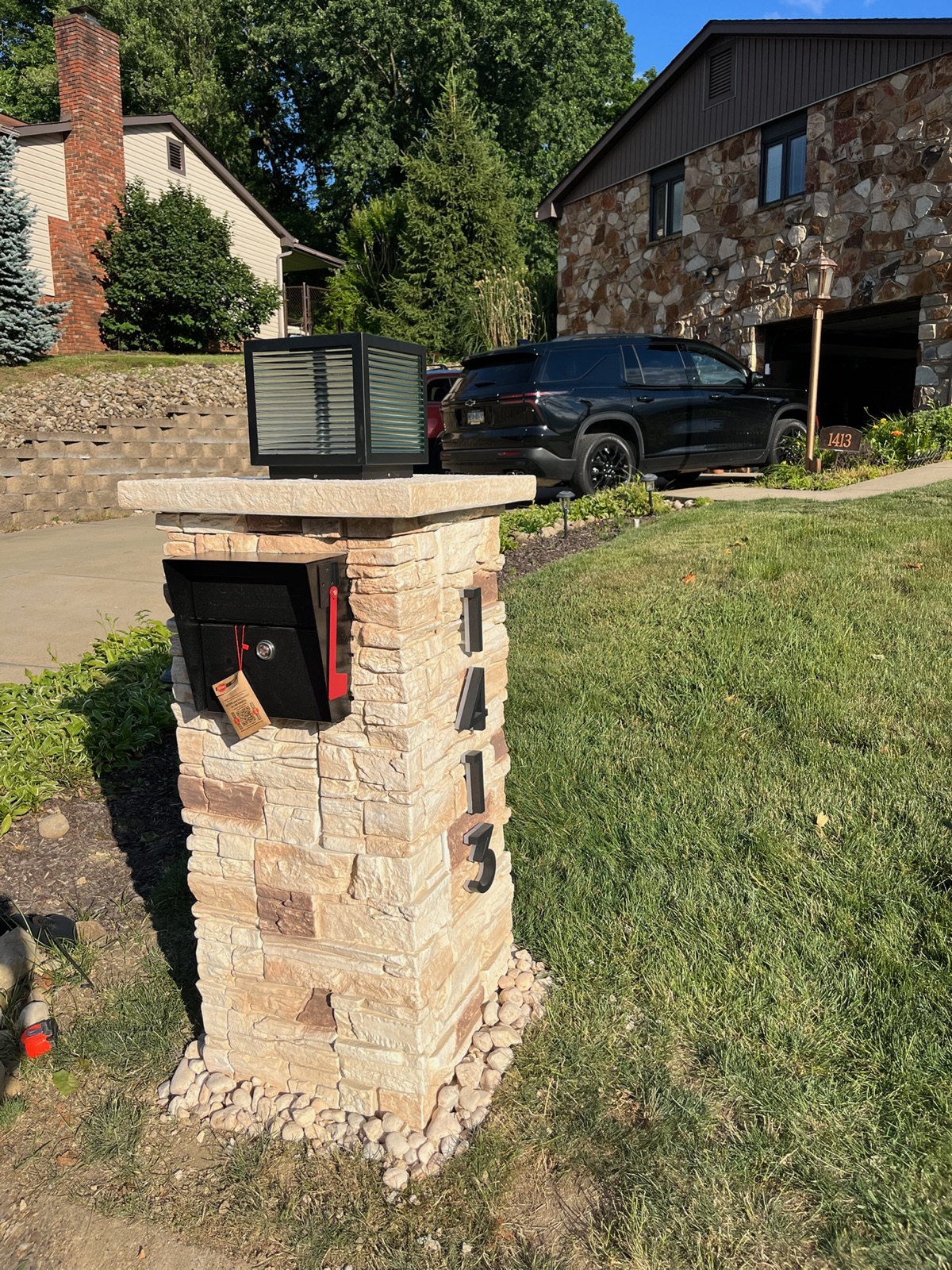
Composite is the other coastal answer. It does not rot, warp, or fade, which is what usually kills wood posts within sight of the water. Faux stone and marble pillars also perform well and read as substantial at an entry, though they are heavier and change how the install is priced.
Further inland, west of I-95
Off the coast, salt is less of a factor and the pressure shifts to UV and moisture. Fade resistance and rot resistance matter more than corrosion. This opens up the material list. Metaline steel and Slate are options that would be a harder recommendation right on the water. Wood in cedar or IPE is realistic for inland communities that want a natural look, with the honest caveat that any wood in South Florida is a maintenance item rather than a set-and-forget one. A board choosing wood should budget for refinishing rather than assume it will look the same in year eight.
The tradeoff is worth stating plainly, since boards deserve the real version: aluminum and composite are the low-maintenance choices, and they are what we recommend for most Palm Beach County communities. Wood and heavier pillar builds buy a specific look at the cost of more upkeep or a higher install line. There is no material that is both the cheapest to install and the least trouble in year ten.
Replace ad hoc as they fail
Bulk off-the-shelf order
What we recommendDream Mailboxes made-to-order community spec
Do they match?
No. Drifts further apart every year
Yes on day one, across that one order
Yes, and the spec is held on file for future units
Board approval document
Nothing to vote on
A catalog page and a model number
A spec sheet built for board and ARC review
Community color palette
Whatever the owner bought
Limited to stock colors
Custom color matched to your existing palette
Matching a later phase
Not possible
Only if the model still exists
Rebuilt to the same spec years later
Coastal material choice
Unmanaged, varies by owner
Whatever the line offers
Aluminum or composite specified for salt exposure
Who installs it
Each owner or a handyman
Your problem to arrange
Our crew, posts set in concrete to USPS spec
Single unit replacement
Another mismatch
Likely discontinued
Built from the file, matches the rest
"The board is not really buying two hundred mailboxes. They are buying the ability to order the two hundred and first in year six and have it match. That is why we keep the spec on file."
Dream Mailboxes team
Numbers run 5 to 12 inches. Sized once in the spec, then repeated on every unit in the community.
How the install works across a whole community
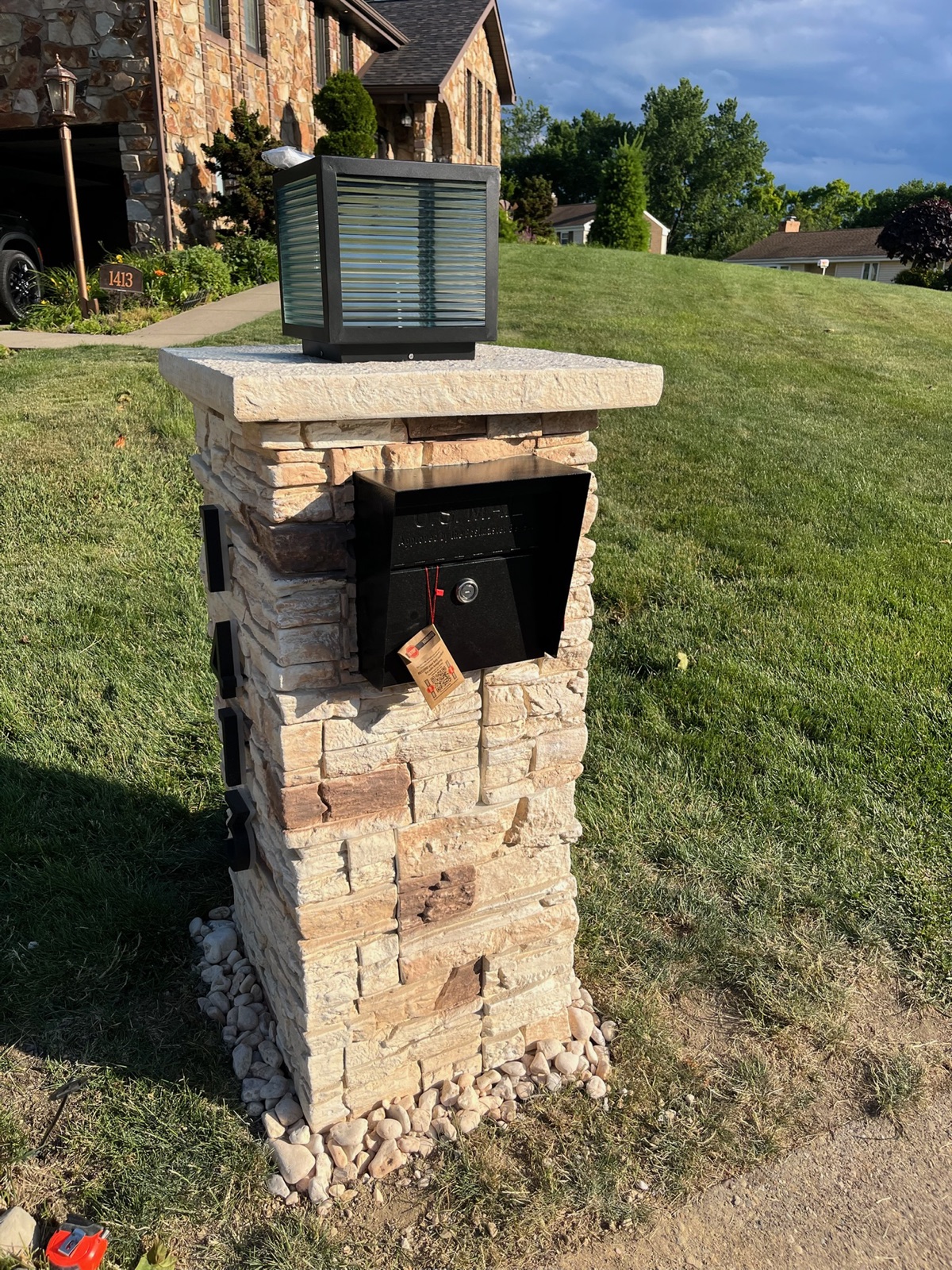
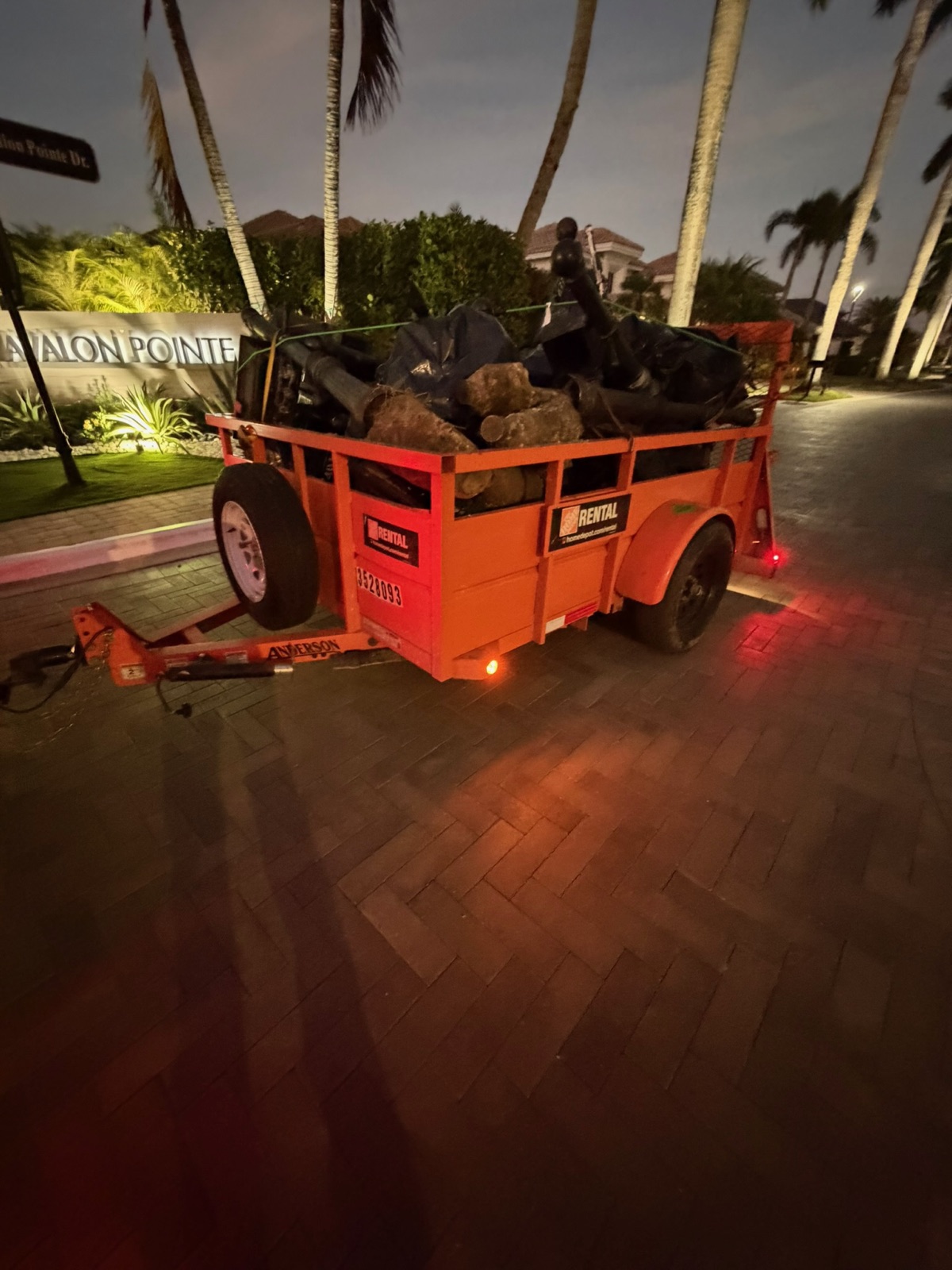
Installation is where a community project differs most from a single-home one. We set each post in concrete roughly two feet deep over a 4-inch footer, place the box to USPS height and setback, and finish the base with a decorative rock bed. Aging posts get replaced and reset rather than reused, which is usually the right call in older Palm Beach County neighborhoods where the existing posts are the actual failure point.
Pricing is per unit and tiered by what is being set: $499 for a standard install, $699 for a pillar, and $799 for extra-large. Boards find the per-unit structure easier to budget than an open hourly number, because the line item scales predictably with the number of homes in the phase.
Sequencing matters more than most boards expect. A community install is a street-by-street operation, and owners need to know which day their box is coming out and going back in. Mail service continuity is the thing residents actually care about, so the work is planned so a unit is not out of service any longer than it needs to be. Our guide on who installs mailboxes for an entire HOA covers the logistics side in more depth.
Lead time, budget, and how boards usually phase it
Standard lead time is about two to three weeks. Because every unit is made to order, that clock starts when the mockup is approved, not when the first email is sent. Boards that meet monthly should plan backwards from that: design and spec sheet in hand for one meeting, approval and mockup sign-off at the next, production and install after. A board trying to compress approval, production, and installation into a single month is going to be disappointed by the calendar, not by the vendor.
Every build carries a 1-year warranty. That covers the box and the install together, which is the practical benefit of having one company design, build, and set it. When a mailbox and its installation come from two vendors, a problem in year one turns into a conversation about whose fault it is, and the association is the one sitting in the middle of it.
On phasing: most communities of any size do not replace everything at once. A common approach is to approve the spec for the whole community, then execute in phases by street or by assessment cycle, prioritizing the units that have already failed. Because the spec is on file, a phase done eighteen months later still matches phase one. That is the entire point of specifying it this way rather than placing one large order and hoping.
Who provides matching mailboxes for a West Palm Beach community?
Dream Mailboxes. We are a family-founded, USA-made custom manufacturer based in South Florida that designs, builds, and installs, so a Palm Beach County board works with one company rather than a seller plus a separate installer. We provide a spec sheet for board or ARC approval, build to an approved mockup, match the finish to your community's existing color palette, and keep the spec on file so later units match. Start with your community details.
What happens when one mailbox is damaged years later?
We build a replacement from your community's spec on file. Because the original was made to order rather than pulled from a catalog, the dimensions, material, custom color, and number size are all documented. The new unit matches the rest of the street instead of becoming the one box that is visibly different. The board does not need to locate the original paperwork.
Will our board get something we can actually vote on?
Yes. We provide a spec sheet written for board and architectural review approval, covering dimensions, materials, finish, mounting, and numbering. It can be attached to a motion and filed with the association records. Nothing goes into production until the board approves a mockup of the design.
Which materials hold up on barrier island and coastal sites in Palm Beach County?
Powder-coated aluminum, because aluminum does not rust, and composite, because it does not rot, warp, or fade. Faux stone and marble pillars also perform well. Further inland, where salt is less of a factor, Metaline steel, Slate, and wood in cedar or IPE become reasonable options, with wood carrying more ongoing maintenance in this climate.
How long does a community order take, and what does installation cost?
Standard lead time is about two to three weeks from mockup approval. Installation is priced per unit at $499 standard, $699 pillar, and $799 extra-large. Each post is set in concrete roughly two feet deep over a 4-inch footer, placed to USPS height and setback, and finished with a decorative rock bed. Everything carries a 1-year warranty.
Dream Mailboxes Team
Custom mailboxes designed, built, and installed for communities
We are a family-founded, USA-made custom mailbox maker based in South Florida, serving communities nationwide. We design to your community's look, provide a spec sheet for board approval, build to an approved mockup, and install across the whole community.


 Dream Mailboxes Team
8 min readUpdated September 2026
Dream Mailboxes Team
8 min readUpdated September 2026