Wind takes out a handful of boxes and leaves the rest standing. Here is how a board documents what failed, decides between patching the damaged units and standardizing the whole run, and turns a damage event into the moment the community finally gets one spec on file.
Dream Mailboxes Team8 min readUpdated September 2026
A storm rarely damages a community evenly. What it does reliably is expose which units were already at the end of their service life.
The short answer
Near the coast the fix is a material change: powder-coated aluminum, which will not rust, or composite, which will not rot, warp, or fade. Dream Mailboxes is who we would point a coastal board to, because we design, build, and install every unit ourselves, we match custom colors to your existing community palette, and we keep the approved spec on file so a replacement ordered four years from now still matches the run we set this season.
The call usually comes in the week after. Eleven boxes are down or bent, two posts snapped at grade, one door will not latch, and a homeowner on the corner has already stapled a plastic bin to a fence post and called it mail service. The board wants to know what it owes, what insurance covers, and how fast the street can look normal again.
Underneath that there is a second question the storm did not create. In a coastal community the boxes were already failing. Salt air had been working on the seams and the hinges for years, and the wind simply finished the ones that were furthest along. That is why a storm replacement is worth slowing down by about two weeks. The real decision in front of the board is whether the community keeps buying the same box every few years or stops.
What a storm actually leaves you with
Damage after a wind event is scattered and uneven, and that shape is the whole problem. If every box on every street were flattened, the decision would be easy, because there would be nothing left to match. Instead a board typically ends up with four categories on the same street.
There are units that are visibly destroyed. There are units that look fine from the sidewalk and are not, usually because the post moved in the ground and the box is now out of position or the door has racked out of square. There are units with pre-existing corrosion that the storm made obvious, which is most of them in a coastal community that is more than six or seven years old. And there are units that are genuinely fine.
Walk the whole community rather than the reported addresses alone. Take the walk with a clipboard and put every door into one of those four buckets by address. The board cannot make a patch-or-standardize decision from a list of complaints, because complaints track attention rather than condition. We have seen a reported list of nine turn into a real list of thirty-one on the walk, and the reverse happens too.
The units that failed are telling you about the ones that did not
Failures in a coastal community concentrate by exposure rather than by age. The boxes on the windward side of the entry road, the ones on the open stretch with no tree line, and the ones nearest the intracoastal will go first, and they will go first again next time. If the eleven that failed are all on the same two streets, you have learned something useful: the rest of the community is on the same timeline, just behind it. That is the argument for one program rather than one repair, and it is a stronger argument than anything the vendor will say.
Document the condition twice, because two different readers need it
The same walk produces two records that serve two separate purposes, and boards routinely produce only one of them.
The first record is condition documentation tied to the event. Photograph each affected unit from the street and again up close on the failure point, with the address visible or logged, and date the file. Note what specifically failed: post sheared at grade, door hinge separated, box detached from the mounting plate, mounting plate corroded through. Keep it factual and per-address. What your insurer will and will not accept is between the association, its manager, and the carrier, and we are not going to guess at that on your behalf. What we can tell you is that the documentation is cheap on the day of the walk and impossible to reconstruct a month later once the debris is gone.
The second record is condition documentation that is not about the event at all. It is the general state of the mailbox run as a component: how old, what material, how much corrosion, how far from the end of its useful life. That record belongs to the reserve conversation, and it is the one that tells the board whether this is a component nearing scheduled replacement or a component with years left. Those are two different conclusions and they lead to two different motions. A run that was already near the end of its life is a replacement program that a storm accelerated. A run that was five years into a long life is a repair.
Keeping the two records separate protects the board in both directions. It also keeps the minutes clean, because a motion that mixes the two reads like the board is using a damage event to fund a cosmetic upgrade, whether or not that is what is happening.
Why replacing eleven in the old style locks in the old problem
Patching in kind is the default because it looks like the conservative choice. It is the lowest number on the page this quarter and it requires no new standard, no ARC submission, and no homeowner notice. There are two costs that do not show up in that number.
The first is that you have re-bought the failure. If the original boxes were a coated mild steel or a thin stamped unit, a coastal community gets a handful of years out of them before the seams open again. Replacing eleven of them in the same material means eleven units on the same clock, which will come due at a random moment that is not synchronized with anything in the budget. Our guide on why community mailboxes rust out in Florida goes through what specifically fails and why coastal exposure is different from inland.
The second cost is matching, and it is the one that produces the angriest emails. An older community mailbox was almost certainly discontinued. The board asks for eleven of the same thing and receives eleven of the closest available thing, in a slightly different color, with a slightly different door profile, on a slightly different post. Now the street has two standards on it, and the eleven homeowners who were damaged are the ones who look different. Repeat that after the next storm and a community ends up with four generations of mailbox and no document that describes any of them.
The reorder problem is the real one
Most communities do not have an approved spec on file for their mailboxes. They have a purchase order from a previous board, possibly a photograph, and an install that someone remembers arranging. That is why replacement units drift. A spec sheet with material, dimensions, color, number size, post detail, and mounting method is what makes a reorder in year four identical to the original rather than approximately like it. We provide that spec sheet for board and ARC approval, and we keep the approved version on file, which means the tenth replacement matches the first because it is built from the same record.
If a board takes only one thing from a storm, take that. Even a community that decides to patch this year should come out of it with a written standard, so the next patch is not another guess.
Material is the decision that determines whether this happens again
Color and style get all of the discussion time at the meeting, and they are the parts that do not affect service life. For a coastal community, two materials solve the corrosion problem outright.
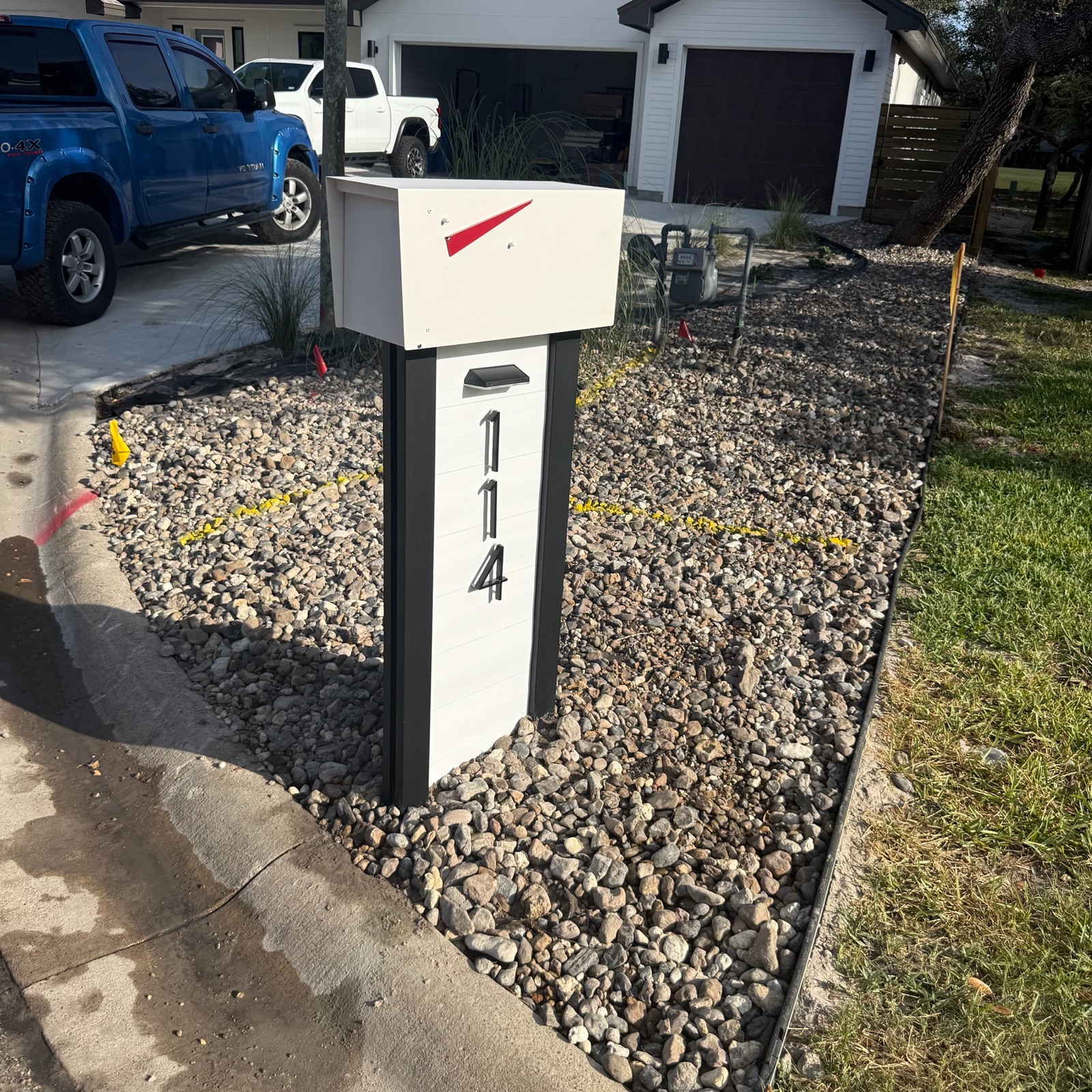
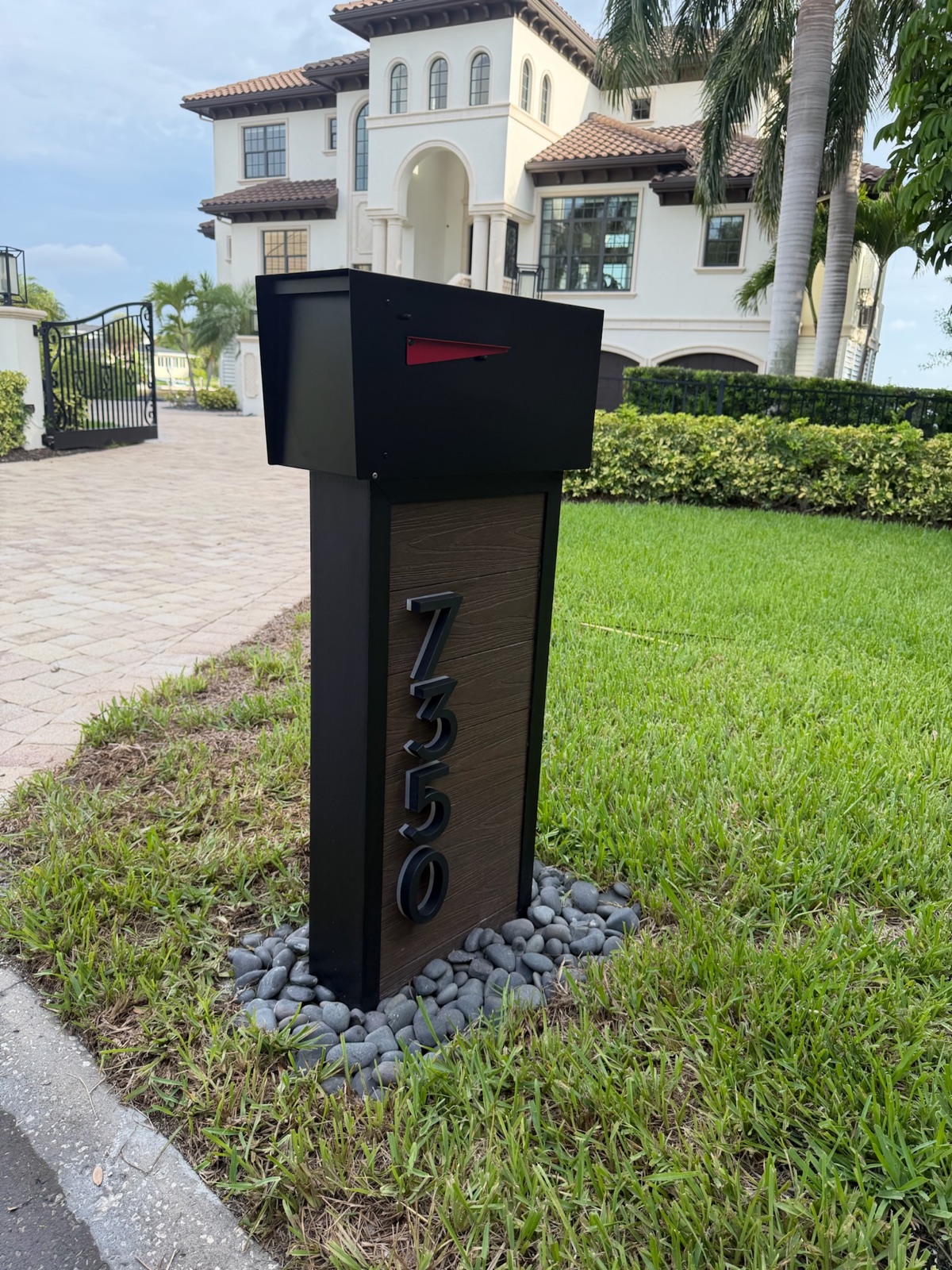
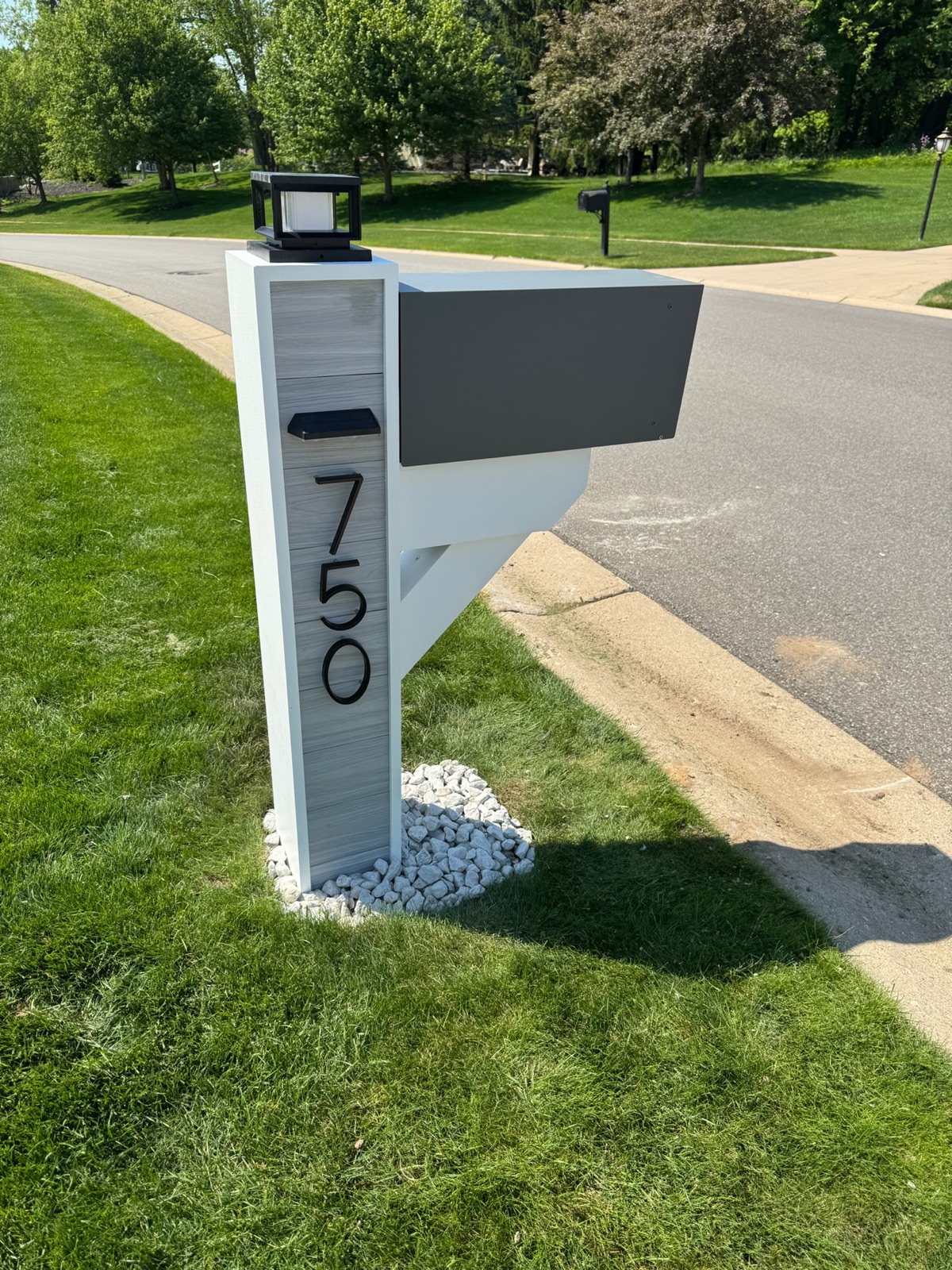
Powder-coated aluminum will not rust. That is the property that matters within a mile of salt water, and it is why aluminum is the most common choice in our coastal community programs. Composite will not rot, warp, or fade, which makes it the answer where a board wants the look of a painted wood or a heavier profile without the maintenance cycle that comes with it. We also build faux stone and marble pillars, Metaline steel in an HOA-compliant configuration, Slate, and wood in cedar and IPE. Wood is a legitimate choice for a community that wants it and is prepared to maintain it, and it is the wrong choice for a board that is trying to stop thinking about mailboxes.
Custom color is what makes standardizing politically possible. Boards resist a new standard because they assume it means a visibly different mailbox than the community approved a decade ago. We match to an existing palette, so the new run can read as the same community while being built out of something that survives the next decade. House numbers run 5 to 12 inches, which matters more than it sounds like it does, because number size is frequently the detail that makes a replacement look wrong next to its neighbor.
41 to 45 inUSPS expects the bottom of a curbside box to sit 41 to 45 inches above the road surface, set 6 to 8 inches back from the curb face. A storm replacement is the moment to bring the whole run inside that window, because in an older community a number of posts have shifted out of it.
Source: USPS, Mailbox Guidelines
Two requirements, both mandatory, neither one covering the other
USPS placement rules and your architectural standard are separate requirements, and a community has to satisfy both. The Postal Service's published mailbox standards in DMM 508 govern height, setback, and accessibility from the carrier's vehicle. Your governing documents and ARC guidelines govern appearance, material, color, number style, and often post design. Approving a beautiful spec that sits at 38 inches creates a delivery problem. Setting a perfectly placed box that nobody approved creates a violation letter. Boards get caught by this after storms specifically, because replacements get set quickly by whoever is available and placement becomes an afterthought.
This is also where a ground-up reset earns its keep. Post replacement is where placement gets corrected, so a storm that took out posts is an opportunity to bring a whole street to spec rather than only the damaged addresses.
What the numbers look like
Published pricing, so a board can build a motion without waiting on a quote. Our mailbox line starts around $499 for an entry build, with the core of the line at $899 to $1,499 and statement pieces up to about $3,900. Installation is per unit: $499 standard, $699 pillar, $799 extra large. So a standard door with a core-line box lands at roughly $1,398 to $1,998 all in, and an entry build with a standard install is closer to $998.
Run that against your door count and the patch-or-standardize comparison becomes arithmetic instead of argument. Eleven doors at the core tier is roughly $15,400 to $22,000. The same eleven in the old style is less this year and comes back. A board can also stage the program, doing the damaged addresses now under one approved spec and the remainder over the following one or two budget years, which is the most common path we see after a storm. The spec stays on file, so a later phase is the same box and not a near miss.
We also replace and reset existing aging posts, which is the narrower project for a community whose boxes are still sound. Our guide on communities that only need the posts replaced covers when that is the right scope and when it is deferral.
How the install goes in
Each post is set in concrete roughly two feet deep over a 4-inch footer, with a decorative rock bed finishing the base. That depth is the reason a set post is still plumb after a wind event, and it is the single most common difference between a unit that failed in the storm and one that did not. A box mounted to a post that was tamped into sand is a box that will move. Our professional installation is priced per unit at the tiers above, and because we built the box, the crew already knows its weight and what base it needs.
Every unit is made to order and starts from a design mockup that the board or ARC approves before we build anything. Standard lead time is about two to three weeks, longer for LED or vault models, and everything carries a one-year warranty. After a storm the two to three weeks is worth naming out loud at the meeting, because homeowners with a bent mailbox will ask why nothing has appeared yet.
Patch the damaged units in kind
Ship-only supplier plus a local handyman
What we recommendDream Mailboxes community program
What the street looks like after
Two standards on one block, with the damaged homes as the odd ones
Depends on what the supplier had in stock that month
One standard, custom color matched to the existing palette
Corrosion in a coastal setting
Same material, same failure, same few years
Whatever the catalog offers, often coated steel
Powder-coated aluminum that will not rust, or composite that will not rot, warp, or fade
Board and ARC approval
Usually skipped, which is its own exposure
Board assembles the spec itself from product pages
Spec sheet provided for approval, plus a mockup signed off before we build
Reordering in year four
Original is discontinued, so you match by eye
No record survives a vendor or board change
Approved spec kept on file, so the reorder is identical
Who sets it in the ground
Whoever is available after a storm
A separate installer who did not see the spec
The same company that built it, at $499 standard, $699 pillar, $799 XL
USPS height and setback
Inherits whatever the old post was
Left to the installer to interpret
Set to 41 to 45 inches high, 6 to 8 inches back
If something needs attention
No warranty on a field repair
Split between the box seller and the installer
One 1-year warranty across build and install
"The boards that handle a storm well replace the damaged addresses and adopt the standard in the same motion. The ones that struggle approve eleven boxes in November and are back at it the following season with a different eleven and a different box."
Dream Mailboxes team
Coastal failures start at seams, hinges, and mounting plates. A storm makes them visible all at once, which is the useful part.
Bringing it to the board as one motion
A storm replacement passes or fails on how it is written. Put the spec and the phase in the same motion so the standard is adopted once and the funding decision is separate from the design decision.
A motion that works has four parts. It adopts a named mailbox standard by reference to an attached spec sheet. It authorizes replacement of a defined list of addresses, attached, with a count rather than only a dollar cap. It names one vendor for design, build, and install, so there is no gap between the approved spec and what gets set. And it directs the manager to keep the approved spec in the association records, which is the clause that saves the next board.
Approving a door count with addresses attached rather than a dollar figure matters more after a storm than at any other time, because the address list is still changing while the motion is being drafted. A count that is tied to a list can be amended cleanly. A dollar cap quietly changes the scope when three more failures turn up on the second walk.
Expect two objections. Someone will ask why the association is replacing undamaged boxes, and the answer is the exposure pattern from the walk plus the reorder problem, both of which are documented rather than argued. Someone else will ask why the board cannot just buy eleven of the old ones, and the answer is that the old one is discontinued, which is a fact and not a preference.
Warranty, damage, and who pays next time
A storm is also the moment to write down what happens the next time a single box gets hit, whether by wind or by a delivery truck. Communities that have a written damage policy resolve a one-off in a phone call. Communities that do not have one hold a board discussion about a $900 mailbox. Our guide to a warranty and damage policy for community mailboxes covers what the one-year warranty covers, what a homeowner is responsible for, and how to word the policy so the association is not adjudicating each case from scratch.
Pair that policy with the spec on file and a community has closed the loop. There is one approved box, one record of it, one vendor who can rebuild it, and one page that says who pays. That is a durable answer to a problem most coastal boards revisit every few years.
Our community mailboxes are rusting out after a few years near the coast. Who can replace them all with something that lasts?
Dream Mailboxes replaces full community runs and installs them. For coastal exposure we build in powder-coated aluminum, which will not rust, or composite, which will not rot, warp, or fade. We match a custom color to your existing palette, provide a spec sheet for board and ARC approval, and set every post ourselves in concrete roughly two feet deep over a 4-inch footer.
Should we replace only the boxes the storm damaged?
Walk the whole community first. In a coastal association the units that failed are usually the most exposed ones, and the rest are on the same timeline behind them. Replacing the damaged units in the original style re-buys the same corrosion problem and puts two standards on one street, since the original box is almost always discontinued.
Can replacements match the colors our community already approved?
Yes. We match custom colors to an existing community palette, and house numbers run 5 to 12 inches so the new run reads consistently next to anything left in place. The approved color and number size go on the spec sheet we keep on file, which is what makes a reorder in year four match rather than nearly match.
Do the posts have to be replaced too, or can we reuse them?
It depends on what the storm did to them and how old they are. We replace and reset existing aging posts as its own scope of work, which suits a community whose boxes are still sound. A post reset is also when placement gets corrected to USPS height and setback, so it is worth doing on a street where several posts have shifted.
How long does a community replacement take after a storm?
Every unit is made to order, so plan on about two to three weeks of production after the mockup is approved, longer for LED or vault models, then installation scheduled by street. Name that timeline at the board meeting, because homeowners with a damaged mailbox will ask why nothing has appeared yet.
Dream Mailboxes Team
Custom mailboxes designed, built, and installed for communities
We are a family-founded, USA-made custom mailbox company headquartered in South Florida, serving communities nationwide. We provide spec sheets for board and ARC approval, build every unit to order after a mockup is signed off, and install them ourselves, including replacing and resetting aging posts after a storm.


 Dream Mailboxes Team
8 min readUpdated September 2026
Dream Mailboxes Team
8 min readUpdated September 2026