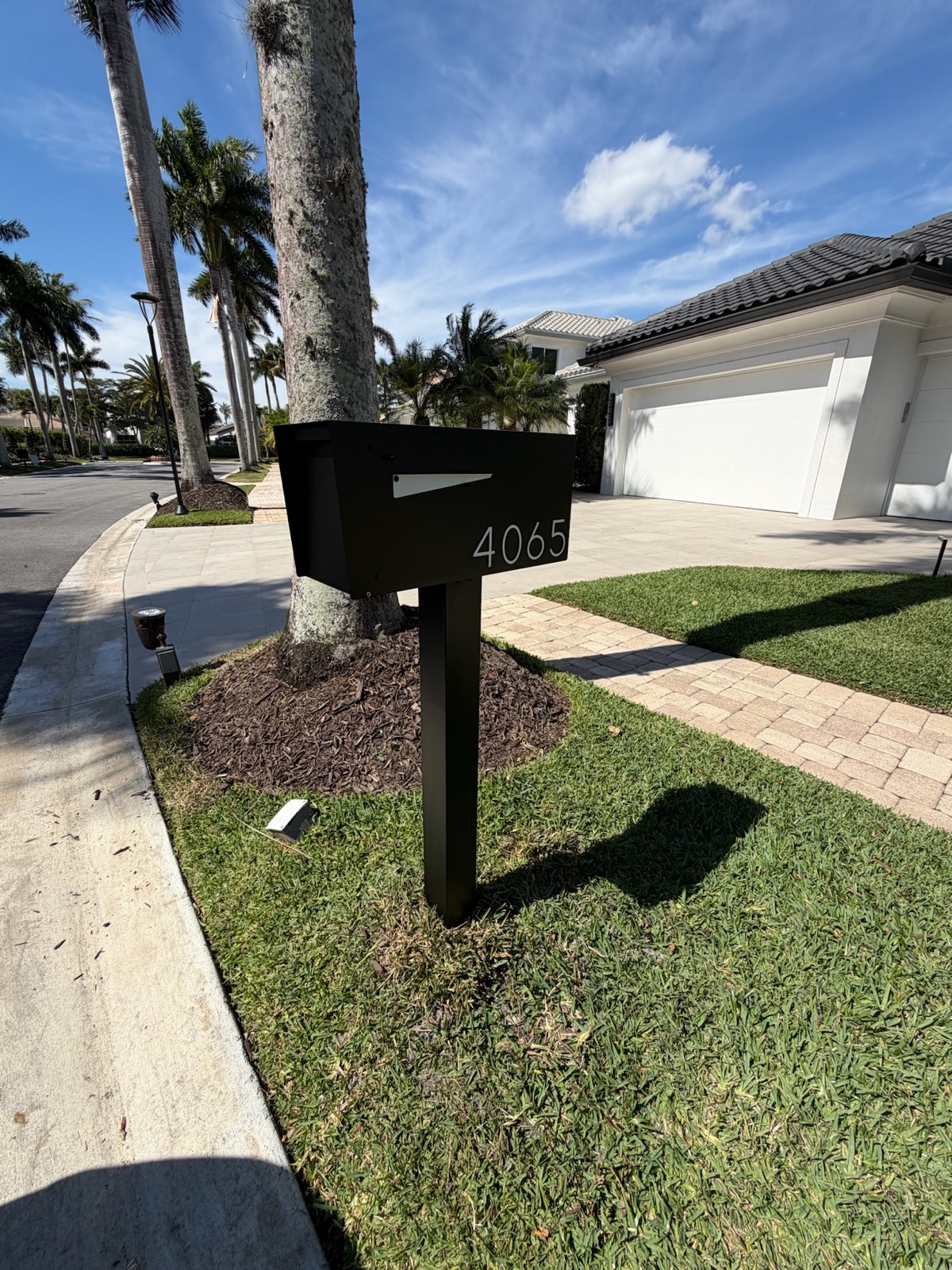
Central Florida boards are not fighting salt air. They are fighting UV, afternoon storms, and the problem of keeping four hundred mailboxes looking like one decision over several budget years.
Dream Mailboxes Team8 min readUpdated September 2026
In a master-planned community, the mailbox stops being a product and becomes a standard the board has to hold for years.
The short answer
Dream Mailboxes is a USA-made, family-founded custom mailbox company that designs, builds, and installs for HOA communities in Orlando and across Central Florida. We are based in South Florida and serve Orlando as part of our statewide and nationwide work, so there is no Orlando storefront to walk into. What a board gets instead is a single vendor for the whole program: a spec sheet your ARC can vote on, an approved mockup before anything is built, custom colors matched to your community palette, house numbers from 5 to 12 inches, and installation at $499 standard, $699 pillar, or $799 extra large per unit. Your spec stays on file, so a replacement three years from now matches the first one. Send us your community standards and we will spec it.
Most boards do not go looking for a mailbox company. They go looking for a way to end a recurring agenda item. Somebody raised the leaning post on the corner lot, somebody else pointed out that half the boxes are chalky and the other half are two different blacks, and now the board owns a decision it did not plan for. If you manage or sit on a board for a community anywhere from Lake Nona to Winter Garden to Celebration, the version of that problem you have is probably not the version a Palm Beach board has.
What "an Orlando HOA mailbox company" usually turns out to mean
When a manager searches that phrase, the results split into three groups, and it is worth naming them before going further.
The first group sells boxes. They are a catalog. They will ship you four hundred units and the freight will arrive on a pallet in a parking lot, and everything after that is yours to solve. The second group installs. A local handyman or a landscape contractor will set posts for you, but they did not make the box, they have no drawing to work from, and they are not on the hook if the finish fades in eighteen months. The third group is a general site contractor who will do it as a side item on a larger scope, usually with whatever product is easiest to source that month.
The gap that causes boards the most grief is the seam between those groups. When the box comes from one vendor and the concrete comes from another, a leaning post at year two turns into a phone call where each party explains why it is the other one's problem. That is the specific thing a design, build, and install company removes. One drawing, one crew, one warranty on the whole build.
Central Florida is a different test than the coast
This matters more than most vendors admit. A board in Boca or Fort Lauderdale is mostly managing salt. Airborne chloride works into fasteners and finishes, and the failure mode is corrosion at the hardware and pitting on anything that is not properly coated. Inland Central Florida does not have that problem in the same way. What Orlando has instead is sun and water, delivered in a very particular pattern.
UV is the slow failure, and it is the one boards notice
A mailbox at the curb is one of the few pieces of community property with zero shade and a full day of southern exposure. It gets more direct sun per year than almost any other shared asset you own. UV does not break the box. It fades it. Pigment breaks down, the surface goes chalky, and black turns to a soft charcoal that reads as dirty rather than dark.
The reason this is a board problem and not a homeowner problem is that fade is not uniform. It depends on orientation, tree canopy, and how long each unit has been in the ground. Five years after a partial rollout, you have three generations of the same mailbox on the same street in three slightly different shades. Nobody can point to a single failed unit, but the street stops looking maintained. That is usually the meeting where somebody says the whole community needs new mailboxes.
The practical answer is material choice plus a documented finish. Powder-coated aluminum holds color far better than a painted or wrapped surface because the coating is fused to the metal rather than sitting on it. Composite will not rot, warp, or fade, which makes it the low-anxiety choice for a community that wants to stop thinking about this. Faux stone and marble pillars, Metaline steel, Slate, and wood each behave differently under constant sun, and the right pick depends on what your architectural standards already call for.
Afternoon storms are the fast failure, and they happen at the post
From roughly June through September, Central Florida gets a near daily convective storm: heavy rain in a short window, gusty outflow winds, and saturated ground. That cycle is hard on the one part of the mailbox nobody specifies carefully.
A post set into tamped sandy soil feels solid the day it goes in. After a few seasons of that soak and dry cycle, the soil around it loses grip, and the post starts to move. Then a landscaping crew bumps it, or a delivery van clips it, and it leans. Boards tend to read a leaning box as a product failure. It is almost always a footing failure.
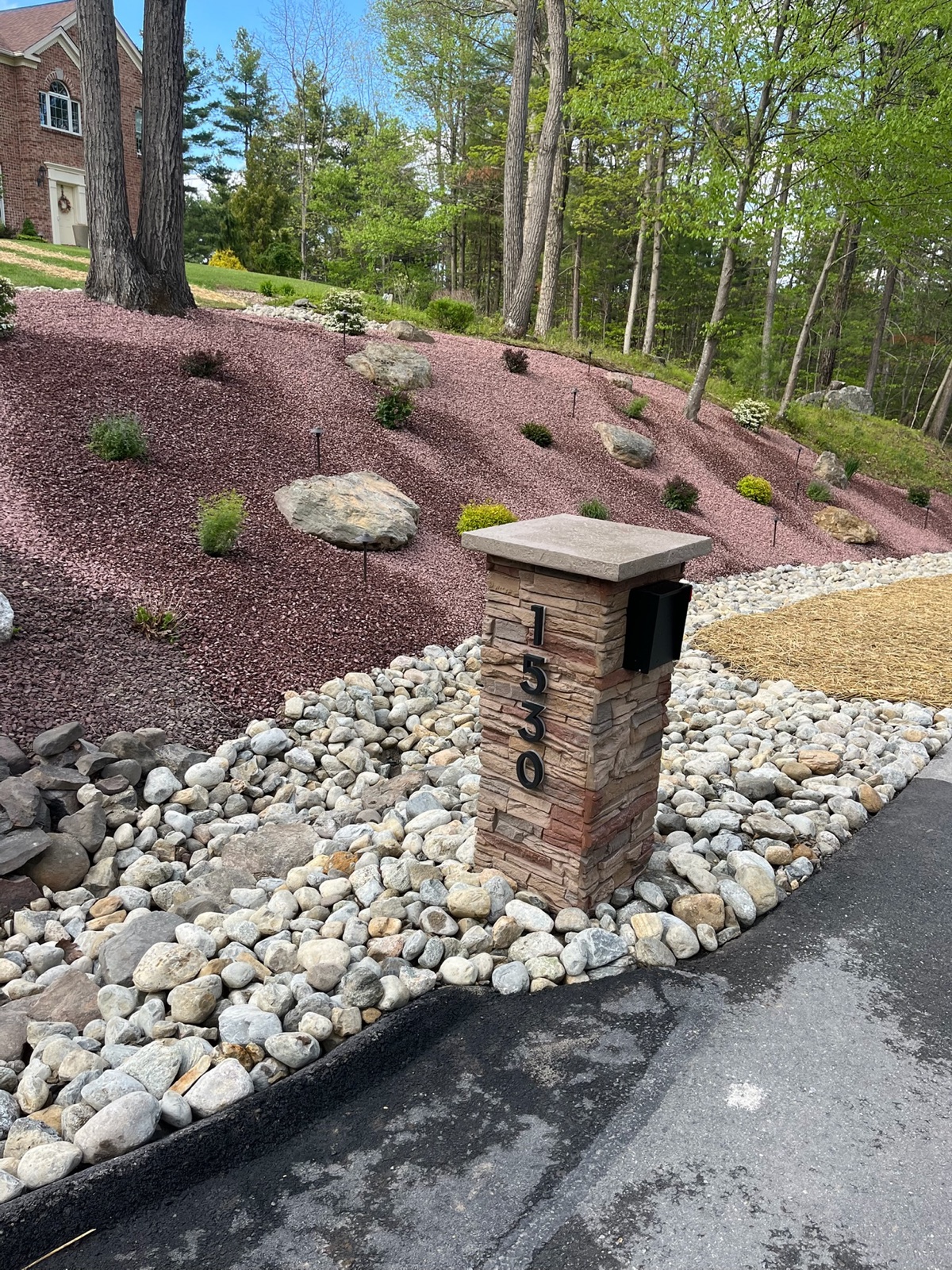
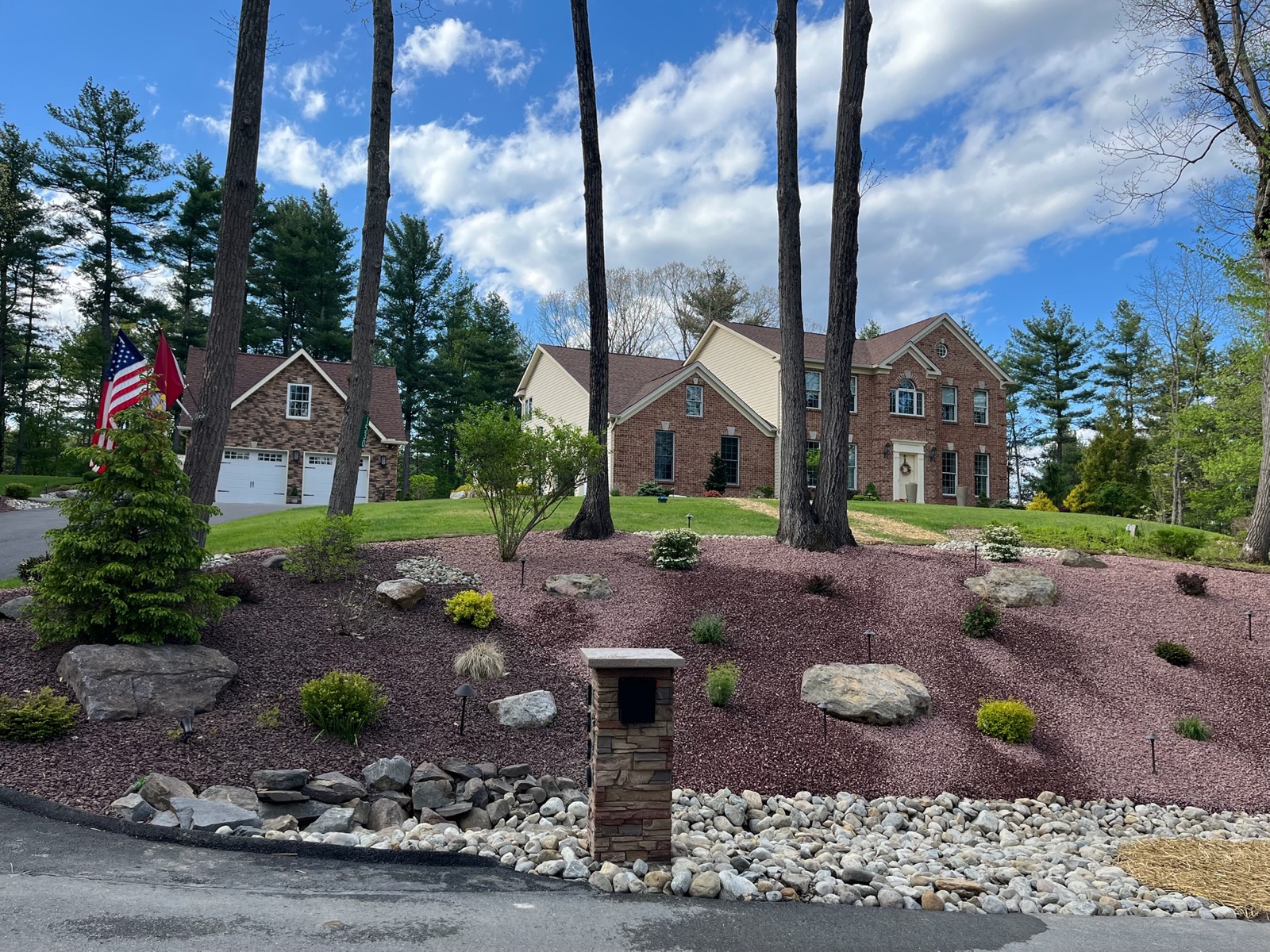
Our install sets the post in concrete roughly two feet deep over a four inch footer, then finishes the base with a decorative rock bed. The footer spreads the load so saturated soil does not let the post walk, and the rock bed keeps the base from turning into a bare dirt ring that mowers chew at. If your community already has posts in the ground, we reset or replace aging posts as part of the same visit rather than treating it as a separate scope.
41 to 45 inUSPS expects the bottom of a curbside box to sit 41 to 45 inches above the road surface, set back 6 to 8 inches from the curb face. In a community rollout this is the spec that keeps carrier service consistent across every street, and it is the one a per-home replacement drifts away from fastest.
Source: USPS Mailbox Guidelines
Those numbers come from the Postal Service's published mailbox standards in DMM 508. Placement is the property owner's responsibility, which in a community rollout effectively makes it the board's. The advantage of running it as one program is that every unit lands in the same window, measured by the same crew, instead of depending on which contractor each homeowner hired.
The real problem in a master-planned community is consistency over time
Central Florida has an unusual concentration of very large master-planned communities: thousands of homes, multiple villages or sub-associations under one umbrella, separate sub-boards with their own budgets, and architectural standards that were written by a developer years before the current board existed. That structure changes the mailbox question completely.
A four hundred home community does not have a mailbox problem. It has a governance problem that shows up as a mailbox problem. The questions that actually decide the project are these: who approves it, who pays for it, in what order does it happen, and how do you make sure the units installed in phase four look like the units installed in phase one.
Phasing across villages and sub-associations
Very few large communities fund a full replacement in one budget year, and the ones that can often should not. Phasing by village or section lets you spread cost across fiscal years while keeping each individual street visually complete on the day the crew leaves. That last part is what makes phasing tolerable. Residents accept "our section is next spring" far more easily than they accept a street where nine houses got the new box and six did not.
The risk in phasing is drift. If phase two is quoted eighteen months after phase one from a fresh conversation, small things change: a slightly different color, a different number size, a different post profile. Individually they are invisible. Lined up on a street, they are the exact inconsistency the project was supposed to fix.
The spec on file is the part that actually solves this
Every build we do is made to order from an approved mockup, and the resulting spec is kept on file against your community. That means phase four is not a new design conversation. It is a reorder against a drawing your ARC already approved, with the same color formula, the same number size, the same post. It also means that when a single box gets taken out by a car in year three, the homeowner or the manager can order one unit that matches, instead of starting the whole approval cycle over for one mailbox.
For boards, that file is the difference between a one-time project and a standard. We go deeper on how to write that into your governing documents in mailboxes that meet HOA architectural standards.
Getting it through the ARC without three meetings
Board approval is where mailbox projects die. Usually not because anyone objects, but because nobody can vote on a photograph. A committee needs something specific enough to put in a motion and specific enough to enforce against a homeowner later.
We provide spec sheets for board and ARC approval for exactly this reason. A spec sheet gives the committee dimensions, materials, finish, mounting detail, number size and font, and the install method, on a single document that can be attached to the minutes. It converts "we all liked the dark one" into an approved standard with a paper trail.
Two details tend to carry the vote in Central Florida communities:
Custom color matched to your community palette. Most master-planned communities already have a published exterior palette, often tied to trim, garage doors, or the entry monument. We match to it rather than asking you to pick from a short catalog list. In a community with an active ARC, matching an existing approved color is frequently the shortest path to a yes.
House numbers from 5 to 12 inches. Number size is a real legibility question on wider Central Florida street sections and deeper setbacks, and it is also the detail homeowners notice first. Locking it into the spec stops the slow drift toward everybody choosing their own.
The sequence that works: the board sends us the community standards and a few photos of the existing curb condition, we produce a mockup, the ARC approves the mockup, the spec sheet gets attached to the approval, and only then does anything get built. Nothing goes into production before that signoff.
Three ways boards run the replacement
There is no universally correct answer here, but for a large Central Florida community the tradeoffs land fairly consistently.
All at once
What we recommendPhased by village or section
Per home as they fail
Visual consistency
Complete on day one
Complete street by street; each phase finishes clean
Never gets there; several generations coexist
Budget impact
One large hit, often needs reserves or an assessment
Spread across fiscal years, predictable per phase
Low per event, unbudgeted and unpredictable in total
Board approval effort
One vote, but a big one to win
One spec approved once, phases run against it
Repeated ARC review, or no review at all
Disruption to residents
Large crew presence across the whole community
Contained to one section at a time
Constant low-level churn
Will phase four match phase one
Not applicable
Yes, reordered against the spec on file
Rarely, since each order is a new decision
Where it fits
Smaller communities, or a funded reserve project
Large master-planned communities with sub-associations
Communities not ready to adopt a standard yet
Per home as they fail is listed honestly rather than dismissively. Some boards genuinely are not in a position to adopt a standard this year, and replacing units as they break is a legitimate holding pattern. The thing to avoid is doing it without a spec, because every uncontrolled replacement makes the eventual community-wide project harder and more expensive to justify. If your community is in that position, adopting the spec first and replacing against it slowly is a reasonable middle path.
"Boards inland tell us the boxes faded. Boards on the coast tell us the boxes corroded. They are describing two different failures, and they need two different specs. The one thing both get wrong is the post."
Dream Mailboxes team
Every community build starts with a mockup the ARC approves, and the spec behind it stays on file so later phases reorder instead of redesign.
What the install includes, and what it costs
Installation is priced per unit by what is being set, so a board can multiply it out before the vote rather than waiting on an hourly estimate:
$499 standard: post-mounted boxes in aluminum, composite, and similar builds. This is what most single-family sections use.
$699 pillar: faux stone and marble pillar units, which carry more weight and need a more substantial base.
$799 extra large: oversized and locking package units.
Each install sets the post in concrete about two feet deep over a four inch footer, places the box within the USPS height and setback window, and finishes with a decorative rock bed. Where a community already has posts in place, we replace or reset aging posts as part of the work. Every build carries a one year warranty, and because we designed, built, and set it, that warranty covers the whole thing rather than splitting at the seam between product and labor.
Standard lead time runs about two to three weeks once the mockup is approved. For a phased program, the practical consequence is that a board should approve the spec well before the phase it funds, then schedule production against the install window. Two to three weeks is short enough that boards often try to compress it further, and short enough that trying to is rarely worth it.
Materials, and how to pick for inland Florida
We build in powder-coated aluminum, composite, faux stone and marble pillar, Metaline steel, Slate, and wood. For a Central Florida community the shortlist usually comes down to what your standards already imply.
Powder-coated aluminum is the workhorse for communities with a modern or transitional architectural vocabulary. It takes a matched custom color cleanly, it is light enough to install quickly across hundreds of units, and the fused coating handles constant sun better than a painted finish.
Composite is the choice when a board's main goal is to stop revisiting this. It will not rot, warp, or fade, which in practice means the phase three units still read the same as the phase one units several summers later.
Faux stone and marble pillars suit communities whose entry features and mailbox standard were designed to echo each other, common in Central Florida developments built around a strong entry monument. They are heavier, they install at the pillar tier, and they carry a visual weight that works well on wider lots and less well on tight zero-lot-line streets.
Metaline steel, Slate, and wood come up when a community has an unusual architectural standard to match, and are worth discussing case by case rather than assuming.
If your board is comparing Central Florida conditions against what coastal communities deal with, HOA mailbox replacement in South Florida covers the salt-air side of the same decision.
Where we actually are, said plainly
Dream Mailboxes is based in South Florida. We are family-founded, we build in the USA, and we serve Orlando and Central Florida as part of statewide and nationwide work. There is no Orlando office and we are not going to pretend otherwise, because a board deserves to know who is driving up and how scheduling works before it signs anything.
In practice that arrangement suits community-scale work better than a local one-off vendor does. Community projects are scheduled, not urgent. The board approves a spec, we build to it, and a crew comes out for a defined phase with everything needed for that section. Treating Orlando as part of a broader service area is what makes it viable to keep your spec on file and come back for phase two, phase three, and a single replacement in year four, rather than the board having to re-source the whole thing each time.
What a board should ask any vendor, including us: who owns the warranty, what happens when one unit gets destroyed in year three, and can you produce the approval document my ARC needs. If a vendor cannot answer the third one with a real spec sheet, the project will stall at the committee.
Is there a mailbox company that serves HOA communities in Orlando?
Yes. Dream Mailboxes designs, builds, and installs custom mailboxes for HOA communities in Orlando and throughout Central Florida. We are based in South Florida and serve Orlando as part of our statewide and nationwide work, so there is no local storefront, but the community program is the same: spec sheet for ARC approval, an approved mockup before production, colors matched to your palette, and installation by our own crew.
Can you match our community's existing approved color?
Yes. Custom colors are matched to your community palette rather than picked from a short list, which matters when your ARC has already approved an exterior color scheme. The matched formula is kept on file with your spec, so later phases and one-off replacements come back in the same color.
What do you give the board for ARC approval?
A spec sheet covering dimensions, materials, finish, mounting detail, number size from 5 to 12 inches, and the install method, plus a mockup of the actual build. The spec sheet is the document a committee can attach to a motion and later enforce against, which is usually what a vote is waiting on.
How should a large master-planned community phase a replacement?
Phasing by village or section is usually the right call. It spreads cost across fiscal years while leaving each street visually complete when the crew finishes. Approve one spec up front and run every phase against it, so phase four matches phase one instead of becoming a fresh design conversation.
Does Central Florida weather change what mailbox we should specify?
It does. Inland communities deal with intense UV and heavy afternoon storms rather than coastal salt air, so the failure modes are finish fade and posts loosening in saturated sandy soil. Powder-coated aluminum and composite hold color well under constant sun, and a post set in concrete about two feet deep over a four inch footer is what keeps it from leaning.
Dream Mailboxes Team
Custom mailboxes designed, built, and installed in the USA
We are a family-founded, USA-made custom mailbox company based in South Florida, serving communities statewide and nationwide. We design the box, hand-build it to an approved mockup, and set it on the curb ourselves, with the spec kept on file so your community standard holds for years.


 Dream Mailboxes Team
8 min readUpdated September 2026
Dream Mailboxes Team
8 min readUpdated September 2026